
A test that looks similar on paper may not meet federal requirements. The difference between DOT and non-DOT drug test requirements comes down to regulatory coverage and procedures, not simply the test label or the employer’s preference.
It’s understandable that drivers and employers feel unsure about which rules apply. DOT testing is required for covered safety-sensitive transportation roles and follows federal procedures under 49 CFR Part 40. Non-DOT testing is governed by employer policy and applicable state law, so its procedures and testing choices may differ.
This guide explains who may need each test and how the two frameworks compare, including differences in specimens, testing panels, collection, and results. You’ll also learn how to identify the testing framework for a role and what to do when a federal requirement applies. The center provides both DOT and non-DOT drug testing, along with FMCSA Clearinghouse Consortium support for owner-operators and fleets managing FMCSA obligations.
Key Takeaways
- The difference between DOT and non-DOT drug test requirements depends on the rules governing the role, not just the test’s name.
- Determine whether the employer, regulated operation, safety-sensitive duties, and applicable agency rules place the role under DOT requirements.
- Compare testing procedures carefully. Specimens, panels, collection, and record handling can vary, so don’t assume every employer test follows the same process.
- When a test is requested, identify its type, follow the instructions, and keep relevant employer documentation.
- Use the testing process that matches the requirement. The center offers DOT and non-DOT testing and FMCSA Clearinghouse Consortium support for owner-operators and fleets.
Difference Between DOT and Non-DOT Drug Tests: The Essential Distinction
DOT testing follows applicable federal transportation rules; non-DOT testing follows an employer’s policy. That’s the core difference between DOT and non-DOT drug test requirements. The deciding factor isn’t what someone casually calls the test. It’s whether the job and testing event fall under a transportation agency’s regulations.
A test’s specimen, panel, or collection location doesn’t determine its regulatory status on its own. The employer must identify the correct framework and order the test accordingly. A non-DOT test does not satisfy a federal DOT testing obligation simply because it screens for similar substances or uses a similar collection method.
In short: DOT testing is regulated testing for covered transportation roles; non-DOT testing is workplace testing designed under employer policy and applicable law. A general overview of drug testing can explain common methods, but it doesn’t establish whether a particular job or test is DOT-regulated.
What makes a drug test a DOT test?
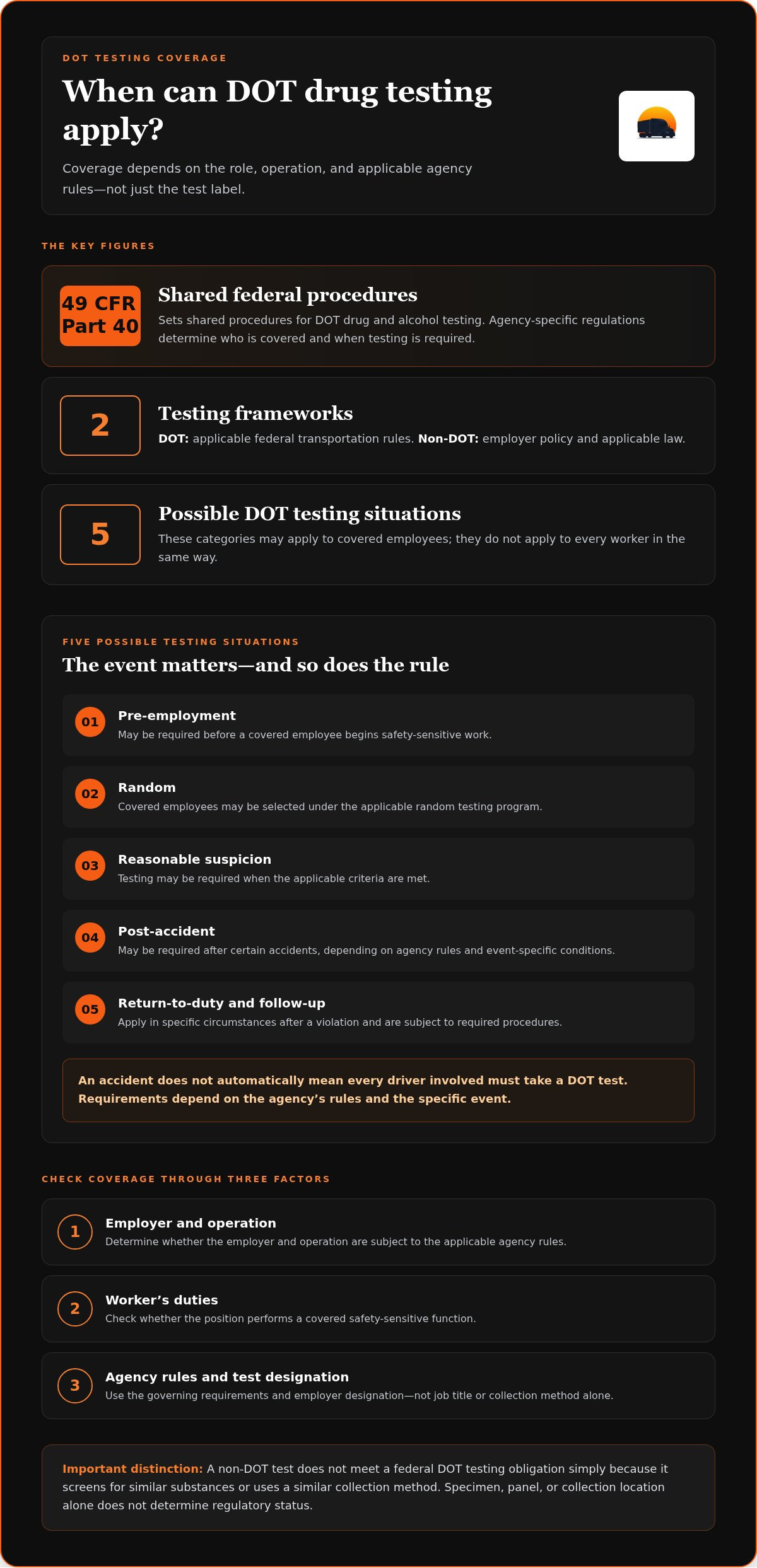
A DOT drug test is part of a federally regulated program. Covered employers and employees must follow the U.S. Department of Transportation rules that apply to their operation. 49 CFR Part 40 sets shared procedures for DOT drug and alcohol testing, while the relevant agency’s regulations determine which employers, employees, safety-sensitive functions, and testing events are covered.
This distinction matters in practice. A commercial driving role alone doesn’t tell you whether a specific test is DOT-regulated. The operation and duties must fall within the applicable agency rules, and the test must be conducted and documented under the required DOT framework. A company’s label for a test cannot make an employer-policy test federally compliant.
What does non-DOT drug testing mean?
Non-DOT drug testing is conducted under an employer’s workplace policy rather than DOT testing procedures. Employers may set different programs for purposes such as pre-employment screening or workplace policy enforcement. Depending on the policy and applicable law, programs may vary in the substances tested, specimen types, and timing. Those choices aren’t universal features of every non-DOT test.
Employer flexibility has limits. Applicable federal and state laws can constrain workplace testing policies, so “non-DOT” doesn’t mean that any procedure or policy is automatically permitted. For drivers, read the test request and determine whether it identifies a DOT test. If a federal requirement applies, don’t assume an employer’s separate non-DOT test fulfills it. The correct framework must be used from the start, including its procedures and records.
Who Must Follow DOT Drug Testing Rules and When?
Driving a commercial vehicle doesn’t automatically make every drug test DOT-regulated. Coverage depends on the employer and operation, the worker’s duties, and the rules of the DOT agency overseeing that operation. A driver may take a non-DOT test under an employer’s policy even while other testing obligations are governed by federal rules.
Use the role and governing requirements to identify the right framework. A job title by itself isn’t enough: employees with similar titles may have different duties or work in different kinds of operations. Employers should determine which positions are covered and tell workers whether a specific test is part of the DOT program.
How do drivers and employers identify DOT coverage?
Start by identifying whether the position performs a safety-sensitive function under the applicable agency rules. Then determine whether the employer and operation are subject to those rules and whether the employee’s role falls within their scope. Check the governing requirements and the employer’s designation rather than relying on a title such as “commercial driver” or on the test’s collection method.
The U.S. Department of Transportation’s 49 CFR Part 40 - DOT Drug and Alcohol Testing Regulations explains shared testing procedures. Agency-specific rules establish who is covered and when testing is required. For a broader overview of program responsibilities, consult this DOT drug testing compliance guide.
Which situations can trigger DOT testing?
For employees covered by the applicable rules, DOT testing may occur in several situations. These categories are common, but they don’t all apply to every worker or arise under identical conditions:
- Pre-employment: Testing may be required before a covered employee begins safety-sensitive work.
- Random: Covered employees may be selected for testing under the applicable random testing program.
- Reasonable suspicion: Testing may be required when the applicable criteria are met.
- Post-accident: Testing may be required after certain accidents, depending on the agency’s rules and event-specific conditions.
- Return-to-duty and follow-up: These apply in specific circumstances after a violation and are subject to required procedures.
Thresholds and requirements vary by agency and event. An accident, for example, doesn’t automatically mean every driver involved must take a DOT test. Employers should apply the current rule to the specific operation and situation, rather than treating this list as a one-size-fits-all checklist.
Drivers should read the test instructions and identify whether the request is DOT or non-DOT. If the role or testing event is unclear, review the employer’s designation and the governing agency rule before assuming one test fulfills another obligation. Understanding the difference between DOT and non-DOT drug test coverage helps employers arrange the appropriate process and helps drivers respond to the correct request. The center provides DOT and non-DOT drug testing.
DOT vs. Non-DOT Drug Test: What Changes in Practice?
Practical differences show up at each step, from the test order to how a result is reviewed and handled. A non-DOT employer may design a program around its written policy, but that flexibility doesn’t make the test interchangeable with a federally regulated one.
Matching substances or specimens alone does not make a test DOT-compliant. DOT status depends on using the correct procedures and documentation under the rules that cover the worker and test. The Federal Motor Carrier Safety Administration’s FMCSA Drug and Alcohol Testing Overview provides program details for covered commercial motor vehicle drivers.
| Area | DOT test | Non-DOT test |
|---|---|---|
| Governing rules | Follows applicable federal transportation regulations and required procedures. | Follows the employer’s written policy and applicable laws. |
| Covered workers | Applies to employees and testing events covered by the relevant agency rules. | Applies to workers named in the employer’s policy. |
| Collection | Must follow the formal collection process required for the DOT program. | Process depends on the written program and applicable law. |
| Specimen | Must use a specimen and collection method authorized for the applicable DOT test at the time it is conducted. | May vary by employer policy and law; choices are not universal. |
| Drug panel | Uses the federally prescribed panel and rules in effect for the applicable program. | Substances tested depend on the employer’s policy and legal limits. |
| Records and results | Handled and documented under DOT requirements. | Handled under employer policy and applicable privacy, employment, and recordkeeping laws. |
Do DOT and non-DOT tests use the same specimens and drug panels?
Not necessarily. DOT testing must use the specimen type, collection method, and drug panel authorized under the applicable federal requirements when the test takes place. Federal rules can change, so employers should verify current agency guidance before arranging testing. Non-DOT policies may choose different specimens or substances where permitted by law. That doesn’t mean every method or panel is allowed in every jurisdiction or workplace.
A result also has limits: a drug test detects substances or metabolites under the method used. It doesn’t, by itself, establish that a person was impaired at a particular time.
How do collection, review, and records differ?
DOT collection and result handling follow formal procedures. For DOT drug tests, a Medical Review Officer (MRO), a licensed physician with specific training, reviews laboratory results and evaluates any medical explanation provided by the donor. The MRO verifies and reports the result through the required process; the employer makes employment decisions under its obligations and policies. For non-DOT testing, review and record procedures depend on the employer’s program and applicable law.
Keep the categories separate from the start. The center provides both DOT and non-DOT drug testing, with each handled under its applicable process.
What Should You Do When a DOT or Non-DOT Test Is Requested?
A clear process helps prevent mix-ups, especially if an employer runs both testing programs. Identify the test type, follow its instructions, and keep the paperwork that explains why it was requested. Don’t assume a non-DOT test satisfies a federal DOT testing obligation, even if the test seems similar.
- Identify the stated test type. Check the employer’s request or testing paperwork to see whether the test is DOT or non-DOT. If the request is unclear, raise the question promptly through the designated employer or testing contact.
- Follow the applicable instructions. Use the collection site’s directions and provide the identification and information requested. Don’t substitute another test or collection process based on your own assumptions.
- Keep relevant records. Save the test request and employer communications according to your workplace process. Employers should keep DOT and non-DOT policies, forms, and records clearly separated.
What should a driver do before providing a specimen?
Read the instructions before arriving and confirm which testing framework the request states. Bring the required identification, follow collection-site directions, and provide accurate information. If the test type or a procedure is unclear, raise the question promptly with the designated contact rather than guessing. Clear documentation helps the driver and employer understand which process was requested.
What happens after a refusal or positive result?
Next steps depend on whether the test is DOT or non-DOT, the applicable rules, and the employer’s policy. Under DOT rules, a verified positive drug test or a refusal to test can prevent an employee from performing safety-sensitive duties. The DOT process generally involves evaluation by a Substance Abuse Professional (SAP) and completion of required steps before return to duty. Follow-up requirements may also apply. The specific path depends on the case and current rules.
A test result doesn’t, by itself, determine every employment or licensing outcome. Employers should follow applicable procedures, document required actions, and avoid treating a non-DOT result as a DOT program result. Drivers should keep notices and instructions, respond through the designated process, and avoid assumptions about what happens next.
For employers, separation starts with clear written policies, distinct test orders, and recordkeeping that identifies the applicable program. Owner-operators and fleets managing FMCSA obligations can consult this FMCSA Clearinghouse compliance guide for related reporting and consortium context.
The center provides DOT or non-DOT drug testing using the appropriate testing process.
Get DOT or Non-DOT Drug Testing Support and Compliance Guidance
Before arranging a test, identify which rules apply to the role and testing request. Use the employer’s instructions and relevant agency requirements to determine whether the test must follow a DOT program or an employer’s non-DOT policy. Choosing the right framework first helps prevent confusion between processes that may look similar but aren’t interchangeable.
The difference between DOT and non-DOT drug test requirements is about more than the collection itself. The correct program determines which procedures apply and how the test should be handled. If you’re coordinating testing for a fleet or working as an owner-operator, keep the stated test type and related documentation clear from the start.
How the center supports commercial drivers and employers
The center provides DOT and non-DOT drug testing as distinct services. Drivers and employers can arrange the testing category that matches the applicable request, rather than treating one process as a substitute for the other.
For owner-operators and fleet companies managing FMCSA obligations, the center also supports FMCSA Clearinghouse Consortium participation. Consortium support is relevant to employers who need to manage applicable program responsibilities. The service complements testing support without changing which rules apply to a particular driver or test.
Take the next step with the correct testing framework
Before arranging testing, use this short checklist:
- Review the request. Note whether the employer or testing instructions identify the test as DOT or non-DOT.
- Match it to the role. Consider the worker’s duties, the operation, and the applicable regulatory or employer requirements.
- Keep the process distinct. Follow the instructions for the stated test and retain relevant employer documentation.
If the request doesn’t clearly state the test type, address the question through the designated employer or testing contact before proceeding. Don’t assume that a non-DOT test fulfills a DOT obligation, or that a DOT test is required simply because someone drives commercially. The applicable role and rules determine the right path.
Clear instructions can make the next step more straightforward for drivers and employers. The center provides DOT and non-DOT testing, along with Clearinghouse Consortium support for owner-operators and fleets. Explore DOT and non-DOT testing services to take the next step with the appropriate testing framework.
Make the Next Testing Decision with Confidence
Turn what you’ve learned into a repeatable workplace step: before arranging a test, make sure the person responsible can identify the applicable framework and keep the request aligned with it. That checkpoint can help reduce uncertainty when roles, duties, or testing needs change.
The difference between DOT and non-DOT drug test requirements matters most when a test is being arranged. The center provides both testing types and FMCSA Clearinghouse Consortium support for owner-operators and fleets. Use the applicable employer or regulatory instructions to determine the next step, then choose the service that fits that framework.
Explore DOT and non-DOT testing services and move forward with greater clarity.
Frequently Asked Questions
Is a DOT drug test more strict than a non-DOT drug test?
DOT testing is more prescriptive because federal rules set the procedures for covered tests. That doesn’t automatically mean a DOT test is more sensitive or that every non-DOT test is less thorough. An employer’s non-DOT program may use its own panel or procedures, within applicable law. Compare the actual program requirements, not just the word “strict,” to understand what a test covers.
Can a non-DOT drug test satisfy a DOT testing requirement?
No. A non-DOT test generally can’t stand in for a required DOT test, even if it screens for the same substances or uses the same specimen type. DOT compliance depends on the applicable federal procedures, documentation, and result handling. If a driver receives a non-DOT test request but believes a DOT obligation applies, they should promptly raise the discrepancy with the designated employer contact.
Are DOT drug tests always urine tests?
No. Urine has been the established DOT specimen, but DOT has authorized oral fluid testing as an alternative method. Its use depends on the required federal implementation conditions, including the availability of qualifying laboratories. Employers should follow current DOT guidance and the test instructions rather than assume a particular specimen is available or acceptable for every DOT test.
Does every CDL holder have to take a DOT drug test?
No. Holding a commercial driver’s license alone doesn’t mean every test a driver takes is DOT-regulated. Coverage depends on the applicable agency rules, the employer and operation, and whether the driver performs a covered safety-sensitive function. For example, someone with a CDL working in a role outside a regulated operation may be subject to an employer’s non-DOT policy instead of DOT testing for that request.
Can an employer require both DOT and non-DOT drug tests?
Yes, an employer may have separate DOT and non-DOT testing programs where applicable rules and workplace policies allow. For instance, an employer might order a DOT test for a federally regulated event and a separate non-DOT test under its broader workplace policy. Each request must be handled and documented under its own framework. A non-DOT test can’t replace a required DOT test.
What happens if a driver refuses a DOT drug test?
A refusal under DOT rules is treated as a violation, and the driver must be removed from safety-sensitive duties. The driver generally must complete the required return-to-duty process, including evaluation by a Substance Abuse Professional, before returning to covered work. The employer must follow applicable procedures, while the driver should promptly review the notice and follow the instructions provided for the specific case.
Does a non-DOT positive test go into the FMCSA Clearinghouse?
Not just because it’s positive. The FMCSA Clearinghouse concerns reportable drug and alcohol violations under applicable FMCSA requirements, not every result from an employer’s separate non-DOT program. A non-DOT result by itself shouldn’t be treated as a Clearinghouse violation. Employers should distinguish the test type and reporting basis, and drivers with questions about a specific record should review the notice and applicable FMCSA process.


