

Could a medical diagnosis affect your CDL without automatically ending your driving plans? The answer depends on how the condition affects safe driving and how it fits federal medical certification standards. That’s why online lists of disqualifying medical conditions for CDL can be misleading: some conditions may prevent certification, while others call for closer review, treatment records, or an individual assessment.
If you’re worried about losing work or being unable to start a driving career, it’s understandable to want a clear answer. This guide explains the health areas covered by FMCSA standards under 49 CFR 391.41, how a certified medical examiner evaluates your situation, and what documentation may help make the evaluation more straightforward. You’ll learn how vision, hearing, diabetes, seizures, sleep apnea, heart conditions, and medications may factor into the assessment, and why a diagnosis alone doesn’t always determine the outcome.
Use this information to prepare questions and gather relevant records before your DOT physical. The examiner makes the certification decision based on the applicable standards and your individual circumstances.
Key Takeaways
- Federal medical qualification for interstate commercial drivers is governed by 49 CFR Part 391, which sets the standards examiners apply.
- Review the health areas behind disqualifying medical conditions for CDL, including cardiovascular, respiratory, neurological, sensory, metabolic, and musculoskeletal concerns.
- A condition’s name alone doesn’t determine the outcome. The examiner considers how it relates to the applicable standard and the driver’s individual circumstances.
- Prepare for your DOT physical by gathering relevant medical records and listing your medications, including dosages and prescribing clinicians.
- A DOT physical gives an FMCSA-certified medical examiner an opportunity to assess your health information and medical qualification.
What does a disqualifying medical condition for a CDL actually mean?
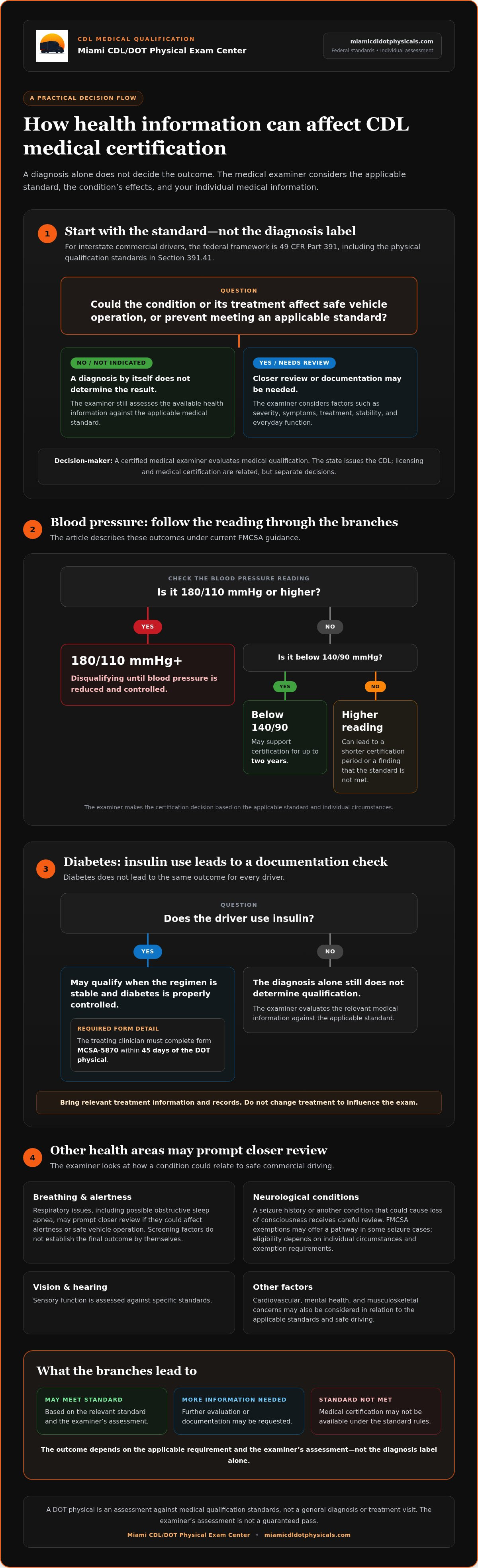
A diagnosis by itself doesn’t decide whether you meet commercial driver medical requirements. Under federal rules, the question is whether your health condition prevents you from meeting an applicable physical qualification standard or could affect your ability to drive safely. The examiner considers the condition’s effects, relevant medical information, and the standards that apply to your operation.
Quotable definition: “A disqualifying medical condition for a CDL is a health issue that prevents a driver from meeting an applicable medical qualification standard, not simply a diagnosis appearing in their medical history.”
For interstate commercial drivers, the federal framework is in 49 CFR Part 391, including the physical qualification standards in Section 391.41. These standards address a driver’s ability to operate a commercial motor vehicle safely. A condition may call for further evaluation or documentation. If a driver doesn’t meet a standard, they may be unable to receive medical certification under the standard rules. The outcome depends on the applicable requirement and the examiner’s assessment, not the diagnosis label alone.
How CDL licensing and medical certification fit together
A state issues the commercial driver’s license, while a certified medical examiner evaluates whether the driver meets applicable medical qualification standards. These are related steps, but they are not the same decision. A medical examiner’s finding does not, by itself, determine every licensing requirement or outcome.
Requirements can vary with the type of commercial driving and the jurisdiction. Interstate drivers are subject to federal medical qualification rules; intrastate operations may involve state requirements. If you’re unsure which rules apply to your driving, confirm the requirements with the relevant licensing authority or employer. A general overview of a Commercial Driver's License (CDL) can help clarify how licensing differs from medical qualification.
What the DOT physical is designed to assess
A DOT physical is a health assessment focused on factors relevant to safe commercial driving. The examiner reviews your health history and evaluates whether your condition or treatment could affect safe vehicle operation, including through impaired function or loss of consciousness. It isn’t a general diagnosis or treatment visit. It’s an assessment against federal medical qualification standards.
Examiners listed on the FMCSA’s National Registry of Certified Medical Examiners are authorized to perform these examinations. They review the information available and determine whether you meet the applicable standard. A DOT physical provides an opportunity for that assessment, not a guaranteed pass. For a practical overview of what to expect, see the DOT physical requirements and process guide.
This distinction matters when you’re reading lists of disqualifying medical conditions for CDL. A listed condition may raise a question for the examiner, but its presence alone doesn’t determine the outcome. The key is how it relates to the relevant standard and your ability to drive safely.
Which medical conditions can affect CDL medical qualification?
A diagnosis list can’t tell you whether you’ll qualify. The medical examiner considers how a condition affects safe driving, including its severity, symptoms, treatment, stability, and effects on everyday function. Two drivers with the same diagnosis may have different medical information and receive different assessments.
A DOT physical reviews cardiovascular, respiratory, neurological, sensory, metabolic, mental health, and musculoskeletal factors that could affect safe commercial driving.
Heart, blood pressure, breathing, and metabolic health
Cardiovascular concerns are assessed against the applicable medical standards and the information available about the condition. Blood pressure readings also matter. Under current FMCSA guidance, a reading below 140/90 mmHg may support certification for up to two years; higher readings can lead to a shorter certification period or a finding that the standard isn’t met. A reading of 180/110 mmHg or higher is disqualifying until blood pressure is reduced and controlled.
Respiratory issues, including possible obstructive sleep apnea, may prompt closer review if they could affect alertness or safe vehicle operation. Screening factors can lead an examiner to recommend further evaluation, but they don’t establish the final outcome by themselves.
Diabetes also doesn’t lead to the same outcome for every driver. Drivers using insulin may qualify if their regimen is stable and their diabetes is properly controlled. The treating clinician must complete the required MCSA-5870 form within 45 days of the DOT physical. Bring relevant treatment information and records, and discuss current care with the examiner. Don’t change treatment to influence the exam.
Neurological, sensory, mental health, and mobility concerns
A seizure history or another neurological condition that could cause loss of consciousness receives careful review under current FMCSA criteria. FMCSA exemptions may offer a pathway in some seizure cases, but eligibility depends on the individual circumstances and exemption requirements.
Vision and hearing are assessed against specific standards. For vision, the federal standard includes distant visual acuity of at least 20/40 in each eye, with or without corrective lenses, and a horizontal field of vision of at least 70 degrees in each eye. The driver must also recognize standard traffic signal colors. A vision exemption program exists for drivers who don’t meet the standard. Hearing is assessed through the ability to perceive a forced whisper in the better ear from at least five feet, with or without a hearing aid; an audiometry test or exemption pathway may apply in some cases.
Mental health conditions and their treatment may be relevant if symptoms or side effects affect alertness, judgment, or safe operation. Musculoskeletal limitations, including an impaired or missing limb, may affect vehicle control. A Skill Performance Evaluation certificate may provide a route for some drivers to demonstrate safe operating ability.
These examples aren’t an automatic-fail checklist. The examiner applies current standards to the driver’s circumstances and supporting information. A DOT physical exam provides an opportunity for an FMCSA-certified examiner to review your health information.
Does a medical condition automatically disqualify you from a CDL?
No. A condition’s name alone doesn’t establish whether you’ll qualify. The medical examiner applies the relevant federal standard to your health status, symptoms, treatment, and supporting records. The key question is whether you meet the standard for safe commercial driving, not whether a diagnosis appears on a list of disqualifying medical conditions for CDL.
Some situations can mean a driver doesn’t meet a standard as things currently stand. For example, current use of a Schedule I controlled substance is disqualifying under the federal rule. Other conditions call for an individual assessment. Depending on the findings and applicable rules, the examiner may certify for a limited period, request more information before deciding, or determine that the standard isn’t met. Certification length isn’t guaranteed in advance.
When the medical examiner may assess the individual case
The examiner considers your medical history alongside your current condition, treatment, and records. Insulin-treated diabetes is one example of a condition with specific criteria under 49 CFR 391.46. It isn’t an automatic disqualifier: the treating clinician must complete the MCSA-5870 form within 45 days of the DOT physical, and the examiner evaluates the submitted information under the rule. Meeting a documentation requirement doesn’t guarantee certification; the examiner still makes the decision based on the applicable standards.
Be prepared to explain how a condition is managed and provide relevant records. If information is missing or the examiner needs clarification, further evaluation may be needed. Don’t stop treatment, change medication, or withhold health information to try to affect the result.
When an exemption or alternative standard may apply
A formal exemption is different from an examiner’s routine review. It’s a specific FMCSA pathway with its own eligibility criteria and application process, and it doesn’t guarantee approval. FMCSA exemption programs cover certain vision, hearing, and seizure-related situations. A driver must meet the requirements for the particular program and have an applicable exemption; the examiner cannot grant one during the physical.
The three possible pathways are distinct:
| Pathway | What it means |
|---|---|
| Examiner assessment | The examiner reviews the driver’s condition and records against the standard. Some conditions, including insulin-treated diabetes, have specific criteria. |
| FMCSA exemption | The driver applies through a formal program for an exception to a standard. Eligibility and approval depend on FMCSA requirements. |
| Standard not met | The examiner finds the driver doesn’t meet an applicable requirement. Certification may not be issued unless the relevant status changes or an applicable pathway is available. |
Use the examiner’s decision and any written instructions to understand your next step. A DOT physical provides an opportunity for an evidence-based assessment, not a promise of a particular outcome.
What should you do before a DOT physical if you have a condition?
Preparing in advance can help the medical examiner understand your health history and assess the information relevant to your situation. It won’t guarantee certification, but organized records can reduce avoidable confusion. Before your appointment:
- Gather relevant records. Collect recent treatment summaries, specialist reports, and information about your condition’s current status. Include monitoring records when they apply, such as CPAP compliance reports for sleep apnea or recent A1C results for diabetes.
- Make a complete medication list. Write down prescription and nonprescription medications, dosages, and prescribing clinicians. Include medications you take regularly, even if you don’t think they affect driving.
- Attend the exam and answer accurately. Bring your records and assistive devices, such as corrective lenses or hearing aids. Describe your health history and current treatment honestly.
- Follow the examiner’s instructions. If the examiner needs additional information or evaluation, find out what documentation is requested and provide it through the appropriate process.
Don’t stop, change, or conceal treatment to influence the outcome. Changes can affect your health, and incomplete information can make it harder for the examiner to assess your circumstances. For a broader checklist and appointment preparation tips, use the 2026 DOT physical preparation guide.
Records and information to bring
Bring records that explain the condition, how it’s managed, and whether your status has changed. Depending on your health history, useful documents may include a diagnosis or treatment summary, specialist findings, blood pressure records, diabetes monitoring information, or a cardiologist’s report. Keep your medication list current, including dosages and prescribing clinicians. The examiner can tell you if more information is needed for the assessment.
These details matter because disqualifying medical conditions for CDL aren’t decided from a diagnosis label alone. Current treatment, stability, and functional effects may help the examiner apply the relevant standard. Share information related to your condition rather than trying to predict what the examiner will consider important.
How to handle a deferred or unsuccessful determination
A deferral generally means the examiner needs more information before completing the assessment. It isn’t the same as a final decision that you don’t meet the standard. If certification isn’t issued, read the examiner’s instructions carefully to understand whether more records or an evaluation are needed, or whether the standard wasn’t met. Don’t assume a deferral guarantees later certification, and don’t rely on a set decision timeline.
If medication questions are part of the review, learn how your prescriptions may be considered in the medications that may affect CDL medical certification guide. Follow the examiner’s directions and keep copies of documents you submit. For an exam focused on medical qualification, schedule a DOT physical exam with an FMCSA-certified medical examiner.
How a DOT physical exam can clarify your CDL medical eligibility
If a health condition has raised questions about your medical qualification, a DOT physical is the appropriate setting for an examiner to assess your health information against applicable standards. It gives you an opportunity to explain your medical history, current treatment, and records relevant to the evaluation. The exam focuses on whether you meet medical qualification requirements, not on judging you for having a diagnosis.
Online lists of disqualifying medical conditions for CDL can’t determine your individual result. A medical examiner reviews your circumstances and applies the standards that govern your operation. The assessment may find that you meet the applicable requirements, that more information is needed, or that a standard isn’t met. No appointment can guarantee certification or a particular certificate duration.
What the medical examination can help establish
The examination evaluates medical qualification under applicable federal standards. The examiner considers health information relevant to safe commercial driving and may ask for additional records or clarification before making a determination. For example, records about ongoing treatment or the status of a managed condition may help explain information reported during the exam. Bring relevant documents and answer questions accurately so the examiner can assess what applies to your situation.
A DOT physical addresses medical qualification. It doesn’t replace every step involved in obtaining or maintaining a state-issued CDL, and it can’t resolve licensing issues outside the medical assessment. If the examiner requests more information, follow the instructions provided. The decision depends on the applicable criteria and the information available.
- Bring relevant health information. Organized records can help explain your current status and treatment.
- Share an accurate history. Be prepared to discuss conditions and medications openly.
- Allow for further review if needed. The examiner may need additional documentation to complete the assessment.
Take the next step with a DOT physical
Having a diagnosis doesn’t automatically mean you’ll fail to qualify. The medical examiner assesses whether you meet the applicable standard based on your health information, rather than deciding from a condition’s name alone. An FMCSA-certified medical examination gives commercial drivers a structured opportunity to have that assessment. The examiner determines the outcome based on the individual facts and current requirements.
Our center provides FMCSA-certified medical examinations for commercial drivers. If you need a professional assessment of your medical qualification, arrange a DOT medical examination.
Take the Next Step With Confidence
A concern about disqualifying medical conditions for CDL doesn’t have to stop you from moving forward. Make a clear plan: keep your treatment information organized, be open about your health history, and approach the medical evaluation as a practical step toward understanding your options. Your examiner will assess your circumstances under the applicable standards, and the decision will depend on that review.
When you’re ready, arrange an examination with our center. We provide FMCSA-certified medical examinations for commercial drivers, along with DOT and non-DOT drug testing services. A professional assessment can help you understand your medical qualification status and any next steps the examiner identifies.
Schedule a DOT medical examination and take the next step with a clearer plan. Your diagnosis doesn’t define your entire driving future. Move forward with accurate information and confidence.
Frequently Asked Questions
Is a medical condition an automatic disqualification from getting a CDL medical card?
No. A diagnosis alone doesn’t determine whether you’ll receive a medical card. The examiner considers how your health affects safe driving and whether you meet the relevant standard. Online lists of disqualifying medical conditions for CDL can’t account for your current symptoms, treatment, or functional status. For example, the same diagnosis may involve different levels of control or different effects on daily activities. Ask the examiner which information is relevant to your evaluation.
Can you get a CDL medical card if you have diabetes?
Possibly. Diabetes doesn’t lead to the same outcome for every driver, and the assessment depends in part on how it’s treated and managed. If you use insulin, bring the required medical information, including the treating clinician’s completed MCSA-5870 form within the applicable timeframe. Recent diabetes monitoring results may also help explain your current status. Don’t adjust your medication or routine for the exam. The medical examiner reviews the information against current requirements and makes the certification decision.
Can sleep apnea disqualify a commercial driver?
It can affect the medical assessment, but a sleep apnea diagnosis alone doesn’t settle the result. The examiner considers whether the condition or its effects could interfere with safe driving and may review information about treatment. If you use CPAP, bring a compliance report if available, along with relevant treatment records. Be accurate about symptoms and care. Blanket online claims that sleep apnea always disqualifies drivers or never affects eligibility shouldn’t replace an assessment under current FMCSA guidance.
What happens if a DOT medical examiner defers your examination?
A deferral usually means the examiner needs more information before completing the certification decision. Ask which specific record, test result, or clarification is outstanding, then follow the examiner’s instructions. For instance, the examiner may need documentation that explains a treatment plan or a recent change in your health. A deferral isn’t a promise of certification, and it doesn’t establish a decision timeline. Keep copies of anything you submit and confirm how the examination will proceed.
Can a driver with a seizure history qualify for a CDL medical card?
Possibly, but a seizure history requires review under current FMCSA standards and may involve a formal exemption pathway. Relevant details can include the circumstances of the seizure, the driver’s history, and whether the condition is controlled. An examiner or general online checklist can’t determine individual eligibility. Provide an accurate history and any records requested. Before relying on older guidance, review current federal criteria, since exemption requirements and individual circumstances affect the available options.
Can vision or hearing loss prevent CDL medical certification?
It can, if the applicable standard isn’t met, but the result depends on the specific impairment and current criteria. For example, corrective lenses or a hearing aid may be relevant to how an examiner assesses your ability to meet a standard. Some drivers may have a formal exemption or alternative pathway, but it isn’t automatic. Bring any devices you use and relevant records, and let the examiner assess your situation rather than assuming either disqualification or eligibility.
Should I stop taking medication before a CDL physical?
No. Don’t stop, skip, or change medication to try to affect your exam result. Changes to treatment should be discussed with the clinician who prescribes it, not made for the purpose of a DOT physical. Prepare a complete list of prescription and nonprescription medications, including dosages and prescribing clinicians. The examiner considers medication information alongside your health status and applicable standards. If you’re concerned about a medicine’s effects, raise that concern with the appropriate healthcare professionals before the examination.


