

A felony conviction doesn’t automatically prevent you from getting a DOT medical card. If you’re asking, “can you get a DOT medical card with a felony,” the key is to separate medical certification from permission to hold or use a CDL. A conviction may affect driving eligibility, particularly if the offense involved a motor vehicle, but the DOT physical evaluates your health and fitness to drive safely.
It’s understandable to worry that a criminal record could affect your plans. This guide explains what the medical examiner assesses, how a felony may affect CDL status, and where to review restrictions tied to your conviction. Your state’s driver licensing agency is the official source for state CDL requirements. The DOT physical addresses medical fitness.
At your exam, expect a health history review and checks such as vision, hearing, blood pressure, and general physical condition. Answer health questions honestly and bring relevant medical information. Knowing which process applies can help you take the right next step without assuming a felony alone determines your medical certification.
Key Takeaways
- For “can you get a DOT medical card with a felony,” the key point is that a felony alone doesn’t determine the outcome of a DOT medical examination.
- Separate medical certification from CDL eligibility and employer hiring decisions. Each involves different considerations.
- Identify the exact conviction and any current court or license restrictions before assessing your next steps.
- Review your CDL status with your state licensing authority and check the FMCSA rules that apply to your situation.
- Prepare for the DOT physical with accurate health information and relevant medical records. The exam evaluates medical qualification, not criminal-record eligibility.
Can you get a DOT medical card with a felony? Start with the key distinction
A felony alone does not determine the outcome of a DOT medical examination. The exam focuses on whether your health meets applicable medical qualification standards. A DOT medical card documents medical certification. It is not a criminal-background clearance, a CDL, or permission to operate every commercial vehicle.
Definition: A DOT medical card documents a medical examiner’s decision about your health-related qualification to drive a commercial motor vehicle. It does not resolve whether a conviction affects your CDL or eligibility to operate a particular vehicle.
Several separate decisions can affect your work plans. A medical examiner assesses your health. Licensing agencies administer CDL requirements, courts handle court orders and restrictions, and employers make their own hiring decisions. A favorable decision in one area doesn’t automatically settle the others.
What does a DOT medical card certify?
The DOT physical evaluates health-related qualification under applicable FMCSA standards. The examiner considers your medical fitness, not whether a conviction should affect your driving privileges. A conviction is not itself a medical finding, though your health and examination results may affect certification.
The medical examiner does not issue a CDL, remove a license restriction, or decide whether an employer will hire you. A Commercial Driver's License (CDL) is a separate credential with its own licensing and eligibility requirements. A medical card supports medical qualification but does not replace a CDL.
Does a felony automatically disqualify a commercial driver?
No single answer applies to every conviction or driver. A felony alone does not settle the DOT medical exam, but conviction-specific rules may affect CDL status or the ability to operate a commercial motor vehicle. The offense, circumstances, current license status, and applicable restrictions can all matter.
For example, a conviction involving a motor vehicle may raise different CDL questions from a felony unrelated to driving. That example isn’t a complete legal test. Review current FMCSA requirements and the rules of the state that issued your license. Check any active court or licensing restrictions before assuming you’re eligible to drive.
A DOT medical card addresses medical fitness; CDL and operating eligibility are separate questions governed by applicable licensing rules. Keep those decisions distinct as you plan your next step. A medical examiner’s certification doesn’t override a CDL disqualification or authorize driving contrary to a court order, license restriction, or other applicable requirement.
If you need medical certification, a DOT physical can assess that part of the process. It can’t guarantee certification or answer every question about your conviction. Confirm your current CDL status with the appropriate state licensing authority, then approach the medical exam as an evaluation of your health under applicable standards.
What the DOT physical examines, and what it does not decide
A DOT physical is a health-focused assessment. It helps a certified medical examiner determine whether your physical and mental health meet applicable FMCSA medical standards for operating a commercial motor vehicle. The exam isn’t a criminal-record review, and it doesn’t grant, suspend, or restore CDL privileges.
That distinction answers part of the question, “can you get a DOT medical card with a felony,” but the exam can’t resolve every part of your situation. The examiner evaluates medical information and examination findings. Licensing authorities determine CDL status, while courts and employers make decisions within their own roles.
How the medical examiner makes a certification decision
The examiner considers your health history, physical examination findings, and relevant supporting records. The exam may include checks of vision, hearing, blood pressure, and general physical condition. If a health concern needs clarification, medical records or information from a treating clinician may help the examiner assess it.
Certification depends on applicable medical standards and the examiner’s assessment of your individual health. A felony conviction is not, by itself, a medical finding. The examiner’s decision doesn’t determine whether your conviction affects your license or operating eligibility. For more information about the process and requirements, read this DOT physical requirements and process guide.
When a health issue, not a felony, may affect certification
Medical findings can affect the exam outcome independently of a criminal record. For example, vision or hearing results, cardiovascular concerns, or medications may call for closer review under applicable standards. These examples don’t automatically mean a driver will fail. The examiner considers the specific condition, its management, relevant records, and how the findings relate to safe driving.
There’s no responsible way to promise a certification result before the examination. Two drivers with the same diagnosis may have different medical histories, treatment plans, or findings. A medical condition may require additional information or closer assessment, and the applicable standard guides the decision. Be accurate on your health history form, disclose medications and relevant conditions, and bring supporting records that explain your health or treatment.
Before your appointment, gather current medication details and relevant records. This guide to preparing for a DOT physical can help you organize what to bring and understand what the exam covers. Answer questions honestly, since withholding health information can complicate the assessment.
Miami CDL/DOT Physical Exam Center provides FMCSA-certified DOT Physical Exams. Dr. Tanya Kahl has over 25 years of experience in DOT physical examinations. Learn about the DOT physical exam process and prepare for an assessment focused on your medical qualification, not your criminal record or CDL status.
How felony convictions can affect CDL or CMV eligibility
A felony conviction can raise a CDL or commercial motor vehicle (CMV) eligibility question even when it has no bearing on the medical examiner’s health assessment. Treat these as separate decisions. Federal safety requirements, state licensing rules, court restrictions, and an employer’s hiring policies may each affect what happens next.
| Question | Who assesses it | What it addresses |
|---|---|---|
| Medical certification | FMCSA-certified medical examiner | Whether health-related findings meet applicable medical standards |
| CDL status and operating eligibility | State licensing agency, applying relevant federal and state requirements | Whether the driver holds a valid CDL and may operate a CMV under current restrictions |
| Hiring | Individual employer | Whether the employer chooses to hire the driver under its policies |
A medical card doesn’t establish that your CDL is valid, remove a restriction, or guarantee that an employer will hire you. Likewise, a CDL status decision isn’t a medical certification. A positive answer in one category doesn’t settle the others.
Which authorities or records may matter?
FMCSA rules provide the federal safety framework, while the state driver licensing agency maintains and administers CDL status. Court records may show sentencing terms or active driving restrictions. Review the documents and official records that apply to your situation, then confirm current requirements with the relevant authorities. This overview can’t determine the legal effect of a particular conviction.
Federal rules address certain felony offenses connected to motor vehicles, including circumstances involving use of a commercial motor vehicle to commit a felony or a fatality-related offense. That does not mean every felony has the same consequence. The precise rule and its application depend on the offense and facts, so don’t rely on a general description as a final eligibility decision.
Why conviction details matter more than the label alone
“Felony” is a broad label, not a complete account of a driver’s status. The offense category, case disposition, how the offense occurred, and any resulting court or license restrictions can change the analysis. A conviction may also lead to a separate CDL action. Don’t assume the felony label alone proves either eligibility or disqualification.
Start with the conviction and current records. Note the offense and disposition, identify any court-ordered driving limits, and check whether the licensing agency shows a suspension, disqualification, or other restriction. State requirements can differ, and rules may change. If records or notices are unclear, seek an explanation from the authority responsible for them.
Verify your own CDL status through official records; don’t rely on the felony label alone. This helps distinguish a medical certification question from a restriction on operating a CMV. It also reduces the risk of mistaking a medical card for permission to drive when a separate licensing or court restriction applies.
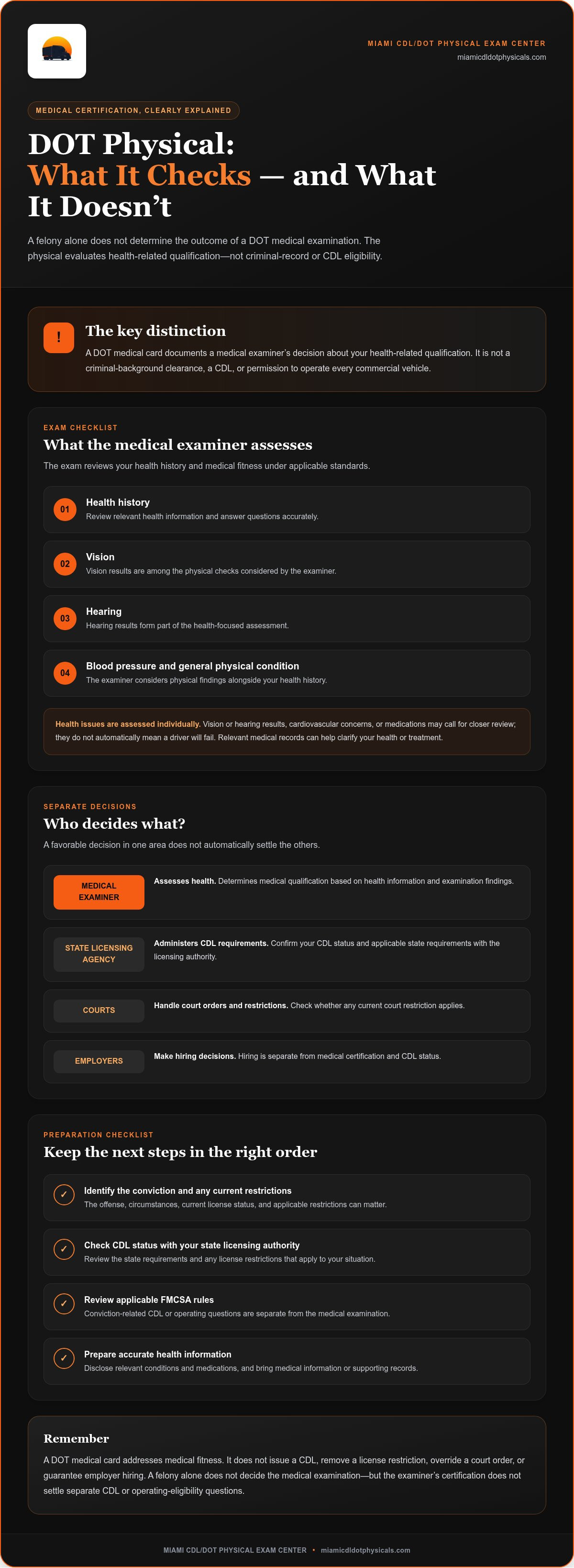
Next steps for a DOT medical card with a felony
If you’re asking, “can you get a DOT medical card with a felony,” handle the medical exam and driving-eligibility questions as separate tasks. Use this checklist to identify what needs attention, confirm your current status, and prepare for a health-focused examination. The medical examiner does not decide your legal eligibility to drive.
- Identify the exact conviction and any active restrictions. Review your case records for the offense, disposition, and any court orders or driving limits. Don’t rely only on the broad felony label. The details can help you identify questions for the authority responsible for your CDL record.
- Check your current CDL status. Contact the state driver licensing agency that maintains your record. Ask about your license status and any suspension, disqualification, or restriction affecting commercial driving. Keep the agency’s response or record for reference.
- Review applicable federal requirements. Compare your circumstances with current FMCSA rules, especially if the conviction involved a motor vehicle or commercial vehicle. Federal requirements and state licensing decisions work together, but a general article can’t determine how a rule applies to your case.
- Prepare for the DOT physical. Gather identification, current medication information, and relevant health records. Complete the health history accurately. Bring documents that help explain a diagnosis, treatment, or other medical concern, and be ready to discuss them with the examiner.
Prepare for the exam without confusing it with a background check
Your appointment is for an assessment of medical qualification, not legal advice about a conviction. Answer health questions truthfully and raise medical concerns directly. Don’t withhold requested information or assume a felony needs to be discussed as a medical condition. The examiner can assess relevant health information but can’t interpret court documents or determine whether your CDL permits you to operate a CMV.
Accurate information helps the examiner evaluate your circumstances under applicable medical standards. If you take medication or have a condition that may need explanation, bring relevant details rather than guessing. If you’re unsure what a medical question means, ask for clarification during the exam. A DOT physical can’t guarantee a particular certification outcome before the examiner completes the assessment.
Check driving eligibility through the appropriate channel
For a conviction-specific question, use your current CDL record and the state licensing agency’s guidance as a starting point. If a court order, notice, or licensing decision is unclear, qualified legal counsel can help interpret how it applies to your circumstances. Keep a note of whom you contacted, what records you reviewed, and any follow-up the authority requires. This creates a practical reference without treating an exam result as legal clearance.
Once you’ve organized your health information, arrange a professional DOT physical with an FMCSA-certified medical examiner. The exam assesses your medical qualification, while your CDL status and any conviction-related restrictions remain separate questions for the appropriate authorities.
Get a professional DOT physical when you need medical certification
A DOT physical evaluates your health-related qualification under applicable medical standards. It doesn’t decide whether a felony affects your criminal-record status, CDL, or permission to operate a commercial motor vehicle. Review driving eligibility with the appropriate licensing authority, and use the physical to address medical certification.
Miami Physical Exam / DOT provides FMCSA-certified DOT Physical Exams with a professional, courteous approach. Dr. Tanya Kahl is an FMCSA-certified medical examiner and has served as an examiner since 2014. Her credentials include Registry #2356768299 and License #CH7840. The appointment assesses your medical information and findings, but certification can’t be guaranteed before the examination is complete.
What to expect from a professional DOT physical
Bring identification, current medication information, and relevant health records that may help explain a diagnosis or treatment. The examiner reviews your health history and conducts an assessment focused on medical qualification. It may include checks such as vision, hearing, blood pressure, and general physical health.
Answer questions accurately and raise health concerns during the exam. The examiner makes an individual assessment based on your information, findings, and applicable standards. Certification outcome and duration depend on that medical assessment. A felony alone doesn’t determine the medical result, and a DOT physical doesn’t resolve a separate CDL restriction.
Take the next step with clear expectations
Dr. Kahl brings over 25 years of experience in DOT physical examinations. Same-day medical cards are provided, and results are sent directly to the DMV/state agency. These details describe the exam process, not a promise that every driver will qualify for certification.
If you need medical certification, prepare for your exam and bring the information needed for a careful assessment. For conviction-related driving questions, rely on the appropriate licensing authority. Learn about the DOT physical exam.
Move forward with a clear plan
Uncertainty about work can make it tempting to postpone every next step. Instead, handle each question through the right process: confirm your driving status with the appropriate licensing authority, then address medical certification through a DOT physical. If you’re still wondering, “can you get a DOT medical card with a felony,” focus on the medical assessment rather than treating it as a ruling on your conviction.
Miami Physical Exam / DOT provides medical examinations with FMCSA-certified examiner Dr. Tanya Kahl. She has served as an examiner since 2014, is listed under Registry #2356768299, and has over 25 years of experience in DOT physical examinations. Same-day medical cards are provided, and results are sent directly to the DMV/state agency. Certification depends on the examiner’s medical assessment, so no outcome can be promised in advance.
Prepare for your medical evaluation and address each part of the process one step at a time. Schedule a professional DOT physical exam.
Frequently Asked Questions
Can a pending felony charge affect my DOT medical card?
A pending charge isn’t itself a medical diagnosis, so it doesn’t determine the health assessment involved in a DOT physical. If you’re asking, “can you get a DOT medical card with a felony,” remember that an unresolved case may still involve court conditions or license restrictions that affect driving separately. Check your current CDL status and applicable official requirements. A medical card doesn’t authorize you to drive contrary to an active restriction.
Does an expunged felony automatically restore my CDL eligibility?
No. Expungement doesn’t necessarily resolve every federal or state licensing question, and its effect can depend on the jurisdiction and record involved. A medical examiner assesses health, not the legal effect of an expungement. Review your current driving record with the licensing authority responsible for your CDL. For advice about how an expungement applies to your case, consult qualified legal counsel and keep copies of relevant court and licensing documents.
Can a felony drug conviction affect a commercial driver's license?
It may raise a separate CDL or employment eligibility issue, but the effect depends on the conviction, applicable rules, and any resulting restrictions. It doesn’t automatically determine the examiner’s health-based decision. Review current FMCSA requirements and your state CDL record for information specific to your status. Keep questions about a criminal conviction separate from your DOT physical, and don’t assume that medical certification resolves a licensing or hiring decision.
Will a DOT medical examiner ask about my criminal record?
A DOT physical is a medical examination, not a criminal background investigation. Follow the forms and instructions provided for your appointment, and answer medical questions accurately. If a form asks something you’re unsure how to answer, request clarification rather than guessing. Questions about conviction reporting, CDL restrictions, or employer screening belong with the relevant licensing authority, employer, or qualified legal adviser, not the medical examiner’s health assessment.
Can an employer refuse to hire me because of a felony if I have a DOT medical card?
A DOT medical card doesn’t guarantee a job or settle an employer’s screening requirements. Hiring decisions may involve company policies, the role, applicable law, and your CDL status or restrictions. For a specific job opportunity, ask the employer about its hiring process and the records it considers. For advice about your rights or a disputed hiring decision, consult qualified legal counsel familiar with the circumstances.
What should I bring to a DOT physical if I have a felony?
Bring identification, an accurate list of medications, and health records relevant to your medical assessment, such as information about current treatment or a condition the examiner may need to evaluate. Follow appointment instructions about forms or additional documents. A conviction doesn’t turn the exam into a background check. If it has resulted in a driving restriction, review that separately with the licensing authority before operating a commercial vehicle.


