

A general workplace drug-testing policy may not meet federal DOT rules. DOT drug testing requirements for employers depend on which employees perform safety-sensitive duties, which transportation agency regulates the work, and whether each required testing event is handled correctly. For trucking employers, that often means identifying drivers operating commercial motor vehicles that require a CDL and applying the FMCSA process rather than relying on a one-size-fits-all policy.
Hiring, random selections, and incident response each involve different responsibilities. This guide explains which roles are covered, when testing is required, and how employers can organize a consistent program.
You’ll get a practical overview of the six testing situations: pre-employment, random, post-accident, reasonable suspicion, return-to-duty, and follow-up. We’ll also explain how the FMCSA Clearinghouse fits into employer duties, what procedures and records belong in the workflow, and how a consortium can help eligible employers and owner-operators manage random-testing participation. A well-defined process makes it easier to administer DOT testing separately from non-DOT testing.
Key Takeaways
- Determine coverage by an employee’s regulated transportation duties and applicable agency rules, not job title alone.
- Set a clear process for policy, employee education, testing arrangements, and assigning responsibility.
- Understand how the six required testing events differ and what action each calls for.
- DOT drug testing requirements for employers go beyond a general workplace policy. Build a workflow for DOT-specific procedures and records.
- DOT Drug Testing and a consortium program can support testing and random-testing participation.
DOT drug testing requirements for employers: who is covered?
DOT-regulated drug testing is required under federal transportation rules for employees performing specified safety-sensitive functions. It isn’t a standard workplace test with a DOT label added. The applicable agency rules and federal procedures determine who is covered and how testing must be conducted. A company may have employees subject to DOT requirements alongside employees covered only by its non-DOT policy.
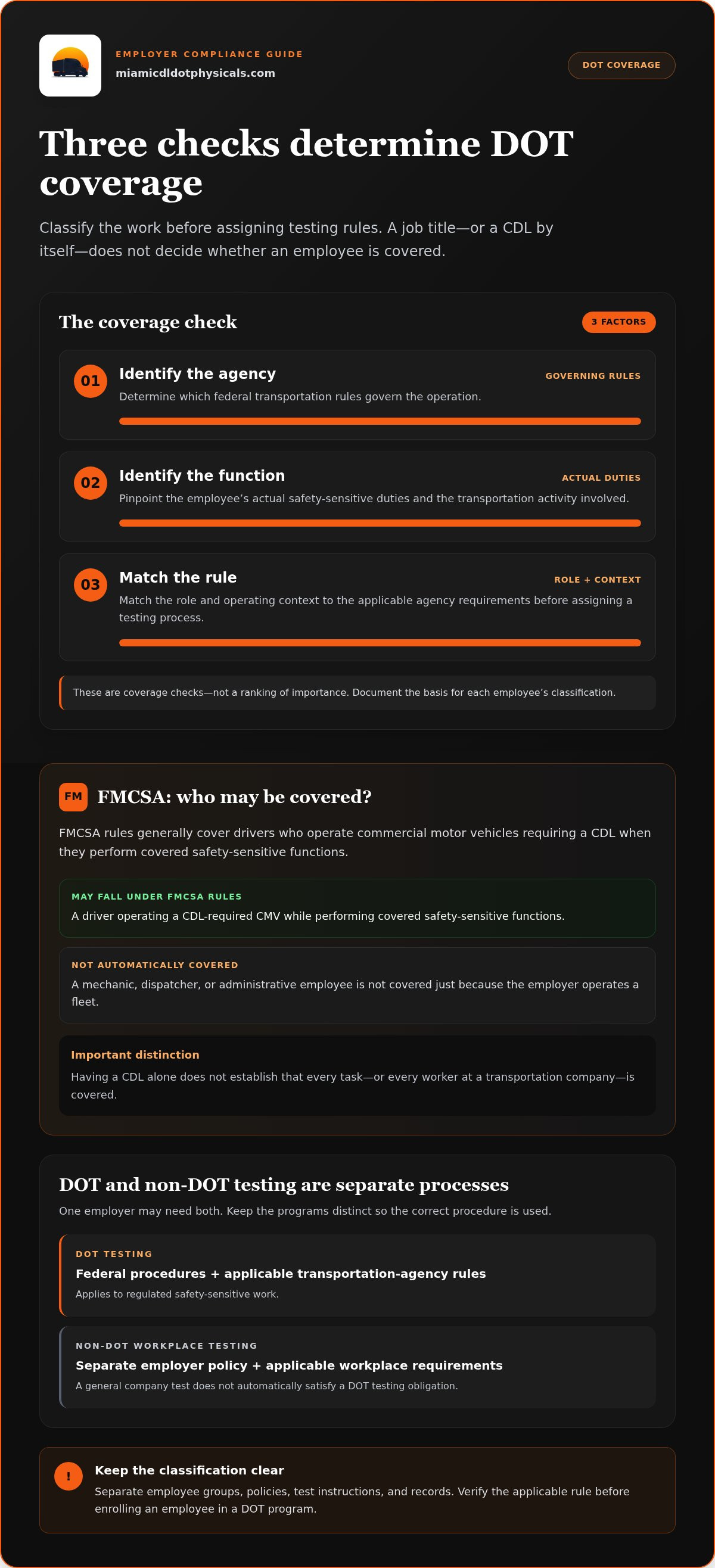
Classify the work before assigning testing rules. Job titles can help identify roles, but they don’t determine coverage on their own. Consider the employee’s actual duties, the transportation activity, and the agency rules that apply. The broader context of drug-impaired driving and occupational regulations helps explain the focus on safety-sensitive work, but employers must use the relevant federal requirements to determine coverage.
Quick coverage check
- Identify the agency: Determine which federal transportation rules govern the operation.
- Identify the function: Pinpoint the employee’s actual safety-sensitive duties.
- Identify the rule: Match the role and operating context to the applicable agency requirements before assigning a testing process.
Which employees may fall under FMCSA drug-testing rules?
FMCSA rules generally cover drivers who operate commercial motor vehicles requiring a CDL when they perform covered safety-sensitive functions. Having a CDL alone doesn’t establish that every task or worker at a transportation company is covered. Likewise, working for a motor carrier doesn’t automatically place an office employee in the DOT testing pool.
Review each role and its operating context. A driver operating a CDL-required CMV may be subject to FMCSA testing rules, while a mechanic, dispatcher, or administrative employee isn’t automatically covered just because the employer runs a fleet. Document the basis for each classification and verify the applicable FMCSA rule before enrolling an employee in a DOT program.
DOT testing versus non-DOT workplace testing
DOT testing follows federal procedures and the rules of the transportation agency that regulates the employee’s safety-sensitive work. Non-DOT testing follows a separate employer policy and applicable workplace requirements. The programs aren’t interchangeable: a test ordered under a general company policy doesn’t automatically satisfy a DOT testing obligation, and a DOT test shouldn’t be treated as an ordinary workplace test.
One employer may need both programs. Keep employee groups, policies, test instructions, and records clearly distinguished so staff can identify the correct process before arranging a test. This separation helps prevent a routine company test from being mistaken for a federally regulated test. For further context, the DOT drug testing compliance reference explains key considerations for commercial drivers.
What employers must do to run a DOT drug-testing program
A compliant program needs more than a testing arrangement. Employers must identify covered roles, explain procedures to employees, assign responsibility, and follow the rules that apply to their transportation operation. For FMCSA-regulated employers, 49 CFR Part 382 works alongside the testing procedures in Part 40. Review the current DOT 49 CFR Part 40 regulations and applicable FMCSA requirements when establishing or updating your process.
Make the program practical to follow. Keep a written record of covered positions, the rules applied to those roles, and the person employees and supervisors should notify when a testing event may be required. Explain the policy and testing procedures to covered employees before a test is needed. Reflect DOT drug testing requirements for employers in clear instructions, rather than leaving staff to interpret them during a time-sensitive event.
Set up policies, roles, and testing arrangements
Assign a Designated Employer Representative (DER) and make sure employees and supervisors know the role. Under Part 40, the DER is an employer representative authorized to take immediate action to remove employees from safety-sensitive duties, make decisions in the testing process, and receive related communications. Give supervisors a clear path for reporting observations or incidents to the DER.
Supervisors should recognize when facts may trigger a rule-defined event, such as reasonable suspicion, and follow the employer’s procedure promptly. They should document and communicate observations, not diagnose impairment or decide what a test result means. For FMCSA-regulated employers, supervisors who may make reasonable-suspicion determinations must receive the required training on signs of alcohol misuse and drug use.
Understand the employer’s role in the testing chain
Employers coordinate the process, but don’t perform every function themselves. A collection site collects the specimen and follows collection procedures. The laboratory analyzes the specimen. A Medical Review Officer (MRO) is a licensed physician who reviews laboratory results and evaluates whether a legitimate medical explanation applies before reporting a verified result to the employer. Keep these responsibilities distinct.
Set up a clear handoff so the DER knows who initiates an event, how the employee receives instructions, and how required notifications and records are handled. The employer remains responsible for its program even when a testing provider or consortium helps administer parts of it. A testing provider can support testing arrangements, while a consortium can help eligible employers and owner-operators manage participation in FMCSA random testing. Neither replaces the employer’s applicable duties.
- Document covered roles, the governing rules, and the DER’s contact information.
- Explain the policy and testing steps to covered employees before an event occurs.
- Train relevant supervisors to recognize and report potential triggers without making medical judgments.
- Review policies and procedures against current Part 40 and Part 382 requirements.
Our center provides DOT drug testing and consortium programs to support FMCSA random-testing participation. DOT Drug Testing includes federally compliant 5-Panel and 10-Panel tests for pre-employment, random, post-accident, and reasonable-suspicion testing.
When DOT drug tests are required and how events differ
FMCSA-regulated employers must match each test to the event that triggers it. The six testing categories below have different purposes and conditions. Use 49 CFR Part 40 and Part 382, along with current FMCSA guidance, to verify eligibility, timing, and required steps. A crash or workplace concern doesn’t automatically qualify for a post-accident or reasonable-suspicion test.
| Testing event | Purpose | Who initiates | Employer action to verify |
|---|---|---|---|
| Pre-employment | Screen a prospective covered driver before safety-sensitive work begins. | Employer orders the test as part of the hiring process. | Confirm the role is covered and complete required testing before the driver performs the function. |
| Random | Deter and detect prohibited drug use through an unpredictable selection process. | Employer or its consortium/third-party administrator manages selections. | Verify the pool, selection process, notification, and prompt test completion follow current rules. |
| Post-accident | Test after a qualifying accident under the applicable FMCSA criteria. | Employer determines whether the event meets the rule’s criteria. | Check the accident circumstances and separate drug and alcohol testing triggers and deadlines. |
| Reasonable suspicion | Address specific, contemporaneous observations of possible prohibited use. | A trained supervisor makes the determination under applicable rules. | Document observations and follow the required process; don’t treat a suspicion as a diagnosis. |
| Return-to-duty | Determine whether a driver who violated a drug or alcohol rule may return to safety-sensitive work. | Employer arranges testing after the required SAP process. | Verify the required evaluation and return-to-duty test are completed before return. |
| Follow-up | Monitor a driver after return to duty under the required follow-up plan. | Employer arranges tests according to the SAP’s direction. | Track the plan and complete required tests without substituting a routine random test. |
How required testing events differ
Drug and alcohol rules don’t always share the same trigger or deadline. For example, post-accident alcohol testing has its own criteria and time limits, distinct from drug testing. Apply the relevant rule to each substance and event, and document why testing was or wasn’t required. Use the table as a practical guide, then check the current rule for a specific incident.
Random testing, consortiums, and the Clearinghouse
For calendar year 2026, FMCSA’s minimum annual random-testing rate is 50% for drugs and 10% for alcohol. These percentages apply to the covered driver pool, not to a guaranteed number of tests for each individual. Selection must remain genuinely random and spread through the year. A consortium can help eligible employers and owner-operators administer random-testing participation, but it doesn’t remove the employer’s responsibility to comply.
Keep random-testing administration distinct from Clearinghouse queries and reporting, which are separate employer duties. For more detail on consortium administration, see the FMCSA Clearinghouse consortium guide. Apply DOT drug testing requirements for employers to each event and verify current eligibility and timing before directing an employee to test.
How employers can prevent common DOT testing compliance mistakes
A reliable process prevents a common error: assuming a general workplace policy or drug test automatically satisfies DOT rules. It doesn’t. DOT testing follows specific procedures, documentation, and event requirements. Before initiating a test, confirm the employee’s status and the reason for testing. A clear sequence helps the DER and other staff apply the correct process and document what happened.
A practical employer checklist for each testing event
Use this workflow for each event, then confirm the details against the current applicable rule. Don’t rely on memory or a form used for a different testing program.
- Confirm coverage. Verify that the employee is in a DOT-regulated role and that the applicable agency rules cover the work being performed.
- Identify the event. Record whether the test is pre-employment, random, post-accident, reasonable suspicion, return-to-duty, or follow-up. Confirm that the event’s specific trigger applies.
- Check timing and instructions. Review the current requirements for that event, including any applicable deadlines and whether drug testing, alcohol testing, or both are called for.
- Use the correct process. Arrange the test under DOT procedures and use the required documentation, including the appropriate Federal Drug Testing Custody and Control Form for a DOT drug test.
- Track the handoff. Ensure the employee receives clear instructions and that the collection process follows required chain-of-custody procedures. Route questions or issues to the responsible program contact.
- Document and close the event. Record the relevant steps and completion status in the appropriate program file. Track required next actions without interpreting laboratory findings as the employer.
Avoid confusing DOT and non-DOT procedures
Keep separate policies, forms, employee classifications, and records for DOT-regulated and non-DOT testing. Mixing them can make it difficult to tell which rules governed a test or which documentation belongs in the file. For example, if a company driver is covered by FMCSA rules while an office employee is not, staff should be able to distinguish the driver’s DOT test paperwork from the office employee’s non-DOT records at every step.
Build in a final review before closing an event. Confirm that the event type, required forms, chain-of-custody documentation, and follow-up actions align. Don’t guess at record-retention periods. Verify current retention requirements and FMCSA Clearinghouse query and reporting duties against official guidance, then organize the applicable records so the employer can locate them when needed.
These checks make DOT drug testing requirements for employers easier to apply consistently, but they don’t replace reviewing current Part 40 and Part 382 rules. Our center provides DOT drug testing as part of an employer’s testing process.
Get help managing employer DOT drug-testing requirements
A workable program starts with three steps: identify which employees are covered, map the testing events that apply to their roles, and arrange the appropriate testing process. This structure helps employers distinguish federally regulated testing from general workplace screening and gives staff a clear route for handling each event. Testing support can help with administration, while the employer remains responsible for meeting applicable federal requirements.
When testing and consortium support can help
Employers managing covered drivers can use DOT Drug Testing as part of their testing arrangements. Owner-operators and eligible employers that need to participate in FMCSA random testing can also use a Drug Consortium Program to support that participation. Consortium membership is a monthly program for trucking companies and owner-operators. It supports participation, but doesn’t exempt employers from their obligations. Keep responsibility for coverage decisions, required actions, and program oversight clear.
Match the service to the employee’s status and the applicable program. DOT Drug Testing is for DOT-regulated testing, while Non-DOT Drug Testing is a separate service for non-DOT workplace programs. Non-DOT testing is available for pre-employment, court-ordered, and workplace testing. Keep the two programs distinct in employer procedures and records, and determine the correct pathway before arranging a test.
Before setting up your process, make a short internal plan:
- List the roles you’ve identified as covered and the basis for each classification.
- Note the testing events relevant to those employees and who coordinates each one.
- Decide whether your organization needs a consortium to support FMCSA random-testing participation.
- Keep employer oversight and required compliance steps assigned, even when a program supports administration.
Take the next step toward a consistent program
Our center provides DOT Drug Testing, Non-DOT Drug Testing, and Drug Consortium Programs for employers and owner-operators. The consortium program supports FMCSA random-testing participation, while DOT and non-DOT testing remain separate options for their respective programs.
Match the service to the role and testing requirement, then maintain written procedures and employer oversight. A clear distinction between DOT and non-DOT processes helps staff follow a consistent path from event initiation through documentation.
Review the DOT testing and consortium support available through our center as you organize your program.
Put your compliance process into practice
Turn your coverage decisions into a routine your team can follow. Assign responsibility for keeping procedures current, communicating changes to affected employees, and reviewing how testing events are handled. This ongoing attention keeps DOT drug testing requirements for employers connected to day-to-day operations rather than treated as a one-time setup task.
Choose the testing program that matches the employee and purpose. Our center offers DOT Drug Testing and Non-DOT Drug Testing as distinct services. Drug Consortium Programs support random-testing requirements for trucking companies and owner-operators, while employer responsibilities remain in place. A clear plan can help your organization manage these arrangements with confidence.
Explore the available options and take the next step toward a consistent program: Explore DOT Drug Testing and Drug Consortium Programs.
With a defined process and appropriate support, your team can manage testing events with greater clarity and confidence.
Frequently Asked Questions
Can an employer use hair testing to meet a DOT drug-testing requirement?
No. Hair testing doesn’t meet DOT drug-testing requirements. As of October 2026, urine remains the usable specimen method for DOT-regulated testing. Although federal rules authorize oral fluid testing, employers can’t implement it until the required laboratory certifications are in place. A company may have separate non-DOT testing procedures, but those don’t replace the required DOT method. Confirm current DOT guidance before changing testing procedures.
What happens if an employee refuses a DOT drug test?
A refusal is handled as a DOT violation, not as an ordinary missed appointment. Depending on the circumstances, refusal can include failing to appear as directed, leaving before the process is complete, or tampering with a specimen. The employer must follow the applicable rule, remove the employee from safety-sensitive functions, and complete required reporting and return-to-duty steps. Document what occurred and consult the DER before deciding how to proceed.
Is a Medical Review Officer required for DOT drug testing?
Yes. DOT drug-test results must go through a Medical Review Officer, or MRO, who is a licensed physician trained in the review process. The MRO evaluates laboratory results and gives the employee an opportunity to provide a legitimate medical explanation when appropriate. Employers shouldn’t interpret laboratory findings themselves or treat an unreviewed result as verified. The MRO’s role is specific to drug-test result review, not general employer policy decisions.
How long must employers keep DOT drug-testing records?
Retention depends on the record type under FMCSA rules. Generally, keep records of verified positive drug tests, refusals, and alcohol tests with results of 0.02 or higher for five years; collection-process records for two years; and negative drug tests and alcohol results below 0.02 for one year. Other records may have different periods. Check current 49 CFR 382.401 and applicable agency guidance, then apply the correct period to each record category.
Can an employee take prescription medication while performing a safety-sensitive job?
Having a prescription doesn’t automatically determine whether an employee can safely perform a safety-sensitive function. A legitimate prescription may be relevant during an MRO review, but the employer must also consider whether the employee can perform the work safely under applicable rules. Employees should discuss job duties with their prescribing clinician and follow the employer’s reporting procedure. Don’t advise an employee to stop prescribed medication or assume a prescription excuses every positive result.
Does a DOT drug-testing consortium take over the employer’s compliance responsibilities?
No. A consortium can support random-testing participation and related administration, but it doesn’t transfer every employer duty or eliminate the employer’s accountability. Employers still need to know which workers are covered, maintain applicable program responsibilities, and complete required actions such as Clearinghouse duties. Owner-operators also have specific program obligations. Define which tasks the consortium handles and keep employer oversight clear so important steps aren’t missed.
Can one company have both DOT-regulated and non-DOT employees?
Yes. A company may have employees covered by DOT rules and others who are tested only under a non-DOT workplace program. For example, a covered commercial driver and an office worker may follow different testing procedures even though they share the same employer. Maintain distinct policies, forms, and records for each group. DOT drug testing requirements for employers apply based on the regulated role and function, not simply the company’s industry.


