

Knowing how to manage a random drug testing pool starts with separating DOT-covered employees from non-DOT testing. Put employees subject to FMCSA testing in the DOT pool, and keep non-DOT testing in a completely separate pool. U.S. DOT drug and alcohol testing programs are subject to 49 CFR Part 40, according to the Electronic Code of Federal Regulations.
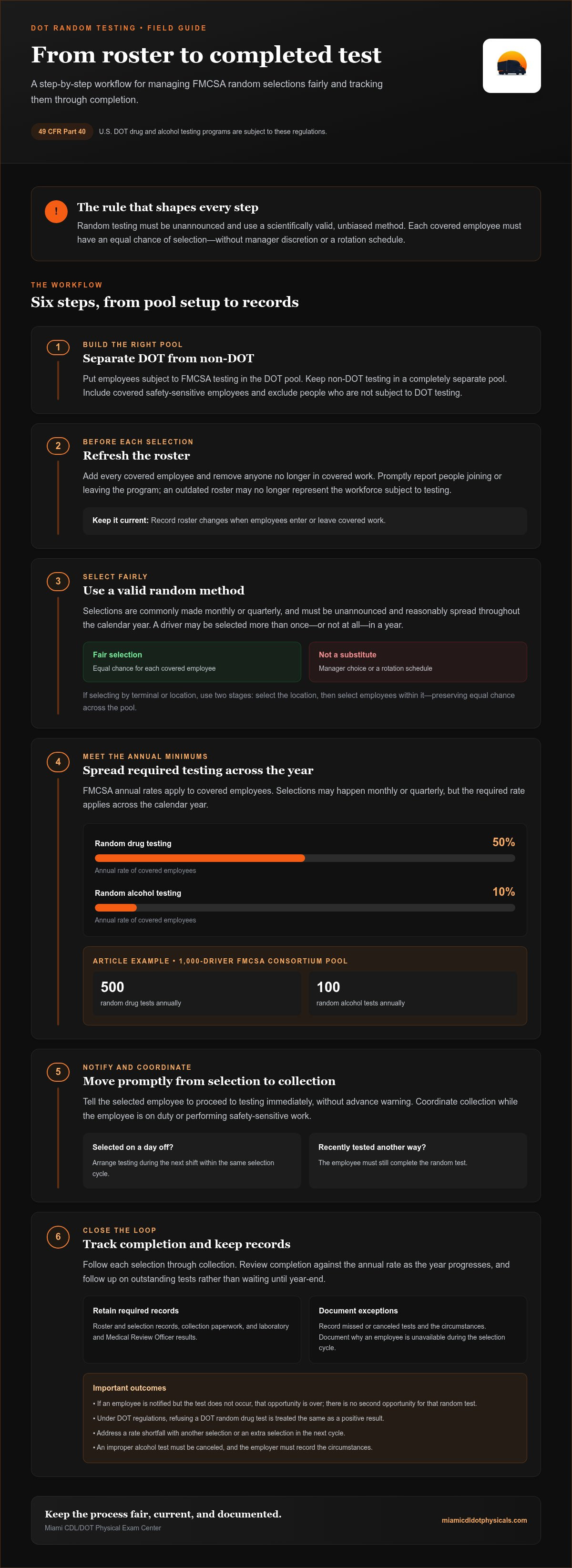
Random testing must be unannounced, and selection must give covered employees a fair chance of being chosen. A driver may be selected more than once in a year or not at all, so a rotation schedule or manager’s discretion cannot replace a valid random selection process.
This guide explains why random testing matters, which drivers belong in a DOT pool, how selections and testing timelines work, and how to keep DOT and non-DOT programs separate. You’ll also learn when a company can manage its own pool and when an owner-operator needs a consortium. Clear pool boundaries and consistent records help keep the process organized and aligned with the rules that apply to your workplace.
Key Takeaways
- Keep the DOT roster current by including covered safety-sensitive employees and excluding those who aren’t subject to DOT testing.
- FMCSA-regulated employers must conduct random drug testing at an annual rate of 50% of covered employees, according to the Federal Motor Carrier Safety Administration (FMCSA).
- Maintain separate pools for DOT and non-DOT testing, and account for each DOT agency’s rules when employees work across regulated modes.
- Track selected tests through completion and retain the records required for the applicable retention periods.
- Understand when your company can manage its own pool and when an owner-operator must join a consortium.
Why is random testing so important?
Random testing gives each covered employee a chance of selection without advance notice. Before each selection, update the pool roster: include every safety-sensitive employee subject to DOT testing and remove anyone who is no longer covered. A current roster ensures selections reflect the workforce subject to the applicable rules, not outdated job assignments or a manager’s preferred list.
Federal requirements depend on whether the employee’s role falls under a DOT agency’s rules. U.S. DOT drug and alcohol testing programs are subject to 49 CFR Part 40, according to the Electronic Code of Federal Regulations (eCFR); state workplace testing laws may also apply, alongside relevant OSHA, FCRA, EEOC, and Drug-Free Workplace Act considerations.
The selection method must be scientifically valid and unbiased. Don’t choose employees at a manager’s discretion or by rotation. A valid method gives everyone in the pool an equal chance, even if one employee is selected repeatedly while another isn’t selected during the year. Keep selection decisions separate from performance reviews, attendance concerns, and personal preferences.
Notification and collection timing matter. Tell a selected employee to proceed to testing immediately, without advance warning, and coordinate the collection while the employee is on duty or performing safety-sensitive work. If a driver is selected on a day off, arrange testing during the next shift within the same selection cycle. Employees must complete a random test even if they recently took another type of test.
For an extended absence or long-term illness, document why a selected employee is unavailable during the selection cycle. Address a rate shortfall with another selection or an extra selection in the next cycle. If an employee is notified but the test doesn’t occur, that opportunity is over: there’s no second opportunity for that random test. Under DOT regulations, refusing a DOT random drug test is treated the same as a positive result.
Retain the roster, selection records, collection paperwork, and laboratory and Medical Review Officer results for the periods required by regulations. Record roster changes when employees enter or leave covered work, and document missed or canceled tests and the circumstances. For example, an improper alcohol test must be canceled, and the employer must record the circumstances that led to cancellation.
Pool-management costs depend on factors such as roster size, selection frequency, and the administration tasks involved; pricing is provided after a quote request. Clear records and prompt follow-up help employers track selections through collection and identify incomplete tests before a selection cycle ends.
Third-party administration of random testing selections
A third-party administrator can coordinate selections and track completion for an employer’s testing program. Employers remain responsible for meeting applicable testing requirements and keeping pool information accurate.
Selection Methods and Test Timing
A scientifically valid random selection method gives each covered employee an equal chance, without manager discretion or a rotation schedule. Selections are commonly made monthly or quarterly across the calendar year. FMCSA random tests must be unannounced and reasonably spread throughout the calendar year. This approach avoids predictable testing patterns and keeps selection consistent across the pool.
A third-party administrator can use the employer’s current roster to run selections, issue notices, and track whether each selected employee completes a collection. The employer should promptly report roster changes, including covered employees who join or leave the program. An outdated roster can distort selection because it no longer represents the employees subject to testing.
Employers can select employees from one combined pool or organize selections by location. When selecting by terminal or location, use two stages and preserve an equal chance of selection for every employee in the pool. First select the location, then select employees within it. This prevents a location-based process from unfairly excluding workers at smaller terminals.
Annual Rates and Quarterly Distribution
Annual rates set the minimum number of covered employees who must undergo random drug and alcohol testing. FMCSA-regulated employers must conduct random drug testing at an annual rate of 50% of covered employees, according to the Federal Motor Carrier Safety Administration (FMCSA). FMCSA-regulated employers must conduct random alcohol testing at an annual rate of 10% of covered employees, according to the Federal Motor Carrier Safety Administration (FMCSA).
Selections may be conducted monthly or quarterly, but the required rate applies across the calendar year. A 1,000-driver FMCSA consortium pool requires at least 500 random drug tests and 100 random alcohol tests annually. Spread selections across the year instead of leaving most activity until the final quarter. A steady schedule gives employers time to follow up on incomplete tests and manage collection logistics.
Administrators can track selections against the applicable rate and report outstanding tests to employers. Review completion records as the year progresses, not only at year-end. For owner-operators managing selections through a consortium, consortium random testing support can help coordinate the program’s selection process.
Separating DOT and non-DOT testing pools
Keep DOT and non-DOT testing in completely separate pools, with each roster limited to employees covered by that program. U.S. DOT drug and alcohol testing programs are subject to 49 CFR Part 40, according to the Electronic Code of Federal Regulations (eCFR). Separating eligible groups is a core part of how to manage a random drug testing pool because it keeps selection and records tied to the correct program.
DOT Mode Pools and Selection
A DOT mode pool includes employees covered by the same agency’s testing rules, and employers generally maintain a separate pool for each DOT mode. This matters when a company operates across regulated industries, since one combined pool may not reflect each mode’s requirements. Within an FMCSA pool, selections must give covered employees an equal chance and be distributed throughout the year.
Limit the DOT roster to employees subject to that agency’s testing program. FMCSA regulations prohibit including non-CDL drivers in an FMCSA DOT random testing pool. A driver performing safety-sensitive work for two employers must be included in each employer’s DOT random program. When an employee falls under more than one DOT agency, the applicable rate depends on which agency regulates most of that employee’s safety-sensitive work.
Separate records and selection lists help prevent a non-DOT test from being recorded as a DOT test. Employers may test beyond DOT requirements, but they can’t identify additional testing as a DOT test. For example, a company may maintain a separate non-DOT program for employees outside its covered CDL group, with distinct rosters and test documentation.
Standalone Random Pools
A standalone random pool is managed by an employer for its own covered workforce instead of through a consortium. Employers with more than 20 drivers are generally recommended to use a standalone pool. The choice affects how the employer maintains the roster, administers selections, and tracks whether required testing is completed. Employers deciding how to manage a random drug testing pool should base that choice on who is covered and how the program will be administered.
An employer with more than one CDL driver or employee subject to DOT testing may manage its own program. An owner-operator with one CDL driver who isn’t leased to another motor carrier must join a consortium for random testing. A consortium combines eligible participants for selection, while each employer remains responsible for its own compliance duties and employee actions.
Keep the two program types distinct, even when the same worker is tested under both. Assign each test to the correct pool before selection, use the appropriate documentation, and preserve separate results and records. This prevents a non-DOT collection from counting toward a DOT minimum or being mislabeled in the employer’s compliance files.
Using a compliance partner or third-party administrator
A compliance partner or third-party administrator (C/TPA) can coordinate random selections, track collections, and help organize records. The employer still needs to keep employee information accurate and respond when a selected driver doesn’t complete testing. Define responsibilities in the testing program so roster updates, notifications, follow-up, and record retention each have a clear owner.
For drug and alcohol testing, use a SAMHSA-certified laboratory and a qualified Medical Review Officer (MRO). Their roles support the proper handling of collections, chain of custody, and review of laboratory results. Keep collection paperwork linked to the correct employee and selection. That connection helps show which test was conducted, when it occurred, and how the result was handled.
Monitoring is part of administration, not an end-of-year cleanup task. C/TPAs should monitor completed random tests daily or weekly and follow up with employers when selected tests aren’t completed within an acceptable timeframe. Employers can then address a missed collection while the selection cycle is active, rather than discovering an unresolved test during an audit.
Set a routine for comparing selections with completed collections. For each selection, record the employee, selection date, notification, collection status, and any follow-up. If a selected driver is absent, document the reason and action taken. If a test is canceled, retain the circumstances that led to cancellation. Clear records make exceptions traceable instead of leaving gaps in the testing file.
Keep records in a structured system searchable by employee, testing period, and test type. DOT random testing records generally must be retained for five years, while negative and canceled results must be retained for two years under the FMCSA recordkeeping schedule. Separate drug and alcohol records where needed, and preserve pool rosters, selection records, collection paperwork, and laboratory and MRO results for their required periods.
Common mistakes include using an outdated roster, failing to follow up on an incomplete collection, mixing DOT and non-DOT paperwork, or losing the link between a selection and its result. A simple monthly review can catch these problems: reconcile the roster, compare selections with completed tests, and flag missing documentation for action.
Audit readiness means the employer can show how a selection moved from roster to notification, collection, and recorded result. Keep dated, versioned rosters and selection records so a reviewer can see who was eligible when selections occurred. A C/TPA may help administer those steps, but transportation employers should review reports regularly and resolve open items promptly.
Who belongs in a DOT random testing pool
Start with the job and vehicle, not the employee’s title. FMCSA drug and alcohol testing rules apply to people operating a defined commercial motor vehicle in intrastate or interstate commerce when subject to CDL requirements under 382.107. Review each person’s actual driving duties and the vehicle they operate before adding them to the eligible roster. A job title alone doesn’t establish whether someone is covered.
Include all part-time CDL drivers of commercial motor vehicles in their employer’s DOT random testing pool at all times. Part-time status doesn’t remove a driver from the pool if the driver remains subject to the rules. For example, an employer shouldn’t remove a covered driver simply because that person drives only on selected shifts or works another job.
A CDL driver who performs safety-sensitive work for two employers must be included in each employer’s DOT random testing program under 49 CFR 382.305. Each employer needs to account for the driver in its own pool and selection process. The employers’ rosters shouldn’t assume that testing under one employer’s program replaces the other employer’s responsibility.
Use a clear process to update the roster when an employee’s status changes. When an employee starts or stops covered driving, update the record so future selections use the correct eligible group. A computer roster can organize names and job information, but someone must still review changes against actual duties. Record the reason for each addition or removal so eligibility decisions are documented.
Eligibility for random drug testing and alcohol testing can overlap, but alcohol testing has a defined timing limit. Under 49 CFR 382.305(m), FMCSA alcohol testing is permitted only while a driver is performing safety-sensitive functions, just before starting them, or just after ceasing them. Keep that timing in mind when arranging a collection after notification, rather than treating alcohol testing as available at any time.
Don’t add non-CDL drivers to an FMCSA DOT random testing pool. If an employer tests those workers under a separate workplace policy, keep that testing distinct from DOT selections and records. Make the difference clear on the roster: identify who is covered by FMCSA rules, who is subject to another DOT agency, and who belongs only in a non-DOT program. This prevents a non-DOT test from being counted or labeled as a DOT test.
For an owner-operator who needs help participating in an FMCSA random testing program, an FMCSA Clearinghouse Consortium is a relevant next step. Use the eligibility criteria first, then ensure the driver is represented in the correct pool and receives any required selection notification.
Miami CDL/DOT Physical Exam Center: DOT Physical Exam
Miami CDL/DOT Physical Exam Center provides DOT Physical Exams for commercial drivers who need a medical examination for work. If you’re organizing driver compliance alongside a random testing program, keep the medical exam and testing steps distinct, then arrange each as needed.
Owner-operators and fleet companies seeking help with federal drug and alcohol program compliance can use the FMCSA Clearinghouse Consortium. It’s a relevant option for owner-operators who need consortium participation for random testing. These services support different parts of a driver’s compliance needs, from a DOT physical to consortium participation.
Contact Miami CDL/DOT Physical Exam Center to discuss a DOT Physical Exam or FMCSA Clearinghouse Consortium.
Make Your Testing Process Part of the Routine
A reliable program depends on clear ownership, not a one-time roster cleanup. Decide who maintains employee eligibility, who reviews selection reports, and who closes out incomplete collections. Use each roster update as a prompt to confirm that the process still reflects current job duties. This gives your team a practical framework for how to manage a random drug testing pool as drivers and responsibilities change.
Keep medical qualification and drug testing distinct, while coordinating them within your broader compliance workflow. Miami CDL/DOT Physical Exam Center offers DOT Physical Exams, DOT Drug Tests, and Non-DOT Drug Tests. These services support drivers and employers handling separate medical and testing requirements.
Choose a clear next step based on what your program needs now. If a driver needs an exam or your workplace needs testing, contact Miami CDL/DOT Physical Exam Center to get started. A consistent process helps your team move forward with clarity.
Frequently Asked Questions
What is a random drug testing pool and how does it work?
A random drug testing pool is the eligible group from which employees are chosen for unannounced testing. A selection method draws from that group without favoring particular workers, and selected employees proceed to a collection. For example, a company might keep separate eligible rosters for covered commercial drivers and workers tested under a non-DOT workplace policy. Each roster must match the program it supports.
How do you create and maintain a random drug testing pool?
Start by identifying which employees are subject to the applicable testing program, then build a roster of those workers. Review job duties and vehicle operations when deciding whether a driver is covered, rather than relying on job titles alone. Update the roster as employees enter or leave covered work. Record roster changes and distinguish DOT employees from people tested under a separate workplace policy.
How often should employees be selected for random drug testing?
Selections are commonly conducted monthly or quarterly and should be reasonably spread throughout the calendar year for FMCSA programs. This describes when selections occur, not a personal testing appointment that employees can predict. A worker may be selected more than once, while another may not be selected during the year. Keep every selection unannounced and coordinate the collection promptly after notifying the selected employee.
How do you calculate random drug testing selection rates and pool size?
Use the applicable annual rate and the average number of covered employees in the pool to determine required testing volume. For FMCSA-regulated employers, the annual rates are 50% for random drug tests and 10% for random alcohol tests, according to the Federal Motor Carrier Safety Administration (FMCSA). For example, calculate each requirement separately, using the covered pool average rather than counting workers outside the program.
What software or services manage workplace random drug testing pools?
Employers can use a qualified administrator or tracking system to organize eligible rosters, selections, notifications, and completed collections. Choose a process that preserves selection records and flags tests that remain incomplete. Miami CDL/DOT Physical Exam Center offers an FMCSA Clearinghouse Consortium, DOT Drug Tests, and Non-DOT Drug Tests. These services address testing and consortium needs rather than providing a named software product.
How do DOT random drug testing rules differ from non-DOT programs?
DOT programs apply to employees covered by a relevant federal transportation agency, while non-DOT testing follows a separate workplace program. U.S. DOT drug and alcohol testing programs are subject to 49 CFR Part 40, according to the Electronic Code of Federal Regulations (eCFR). Keep each program’s pool, test designation, and records distinct. A test conducted under a separate employer policy must not be labeled as a DOT test.
How should employers notify selected employees and handle missed tests?
Notify a selected employee without advance warning and direct them to proceed promptly for collection. If a driver is selected on a day off, arrange testing during the next shift within the same selection cycle. Document an extended absence or long-term illness and address any rate shortfall with another selection or an extra selection in the next cycle. Once notified, an employee has no second opportunity if the test doesn’t occur.
How can a random drug testing pool ensure confidentiality and defensible selection records?
Limit access to roster and result information to people who need it to administer or review the program. Keep dated rosters, selection records, collection paperwork, and laboratory and Medical Review Officer results together in a secure record system. DOT random testing records generally require retention for five years; negative and canceled results require two years under the stated FMCSA schedule. Record who changed roster details and why, so later reviews can trace decisions.


