

No CDL doesn’t always mean no DOT medical card. A DOT physical for non-CDL drivers may be required when they operate a commercial vehicle in interstate commerce with a gross vehicle weight rating of at least 10,001 pounds. The CDL licensing threshold is different, so a driver can need a medical exam without needing a CDL.
It’s easy to assume DOT physicals apply only to CDL holders, but the vehicle, its use, and the type of work all matter. This guide explains which jobs and vehicles may require an exam, what the health history form asks, what the physical includes, and how certification periods work. It also covers factors that affect the exam’s cost without quoting a price. In the United States, DOT physicals must be performed by certified medical examiners. The exam includes a urine test for fitness determination, which is not the same as a drug test.
Key Takeaways
- A non-CDL driver may still need a medical card; the vehicle’s weight, passenger use, and type of operation help determine when the requirement applies.
- The Federal Motor Carrier Safety Administration identifies vehicles transporting more than 8 passengers for compensation as commercial motor vehicles under the federal definition.
- The health history form asks about medical conditions and substance use, so prepare to answer accurately and bring relevant health information.
- Exam costs can vary with what the exam involves. The article explains the factors that affect the final price without quoting a service fee.
- DOT physicals must be performed by certified medical examiners. Learn what to look for when arranging an exam and what to expect during it.
What Is a DOT Physical Exam?
A DOT physical assesses whether a driver can safely perform safety-sensitive driving duties. Non-CDL drivers who need the exam are assessed under the same medical standards as CDL drivers.
Examination Components and Systems
A DOT physical reviews the physical systems and functions that can affect safe motor vehicle operation. The medical examiner checks your vision and hearing, reviews your health history, and assesses relevant conditions, including respiratory dysfunction and sleep apnea. These checks help determine whether a medical issue could interfere with driving or transportation work.
The vision check requires 20/40 vision or better in each eye. For hearing, a driver can meet the requirement by hearing a forced whisper from at least 5 feet away. These tests assess whether you can see and hear information needed while operating a vehicle. The exam also includes a urine test for Commercial Driver Fitness Determination. That urinalysis isn’t a drug test unless an employer separately requests one.
Blood pressure can affect the certificate’s length. Drivers with blood pressure below 140/90 may qualify for the standard two-year certificate. Managed hypertension in the Stage 1 range, from 140 to 159 systolic or 90 to 99 diastolic, typically results in a one-year certificate. Stage 2 readings, from 160 to 179 systolic or 100 to 109 diastolic, typically result in a one-time three-month certificate while the driver works to lower blood pressure. At 180 systolic or 110 diastolic, a driver is disqualified until blood pressure is controlled to 140/90 or below.
The federal motor carrier regulations define 13 physical qualification standards. A certificate may be valid for up to 24 months, depending on health; some medical conditions can result in a certificate valid for 12 months or less. The examiner may also request documentation from a primary doctor for certain conditions, such as heart-related issues. This helps the examiner evaluate how a condition affects the specific demands of driving.
Documents for the Examination
If you have a condition that may require supporting records, such as a heart-related issue, bring relevant documentation from your primary doctor. The medical examiner may need these documents to assess your health and determine whether the condition affects safe driving. Having records ready can help the examiner review them during your DOT physical.
The health history form is part of the examination, so provide accurate information about your medical history and current conditions. The examiner considers it alongside the physical checks, vision and hearing results, and urinalysis. A DOT physical for non-CDL drivers is not simply a general checkup: each result helps assess whether you meet the applicable physical standards.
Vehicles and work roles that may require a non-CDL DOT physical
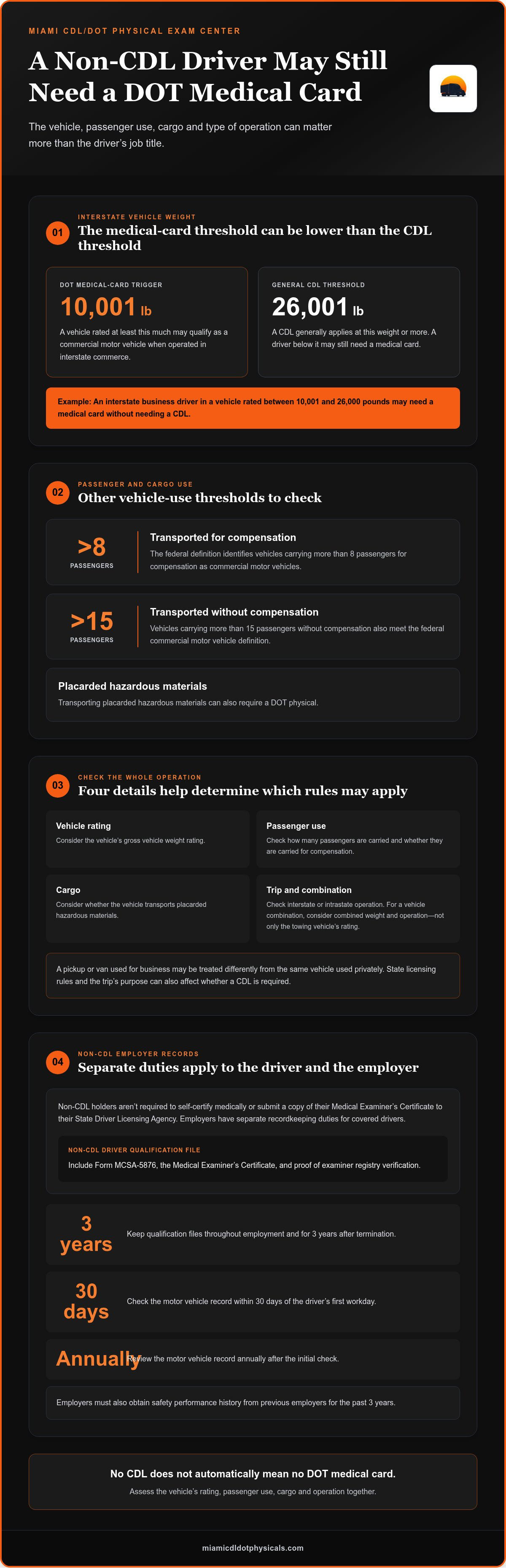
You may need a federal medical card without holding a commercial driver’s license. Key factors include the vehicle’s weight, passenger capacity, cargo, and whether the work crosses state lines. A pickup or van used for business may be subject to different rules from the same vehicle used privately. Consider the vehicle’s rating and your driving activity together, rather than relying on your job title alone.
According to the Federal Motor Carrier Safety Administration, a vehicle with a gross vehicle weight rating of at least 10,001 pounds is a commercial motor vehicle when operated in interstate commerce, potentially requiring a medical card even if the driver does not need a CDL. The Federal Motor Carrier Safety Administration also identifies vehicles transporting more than 8 passengers for compensation as commercial motor vehicles. Vehicles transporting more than 15 passengers without compensation also meet the federal definition, according to the Federal Motor Carrier Safety Administration.
Passenger rules can affect shuttle, transportation, and group-trip work. If you carry passengers for payment, consider the compensation threshold; if you transport a group without compensation, consider the separate passenger threshold. Transporting placarded hazardous materials can also require a DOT physical. For a vehicle combination, consider its combined weight and type of operation, not only the towing vehicle’s rating.
The medical-card threshold differs from the CDL threshold. A CDL generally applies at 26,001 pounds or more, while a non-CDL driver may operate a qualifying vehicle below that threshold and still need a medical card. For example, an interstate business driver in a vehicle rated between 10,001 and 26,000 pounds may fall into this category. State licensing rules and the purpose of the trip can also affect whether a CDL is required.
For non-CDL drivers, federal medical self-certification and state submission differ from CDL processes. Non-CDL holders aren’t required to self-certify or submit a copy of their Medical Examiner’s Certificate to their State Driver Licensing Agency. Federal medical criteria apply to covered interstate drivers, while employers have separate recordkeeping duties for covered drivers.
A non-CDL driver qualification file should include Form MCSA-5876, the Medical Examiner’s Certificate, and proof of examiner registry verification. Employers must keep these files throughout employment and for three years after termination. They must obtain safety performance history from previous employers for the past three years, check the motor vehicle record within 30 days of the first workday, and review it annually thereafter. These file duties are separate from a driver’s state license submission.
Before accepting a driving assignment, identify the vehicle’s rating, passenger use, cargo, and interstate or intrastate operation. Then compare those details with the employer’s compliance records and applicable state rules. If the assignment requires medical qualification, DOT physical exam information can help clarify the exam’s role in meeting that requirement.
DOT health history form questions
The DOT health history form gives a certified medical examiner context for the physical exam. It records your reported health history and substance-related answers, helping guide follow-up during the examination. For non-CDL drivers, the form matters because the examiner considers your answers alongside physical findings when assessing fitness for commercial driving.
Answer each question accurately and describe your situation clearly. If a question applies, provide enough context for the examiner to understand your answer. For example, identify the issue and explain any relevant history rather than leaving the examiner to infer details. The form is part of a motor carrier safety review, not a substitute for the physical examination.
Take particular care with substance-use questions. The form asks whether you’ve used an illegal substance within the past two years. It also includes a second question about illegal substances. Answer both questions directly, and discuss any yes answer with the examiner.
That consequence makes accuracy important for drivers seeking a DOT medical card, including those working on interstate routes. Don’t treat the form as a casual intake sheet or guess at an answer. Read each item, respond truthfully, and explain answers that need context. If you’re unsure what a question means, ask the certified medical examiner to clarify it before submitting the form.
The form and examination work together. Your written history gives the examiner a starting point, and the examiner can ask relevant follow-up questions. A reported condition may lead to a request for supporting information, such as documentation from your primary doctor for certain heart-related issues. That documentation helps the examiner understand how the condition relates to safe vehicle operation.
Keep the health history form separate from drug testing. The DOT physical includes a urine test for Commercial Driver Fitness Determination, but that urinalysis isn’t a drug test unless an employer requests one separately. A yes answer to an illegal-substance question has its own stated consequence, so don’t confuse it with the purpose of the exam’s urine test.
Before completing the form, take a moment to review each answer for accuracy and completeness. Bring relevant medical documentation if a condition may require it, and be prepared to discuss your responses with the examiner. The Medical Examination Report, Form MCSA-5875, records the examination, while the Medical Examiner’s Certificate, Form MCSA-5876, is a separate document. Understanding those roles helps keep the form, exam, and certification process clear.
DOT physical costs
The cost of a DOT physical depends on the exam and what the medical examiner needs to review. There is no single price that applies to every commercial driver. The price depends on the case and is given after a quote request; cost factors include the exam’s scope, any additional testing, and review of medical documentation.
Start by distinguishing the physical exam from other compliance expenses. A DOT physical evaluates medical fitness to operate a qualifying motor vehicle; a commercial license is a separate licensing matter. The exam’s urine test supports Commercial Driver Fitness Determination. It isn’t a drug test unless an employer requests one separately, so don’t assume both services are included in one charge.
The information the examiner needs to assess can affect the work involved. For example, a driver with a heart-related condition may need documentation from a primary doctor. Reviewing those records is different from assessing a driver whose condition does not require supporting documentation. Additional testing requested separately can also affect the total amount paid.
Before arranging a physical, consider what the appointment covers and what may be billed separately. These questions can help you understand a quote:
- Does the quoted amount cover the DOT physical examination itself?
- Is any separately requested drug test included or charged apart?
- Could additional medical documentation or testing change the total?
- What payment methods are accepted for the appointment?
Ask for a price breakdown before the exam, then compare the services included rather than focusing only on the headline amount. One quote may cover only the examination, while another may account for additional work. Clarifying the scope helps you avoid confusing a DOT physical with a drug screen or another employer requirement.
A certified medical examiner performs DOT physicals in the United States. The examiner reviews your health history and physical findings to assess qualification, while any employer drug-testing requirement remains separate. For example, an employer may request a drug test even though the exam’s urinalysis serves a different purpose.
Keep the certificate’s validity in mind when planning future expenses. A medical certificate can be valid for up to 24 months, depending on the driver’s health; certain conditions may lead to a shorter period. That means the timing of a future physical depends on the certificate issued, not simply the driver’s license renewal date. Review the expiration date on your certificate when budgeting for the next exam.
Finding a DOT physical exam
In the United States, only certified medical examiners can perform DOT physicals. This applies whether you hold a commercial license or drive a qualifying commercial motor vehicle without one. Identify an examiner certified to conduct the federal exam, rather than booking a general physical that may not meet the requirement. The Federal Motor Carrier Safety Administration’s National Registry helps you verify an examiner.
Before you book, confirm that the appointment is specifically for a DOT physical exam. A routine checkup and a DOT physical serve different purposes: the DOT exam evaluates whether your health meets commercial driving standards. An employer’s separate drug test is also distinct from the physical’s urinalysis. Clarifying the appointment type helps you arrange the service that meets your need.
Prepare information that helps the examiner assess your medical history. If you have a condition, such as a heart-related issue, that may require supporting records, bring relevant documentation from your primary doctor. Be ready to complete the health history form accurately and discuss your answers. If you take medication or have a medical concern that affects driving, organize the relevant details before the exam.
Use the vehicle’s rating and work assignment to explain why you need certification. For example, you may drive a vehicle for interstate business even though your license isn’t a CDL. Sharing how you use the vehicle and your employer’s requirement helps frame the visit, but the examiner determines qualification through the exam and applicable standards. The appointment assesses medical fitness, not licensing eligibility.
After the examination, results are reported electronically to the National Registry of Certified Medical Examiners. The medical examiner issues the certificate when you qualify, and its validity depends on your health. Keep the certificate’s expiration date in view; a certificate may be valid for up to 24 months, while some health conditions can result in a shorter period. Plan ahead so renewal timing doesn’t interrupt work.
For an employer, confirming the examiner’s registry status supports the driver qualification file. The file should include the Medical Examiner’s Certificate, Form MCSA-5876, and proof of examiner registry verification. This recordkeeping step is separate from the driver’s state license submission, which non-CDL holders aren’t required to make federally.
Choose a certified examiner and a DOT-specific appointment, then bring relevant medical records and complete the health history carefully. If you’re ready to arrange a DOT physical exam, use the appointment process to take the next step toward medical qualification.
Miami CDL/DOT Physical Exam Center: DOT Physical Exam
Miami CDL/DOT Physical Exam Center provides DOT Physical Exams for drivers who need a medical examination for commercial driving. Turn to the center when your vehicle or work assignment requires medical certification, or when your current certificate is nearing expiration. The exam assesses your health against applicable DOT standards; the examiner determines whether you qualify and the certificate’s validity.
Bring relevant medical records and be ready to complete the health history form. If your employer also requires drug testing or Clearinghouse support, the center offers DOT Drug Testing, Non-DOT Drug Testing, and an FMCSA Clearinghouse Consortium. These are separate services, so choose the one that matches your requirement.
To arrange a DOT Physical Exam or learn more, contact Miami CDL/DOT Physical Exam Center or visit miamicdldotphysicals.com.
Take the Next Step With Confidence
Turn what you’ve learned into a clear plan for your next work assignment. A DOT physical for non-CDL drivers is easier to arrange when you distinguish medical certification from any separate testing your employer requires. Note what your job calls for, gather relevant health information, and choose the service that matches your need.
Miami CDL/DOT Physical Exam Center offers DOT Physical Exams, DOT Drug Testing, and Non-DOT Drug Testing. These services address different requirements, so identify the one you need before arranging your next step. Keeping your medical qualification and employer paperwork organized can also help you prepare for upcoming driving responsibilities.
For help arranging an exam or selecting the appropriate testing service, contact Miami CDL/DOT Physical Exam Center. Take the next step at a pace that works for you, and move forward prepared.
Frequently Asked Questions
How Long Is a DOT Medical Card Valid?
A DOT medical card can be valid for up to 24 months, depending on the driver’s health. A shorter certificate may apply when a health condition needs closer monitoring; some drivers receive certificates valid for 12 months or less. For example, a driver with managed hypertension may receive a shorter certification period. Use the expiration date printed on your certificate to plan renewal, rather than assuming every card lasts the same length.
What Is a Non-CDL Driver?
A non-CDL driver operates a vehicle for work without holding a commercial driver’s license. Depending on its weight, passenger use, cargo, and interstate operation, the vehicle may still be a commercial motor vehicle that requires medical certification. For example, a driver may use a vehicle rated below the CDL threshold for business across state lines. “Non-CDL” describes the license held, not whether federal medical requirements can apply.
What’s the Real Difference Between CDL and Non-CDL DOT Physicals?
The medical exam standards are the same for CDL and non-CDL DOT physicals: both use the same examination, tests, and FMCSA regulations. The distinction is whether the driver’s vehicle or work requires a CDL. For example, a driver may need the same medical evaluation while operating a qualifying vehicle that falls below the CDL threshold. License class changes licensing obligations, not the physical standards used to assess medical fitness.
Can You Fail a DOT Physical?
Yes. A driver may not qualify if the examination shows a condition that fails a physical qualification standard or interferes with safe vehicle operation. Blood pressure can affect the decision: under the listed thresholds, readings of < 140/90 correspond to 2-year certification, 140-159 / 90-99 to 1-year certification, 160-179 / 100-109 to 3-month certification, and ≥ 180/109 to disqualification. The examiner also considers relevant medical history and examination findings.
How Often Do Non-CDL Drivers Renew Their DOT Medical Certificate?
Non-CDL drivers generally renew their medical certificate every two years, but the certificate’s expiration date controls. A driver with a health condition may receive a shorter certification period, so renewal timing can vary. For example, a certificate issued for one year needs attention sooner than a standard two-year certificate. Check the date on your current document and arrange another physical before it expires.
Who Performs a DOT Physical?
Only a certified medical examiner can perform a DOT physical in the United States. The examiner must be listed on the Federal Motor Carrier Safety Administration’s National Registry of Certified Medical Examiners. This matters because a general medical checkup doesn’t replace the required DOT examination. Before arranging your physical, confirm that the appointment is specifically for DOT certification and that the examiner is certified to conduct it.
Do Non-CDL Drivers Need a DOT Physical Under Federal FMCSA Rules?
Some do. Federal requirements can apply to non-CDL drivers operating qualifying commercial vehicles in interstate commerce, even without a CDL. The Federal Motor Carrier Safety Administration identifies a vehicle with a gross vehicle weight rating of at least 10,001 pounds as a commercial motor vehicle in this context. Whether a particular job triggers the requirement depends on the vehicle and operation, so a non-CDL license alone doesn’t settle the question.
Which Non-CDL Vehicles and Jobs Require a DOT Medical Card?
Potential examples include interstate business driving in a qualifying vehicle, passenger transportation, and certain placarded hazardous-materials work. According to the Federal Motor Carrier Safety Administration, vehicles transporting more than 8 passengers for compensation and vehicles transporting more than 15 passengers without compensation meet the federal commercial motor vehicle definition. A shuttle driver or group-transport driver may therefore need to consider passenger capacity and whether transportation is compensated.


