

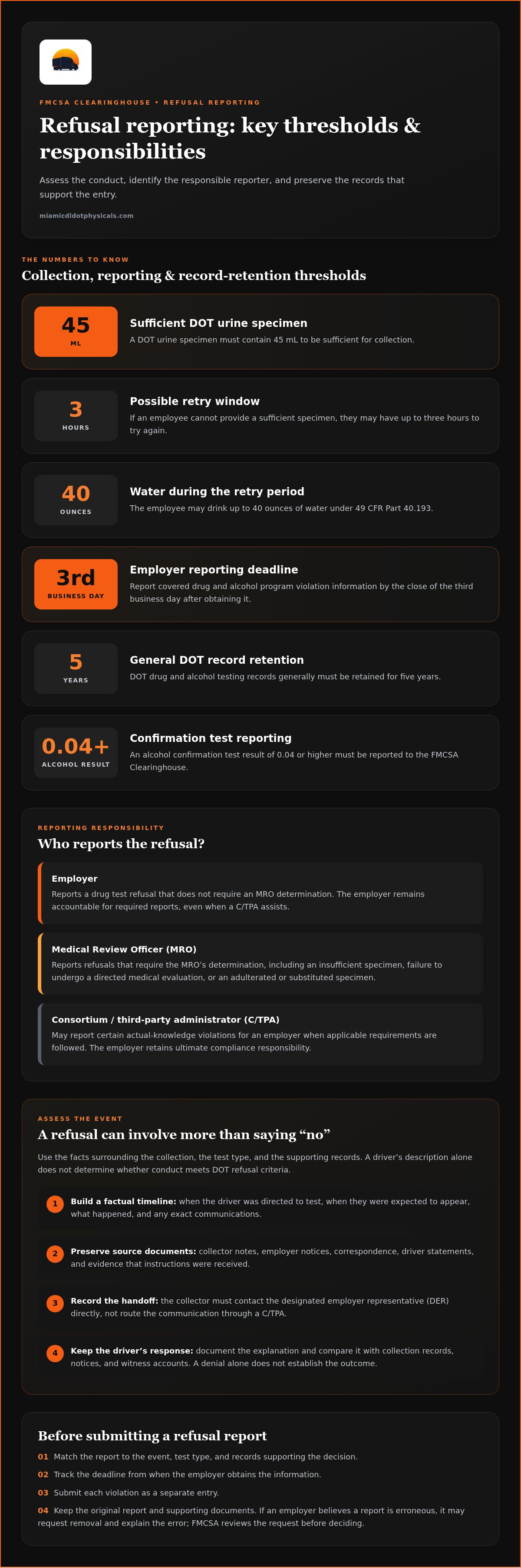
A test refusal isn’t limited to a driver saying “no.” To decide how to report a refusal to test in the Clearinghouse, first determine whether the conduct meets DOT refusal criteria and whether the employer or medical review officer (MRO) is responsible for reporting it. Employers must report covered violation information by the close of the third business day after obtaining it, according to the Federal Motor Carrier Safety Administration (FMCSA).
That distinction matters because some refusals require an MRO determination, while employers report others. Confusing who must report or what qualifies as a refusal can leave a required Clearinghouse entry incomplete.
This guide covers examples of drug and alcohol test refusals, how reporting duties are divided, and how employers report a refusal in the FMCSA Clearinghouse. It also explains what information and records to prepare for an accurate report.
Key Takeaways
- Assess what happened before classifying an event as a refusal; the decision can depend on the conduct and the type of test.
- Identify whether the employer or medical review officer is responsible for reporting, and keep supporting records organized.
- Employers must report covered violation information by the close of the third business day after obtaining it, according to the Federal Motor Carrier Safety Administration.
- Employers must report an alcohol confirmation test result of 0.04 or higher to the FMCSA Clearinghouse, according to the U.S. Department of Transportation.
- Prepare the required driver and test details before entering a refusal report, and submit each violation as a separate entry.
Employer and testing personnel responsibilities
Assign reporting duties before a testing issue arises. Employers remain accountable for required Clearinghouse reports, even when a consortium/third-party administrator (C/TPA) assists.
- Determine who must report. Under 49 CFR § 40.191, an employer is responsible for reporting a drug test refusal that does not require an MRO determination to the FMCSA Clearinghouse, according to the U.S. Department of Transportation. An MRO reports refusals that require the MRO’s determination. A C/TPA may report certain actual-knowledge violations for an employer when it follows applicable requirements, but the employer retains ultimate compliance responsibility.
- Keep the collection process clear. A DOT urine specimen must contain 45 mL to be sufficient for collection, according to the U.S. Department of Transportation. If an employee cannot provide a sufficient specimen, the employee may have up to three hours to try again and may drink up to 40 ounces of water under 49 CFR Part 40.193, according to the U.S. Department of Transportation. Record the collection details accurately before deciding whether the event qualifies as a refusal.
- Coordinate testing personnel with the employer. For a test refusal, the collector must contact the designated employer representative (DER) directly, not route the communication through a C/TPA. The DER should preserve the collector’s notice and relevant test records, then ensure the responsible reporting party receives the details. This direct handoff helps distinguish a refusal from an incomplete or delayed collection.
- Track the reporting deadline. Employers must report drug and alcohol program violation information by the close of the third business day after obtaining it, according to the Federal Motor Carrier Safety Administration. Start tracking from the date the employer obtains the information, and document who is preparing the entry. If a C/TPA submits the report, the employer should still monitor completion and retain supporting records.
- Use the correct path for MRO reports and errors. How does a medical review officer report a refusal to test to the Clearinghouse? The MRO reports refusals requiring an MRO determination through the Clearinghouse. These include refusals involving an insufficient specimen, failure to undergo a directed medical evaluation, or an adulterated or substituted specimen. How can an employer correct or remove an erroneous refusal-to-test report from the Clearinghouse? The employer may request removal and explain the error. FMCSA reviews the request before deciding whether to remove the violation. Keep the original report and evidence supporting the correction request.
What Counts as a DOT Drug or Alcohol Test Refusal?
Use the facts surrounding the collection, not just the driver’s description, to assess a potential refusal. Under 49 CFR 382.107, a refusal can include conduct beyond an explicit “no.” The employer’s report should match the event, the test type, and the records supporting the decision.
- Write a factual timeline. Record when the driver was directed to test, when they were expected to appear, and what happened at the collection site. Include the names or roles of those involved, the test type, and the exact communications. If the driver left before completing a required step, note when they left and what the collector or DER did next. Distinguish direct observations from information reported by someone else.
- Preserve source documents. Keep the collector’s notes, employer notices, correspondence, and driver statements with the event timeline. For a failure to appear, record when the driver was notified, the address and time they were directed to attend, and evidence that they received the notification. These details help establish what the driver was asked to do and whether the instruction was clear.
- Notify the DER and capture the handoff. For a test refusal, the collector must contact the designated employer representative (DER) directly, rather than route the communication through a C/TPA. Record when the DER received the call, what the collector reported, and any follow-up instructions. The employer can then preserve the documents and assess the event under the applicable drug and alcohol testing rules.
- Keep the driver’s response in the file. What should an employer do if a driver disputes or denies a refusal to test? Record the driver’s explanation and compare it with the collection records, notices, and witness accounts. Submit accurate information rather than treating a denial as proof either way. Drivers may petition to correct record accuracy under 49 CFR § 382.717, but that petition cannot challenge the accuracy or validity of a test refusal.
- Retain the complete record. DOT drug and alcohol testing records generally must be retained for five years. Keep the report, supporting documents, and any correction correspondence organized so the employer can explain the basis for its entry. Clear DOT drug testing records also help connect the reported event to the collection process without relying on memory.
When an employer or C/TPA reports a refusal to test to the FMCSA Drug and Alcohol Clearinghouse, the submission must include specific supporting documentation under §§ 382.705(b)(3) and (4). The report should connect the stated refusal basis to records showing what instruction was given and what occurred, so the supporting material can be reviewed alongside the entry. For a failure-to-appear refusal, provide the notification time, the directed-to-appear address and time, and documentation that the driver was notified. Keep those items together with the event record, rather than relying on a general summary.
If an employee is determined to have refused a test because they could not provide a sufficient specimen within the allotted time, they may seek a medical evaluation to document a physiological condition that prevents specimen collection. Preserve and consider any such evaluation alongside the collection documentation when maintaining the record.
Examples of conduct that may constitute a refusal
Assess each event against the test procedure and the driver’s actions. Under 49 CFR Part 40.191, a DOT drug test refusal can involve conduct beyond an express statement of “no.” Use these steps to identify the facts that may support a refusal determination.
- Document an explicit refusal. If a driver directly declines a required drug or alcohol test, record the words they used and the time of the exchange. Note who gave the instruction, who heard the response, and whether the driver was told which test to take. Keep the collector’s account and the DER’s follow-up together. A precise record shows what the driver refused, rather than relying on a general note that they were uncooperative.
- Review a failure to appear. A driver who does not arrive for a directed test may meet refusal criteria, but the report should support that finding. Preserve the notification time, collection address and appointment time, and evidence that the driver received the instruction. For example, retain the employer’s notice and any response from the driver. These records help distinguish a missed test from an instruction the driver never received.
- Separate an incomplete collection from a refusal. An employee who initially cannot provide enough urine has not necessarily refused. Follow the applicable shy-bladder procedure and document whether the employee cooperated with each required step. The determination depends on what happened during collection and whether the employee completed the procedure. Record the collector’s observations and instructions instead of labeling the first unsuccessful attempt a refusal.
- Route MRO determinations correctly. A refusal may involve failing to provide a sufficient specimen, failing to undergo a directed medical examination or evaluation, or providing an adulterated or substituted urine specimen. These situations require an MRO determination and report. Preserve the MRO’s decision and related collection documents so the employer and any consortium or C/TPA can identify the responsible reporting party.
- Match the report to the evidence. Compare the driver’s account with notices, collector records, and the sequence of events before submitting a violation. Refusing a required test has the same consequences as failing a test under 49 CFR 382.211, so an unsupported assumption can have serious effects. Employers must report required information by the close of the third business day after obtaining it. Use that time to confirm the event facts and keep the supporting documents with the report.
FMCSA Clearinghouse reporting for CDL drivers
For CDL drivers, use the FMCSA Drug and Alcohol Clearinghouse to report covered violations and document the right driver record. Under 49 CFR 382.705, employers and medical review officers must report violations of FMCSA’s Drug and Alcohol Testing Policy, including test refusals, to the FMCSA CDL Drug and Alcohol Clearinghouse, according to the Federal Motor Carrier Safety Administration.
- Confirm the reportable event. Identify whether the event is a refusal, a positive drug test, an alcohol result, or another covered violation. Employers must report an alcohol confirmation test result with a concentration of 0.04% or higher to the FMCSA Clearinghouse, according to the U.S. Department of Transportation. Match the entry to the test and driver records before submitting it.
- Use the correct reporting role. Employers report refusals that do not require an MRO determination; MROs report refusals that do. When an MRO reports a positive drug test or refusal, the MRO must enter and verify the driver’s CDL number, state, and country of issuance. The MRO cannot identify the driver by Social Security number.
- Prepare the required details. For a refusal report, enter the reason for the test, refusal type, and test date, except when the refusal is based on failure to appear. For that event, retain the notification time, the address and time the driver was directed to appear, and proof of notification. Include relevant supporting evidence and select a category for each uploaded document.
- Keep violations separate. Submit each violation as its own Clearinghouse entry. For an actual-knowledge report, supporting evidence may include affidavits, photographs, recordings, employee statements, correspondence, or other documentation. Each uploaded file may not exceed 50MB. A clear file description is optional, but the document category is required.
- Understand the driver impact and costs. A reported refusal requires the employer to remove the driver immediately from safety-sensitive functions under 49 CFR Part 40.305. The refusal carries consequences equivalent to a failed test under 49 CFR 382.211, and the information generally remains available to employers until the requirements in 49 CFR 382.719 are met. Reporting and checking are separate Clearinghouse actions; any charge for consortium or C/TPA support depends on the service arrangement.
- Set up owner-operator responsibility. An owner-operator must designate a C/TPA in the FMCSA Clearinghouse, and that C/TPA is responsible for reporting the owner-operator’s drug or alcohol program violations. The C/TPA must accept the designation before accessing the employer’s account. The employer remains responsible for compliance when it designates a C/TPA.
How do employers report a refusal to test in the FMCSA Clearinghouse step by step?
Follow a documented process for every report. Employers must report required drug and alcohol program violation information by the close of the third business day after obtaining it, according to the Federal Motor Carrier Safety Administration. If you’re learning how to report a refusal to test in Clearinghouse, start promptly so you have time to review the event details and supporting evidence.
- Confirm the reporting party. Determine whether the employer or medical review officer (MRO) must report the refusal. Employers report refusals that don’t require an MRO determination. The MRO reports refusals that do. If a consortium/third-party administrator (C/TPA) handles the employer’s reporting, confirm that it has accepted the employer’s Clearinghouse designation.
- Gather the driver and test details. Collect the driver’s identifying information and test record before starting the entry. For a refusal, employers must enter the reason for the test, refusal type, and test date, except when the refusal is based on failure to appear. Check these fields against the collection documents before submitting.
- Prepare failure-to-appear evidence when relevant. Record when the driver was notified, the address and time they were directed to appear, and evidence that the notification reached them. Keep the test instruction and related correspondence together. These records support the reason entered in the report.
- Open a separate violation entry. Sign in to the FMCSA Clearinghouse using the employer’s account, then follow the employer reporting process for a drug and alcohol program violation. Submit each violation as a separate entry. Keeping events separate helps ensure each driver record is accurate. This is essential to reporting a refusal to test in Clearinghouse correctly.
- Attach and categorize supporting files. Upload documents that support the reported facts, such as collection records, driver statements, or correspondence. Select a category for every uploaded document; a file description is optional. Each evidence file may not exceed 50MB. Review the selected category and file before continuing.
- Review, submit, and retain the record. Check the driver, test date, refusal type, and attached evidence against the source documents. Submit the violation, then save the confirmation and report materials with the employer’s records. If a required report is late, employers must provide an explanation. Track completion even when a C/TPA submits the report.
For practical support with employer reporting responsibilities, get FMCSA Clearinghouse Consortium support.
Miami CDL/DOT Physical Exam Center: DOT Physical Exam
Miami CDL/DOT Physical Exam Center provides DOT Physical Exams for commercial drivers who need a DOT medical examination. Owner-operators and fleet managers can use its FMCSA Clearinghouse Consortium for support with federal compliance responsibilities. These services address distinct needs: a physical exam concerns the driver’s medical qualification, while consortium support relates to Clearinghouse program administration. Keep both separate from deciding whether an event meets DOT refusal criteria or submitting an employer’s violation report. The steps in this article can help clarify that responsibility. For a DOT Physical Exam or information about the FMCSA Clearinghouse Consortium, contact Miami CDL/DOT Physical Exam Center.
Set Up Your Next Compliance Step
A clear internal process helps your team handle future testing events consistently. Decide who receives collection-site notifications, who reviews the records, and who completes each required Clearinghouse entry. An FMCSA Clearinghouse Consortium can support compliance administration for owner-operators and fleets. Keep testing needs distinct: Miami CDL/DOT Physical Exam Center offers DOT Physical Exams, DOT Drug Tests, and Non-DOT Drug Tests.
If you’re responsible for a driver’s record, use the reporting steps in this guide to shape your workflow for how to report a refusal to test in the Clearinghouse. For help with relevant testing or consortium needs, contact Miami CDL/DOT Physical Exam Center. A defined process gives your team a practical starting point for handling its responsibilities with care.
Frequently Asked Questions
What counts as a refusal to test under FMCSA drug and alcohol testing regulations?
A refusal can involve more than a driver expressly declining a test. Under 49 CFR 382.107, conduct such as failing to appear when directed, not cooperating with required collection procedures, or providing an adulterated or substituted specimen may qualify. The circumstances matter: document what the driver was instructed to do, what happened, and whether an MRO determination is required before deciding how to classify the event.
Who is responsible for reporting a refusal to test to the FMCSA Clearinghouse?
The employer reports a drug refusal that does not require an MRO determination; the MRO reports a refusal that does. An employer may designate a C/TPA to report on its behalf when applicable requirements are followed, but the employer remains ultimately responsible for compliance. For an owner-operator, the designated C/TPA handles program violation reporting. Keep the reporting role clear when assigning duties for a particular driver or test.
How soon must an employer report a refusal to test to the Clearinghouse?
Employers must report required violation information by the close of the third business day after obtaining it, according to the Federal Motor Carrier Safety Administration. Start tracking the deadline when the employer receives information establishing the violation, and record who received it and when. If the report is late, the employer must provide an explanation. A calendar reminder tied to the receipt date can help the responsible staff member track submission.
What information and documents are needed to report a refusal to test?
Prepare the driver’s identifying details, test date, reason for the test, and refusal type. For a failure to appear, retain the notification time, the address and time the driver was directed to appear, and evidence that they received notice. Other supporting records may include collector documentation, statements, correspondence, or an MRO determination. In the Clearinghouse, each uploaded document needs a category; a description is optional. Check the entry against the records before submitting.


