

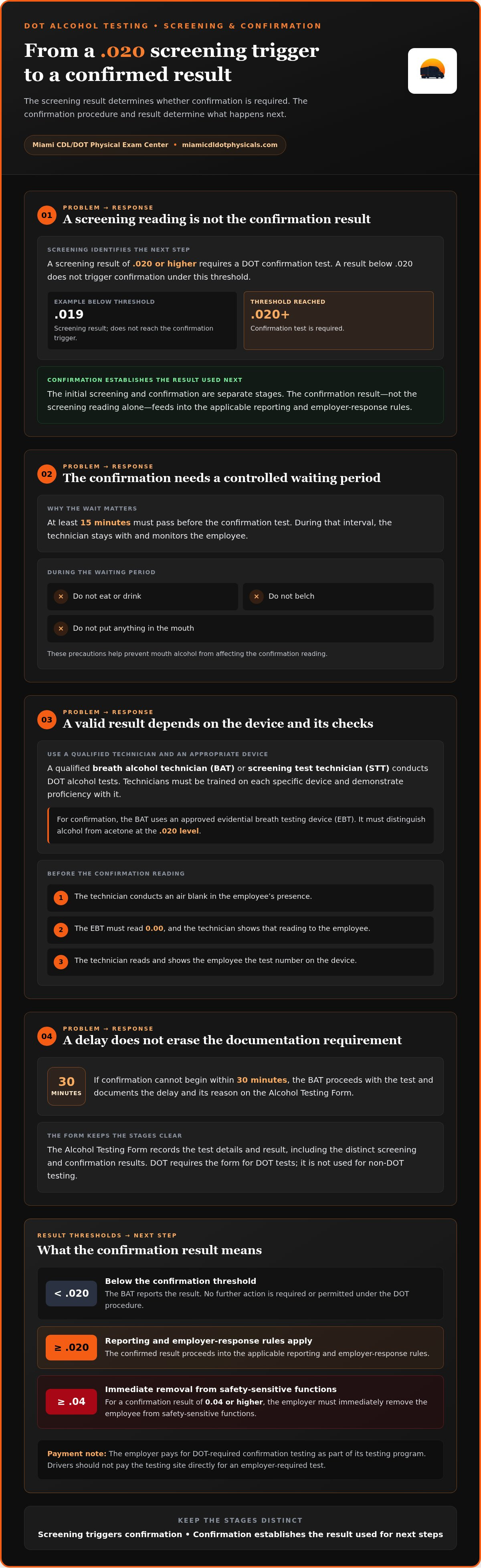
A screening result of .020 or greater triggers a confirmation test, which a qualified breath alcohol technician or screening test technician conducts. The DOT alcohol testing confirmation process includes a wait of at least 15 minutes before confirmation, according to the U.S. Department of Transportation. That confirmation test helps establish the result used to determine what happens next.
It’s understandable to want a clear explanation when a test can affect safety-sensitive work. Screening and confirmation serve different purposes, and the steps between them matter, including how the Alcohol Testing Form is completed.
This guide explains who may conduct DOT alcohol tests, how screening differs from confirmation, and how the confirmation procedure and form work. It also covers how result thresholds affect safety-sensitive duties, so you can understand the process and what happens next.
Key Takeaways
- DOT alcohol tests are conducted by qualified breath alcohol technicians or screening test technicians using approved testing devices.
- A screening result of .020 or higher requires a confirmation test, with at least 15 minutes between screening and confirmation.
- The Alcohol Testing Form records the test details and result; if confirmation cannot begin within 30 minutes, the BAT proceeds and documents the delay and its reason.
- For a confirmation result of 0.04 or higher, the employer must immediately remove the employee from safety-sensitive functions.
- Understanding the result thresholds and next steps helps drivers and employers respond appropriately to a test outcome.
§ 40.211 | Who conducts DOT alcohol tests?
Qualified technicians conduct DOT alcohol tests. A breath alcohol technician (BAT) or screening test technician (STT) performs DOT breath screening and confirmation tests. Technicians must be trained on each specific device and demonstrate proficiency in its operation. A generic training certificate alone does not establish proficiency with every breath-testing device. The technician follows the required procedure, records the result, and ensures the equipment is ready for testing.
For a confirmation test, the waiting period is a required part of the procedure. According to the U.S. Department of Transportation, a DOT alcohol confirmation test must wait at least 15 minutes before it is conducted. During that interval, the technician stays with and monitors the employee. The employee must not eat, drink, belch, or put anything in their mouth. These steps help prevent mouth alcohol from affecting the confirmation reading. The technician then uses an approved evidential breath testing device (EBT) to obtain and document the result.
DOT alcohol tests use devices approved for the specific testing purpose. Breath and saliva devices may be used for screening when approved by the National Highway Traffic Safety Administration (NHTSA). For DOT testing, the device must also appear on the Office of Drug and Alcohol Policy and Compliance (ODAPC) list of approved devices. A device’s general market availability does not make it acceptable for a DOT test. The technician uses a device appropriate to the testing stage.
Confirmation devices have additional performance requirements. A DOT confirmation EBT must distinguish alcohol from acetone at the 0.020 level. Before confirmation, the technician conducts an air blank in the employee’s presence. The EBT must read 0.00, and the technician shows that reading to the employee. The technician also reads and shows the employee the test number on the device. These checks document that the instrument is ready and identify the test record connected to the result.
Device maintenance supports accurate testing. EBT accuracy checks must follow the manufacturer’s quality assurance plan, usually once every 30 days. Technicians keep calibration and calibration-check logs to document device maintenance. Only people trained and authorized to perform EBT calibrations should do that work. These records help show whether the device was maintained and checked properly when an alcohol test took place.
The employer pays for DOT-required confirmation testing as part of its testing program. Drivers should not pay the testing site directly for an employer-required test.
Screening versus confirmation: what changes?
DOT alcohol testing uses screening to identify results that need a more precise confirmation test. Under 49 CFR Part 40, the procedures cover both stages; sections 40.231 and 40.253 address confirmation devices and procedures.
When Screening Results Require Confirmation
A screening test result of .020 or greater requires a DOT confirmation test. A lower screening result does not trigger confirmation under this threshold. This distinction matters because the screening result identifies whether the testing process continues, while confirmation establishes the result used for the next steps.
For example, a result of .019 remains a screening result, while .020 crosses the confirmation threshold. The technician records the screening result and conducts confirmation when required. The two readings are separate stages, not interchangeable entries: the initial screening alone does not replace a required confirmation result. This threshold rule applies to DOT-regulated alcohol testing, not automatically to non-DOT workplace programs.
Keeping the stages distinct helps employees and employers understand why a second test occurs. It also prevents a screening result from being treated as the final confirmation result before the required procedure is complete.
Screening Results and the Threshold
The .020 threshold determines when the screening result moves into confirmation. If the screening result is .020 or higher, the BAT conducts a confirmation test using an evidential breath testing device (EBT). The confirmation device must distinguish alcohol from acetone at the .020 level, supporting a more specific measurement.
A confirmation result below .020 is reported by the BAT, and no further action is required or permitted under the DOT procedure. A result at or above that threshold proceeds into the reporting and employer-response rules. The screening and confirmation results therefore serve different functions: one determines whether confirmation is needed, while the other supplies the confirmed test result.
This difference can matter even when the readings appear close. For instance, an initial result at .020 requires confirmation; the confirmation result then controls the applicable response. The Alcohol Testing Form documents the results of the DOT test so the screening and confirmation stages remain identifiable.
Confirmation Testing Procedures
DOT confirmation testing is the regulated second stage used to verify a screening result at or above .020. 49 CFR Part 40 sets the procedures for DOT drug and alcohol testing, including screening and confirmation. Section 40.231 addresses devices used for confirmation, while section 40.253 covers how the confirmation test is conducted.
The EBT provides a confirmation measurement rather than another screening result. Its ability to distinguish alcohol from acetone at .020 supports the required measurement, and the BAT reports the confirmation result on the Alcohol Testing Form. DOT regulations require that form for DOT tests and prohibit using it for non-DOT testing. That distinction helps keep DOT records separate from an employer’s non-DOT program.
For drivers and employers, the practical point is to follow the correct sequence and record each stage accurately. A screening result that reaches the threshold leads to confirmation; the confirmation result then determines what reporting or work restrictions apply. For related DOT compliance information, explore DOT testing and compliance services.
Explaining the test and completing the Alcohol Testing Form
The confirmation test follows a defined sequence, and the Alcohol Testing Form records the result. Proper timing, required device checks, and accurate entries document how the test was conducted.
Timing and the Monitored Wait
The monitored wait separates an alcohol screening test from confirmation and protects the reliability of the second reading. The technician stays with the employee for at least 15 minutes and instructs them not to eat, drink, belch, or put anything in their mouth. This gives the employee a clear period to follow the instructions before the evidential breath test.
U.S. Department of Transportation rules require the BAT to proceed with confirmation if testing cannot begin within 30 minutes, documenting the elapsed time and reason for delay. The delay does not mean the BAT skips confirmation. The technician records what happened so the timing is clear in the test record.
Privacy and Process Explanations
A clear explanation lets the employee understand each step without confusing screening with confirmation. The BAT can identify the evidential breath testing device, explain the required wait, and show the employee the device’s test number. Before confirmation, the technician conducts an air blank in the employee’s presence, verifies a 0.00 reading, and shows that reading to the employee, according to the U.S. Department of Transportation.
The employee also sees the confirmation result process documented on the Alcohol Testing Form. A printed confirmation result must be attached to the form with tamper-evident tape. These steps create a traceable record while showing the employee which result belongs to the confirmation test.
The form is specific to DOT testing. DOT regulations require the Alcohol Testing Form for DOT tests and prohibit using it for non-DOT testing. It records key details from the test, including the result and required signatures. Refusing to sign Step 2 is a refusal to test. By contrast, refusing to sign Step 4 after confirmation is not a refusal to test.
A technician should accurately document what happened rather than treat an incomplete breath sample as a completed test result. If you cannot provide sufficient breath, tell the BAT what is happening and follow the technician’s directions. A refusal and an inability to provide a sample are not interchangeable, so the documentation must reflect the actual event.
Timing also affects whether a confirmation test remains valid. A confirmation conducted before the full 15-minute waiting period is a fatal flaw that cancels the test. If the confirmation begins late, the BAT still proceeds and documents the delay, rather than silently changing the recorded timeline. Accurate entries make the Alcohol Testing Form a useful record of what actually occurred.
§ 40.241 | What are the first steps in any alcohol screening test?
A confirmed alcohol result shifts the process from testing to employer action. The employer’s response depends on the confirmation result and the employee’s safety-sensitive duties.
After a positive confirmation result, the employer receives the result through the Designated Employer Representative (DER). A result of 0.02 or greater should be reported to the DER immediately. The DER is the employer’s point of contact for receiving and acting on test information. Keeping transmission direct helps protect the employee’s privacy and ensures the person responsible can respond promptly.
Under 49 CFR 40.23, an employer receiving a DOT alcohol confirmation result of 0.04 or higher must immediately remove the employee from safety-sensitive functions, according to the U.S. Department of Transportation. This means the employee cannot continue covered duties after the employer receives that result. The employer should document the result, the notification, and the work restriction in the appropriate records.
For an FMCSA driver with a confirmation result from 0.02 through 0.039, at least 24 hours must elapse before the driver can perform safety-sensitive functions, according to the Federal Motor Carrier Safety Administration. This restriction is distinct from the immediate removal required at 0.04 or higher. The employer should communicate the applicable limit clearly, record when the restriction begins, and ensure the driver does not resume covered work too soon.
Results should be sent to the DER through a confidential channel, not shared broadly with coworkers or unrelated staff. Employers should limit access to people who need the information for their responsibilities. A clear record identifies the confirmation result, when the DER received it, and the action taken. This helps distinguish a screening result from the confirmed result that guides the employer’s response.
DOT Part 40 section 40.255 addresses what happens after an alcohol confirmation test result. In practice, the employer must apply the correct response to the result range, notify the relevant employee, and document the decision. A screening test alone does not replace the confirmation result when confirmation is required. The employer’s next step should follow the confirmed result, not an assumption based on an earlier screening reading.
For a result at or above 0.04, immediate removal from safety-sensitive functions is required. For an FMCSA driver at 0.02 through 0.039, the 24-hour waiting period applies. These thresholds help employers perform the correct action while preserving a clear record of the result and the employee’s work status.
What happens if a DOT confirmation test result is 0.02 or higher
A confirmation result of 0.02 or higher can restrict safety-sensitive work and trigger further employer action. The result range matters: FMCSA drivers with results from 0.02 through 0.039 face a waiting period, while a result of 0.04 or higher requires immediate removal from safety-sensitive functions.
For an FMCSA driver with a confirmation result from 0.02 through 0.039, at least 24 hours must elapse before the driver can perform safety-sensitive functions, according to the Federal Motor Carrier Safety Administration. The waiting period applies even when the result is below 0.04. The employer should communicate the restriction clearly and keep the driver off covered duties until the required time has passed.
Under 49 CFR 40.23, an employer receiving a DOT alcohol confirmation result of 0.04 or higher must immediately remove the employee from safety-sensitive functions, according to the U.S. Department of Transportation. The employer must act on receipt of the result, rather than wait for the employee’s next shift. The restriction applies to safety-sensitive work, not necessarily every task the employee might perform.
A result that violates DOT alcohol rules also leads into the return-to-duty process. A Substance Abuse Professional (SAP) evaluates the employee and recommends education, treatment, follow-up testing, and aftercare. The employee must complete the SAP’s recommendations before returning to safety-sensitive duties. After a positive breath alcohol test, the return-to-duty alcohol test must show a result below 0.02% BAC before the employee resumes that work.
Follow-up testing continues after the return-to-duty step. DOT follow-up testing requires at least six unannounced tests during the first 12 months of safety-sensitive duty. For DOT-covered employees who test positive for alcohol at 0.04% BAC or higher, follow-up testing may be extended for up to 60 months. The SAP determines the follow-up plan based on the employee’s evaluation and recommendations.
Employers should keep the test result, notification, work restriction, and return-to-duty status clearly documented. If a driver with a result of 0.02 or greater needs transportation, University of Iowa DOT alcohol-testing procedures call for transportation from the collection site and home, provided by the employer. This practical step helps prevent the employee from driving after testing.
Owner-operators and fleet employers also need to manage federal compliance responsibilities alongside the testing response. The FMCSA Clearinghouse Consortium can support those compliance needs; explore the FMCSA Clearinghouse Consortium for assistance with federal compliance requirements.
Miami CDL/DOT Physical Exam Center: DOT Physical Exam
Miami CDL/DOT Physical Exam Center provides DOT Physical Exams for commercial drivers managing their medical qualification requirements. After reviewing alcohol-test thresholds and work restrictions, a DOT physical exam may be a relevant next step when you need a medical examination for your commercial driving role. It is separate from alcohol confirmation testing and does not replace an employer’s testing or return-to-duty process.
Owner-operators and fleet companies managing federal compliance responsibilities can use the FMCSA Clearinghouse Consortium. Choose the service that fits your need: a medical examination addresses DOT physical qualification, while the consortium supports Clearinghouse compliance. Understanding the difference helps you choose a practical next step without confusing medical qualification with an alcohol-test result.
Contact Miami CDL/DOT Physical Exam Center or visit miamicdldotphysicals.com to learn more.
Take Your Next Compliance Step With Confidence
Clear information can help you approach workplace testing and medical requirements with greater confidence. Keep your employer’s instructions separate from your own next steps: a testing result and a medical qualification need may require different actions. Understanding the DOT alcohol testing confirmation process can help you focus your conversation on what comes next.
For commercial drivers, Miami CDL/DOT Physical Exam Center offers DOT Physical Exams and DOT Drug Tests. Non-DOT Drug Tests are available for needs outside DOT requirements. Choose the service that matches your situation, whether you need a medical exam or drug testing.
Use the next step that fits your needs, and keep your compliance tasks organized. Contact Miami CDL/DOT Physical Exam Center to learn more about its services. A clear plan can make the path forward feel more manageable.
Frequently Asked Questions
§ 40.261 | What is a refusal to take an alcohol test, and what are the consequences?
A refusal includes refusing to sign Step 2 of the Alcohol Testing Form; refusing to sign Step 4 after confirmation is not a refusal to test. The employer should document what occurred and treat the event according to DOT procedures. A driver who violates DOT alcohol regulations may need evaluation by a Substance Abuse Professional, who recommends education, treatment, follow-up testing, and aftercare.
§ 40.221 | Where does an alcohol test take place?
A DOT alcohol test takes place at a designated testing location, such as a collection site. The test may involve separate screening and confirmation locations. For a two-site test, travel time counts toward the 15-minute confirmation waiting period if the screening technician gave the employee the wait instructions. The employee should follow those instructions during travel and at the confirmation site.
§ 40.247 | What procedures does the BAT or STT follow after a screening test result?
After a negative breath screening result, the result is available instantly, and the technician records and reports it. If screening shows .020 or higher, the BAT moves to confirmation rather than treating the screening reading as final. The technician follows the confirmation procedure, completes the Alcohol Testing Form, and reports the confirmed result through the required employer process. This distinction keeps each test stage clear in the record.
What is the DOT alcohol testing confirmation process?
The DOT alcohol testing confirmation process uses an evidential breath testing device to verify a screening result that reaches the confirmation threshold. The BAT conducts the required checks, observes the waiting period, performs the confirmation test, and documents the result on the Alcohol Testing Form. The initial screening result and the later confirmation result are recorded separately, and the confirmed reading guides the employer’s response.
What alcohol concentration requires a DOT confirmation test?
A screening result of .020 or higher requires a DOT confirmation test. A screening reading below .020 does not trigger confirmation under this threshold. For example, .019 is below the confirmation trigger, while .020 reaches it. The confirmation result is then reported separately from the screening result, so the employer can distinguish the initial screening reading from the result used for subsequent action.
How long must an employee wait between DOT alcohol screening and confirmation testing?
The employee must wait at least 15 minutes before the confirmation test. The BAT monitors the employee during this period and instructs them not to eat, drink, belch, or put anything in their mouth. Confirmation should begin within 30 minutes after screening. If it cannot begin within that window, the BAT still proceeds and documents the elapsed time and reason for delay.
What devices are approved for DOT alcohol confirmation testing?
DOT confirmation testing uses an evidential breath testing device (EBT) listed among the devices permitted for DOT testing. The device must be able to distinguish alcohol from acetone at the 0.020 level. A screening device is not a substitute for an approved confirmation EBT. Before testing, the technician conducts the required air blank and confirms that the instrument displays 0.00.
Who is qualified to conduct a DOT alcohol confirmation test?
A qualified breath alcohol technician (BAT) conducts a DOT breath confirmation test. Depending on the test stage and permitted role, a BAT or screening test technician (STT) may perform DOT breath screening and confirmation. Technicians need training on the specific devices they use, including proficiency demonstrations. Refresher training is required every five years to help maintain familiarity with the equipment and procedures.


