

A medication name alone rarely decides whether you can keep driving commercially. That’s why searching for a “DOT physical disqualifying medications list” can cause more alarm than clarity: some substances are restricted, while many prescribed medications call for an individualized safety review.
It’s understandable to worry that discussing treatment could put your certification at risk. But relying on conflicting online lists or leaving a medication off your paperwork can create bigger problems. The medical examiner considers your health condition, the medication’s effects, and the information available about your treatment. Documentation from your prescribing clinician may help, but it doesn’t guarantee certification.
This 2026 guide explains the difference between prohibited substances and medications that may need closer review, what FMCSA rules say, and how the examiner makes an individual decision. You’ll also learn how to prepare an accurate medication list and what to ask your treating clinician and medical examiner before your DOT physical.
Key Takeaways
- The DOT physical disqualifying medications list isn’t a simple pass-or-fail checklist. The medical examiner considers your health, treatment, and fitness to drive safely.
- Some medicines may prompt closer review because of their potential effects on alertness or safe vehicle operation, but a medication name alone doesn’t determine the outcome.
- Distinguish substances restricted under applicable rules from medications that call for an individualized review.
- Prepare an accurate list of prescription and nonprescription products, along with relevant treatment details, before your examination.
- If the examiner needs more information, be ready to clarify your treatment. Certification decisions depend on the individual review.
DOT physical disqualifying medications: why there is no simple universal list
A medication’s name alone doesn’t determine whether you qualify for a DOT medical certificate. The same drug may raise different concerns depending on the condition it treats, its effects on you, whether your dosage is stable, and whether it could interfere with safe driving. That’s why a DOT physical disqualifying medications list can’t replace an examination tailored to your health and treatment.
A certified medical examiner (CME) evaluates whether you meet the applicable physical qualification standards for commercial driving. The Federal Motor Carrier Safety Administration (FMCSA) establishes federal safety regulations, including medical standards. During the examination, the CME considers relevant rules and information about your health and medication use. Online lists may help you identify questions to ask, but they can’t determine your qualification as an individual driver.
What does “disqualifying medication” mean under FMCSA rules?
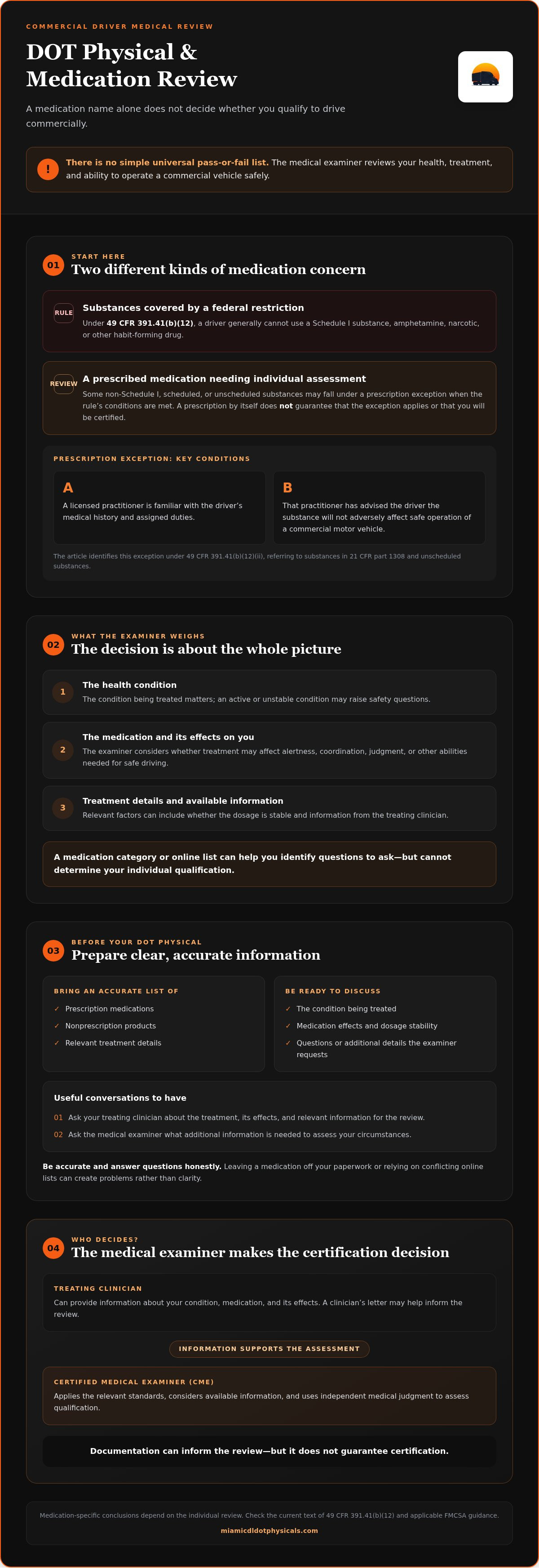
Under 49 CFR 391.41(b)(12), a driver generally cannot use a Schedule I substance, amphetamine, narcotic, or other habit-forming drug. The regulation includes an exception for certain prescribed medications when a licensed practitioner familiar with the driver’s medical history advises that the medication won’t adversely affect safe operation of a commercial motor vehicle. Having a prescription alone doesn’t establish that the exception applies or guarantee certification.
An individualized medication review considers the applicable substance rule and whether the driver’s condition and treatment are compatible with safe commercial driving. The substance restriction is one part of the broader medical qualification assessment, not a complete list of every medication that could raise a safety concern. Check the current text of 49 CFR 391.41(b)(12) and applicable FMCSA guidance before relying on a medication-specific conclusion.
Who makes the final certification decision?
The CME conducting your DOT physical assesses your qualifications and makes the certification decision. Your prescribing clinician can provide useful details about the condition being treated, the medication, and its effects, but doesn’t issue the DOT medical certificate. The examiner may consider that information while applying federal standards and exercising independent medical judgment.
A clinician’s letter can inform the review, but it doesn’t require the examiner to certify you. Likewise, attending an examination doesn’t guarantee a particular outcome. Bring accurate information and answer questions honestly so the examiner can assess your circumstances rather than rely on a medication name or general online list.
Medication types that may need closer review during a DOT physical
Medication review is about more than spotting a drug name. The examiner needs to understand whether a treatment may affect alertness, coordination, judgment, or other abilities needed for safe driving. The condition being treated matters too. An active or unstable condition may raise safety questions even if the medication itself causes few noticeable effects.
The FMCSA’s guidance on disqualifying medications explains that certain substances are restricted, while a prescription exception may apply to some drugs. Under 49 CFR 391.41(b)(12)(ii), “A driver may use a non-Schedule I drug or substance that is identified in the other Schedules in 21 CFR part 1308 or an unscheduled drug or substance, if the substance or drug is prescribed by a licensed medical practitioner who: (A) Is familiar with the driver's medical history and assigned duties; and (B) has advised the driver that the prescribed substance or drug will not adversely affect the driver's ability to safely operate a commercial motor vehicle.” Check the current wording and official guidance before relying on them for an individual decision.
Controlled substances and prescription exceptions
A prescription doesn’t automatically establish that a driver meets the exception or qualifies for certification. The prescribing practitioner’s familiarity with the driver’s health history and commercial driving duties, as well as their safety advice, may be relevant. The medical examiner still makes an independent certification decision under applicable standards.
Common medication groups that can raise safety questions
Use these categories as prompts for a careful review, not as an automatic disqualification list. A drug’s effects can vary by person, dose, timing, and whether treatment is stable.
- Opioids and sedatives: Ask whether the treatment could cause drowsiness, slowed reactions, or impaired coordination.
- Sleep medicines: The examiner may consider lingering effects after waking and whether your alertness is affected during driving hours.
- Stimulants: The medication’s classification, prescribed use, effects, and the condition being treated may all be relevant.
- Seizure medicines: Review may involve both possible medication effects and whether the underlying condition is controlled.
- Other medicines that affect alertness: Include treatments that cause dizziness, fatigue, blurred vision, or difficulty concentrating in your discussion with the examiner.
Don’t stop, skip, or change prescribed treatment based on a general online list. Record the medication, dose, schedule, and any effects you experience, then ask your treating clinician what information may help the examiner assess safe driving. Check medication-specific eligibility questions against current FMCSA guidance and qualified medical review. You can learn more about a DOT physical examination.
Automatic prohibition or individual review? How to tell the difference
A prohibited-substance rule and a medical fitness review answer different questions. A substance rule asks whether a drug is allowed under the regulation; an individualized review asks whether the driver’s health and treatment support safe commercial driving. That distinction helps make sense of the DOT physical disqualifying medications list: a prescription doesn’t mean automatic approval, and medication use doesn’t mean automatic denial.
Under 49 CFR 391.41(b)(12), a driver may not use a Schedule I substance. The rule also addresses amphetamines, narcotics, and other habit-forming drugs, with a limited prescription exception for qualifying use. The FMCSA guidance on disqualifying medications describes the exception and the examiner’s role. Check the current regulation and official guidance before applying these rules to a specific medication or driver.
| Relevant rule | Prescription status | Potential safety concern | Next step |
|---|---|---|---|
| Schedule I substance restriction | A prescription or state authorization does not by itself remove the federal restriction. | The substance is restricted under the federal rule. | Check current DOT and FMCSA guidance. Have cannabis-related statements reviewed against current federal guidance. |
| Other controlled or habit-forming drug covered by the rule | A prescription exception may apply if the licensed practitioner meets the regulation’s conditions. It isn’t automatic approval. | Possible effects on alertness, coordination, judgment, or safe vehicle operation. | Ask the prescribing practitioner for relevant information about the treatment and its effects. The examiner makes the certification decision. |
| Other medication or treatment | Prescription status alone doesn’t decide medical fitness. | Side effects, the treated condition, or symptoms that may affect driving. | Provide accurate treatment details and discuss safety concerns with the examiner. |
When does the controlled-substance rule apply?
The rule’s wording matters. The prescription exception applies only to the drugs and substances covered by the regulation, and only when its requirements are met. State authorization alone doesn’t settle federal commercial-driving qualification. Cannabis rules and related guidance may change, so confirm current DOT and FMCSA information rather than relying on state law or a general online list.
Why can the same medication lead to different outcomes?
A stable treatment with no reported impairing effects may raise different questions from a recent dose change, significant drowsiness, impaired coordination, or unresolved symptoms. The examiner considers the diagnosis, treatment response, available documentation, and whether the overall facts support safe operation. Only the examiner can decide how those facts affect certification. Neither a medication name nor a prescriber’s note guarantees the result.
How to prepare your medication information before the DOT physical
Good preparation helps the medical examiner review your circumstances accurately. Don’t use a general DOT physical disqualifying medications list to decide what to disclose. Bring a complete, current account of your treatment, including prescription and nonprescription products, and answer the examiner’s questions honestly. Never stop, skip, or change medication to influence the examination. Discuss treatment decisions with your prescribing clinician.
What medication records should a driver bring?
Prepare a written medication list and gather relevant records you already have. Include enough detail for the examiner to understand what you take and how your treatment is going.
- List every product. Include prescription medicines, over-the-counter medicines, and other products you use.
- Record key details. Note each medication’s name, dose, schedule, prescribing clinician, and the condition or reason it treats.
- Describe treatment changes. Include recent starts, stops, dose adjustments, or other changes, and when they occurred.
- Note relevant effects. Record side effects or symptoms that could affect alertness, coordination, vision, or concentration, and when they happen.
- Bring supporting information. If available, bring relevant records or a note from your treating clinician that explains the treatment and its stability.
Keep your information organized and share it with the medical examiner as requested. Medical details are personal, so bring records relevant to the review and handle them securely.
Questions to ask your treating clinician before the exam
Your treating clinician can clarify your care, but the medical examiner makes the DOT certification decision. Before the examination, ask whether your condition or treatment could affect alertness, coordination, or safe driving, and whether the clinician can provide relevant details for the examiner. You can also ask which records may help explain recent treatment changes or side effects. Don’t ask for a predetermined certification outcome.
For broader preparation, review How to Pass Your DOT Physical in 2026 and a comprehensive guide to DOT physical and CDL medical compliance. Use these resources to prepare, not as substitutes for a driver-specific medical review.
Once your medication information is ready, you can schedule a DOT physical examination for an individualized review. Bring your list and relevant documentation. Certification depends on the examiner’s assessment.
What to expect when the medical examiner reviews your medications
The medical examiner reviews your medication information as part of your overall assessment, not as a stand-alone checklist. If a drug’s effects, your treatment history, or a detail in your records needs clarification, the examiner may review additional records or ask you or your treating clinician for more information. A request for clarification doesn’t determine the outcome by itself.
If the examiner needs more information
Respond fully to requests, and ask the examiner what information is needed and how to provide it. Your clinician may be able to clarify the treatment, recent changes, or relevant effects, but the examiner decides how that information applies to the qualification standards. Follow up if you’re unsure about next steps. No specific timeline or certification result is guaranteed.
Possible outcomes depend on the complete medical assessment and current requirements. The examiner may issue a medical certificate, issue one for a shorter period, or determine that they can’t certify you based on the information and findings available. Don’t assume one medication automatically leads to a particular result. A medication list can’t predict an individual decision because the examiner considers the driver’s circumstances.
How to take the next step without changing treatment
Keep medication decisions between you and your prescribing clinician. Don’t stop, skip, or adjust treatment to try to affect the examination. Instead, bring the medication information you prepared, including prescription and nonprescription products, doses, treatment changes, and relevant effects. Review a comprehensive CDL medical examination guide for additional preparation context.
An FMCSA-certified medical examination gives the examiner an opportunity to review your health information and determine how the applicable standards apply to you. Bring your records to the examination. The review is individualized, and no certification outcome is guaranteed.
Prepare for your DOT physical with confidence
A medication name alone doesn’t determine your certification. The DOT physical disqualifying medications list is best understood as a starting point for questions, not a substitute for an individualized medical review. The examiner considers applicable rules alongside your condition, treatment details, and potential effects on safe driving.
Before your exam, gather an accurate list of prescription and nonprescription products, note relevant treatment changes or side effects, and ask your treating clinician for information that may help explain your care. Don’t change prescribed treatment to try to affect the examination. The medical examiner makes the certification decision based on the complete assessment, so no medication list or clinic visit can guarantee an outcome.
The center provides FMCSA-certified medical examinations, along with DOT and non-DOT drug testing services. Bring your medication information and take the next step with a clear understanding of what the review involves.
Accurate preparation can make the review more straightforward. Approach your examination informed, prepared, and ready to discuss your questions.
Frequently Asked Questions
Is there an official DOT physical disqualifying medications list?
No, FMCSA doesn’t provide a simple universal list that predicts every driver’s certification outcome. Federal rules restrict certain substances, while the medical examiner also evaluates your health and fitness to drive under applicable standards. Online lists may help you identify topics to discuss, but they can be incomplete or misleading. Use the DOT physical disqualifying medications list as a prompt to check current FMCSA guidance and prepare for an individualized review.
Can prescription medication disqualify me from a DOT physical?
Yes, a prescription medication can raise a concern, but having a prescription doesn’t automatically disqualify you or guarantee approval. Under the federal rule, an exception may apply to certain non-Schedule I substances when the prescribing practitioner meets the regulation’s conditions. The medical examiner still evaluates whether your condition and treatment are compatible with safe driving. Bring accurate medication details and ask your treating clinician for relevant information about treatment effects.
Are opioids or pain medications automatically disqualifying for CDL drivers?
No, the medication category alone doesn’t determine the outcome. Some opioids are narcotics covered by the federal rule, which includes a limited prescription exception when its requirements are met. The examiner may also consider potential drowsiness, slowed reactions, coordination problems, the reason for treatment, and how stable the condition is. Don’t rely on a general list or change your treatment on your own. Discuss medication decisions with your prescribing clinician.
Can I use medical marijuana and still pass a DOT physical?
State medical-marijuana authorization doesn’t override federal commercial-driving rules. Marijuana remains a Schedule I substance under federal law, and the federal controlled-substance restriction applies to commercial drivers. A medical examiner evaluates qualification under applicable federal standards, not state authorization alone. Regulations and official guidance can change, so verify current DOT and FMCSA information before making decisions. Don’t assume that a state-issued medical card makes marijuana use acceptable for commercial driving.
Should I stop taking medication before a DOT physical?
No. Don’t stop, skip, or change prescribed medication to try to influence your examination. That could affect your health and may make it harder for the examiner to understand your usual treatment. Contact your prescribing clinician with questions about medication or possible side effects. For the exam, bring an accurate medication list and describe relevant symptoms or recent changes honestly. The medical examiner assesses your information under current qualification standards.
What medication information should I bring to a DOT physical?
Bring a current list of prescription and nonprescription products, including each name, dose, schedule, prescribing clinician, and the condition it treats. Note recent changes and any relevant effects, such as drowsiness or dizziness. If available, bring supporting records or clinician information about treatment stability and potential effects on safe driving. Accurate details help the examiner review your circumstances. Keep the information organized and share relevant records as requested.
Can the DOT medical examiner contact my prescribing doctor?
The examiner may need clarification about your treatment and can ask you to provide relevant records or clinician information. If direct communication is needed, ask what details are required and whether you need to authorize the exchange of medical information. Your prescribing clinician can explain your condition and treatment, but doesn’t issue the DOT certificate. The medical examiner makes the certification decision after reviewing the available information and applicable standards.


