

Having vision in only one eye doesn’t automatically disqualify you from commercial driving. The DOT physical monocular vision standard offers an alternative qualification pathway, but you must meet specific vision criteria and pass an individual medical assessment. Because this pathway differs from the general vision standard, understanding the requirements and paperwork can help you prepare for the examination.
If you’re unsure whether your vision meets FMCSA requirements, know that the assessment involves more than reading an eye chart. The medical examiner makes the final decision about your overall qualification, considering your vision findings alongside the rest of the examination. This guide explains the federal vision requirements, how the alternative standard works, and what to ask your ophthalmologist or optometrist to document.
You’ll also learn about the Vision Evaluation Report, when to arrange it, and what to bring to your DOT physical. Confirm the requirements with the medical examiner before your appointment so you can give your eye-care professional clear instructions. A DOT physical is the next step in completing the assessment, but no particular certification outcome is guaranteed.
Key Takeaways
- The DOT physical monocular vision standard provides an alternative qualification pathway, but meeting its vision criteria doesn’t guarantee certification.
- Check whether your better eye meets the required acuity and horizontal field-of-vision thresholds, and whether you can recognize traffic signal colors.
- Ask an ophthalmologist or optometrist about completing Form MCSA-5871 within the required timeframe before your DOT physical.
- Before your appointment, confirm documentation needs with the medical examiner. Bring corrective lenses, relevant medical records, and a medication list.
- After the examination, ask for a clear explanation of the outcome, any follow-up steps, and applicable deadlines.
What the DOT physical monocular vision standard means for commercial drivers
Monocular vision means a person has useful vision in one eye only, because the other eye is absent or has a significant vision deficiency. It isn’t the same as needing glasses or contact lenses. Corrective lenses can sharpen vision, while monocular vision describes how much vision is available from each eye. Monocular vision can also affect depth perception, though people may adapt in different ways.
The DOT physical monocular vision standard matters because federal rules don’t automatically disqualify every driver with vision in one eye. Instead, the applicable vision standard and the results of the full medical examination determine whether a driver can qualify. The alternative standard provides a pathway for some drivers, but it does not guarantee approval.
Does monocular vision automatically disqualify a commercial driver?
No. Eligibility depends on whether you meet the applicable standard and satisfy the examiner’s overall assessment. An ophthalmologist or optometrist evaluates and documents your vision. A certified medical examiner considers that information along with the rest of your DOT physical and makes the medical certification decision.
A vision evaluation documents what you can see; it does not, by itself, determine whether you receive medical certification. The eye-care professional’s findings inform the decision, but they don’t replace the medical examiner’s assessment. At the same time, having vision in one eye doesn’t automatically mean you qualify.
How the alternative vision standard fits with the DOT physical
Federal regulation 49 CFR 391.41(b)(10) sets the general vision requirements for commercial drivers. In broad terms, the standard evaluates vision in each eye, horizontal field of vision, and the ability to recognize traffic signal colors. A driver who cannot meet the general standard because of a vision deficiency in one eye may be evaluated under the alternative vision standard in 49 CFR 391.44.
The alternative standard isn’t a blanket exemption from the vision rules. It is a separate federal pathway with its own criteria and documentation, followed by the medical examiner’s decision during the DOT physical. The examiner also considers other applicable physical qualification requirements, so meeting the vision criteria alone doesn’t determine the outcome.
Before arranging an appointment, check the current regulatory text and confirm with the medical examiner which requirements apply to your situation. The applicable rule and your medical history guide the evaluation. A DOT physical with an FMCSA-certified medical examiner provides a full medical assessment, but certification depends on the examiner’s findings.
Which vision criteria and medical factors does FMCSA evaluate?
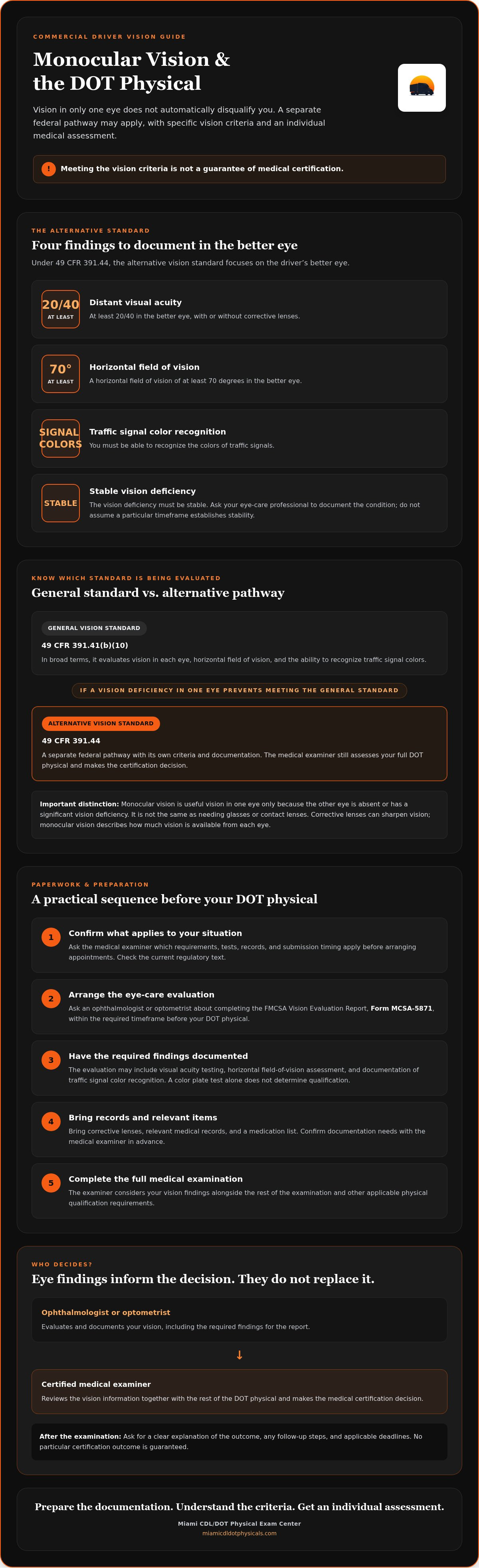
Under 49 CFR 391.44, the alternative vision standard focuses on the driver’s better eye. You must have distant visual acuity of at least 20/40, with or without corrective lenses, and a horizontal field of vision of at least 70 degrees in that eye. You must also be able to recognize the colors of traffic signals and have a stable vision deficiency.
In short, the alternative standard evaluates at least 20/40 distant acuity and a 70-degree horizontal field in the better eye, traffic signal color recognition, and whether the vision deficiency is stable. Stability is part of the federal criteria, but don’t assume a particular timeframe establishes it. Ask your eye-care professional to document your condition and confirm with the examiner how the report will be assessed.
What vision tests may be part of the evaluation?
The evaluation may include a visual acuity test, with corrective lenses if you use them, and an assessment of your horizontal field of vision. The eye-care professional also documents whether you can recognize traffic signal colors. A color plate test alone doesn’t determine qualification. The examiner considers the required findings together with the rest of the evaluation.
Review FMCSA’s Vision Evaluation Report, Form MCSA-5871 for the required eye-care documentation. Confirm with the medical examiner which tests and records you need, and when the completed report must be submitted.
What other medical factors can affect the decision?
Vision is one part of the DOT physical. The medical examiner also assesses whether other health conditions could affect your ability to operate a commercial motor vehicle safely. Share relevant treatment information, recent changes in your health or vision, and any functional effects that may matter during driving. Bring accurate information about your medications and medical history. The examiner considers your individual circumstances, so this guidance can’t predict a certification outcome.
To avoid a last-minute paperwork problem, clarify documentation requirements before your appointment. After your eye-care report is ready, a DOT physical examination is the next step in the medical assessment. Certification depends on the examiner’s review of the applicable standards and your overall examination.
Standard vision requirements vs. the alternative vision standard
The general federal vision standard in 49 CFR 391.41(b)(10) evaluates each eye individually and both eyes together. The alternative standard in 49 CFR 391.44 addresses drivers with a qualifying vision deficiency in one eye who don’t meet the general standard. It is a federal qualification pathway, not an automatic exception. You must meet its conditions and pass the complete medical examination.
| What’s evaluated | General vision standard | Alternative vision standard |
|---|---|---|
| Vision criteria | At least 20/40 acuity in each eye and both eyes, at least a 70-degree horizontal field in each eye, and recognition of red, green, and amber traffic signal colors. | At least 20/40 acuity and a 70-degree horizontal field in the better eye, recognition of traffic signal colors, and a stable vision deficiency. |
| Evidence | Vision testing during the medical examination, including corrective lenses if needed. | A Vision Evaluation Report completed by an ophthalmologist or optometrist, reviewed as part of the examination. |
| Decision-maker | A certified medical examiner assesses the vision findings and the full examination. | A certified medical examiner reviews the specialist’s report and determines whether the driver qualifies. |
The key difference is which eye must meet the acuity and field requirements. The DOT physical monocular vision standard uses the better eye for those measures, while the general standard evaluates both eyes. Under either pathway, an eye-care professional’s approval alone does not provide a DOT medical certificate.
When does the alternative vision standard matter?
It may apply when a driver has a vision deficiency in one eye that prevents them from meeting the general standard. The driver must still meet the alternative standard’s requirements and any other applicable medical qualifications. Federal medical qualification is separate from state licensing rules and employer requirements. Interstate and intrastate rules may differ, so check the requirements that apply to your driving and where you operate.
Who evaluates the driver’s vision and qualification?
An ophthalmologist or optometrist documents vision findings for the examiner. The certified medical examiner reviews that evidence and evaluates the complete DOT physical. The treating eye-care professional does not issue the DOT medical certificate, and a favorable vision report does not guarantee certification. Ask the examiner which standard applies and what documentation to bring.
How to prepare for a DOT physical with monocular vision
Preparing your records can help the medical examiner review your vision information without avoidable back-and-forth. Start by asking the examiner what documents you need. Requirements can depend on whether you’re being evaluated under the general vision standard or the alternative standard in 49 CFR 391.44.
- Contact the medical examiner before your appointment. Explain that you have monocular vision and ask which standard may apply, what records to bring, and whether a specialist’s report is required.
- Arrange eye-care documentation if requested. Under the alternative standard, an ophthalmologist or optometrist must complete the Vision Evaluation Report, Form MCSA-5871. The form must be completed no more than 45 days before the DOT physical. Confirm the timing and submission instructions with the examiner.
- Gather your records and instructions. Bring government identification, appointment instructions, relevant eye-care and medical records, and a current medication list. Include information about your vision history and any recent changes.
- Bring your corrective lenses. If you use glasses or contact lenses, bring your current pair and wear or use them as directed for vision testing. Tell the examiner about any changes in your prescription.
For a quick overview of the general vision rules, see the DOT physical vision requirements guide. Use it as a starting point, then confirm the documentation for your examination directly with the medical examiner.
What should you bring to the appointment?
Keep your paperwork together so the examiner can review it efficiently. Along with identification and requested forms, bring your current corrective lenses, relevant eye-care records, other medical records that may clarify your health history, and a complete medication list. If you’re unsure whether Form MCSA-5871 is needed, ask in advance who must complete it and when the examiner needs it.
What happens if the examiner needs more information?
The examiner may request additional records or clarification before making a decision. Ask exactly what’s missing, who should provide it, how to submit it, and whether a deadline applies. A completed eye-care form supports the assessment, but it doesn’t guarantee certification or determine the outcome on its own.
Once you’ve confirmed what to bring, you can arrange a DOT physical examination for a professional medical evaluation. The examiner will review your documentation and the full examination. Timing and outcome depend on the information available and your individual assessment.
What happens after the examination and how to take your next step
After the DOT physical, the medical examiner may issue a medical certificate, request more information or further review, or be unable to certify you at that visit. The outcome depends on the complete examination and whether the required information is available. A vision report supports the review, but it doesn’t guarantee certification under the DOT physical monocular vision standard.
Before you leave, ask what happens next. If the examiner needs additional records or clarification, confirm what’s missing, who should provide it, how to send it, and any applicable deadline. Clear instructions can help you follow up without unnecessary delays.
If you are certified, what should you confirm?
Review the certificate details, including its expiration date, any restrictions, and follow-up instructions. Certification periods can vary, so don’t assume yours will match another driver’s. Ask how your medical certification information is handled under current FMCSA procedures, and make sure you understand what you need to do to stay compliant.
For broader preparation tips, read the guide to passing a DOT physical. It can help you plan for other parts of the examination beyond vision.
If you are not certified at the first visit, what can you do?
Ask the examiner to explain the specific issue and whether the visit ended because of a medical finding, missing documentation, or a need for further review. If the examiner requests more information, follow up with the appropriate eye-care professional or treating clinician and ask them to address the stated requirement. Arrange another evaluation only after you understand what needs to be completed.
Keep copies of reports and instructions, and track any deadlines the examiner gives you. A DOT physical is an individual medical assessment, so no article or eye-care report can promise a particular result. If you’re ready to complete your evaluation, you can schedule a DOT physical exam for professional review. The medical examiner will determine the outcome based on your examination and applicable requirements.
Prepare for your DOT physical with confidence
Monocular vision doesn’t automatically end your path to commercial driving. The DOT physical monocular vision standard offers an alternative federal pathway for drivers who meet its criteria. The medical examiner still reviews your vision documentation and overall health before making a decision.
Before your appointment, confirm which standard applies and what records are required. Bring your current corrective lenses, relevant medical information, and any requested report from your eye-care professional. If the examiner needs more details, ask what to provide and when.
When you’re ready for the medical evaluation, schedule a DOT physical exam. Miami CDL/DOT Physical Exam Center provides FMCSA-certified medical examinations and drug testing services, with a focus on commercial driver compliance. Certification depends on the examiner’s individual assessment, but arriving prepared can help you understand the process and next steps.
Get your documents in order and clarify questions ahead of time. Schedule your DOT physical exam when you’re ready for the medical evaluation.
Frequently Asked Questions
Can you pass a DOT physical with vision in only one eye?
Possibly. Federal rules provide an alternative vision standard for some commercial drivers with a vision deficiency in one eye. Qualification isn’t automatic: you must meet the applicable criteria, provide required vision documentation, and pass the complete medical examination. A certified medical examiner makes the certification decision. Check the current requirements in 49 CFR 391.44 and confirm with the examiner what applies to your case.
What is the FMCSA monocular vision standard?
The term usually refers to the alternative vision standard in 49 CFR 391.44. It applies to drivers with a qualifying vision deficiency in one eye and evaluates the better eye’s visual acuity and field of vision, traffic signal color recognition, and whether the vision deficiency is stable. Review the current regulatory text and ask a certified medical examiner which vision tests and records are needed for your circumstances.
What vision does the better eye need for the alternative standard?
The better eye must have distant visual acuity of at least 20/40, with or without corrective lenses, and a horizontal field of vision of at least 70 degrees. The standard also requires the ability to recognize traffic signal colors and a stable vision deficiency. Ask the medical examiner which measurements and records are required, and have your eye-care professional document the findings through the applicable process.
Do I need an ophthalmologist or optometrist evaluation before a DOT physical?
If you’re seeking qualification under the alternative vision standard, you need a Vision Evaluation Report, Form MCSA-5871, completed by an ophthalmologist or optometrist. FMCSA requires the report to be completed no more than 45 days before the DOT physical. Confirm current form instructions and timing with the medical examiner before booking or attending. The report documents vision findings, but it doesn’t replace the physical or guarantee certification.
Can an eye doctor approve my CDL medical card?
No. An ophthalmologist or optometrist can assess and document your vision, but a certified medical examiner evaluates your overall medical qualification and makes the DOT certification decision. The examiner considers the vision findings alongside other health information and applicable requirements. Bring the requested records and ask whether any additional steps are needed. A favorable eye evaluation is useful evidence, but it doesn’t by itself qualify you for a medical certificate.
What happens if I do not meet the monocular vision criteria?
If the examiner determines that you don’t meet the applicable requirements, they may be unable to certify you at that visit or may need more information before deciding. Ask which criterion or document needs attention, then follow up with the appropriate eye-care professional or clinician. Don’t assume the result is permanent. Your next steps depend on the individual findings and current federal requirements, so ask the examiner to explain any follow-up instructions and deadlines.
Does the alternative vision standard apply to every commercial driver's license?
The federal alternative standard concerns medical qualification for commercial motor vehicle operation; it doesn’t answer every state licensing or employer requirement. Rules may vary based on whether you drive interstate or intrastate and on the type of operation. Federal interstate requirements don’t automatically settle every intrastate or non-CDL question. Check with the relevant licensing authority and a certified medical examiner to confirm which standards apply to the driving you plan to do.


