

An expired DOT medical card can end your commercial driving day before your state changes your CDL status. There’s no general federal grace period for driving a commercial motor vehicle after required medical qualification expires. The driving with an expired medical card penalty can go beyond a citation: a roadside inspection may put you out of service, and state licensing action may later affect your CDL.
That distinction matters when your paycheck depends on staying behind the wheel. A state deadline to submit renewed paperwork, if one applies, doesn’t create federal permission to drive with an expired certificate. Don’t assume you’re covered because your license still looks commercial or because you’ve scheduled a new exam. This guide explains federal qualification rules, possible penalties, CDL record procedures, and practical steps to restore your medical qualification. Start by checking your certification and state record. Then arrange a DOT physical with an FMCSA-certified medical examiner and verify that the updated result has reached the appropriate licensing record before driving again.
Key Takeaways
- Federal medical qualification, your state CDL record, and your employer’s qualification file are separate. Each may require different follow-up.
- The driving with an expired medical card penalty depends on the circumstances, applicable rules, and jurisdiction.
- If your certification has lapsed, pause covered CMV driving, check the requirements, arrange a DOT physical, and verify your updated status.
- Notify your employer or safety manager and follow company procedures while your qualification is being restored.
- Record your next expiration date and set reminders early to help prevent another lapse.
Driving With an Expired Medical Card: What the Federal Rule Means
Do not operate a commercial motor vehicle (CMV) if your required medical qualification has expired. Under federal rules, a driver subject to medical qualification requirements must meet the physical qualification standards in 49 CFR §391.41 and complete the required medical examination under 49 CFR §391.45. Booking an appointment, waiting for paperwork, or receiving permission from an employer doesn’t extend a certificate’s validity.
The Medical Examiner’s Certificate, often called a DOT medical card, documents that a medical examiner found the driver qualified under the applicable standards for a specified period. Its expiration is separate from the expiration of a Commercial Driver's License (CDL). A CDL may remain unexpired even when the medical qualification required for a particular driving job has lapsed. A valid-looking license doesn’t, by itself, establish current medical qualification.
Is there a grace period for an expired DOT medical card?
Federal rules don’t provide a general grace period to keep driving after required medical qualification expires. A state paperwork deadline, a pending renewal, or an available appointment date doesn’t authorize driving during a lapse. Before operating, verify whether a specific federal exception applies to your vehicle or operation. Don’t assume an exception applies based only on your job title or the fact that your CDL is still active.
Who must hold current medical qualification?
Many drivers who operate CMVs in interstate commerce must meet federal medical qualification requirements, but the rules don’t apply identically to every CDL holder or every trip. Vehicle type, the nature of the operation, and applicable federal or state exceptions can affect whether a medical certificate is required. If your work includes different vehicles or operations, confirm which requirements apply to each one rather than relying on your CDL class alone.
Federal rules set qualification standards, while state agencies administer CDL records and may have separate procedures for recording medical status. For more background on how medical certification fits into CDL requirements, read this DOT physical and CDL medical compliance guide. If your certificate has expired and you’re subject to the requirement, arrange a DOT physical and verify your driving status before returning to covered CMV work. The driving with an expired medical card penalty is one concern; first, make sure you’re qualified to drive.
What Happens After a Medical Card Expires: Federal Rules and State Records
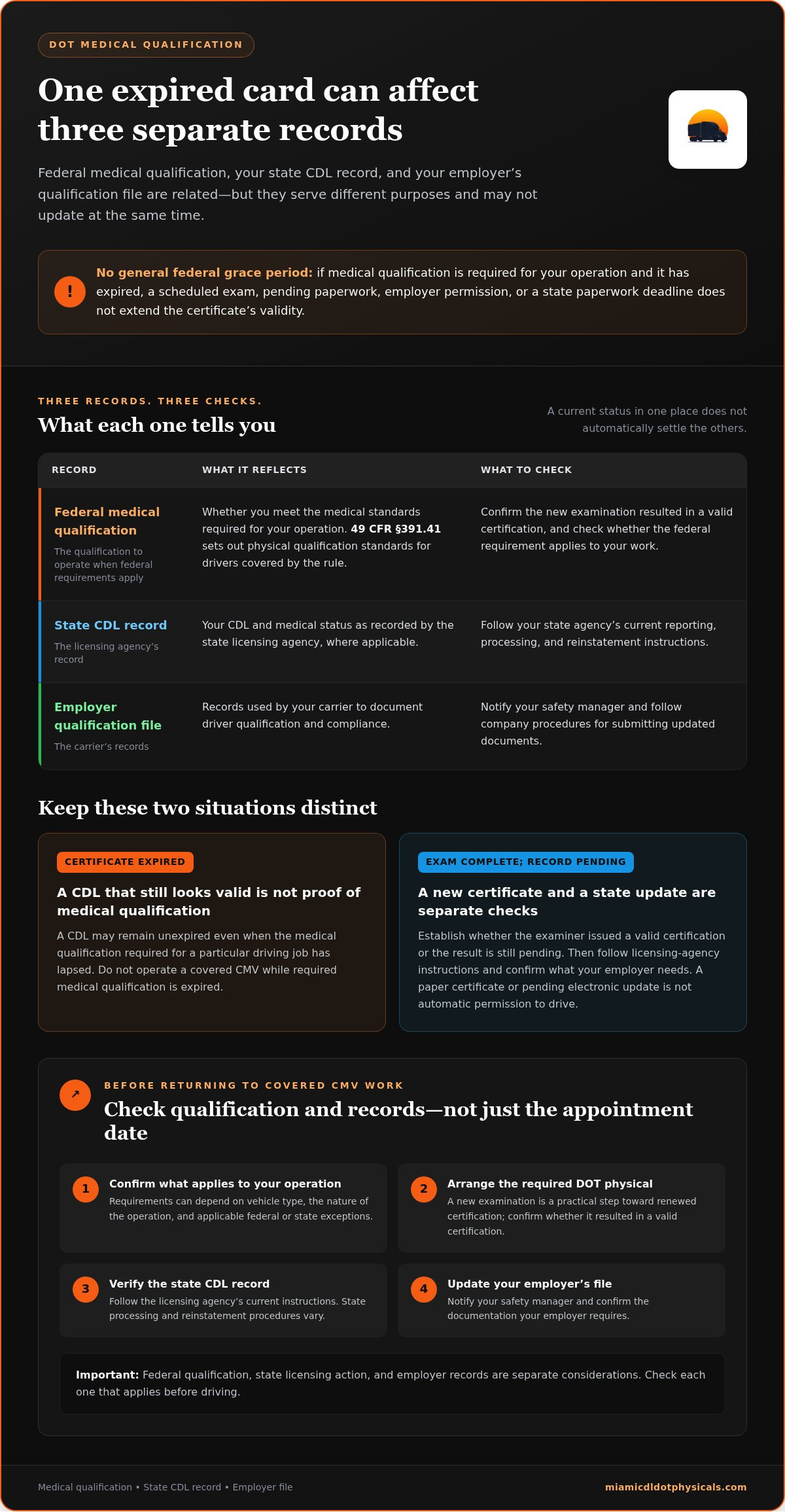
An expired certificate can create separate issues in three places: your federal medical qualification, your state CDL record, and your employer’s qualification file. These records are related, but they don’t update at the same time or serve the same purpose. A state record that hasn’t caught up with a valid new exam is different from a certificate that has actually expired.
| Record or requirement | What it reflects | What to check |
|---|---|---|
| Federal medical qualification | Whether you meet the medical standards required for your operation. 49 CFR § 391.41 sets out physical qualification standards for drivers covered by the rule. | Confirm the new examination resulted in a valid certification and whether the federal requirement applies to your work. |
| State CDL record | The licensing agency’s record of your CDL and medical status, where applicable. | Follow your state agency’s current reporting, processing, and reinstatement instructions. |
| Employer qualification file | The carrier’s records used to document driver qualification and compliance. | Notify your safety manager and follow company procedures for submitting updated documents. |
Federal qualification versus state CDL status
Federal medical qualification is the basis for operating a CMV when federal requirements apply. State agencies administer CDL records and may take separate licensing action based on the information they receive. A state record update doesn’t settle every federal qualification question, and a current certificate doesn’t guarantee that the state record has already been updated.
Processing timelines, notices, and steps to restore a CDL record vary by state. Don’t assume that downgrade, suspension, or reinstatement procedures work the same everywhere. Check your licensing agency’s current instructions and keep your employer informed. The driving with an expired medical card penalty and any licensing consequences depend on the applicable rules and facts, not simply on whether a database is delayed.
What if the exam is complete but the record has not updated?
First, establish whether the medical examiner issued a valid new certification or whether the exam result is still pending. Then follow your licensing agency’s instructions and confirm with your employer what documentation it needs. A paper certificate or pending electronic update shouldn’t be treated as automatic permission to drive. Verify that you’re qualified and that your records meet the requirements for your operation before getting behind the wheel.
If you need a new examination, you can schedule a DOT physical as a practical step toward renewed certification. The exam doesn’t control state licensing decisions, so complete the separate record checks as well.
Expired Medical Card Penalties: Possible Outcomes Without Overstating Them
The consequences of operating a CMV without required current medical qualification depend on the applicable rules, the facts of a stop or review, and the jurisdiction. A citation, out-of-service order, CDL status change, or carrier compliance issue may be possible, but none is automatic in every case. The key questions are whether the driver was required to hold current qualification and what officials determine from the circumstances.
An expired medical card can trigger enforcement or work disruption, but no single penalty applies automatically to every driver or situation.
- Traffic enforcement: During a roadside inspection, officials may review the driver’s qualification and records. A citation or other action may follow if authorities determine a requirement was violated. Fines depend on the applicable rules and circumstances, so don’t rely on a single dollar figure as a guaranteed outcome.
- Possible interruption of driving: An inspection or compliance issue can delay a trip. An out-of-service order may be issued when applicable enforcement criteria are met, but it isn’t an automatic result in every situation solely because a card has expired.
- State licensing action: The state licensing agency may take action affecting CDL status under its procedures. Whether a downgrade or another change occurs, and what steps restore status, depend on the state and the driver’s record.
- Carrier compliance: A carrier may need to keep a driver who lacks required qualification out of covered CMV duties while the issue is resolved. Any audit, safety-rating, insurance, or record consequences depend on the applicable requirements and the specific violation classification.
Can a driver be placed out of service?
Yes, it’s a possible roadside consequence, not a guaranteed one in every case. The inspector’s decision depends on the applicable federal provisions, current out-of-service criteria, and facts found during the inspection. If an officer issues a lawful out-of-service order, comply with it. Don’t resume CMV operation until the order is cleared and you’re legally permitted to continue.
Can an expired card affect a CDL or carrier?
A state may change a CDL holder’s status under its own procedures, but drivers shouldn’t assume a specific downgrade or timeline without checking the licensing agency’s current rules. Separately, carriers are responsible for managing driver qualification and may remove a driver from CMV work if required medical qualification isn’t current. That operational decision is distinct from a state licensing action.
Claims about CSA records, insurance consequences, or safety ratings require checking the current violation classification and the facts of the case. Don’t assume an expired certificate automatically produces a particular score, premium change, or audit finding. For an individual driving with an expired medical card penalty, confirm the cited violation and follow instructions from the relevant enforcement or licensing authority.
What to Do If Your DOT Medical Card Has Expired
Use a clear sequence to address the lapse and confirm your status before returning to covered commercial driving. An appointment is a useful first step, but it doesn’t renew your qualification.
- Stop covered CMV driving. If your required medical qualification has expired, don’t operate a vehicle covered by that requirement while you work through renewal.
- Check the requirements that apply to you. Review your state licensing agency’s current instructions and identify any reporting or record-update steps. Tell your employer or safety manager about the lapse, then follow the company’s qualification procedures.
- Arrange a DOT physical. Book an examination with an FMCSA-certified medical examiner. Bring identification, relevant medical records, and a current list of medications to help the examiner review your health history.
- Verify your status before returning. After the exam, confirm the certification outcome, check the applicable licensing record, and complete required state or employer documentation. Keep examination documents and official status confirmations available as instructed.
How to renew after the card has expired
A DOT physical is the practical route to a new medical qualification when an examination is required. The medical examiner evaluates whether you meet the applicable standards and determines the certification outcome. Completing the exam doesn’t guarantee qualification or a particular certificate duration, so wait for the result and follow any directions provided. For help preparing, review this DOT physical preparation guide.
If you need to arrange an examination, schedule a DOT physical as part of your renewal process.
How to verify you are cleared to return to work
Exam completion and authorization to resume driving aren’t always the same step. Check with the relevant licensing agency to learn whether it has received and processed the required information, and ask your employer or safety manager what its qualification procedures require. Don’t rely on a pending electronic update or a document alone as proof that every requirement is complete.
Keep copies of the examiner’s documentation and any confirmation from the licensing agency or employer, following their instructions for retaining or presenting records. For additional renewal considerations, read the CDL medical card renewal guide. Confirm each applicable step before getting back behind the wheel.
Prevent Another Expiration and Arrange Your Next DOT Physical
A simple tracking routine can help prevent a certificate lapse from disrupting work. Record each driver’s medical certificate expiration date with the qualification records, then set reminders well in advance. Build in time to arrange an examination and complete any state or employer record steps. There’s no single reminder schedule that fits every driver, so choose dates that suit your renewal process rather than treating a suggested lead time as a legal deadline.
Build a simple medical-card renewal routine
Make the process visible to both the driver and the person responsible for safety or compliance. A shared calendar or maintained tracking system can help everyone work from the same current information.
- Save the certificate’s exact expiration date with the driver’s qualification records.
- Set separate reminders for the driver and the responsible safety or compliance contact.
- After a new examination, update the record with the examiner’s stated expiration date and any follow-up tasks.
- Review shorter certification periods promptly. The examiner may set a different expiration date, so don’t assume the next certificate will match the previous one.
For an individual driver, put reminders in a calendar you check regularly and keep a copy of the current certificate with your other qualification documents as instructed. For a fleet, assign someone to review the shared system and follow up on upcoming expirations. A maintained process makes it easier to catch a missed reminder before it becomes a driving-status problem.
Schedule a DOT medical examination
A DOT physical is the practical next step when you need a new medical examination. The center provides FMCSA-certified medical examinations for commercial drivers. The examiner determines the result, so scheduling or completing an exam doesn’t guarantee certification or a particular certificate duration.
An examination also doesn’t replace state licensing or employer record procedures. After the exam, follow the relevant reporting instructions, update your tracking system, and verify any steps required by your licensing agency and employer before resuming covered CMV driving. That handoff helps avoid confusing a completed exam with a fully updated driving status.
Preventing the driving with an expired medical card penalty starts with a dependable reminder routine and timely follow-through. Arrange your next examination and keep the renewal process moving. Schedule a DOT physical examination.
Protect Your Driving Status With a Clear Renewal Plan
When required medical qualification expires, don’t operate a covered CMV until you’ve renewed it and verified your status. Federal qualification, state CDL records, and employer files serve different purposes, so completing a DOT physical may be only one part of the process. The driving with an expired medical card penalty can vary with the circumstances and applicable rules. Fines, licensing actions, and work interruptions aren’t automatic in every case.
Check the requirements that apply to your operation, notify your employer or safety manager, and follow through on any state reporting steps after your examination. Then set reminders well before your next expiration date. A consistent routine can help you avoid a preventable lapse and keep your documentation organized.
The center provides FMCSA-certified medical examinations for commercial drivers, along with DOT and non-DOT drug testing and FMCSA Clearinghouse Consortium support for owner-operators and fleets. If you need to renew your medical certification, schedule a DOT physical examination. Take the next step with a clear plan and move toward returning to work with confidence.
Frequently Asked Questions
Is there a grace period for driving with an expired DOT medical card?
Federal rules don’t provide a general grace period when your operation requires current medical qualification. A scheduled examination, pending appointment, or employer approval doesn’t extend an expired certificate. Stop operating a covered commercial motor vehicle, arrange an examination, and verify applicable state and employer steps before returning to work. Specific exceptions may apply to certain operations, so verify that an exception covers your situation instead of assuming you’re eligible.
Can I drive while waiting for my DOT physical appointment?
If your required medical certification has expired, don’t operate a covered commercial motor vehicle while waiting for your appointment. Booking an examination doesn’t renew your qualification. Some drivers or operations may fall under specific exceptions, but confirm that one applies before driving. After your examination, follow current state and employer procedures, then verify your status and complete any required steps before resuming covered commercial driving.
What is the penalty for driving with an expired medical card?
There isn’t one universal penalty amount for every driver and situation. The driving with an expired medical card penalty may involve enforcement action, an interruption to driving, state licensing consequences, or employer compliance action. Outcomes depend on the applicable rules, the facts, and the jurisdiction. Check current federal and state requirements, and don’t treat an online estimate as a guaranteed fine or result.
Can my CDL be downgraded if my medical card expires?
A state may take licensing action if required medical certification isn’t current, but procedures and timing vary. An expired certificate doesn’t mean every driver’s CDL is automatically downgraded at the same moment nationwide. Check your licensing record and follow instructions from the relevant state agency. Don’t assume a recent examination or pending record update alone clears you to drive a covered commercial motor vehicle.
Can I drive if I passed my DOT physical but my CDL record has not updated?
Treat the examination result and licensing record as related but separate steps. Follow the medical examiner’s documentation instructions, check the licensing agency’s current process, and notify your employer or safety manager. Don’t assume a paper certificate or pending electronic transmission authorizes operation. Before returning to covered CMV driving, confirm that your required medical qualification is current and that applicable state and employer procedures are satisfied.
How do I renew a medical card after it expires?
Arrange a new examination with an FMCSA-certified medical examiner. Bring identification, relevant medical records, and a current medication list. The examiner determines whether you meet the applicable medical standards and the certification period; a particular result or duration isn’t guaranteed. After the examination, follow state reporting and employer documentation procedures. Resume covered driving only after confirming your required qualification is current and applicable return-to-work steps are complete.
Does an expired medical card affect non-CDL commercial drivers?
Medical qualification requirements can apply to some commercial motor vehicle drivers who don’t hold a CDL. The requirements depend on the vehicle, operation, and any applicable exemptions, so non-CDL status alone doesn’t establish that no medical qualification is needed. Review the rules that apply to your specific operation, and verify whether an exemption covers you before driving if your certificate has expired.


