

Registering in the Clearinghouse isn’t the same as completing every required step. If you’re an owner-operator, you may wear both the driver and employer hats, which can make it unclear who must handle queries, testing, and program administration. Understanding how the drug and alcohol clearinghouse for owner operators fits into your compliance routine helps you track each responsibility.
A consortium can help organize ongoing drug and alcohol testing program administration, but it doesn’t take over your legal responsibilities as an employer. Knowing which tasks it handles and which remain yours is key to keeping your compliance routine on track.
This 2026 guide explains Clearinghouse duties for owner-operators, the practical steps involved, and how Clearinghouse queries differ from consortium-managed testing. You’ll also see how the employer, driver, and C/TPA roles fit together, so you can plan for recurring tasks and keep supporting records organized.
Key Takeaways
- Understand why owner-operators may have both employer and driver responsibilities under the drug and alcohol clearinghouse for owner operators.
- Follow a practical setup workflow for registration, query access, testing, and recordkeeping.
- See how limited and full queries differ, and why consent and account permissions matter.
- Compare self-managed compliance with consortium support for organizing testing and ongoing program administration.
- Use a recurring checklist to track key tasks and understand why a reported violation can affect eligibility for safety-sensitive work.
Drug and Alcohol Clearinghouse for Owner-Operators: Who Has Which Duties?
The FMCSA Drug and Alcohol Clearinghouse is a secure database that records drug and alcohol program violations for drivers covered by applicable federal commercial driver’s license (CDL) rules. Employers use it to check a driver’s status and review relevant violations. The Federal Motor Carrier Safety Administration (FMCSA) oversees the federal transportation safety framework that includes these requirements.
For the drug and alcohol clearinghouse for owner operators, the key point is the potential dual role: you may be a driver with an individual Clearinghouse record and an employer responsible for a testing program and required queries. A consortium can help administer parts of that program, but it doesn’t automatically transfer your employer accountability.
When an owner-operator has both employer and driver responsibilities
Having no employees doesn’t necessarily eliminate employer-side duties. If your business employs you as a CDL driver for safety-sensitive work, applicable rules may require you to manage employer functions for yourself, including arranging required Clearinghouse queries and participating in a compliant drug and alcohol testing program.
Keep the roles distinct. Your driver record is where applicable violations are recorded. Employer responsibilities include actions such as checking the Clearinghouse and meeting testing program requirements. The exact duties can depend on your operating and employment structure, so use the applicable FMCSA rules to determine which responsibilities apply to your situation.
What a Clearinghouse consortium does, and does not do
A consortium/third-party administrator (C/TPA) can support administration of a drug and alcohol testing program. For an owner-operator, that support can help organize random testing and related program tasks. The FMCSA requires owner-operators subject to these rules to designate a C/TPA. This is separate from registering for a Clearinghouse account.
A C/TPA’s administrative role is not a blanket handoff of compliance responsibility. You remain accountable for meeting the requirements that apply to you, so understand which tasks your arrangement covers. A consortium also isn’t the Clearinghouse itself: one supports program administration, while the other is the federal database for applicable violation records.
For a closer look at the support role and its boundaries, read this FMCSA Clearinghouse consortium compliance guide. Use it alongside current FMCSA guidance to map your duties before setting up queries and testing.
How Owner-Operators Set Up Clearinghouse and Testing Compliance
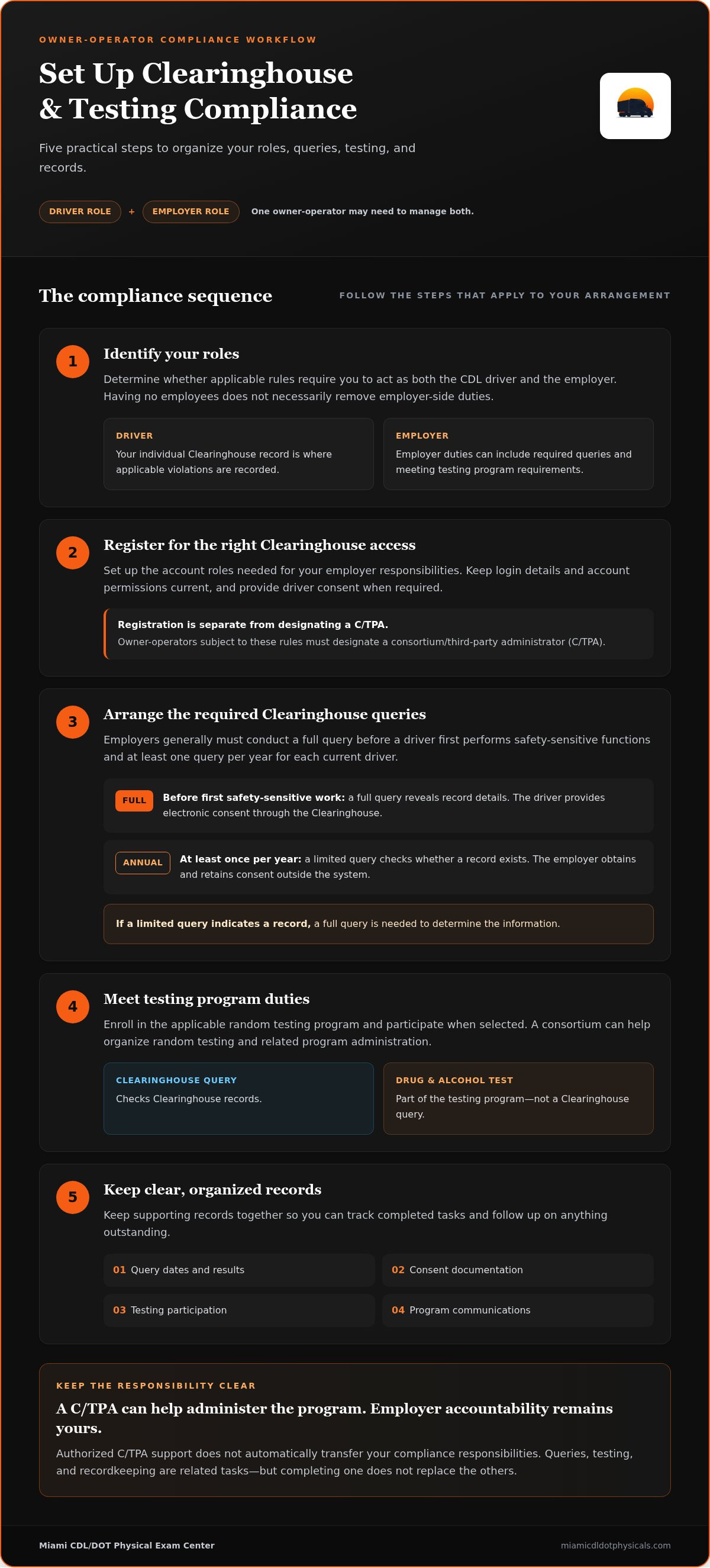
Use this sequence to organize the drug and alcohol clearinghouse for owner operators process. Your responsibilities depend on your role and operating arrangement, so use the current FMCSA drug and alcohol testing rules to determine which requirements apply.
- Identify your roles. Determine whether you must act as both the CDL driver and the employer under the applicable rules.
- Register for the right Clearinghouse access. Set up the account roles needed to handle your employer responsibilities and provide driver consent when required. Keep your login and account permissions current.
- Arrange required queries. Employers generally must conduct a full query before a driver first performs safety-sensitive functions and at least one query per year for each current driver. A limited query checks whether a record exists; a full query reveals the record details. If a limited query indicates a record, a full query is needed to determine the information.
- Meet testing program duties. Enroll in the applicable random testing program and participate when selected. Queries check Clearinghouse records; drug and alcohol tests are separate program requirements.
- Keep clear records. Organize query dates and results, consent documentation, testing participation, and program communications so you can track completed tasks and follow up on anything outstanding.
Register and arrange required Clearinghouse queries
Registration gives you access to account functions associated with your role. For a full query, the driver must provide electronic consent through the Clearinghouse. For a limited query, the employer obtains and retains consent outside the system. Make sure the account performing each task has the appropriate permissions. A designated C/TPA may assist with authorized administration, but you remain responsible for employer compliance.
In short, identify your roles, register, authorize the appropriate query access, complete pre-employment and annual queries as applicable, join the required testing program, and retain supporting records. Keeping query confirmations and consent records together makes it easier to see what has been completed and what still needs attention.
Connect Clearinghouse steps with DOT testing duties
Consortium enrollment helps arrange participation in the random testing program, while Clearinghouse queries check for reportable records. Completing one doesn’t replace the other. A DOT drug test is part of testing compliance, not a Clearinghouse query. For more detail on testing requirements, see this DOT drug testing compliance reference.
An FMCSA Clearinghouse Consortium can help organize ongoing program administration while you retain oversight of your employer duties.
Self-Managed Compliance vs. an Owner-Operator Consortium
Both approaches must meet the same applicable FMCSA requirements. The difference is who handles routine administration and how you keep tasks organized. The FMCSA requirements for owner-operators explain the owner-operator’s dual role. Using a C/TPA for support doesn’t erase employer duties.
| Area | Self-managed | Consortium-supported |
|---|---|---|
| Task tracking | You track due dates, testing participation, and records. | Program administration may help coordinate recurring tasks, depending on the arrangement. |
| Random selection | You must manage participation in the applicable random testing program. | A consortium can help administer random testing processes for enrolled owner-operators. |
| Query support | You manage required Clearinghouse queries and related documentation. | Authorized C/TPA support may assist with query-related administration, as agreed. |
| Record organization | You maintain a system for retaining and retrieving program records. | Administrative support may help keep program information organized; responsibilities vary by arrangement. |
What managing the process yourself involves
Self-management gives you direct control over each step. You’ll need a reliable way to track applicable queries, random testing participation, deadlines, and documentation, then review that system regularly. This can suit an owner-operator who prefers to oversee administrative details. The tradeoff is that a missed reminder or incomplete record can leave a required step unfinished. Managing the program yourself doesn’t change the underlying FMCSA rules.
What consortium support can make easier
A consortium can provide administrative support for the testing program, including coordination of random testing participation and related processes. The specific tasks handled depend on the arrangement. Review the assigned responsibilities and keep track of any employer actions that remain yours. Don’t assume enrollment means every query, record, or reporting duty is automatically handled.
The FMCSA Clearinghouse Consortium provides owner-operators with support for ongoing program administration. Its role is to support the process, not replace your employer accountability. To decide what support would be useful, list the recurring tasks you currently handle and identify where administration could help you stay organized while you retain oversight.
How to Stay Compliant and Handle Clearinghouse Violations
A repeatable routine makes it easier to catch missed notices and keep compliance records in order. Set a regular time to review account access, query activity, testing communications, and documentation. Use the routine to manage your work, while following current FMCSA requirements for the specific tasks and deadlines that apply.
Build a simple recurring compliance routine
- Check account access: Confirm you can sign in and that your account details and permissions are current.
- Track queries: Keep a record of required query dates, completion confirmations, and any follow-up needed.
- Monitor testing: Read consortium notices promptly and follow instructions when selected for testing.
- Organize records: Store query confirmations, testing notices, and completed compliance actions securely so you can retrieve them when needed.
Use a calendar or another dependable reminder system to review the schedule that applies to you. Keep your records together rather than relying on memory or scattered messages. If you’re enrolled in a consortium, respond to its communications and retain relevant notices in your own file.
Understand the violation and return-to-duty process
A reportable violation under applicable FMCSA rules can place a driver in “prohibited” status, making the driver ineligible to perform safety-sensitive functions until completing the required return-to-duty process. A Clearinghouse violation record and return-to-duty eligibility are separate matters: the record documents the violation, while the return-to-duty process establishes whether the driver may resume safety-sensitive work.
The process generally includes an evaluation by a qualified Substance Abuse Professional (SAP), completion of the SAP’s prescribed education or treatment, and a negative return-to-duty test. The test must be directly observed. Afterward, the driver must complete the required follow-up testing plan, which includes at least six unannounced tests during the first 12 months. A negative test by itself doesn’t complete the process or automatically restore eligibility.
Follow the applicable FMCSA procedures and instructions from the SAP and testing program. Don’t assume that a violation has been resolved until the required steps are complete and your Clearinghouse status reflects the applicable outcome.
The FMCSA Clearinghouse Consortium can help organize ongoing program administration as part of a consistent compliance routine.
Choose Clearinghouse Support and Take the Next Compliance Step
A workable compliance plan starts with clarity about your roles, not with a particular tool or service. The drug and alcohol clearinghouse for owner operators involves distinct driver and employer responsibilities, so decide which tasks you’ll manage directly and where administrative support could help keep them organized.
A practical checklist before starting or changing a consortium
- Identify your roles: Account for your responsibilities as a CDL driver and as the employer for your business, based on the FMCSA rules that apply to your operating arrangement.
- List recurring tasks: Note required queries, random testing participation, deadlines, notices, and the records you need to retain.
- Choose your administration approach: Decide which tasks you can reliably manage yourself and which would benefit from support coordinating the testing program.
- Clarify responsibilities: Review the current service arrangement to understand what administrative tasks are delegated and what employer duties remain yours.
- Set up recordkeeping: Choose a secure, consistent place for query confirmations, testing notices, and other compliance documents.
Consortium support may be a practical fit if recurring testing administration and task tracking take time away from your core work, or if you want help keeping program activity organized. Self-management may suit you if you already have a dependable system and can consistently monitor every requirement. Either way, support doesn’t remove the employer’s responsibility to meet applicable rules.
Get help with owner-operator testing administration
The FMCSA Clearinghouse Consortium supports owner-operators and fleets with program administration. DOT drug testing is another relevant part of the compliance process, separate from Clearinghouse queries. Consider both needs together when deciding how to organize your ongoing responsibilities, and keep oversight of any duties that remain yours.
Identify the tasks you want help organizing and put a clear plan in place for queries, testing participation, and records. Get support with Clearinghouse and DOT testing.
Put Your Owner-Operator Compliance Plan in Place
For the drug and alcohol clearinghouse for owner operators, start by identifying your driver and employer responsibilities, then build a reliable routine for required queries, testing participation, and records. Clearinghouse checks and DOT drug testing are connected parts of compliance, but they serve different purposes.
A consortium can help organize ongoing program administration. It doesn’t remove your responsibility to meet applicable requirements, so keep track of what support covers and which duties remain yours. The FMCSA Clearinghouse Consortium provides support for owner-operators and fleets, along with DOT drug testing.
Get support with Clearinghouse and DOT testing and take a practical next step toward a clearer, more organized compliance routine. Build a plan that fits your operation and keep a record of the work completed.
Frequently Asked Questions
Do owner-operators have to register in the FMCSA Clearinghouse?
Owner-operators covered by FMCSA drug and alcohol rules generally need Clearinghouse access for their applicable roles. Because an owner-operator may act as both employer and CDL driver, registration and account permissions must support the responsibilities that apply to each role. Registration alone doesn’t complete compliance: required queries, testing program participation, and recordkeeping may also apply. Use current FMCSA guidance to determine the steps for your business and operating arrangement.
Does an owner-operator need to join a drug and alcohol consortium?
An owner-operator subject to the FMCSA drug and alcohol testing rules must designate a consortium/third-party administrator (C/TPA) to help administer the testing program. This supports requirements such as random testing participation and applicable Clearinghouse administration. The C/TPA’s role depends on the arrangement, and the owner-operator remains responsible for employer duties. Understand which tasks your designated C/TPA handles and keep oversight of the requirements that remain yours.
Can a consortium handle Clearinghouse queries for an owner-operator?
A designated C/TPA may assist with query administration when it has the appropriate authorization and account permissions. The employer remains responsible for ensuring required queries are completed and applicable consent requirements are met. A full query requires the driver’s electronic consent in the Clearinghouse; limited-query consent is obtained and retained outside the system. Keep track of which query tasks are included in the arrangement and retain completion records.
How often must an owner-operator run Clearinghouse queries?
For covered drivers, employers generally must conduct a full query before the driver first performs safety-sensitive functions and at least one query per year for each current driver. An owner-operator’s role as both driver and employer can make this process less intuitive, so follow the FMCSA requirements that apply to your situation. Track query dates and confirmations, and distinguish Clearinghouse queries from separate drug and alcohol testing duties.
What happens if an owner-operator has a Clearinghouse violation?
A reported violation can result in “prohibited” status, which means the driver can’t perform safety-sensitive functions until completing the required return-to-duty process. That process generally includes an evaluation by a qualified Substance Abuse Professional (SAP), completion of prescribed education or treatment, a negative directly observed return-to-duty test, and required follow-up testing. A single negative test doesn’t by itself restore eligibility. Follow current FMCSA procedures and the SAP’s instructions.
Does joining a consortium remove an owner-operator’s legal responsibility?
No. A consortium can provide administrative support for a drug and alcohol testing program, but it doesn’t automatically transfer the owner-operator’s employer accountability. The owner-operator still needs to meet applicable FMCSA requirements and oversee the process. Identify which tasks the C/TPA handles, which actions remain yours, and how you’ll retain records showing required steps were completed.
Is the Clearinghouse the same as a DOT drug test?
No. The Clearinghouse is a federal database that records applicable drug and alcohol program violations and supports employer checks. A DOT drug test is a separate testing procedure within the required drug and alcohol program. A query checks for relevant Clearinghouse records; a test screens for substances under DOT testing rules. Owner-operators may need to manage both query obligations and testing participation, depending on the requirements that apply.


