

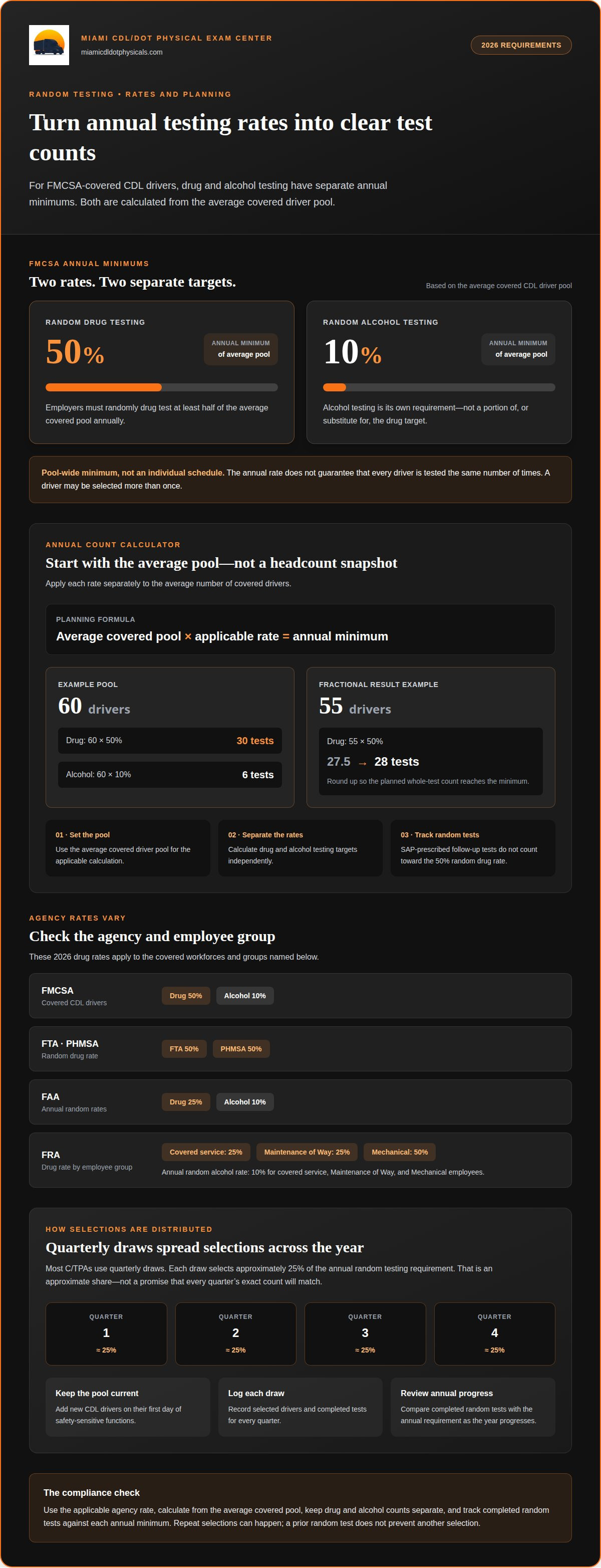
The DOT random drug testing percentage for 2026 is 50%: according to the Federal Motor Carrier Safety Administration, employers must randomly drug test at least half of their average covered CDL driver pool annually. A driver can be selected more than once; the percentage sets an employer-wide minimum, not a one-test limit for each person. The 2026 annual random alcohol testing minimum is 10% of the average covered pool.
It’s understandable to expect random testing to be evenly distributed, but the annual percentage doesn’t guarantee that every driver will be tested the same number of times. The size of the covered pool and the way selections are distributed throughout the year determine what the rate means in practice.
This article explains how to turn the 50% rate into an annual test count, how quarterly draws typically work, and why repeat selections can happen. You’ll also see how the alcohol rate differs, so you can understand the requirements without mistaking a fleet-wide target for an individual schedule.
Key Takeaways
- Base annual test planning on the average covered driver pool, not a single headcount snapshot.
- Quarterly draws commonly spread selections across the year, with each draw covering about a quarter of the annual requirement.
- A previous random test doesn’t prevent a driver from being selected again.
- Keep random tests distinct from SAP-prescribed follow-up tests when tracking annual compliance.
What Is DOT Random Drug Testing?
In 2026, federal random testing rates depend on the agency covering the workforce. For FMCSA-regulated CDL drivers, drug and alcohol requirements use separate rates.
Random Drug and Alcohol Rates
FMCSA random rates set minimum testing shares for covered CDL driver pools. For 2026, the Federal Motor Carrier Safety Administration requires employers to randomly drug test at least 50% of their average covered CDL driver pool annually. The percentage applies to the average pool, so employers use it to plan their overall testing volume.
For 2026, the Federal Motor Carrier Safety Administration requires employers to randomly alcohol test at least 10% of their average covered CDL driver pool annually. Drug and alcohol rates are separate requirements, not one combined target. That distinction matters when employers calculate test counts: meeting the drug minimum alone does not also meet the alcohol minimum.
These FMCSA figures apply to employers with covered CDL drivers performing safety-sensitive functions. The applicable agency matters because DOT programs don’t all use the same rate. A driver’s work and the agency’s rules determine which rate governs the employer’s testing program.
Rates Across DOT Agencies
Other DOT agencies also set random rates for their covered workforces. The Federal Transit Administration’s 2026 random drug testing rate is 50%, and the Pipeline and Hazardous Materials Safety Administration’s 2026 random drug testing rate is 50%. Those figures match FMCSA’s annual drug rate, but the agency’s coverage still matters.
The Federal Aviation Administration’s 2026 random drug testing rate is 25% annually. For the Federal Railroad Administration, drug rates vary by employee group: covered service employees and Maintenance of Way employees have a 25% rate, while mechanical employees have a 50% rate.
Alcohol rates can differ too. The Federal Aviation Administration’s 2026 annual random alcohol testing rate is 10%. The Federal Railroad Administration’s 2026 annual random alcohol testing rate is 10% for covered service employees, maintenance-of-way employees, and Mechanical employees.
Check the agency and employee category before applying a percentage. For example, an FRA mechanical employee is subject to a different drug-testing rate than an FRA covered service employee. Using another agency’s figure can misstate the applicable testing target, even when job titles seem similar.
Calculating annual test counts
Start with the average number of covered drivers in the random pool. Apply the required percentage to that average to calculate the annual minimum. Use the drug and alcohol rates separately because they produce separate testing targets. For planning, use the DOT random drug testing percentage 2026 as the drug-rate reference, then calculate the alcohol target independently.
For example, a fleet averaging 60 covered drivers calculates its drug minimum by applying the 50% rate: 30 random drug tests annually. Applying the 10% alcohol rate to the same pool gives six random alcohol tests annually. These are separate minimums, not a combined total that can be met with either test type.
A 55-driver average pool produces a different drug calculation. Applying the 50% rate gives 27.5, so the example rounds up to a minimum of 28 random drug tests. Rounding up ensures the planned count reaches the required threshold rather than falling short of it. When applying the DOT random drug testing percentage 2026, use whole-test counts that meet the minimum.
- Establish the average pool: Use the covered driver pool average for the applicable calculation.
- Apply the correct rate: Calculate drug and alcohol testing counts separately.
- Round up fractional counts: A 27.5-test result becomes 28 tests in the 55-driver example.
Keep test categories distinct in compliance records. SAP-prescribed follow-up tests do not count toward an employer’s 50% random drug testing rate. They cannot replace random selections when calculating whether the drug-testing minimum has been met.
Small fleets also need to consider how they manage selection across their pool. Without a consortium, the stated example is testing each driver at least once every two years to meet the 50% threshold. A consortium can help coordinate random pool administration, while employers still need accurate pool records and annual counts. Recalculate when the average covered pool changes, then compare completed random tests against each applicable minimum.
Quarterly random testing draws
Quarterly draws divide random selections across the year instead of relying on one annual event. Most C/TPAs use quarterly draws, selecting approximately 25% of the annual random testing requirement each quarter. This approach distributes selections over four quarters and gives employers recurring opportunities to meet the annual target.
The 25% figure is an approximate share of the annual requirement, not a promise that each quarter’s exact count will match. Employers should track completed tests against the annual target as the year progresses. A quarterly draw creates a selection group; it doesn’t, by itself, show whether the full-year requirement has been met.
For practical tracking, keep the annual requirement and each draw’s results together. Record when each draw occurs, which covered drivers are selected, and whether each selected driver completes the test. This lets employers compare selections and completed tests with the annual count, rather than assuming four draws automatically meet the target.
- Maintain the pool: Add new CDL drivers on their first day of safety-sensitive functions.
- Track every draw: Record selected drivers and completed tests for each quarter.
- Review progress: Compare completed random tests with the annual requirement throughout the year.
A driver selected for random testing must proceed to the collection site immediately after notification. Employers should explain the notification and next steps clearly, then document the completed test. A quarterly schedule can help organize draws, but it doesn’t change what happens after a selection.
Pool changes also affect how employers manage draws. Add eligible drivers when they begin safety-sensitive functions, and keep pool records current before selections. That helps ensure each draw uses the right group. Review records after every quarter, then adjust future selections to keep the annual requirement in view. The 25% quarterly approach is common among C/TPAs, while the employer remains responsible for tracking the required annual total.
Can a Driver Be Selected Multiple Times?
Yes. A driver can be selected more than once because random selection doesn’t guarantee that every employee will be tested equally often.
Random Selection Requirements
FMCSA random selection uses a method designed to give each covered driver a chance of selection. The method is governed by 49 CFR §382.305(i). This matters because selections must come from the covered pool, rather than an employer choosing employees based on preference or convenience.
A previous test doesn’t remove a driver from the pool or prevent another selection. For example, one driver could be selected in separate draws while another isn’t selected during the same period. Employers should keep pool records current so eligible drivers remain in the selection process.
Selection Frequency
DOT-regulated employees must be selected often enough for the employer to meet the applicable annual testing rate. There’s no rule that each individual must be tested exactly once. Repeat selections can occur, and the annual requirement is measured across the covered pool.
For drivers, a completed random test doesn’t guarantee a break from later draws. For employers, this means tracking the total required tests and completed selections, rather than relying on equal distribution among drivers.
After notification, a selected driver must proceed to the collection site immediately. Employers should communicate the selection promptly and direct the employee to testing without delay. A driver selected before separating from an employer must still complete the test.
Falling below the required minimum rate can result in a fine of up to $16,000 per violation. Employers should compare completed random tests with the applicable annual requirement and address any shortfall. Accurate pool records and test documentation help show how the program operated.
For support with a DOT drug test, schedule a DOT drug test through Miami CDL/DOT Physical Exam Center.
Miami CDL/DOT Physical Exam Center: DOT Physical Exam
National commercial drivers and fleets can rely on Miami CDL/DOT Physical Exam Center for professional DOT Physical Exams to meet federal medical certification standards. Employers and owner-operators nationwide managing federal testing compliance can also utilize its FMCSA Clearinghouse Consortium for reliable consortium support.
A DOT Physical Exam serves a distinct purpose compared to the **DOT random drug testing percentage 2026** requirements: the physical is a comprehensive medical examination, whereas random testing is a core component of an employer's ongoing drug and alcohol program. Drivers and managers should choose the specific service that fits their immediate compliance need, whether that involves obtaining a medical certificate or securing support with Clearinghouse consortium participation.
For nationwide assistance with a DOT Physical Exam or FMCSA Clearinghouse Consortium services, contact Miami CDL/DOT Physical Exam Center or visit miamicdldotphysicals.com.
Put Your Compliance Plan Into Practice
Use your understanding of the DOT random drug testing percentage for 2026 to build a clear process for your team. Assign responsibility for maintaining the covered driver pool, recording test activity, and reviewing compliance records. A consistent process helps your organization respond to selections and keep its compliance work organized as staffing changes.
For driver health and testing needs, Miami CDL/DOT Physical Exam Center offers DOT Physical Exams, DOT Drug Tests, and Non-DOT Drug Tests. Choose the service that fits your need, whether you require a medical examination or a drug test.
Take the next step at a pace that works for your operation. Contact Miami CDL/DOT Physical Exam Center to discuss its services. A clear plan and the right support can help you move forward with confidence.
Frequently Asked Questions
When must new hires be added to the random pool?
Add a new CDL driver to the random pool on the first day they perform safety-sensitive functions. The trigger is starting those duties, not completing hiring paperwork. For example, if a driver is hired before beginning covered work, add them to the pool when they start safety-sensitive functions. This keeps the selection pool aligned with the people performing covered duties.
What is the DOT random drug testing rate for 2026?
For FMCSA-regulated CDL drivers, the 2026 random drug testing rate is 50% of the average covered driver pool annually, according to the Federal Motor Carrier Safety Administration. DOT rules vary by agency, so this figure should not be applied automatically to every transportation job. Identify the agency overseeing the employee’s safety-sensitive work before using a rate for planning.
What are the FMCSA random drug and alcohol testing percentages for 2026?
For 2026, the Federal Motor Carrier Safety Administration requires random drug testing at 50% of the average covered CDL driver pool annually, and random alcohol testing at 10% of that pool annually. Keep the drug and alcohol calculations separate in program records. For example, a completed drug test cannot be counted as an alcohol test when tracking the two requirements.
How does DOT calculate the minimum random testing rate?
For an FMCSA program, calculate the minimum by applying the applicable rate to the average covered CDL driver pool, then track drug and alcohol counts separately. If the calculation produces a fraction of a test, plan for a whole-test count that meets or exceeds the minimum. Exclude SAP-prescribed follow-up tests from the annual random drug-testing calculation.
Who must be included in a DOT random testing pool?
For FMCSA coverage, include CDL drivers performing safety-sensitive functions under 49 CFR Part 382. The work performed and the governing agency determine pool eligibility, not job title alone. Employers should maintain a current list of covered employees, including drivers who begin safety-sensitive duties after hire, so selections draw from the appropriate workforce.
Where does the DOT publish its official 2026 random testing rates?
For motor carriers, use the Federal Motor Carrier Safety Administration’s official random testing rate information. Other DOT-regulated modes have agency-specific rates, so consult the relevant agency’s official materials rather than assuming the FMCSA rate applies. For example, the Federal Transit Administration and Pipeline and Hazardous Materials Safety Administration publish rates for their respective covered groups.


