

A DOT physical must be completed in person, not by video call. Finding a DOT certified medical examiner starts with locating an examiner listed on the FMCSA National Registry. Under the Electronic Code of Federal Regulations, interstate commercial drivers’ medical examinations generally must be performed by a listed examiner, subject to the regulation’s exceptions.
It makes sense to look for a clinic that fits your schedule and an examiner familiar with commercial driving requirements. This guide explains how to verify an examiner’s listing, choose a clinic, and prepare for vision, hearing, blood pressure, and other checks. You’ll also learn what to consider about an examiner’s experience and the reporting process, so you can approach your DOT physical with a clear plan.
Key Takeaways
- Use the FMCSA National Registry to locate an examiner and confirm they’re listed. The Federal Motor Carrier Safety Administration says interstate commercial drivers must obtain Form MCSA-5876 from a certified examiner on the Registry.
- Search by city, state, or ZIP code to find a convenient clinic, then plan an in-person visit since a DOT physical can’t be completed by video call.
- Prepare for vision, hearing, blood pressure, urine, and physical checks by bringing your identification and relevant health information.
- Ask how exam results are reported and what happens if the examiner needs more information. Certified examiners must submit interstate driver exam results by midnight local time on the next calendar day.
How to verify a medical examiner on the FMCSA National Registry
Start with the FMCSA National Registry and confirm the examiner’s listing before booking. The directory lets you search by location or identifying details.
Searching the National Registry by Location
Open the National Registry search and enter a city and state or a ZIP code. Review examiners near your route, home, or workplace, then note the examiner’s name and business. The advanced search also allows searches by National Registry number, first and last name, or business name.
Before scheduling, confirm that the examiner is listed in the directory. Under the Electronic Code of Federal Regulations, the examination generally must be conducted by an examiner listed on the National Registry of Certified Medical Examiners, subject to the regulation’s exceptions. Treat a search result as a starting point, then make sure the listing matches the person who will conduct your exam.
Examiner Credentials and Choice
A DOT medical examiner must have a medical credential or license that permits physical examinations under applicable state laws. Certification also requires training based on the FMCSRs and related guidance, plus passing the National Registry Medical Examiner Certification Test. FMCSA verifies the test score and medical credential before certification and listing.
Federal listing rules allow you to choose a listed examiner; they don’t require your employer to choose one for you. Your employer may have scheduling policies, so follow them while confirming the examiner’s Registry listing.
Interstate commercial motor vehicle drivers must obtain a Medical Examiner’s Certificate, Form MCSA-5876, from a certified medical examiner listed on the National Registry, according to the Federal Motor Carrier Safety Administration. A certificate can be valid for up to 24 months, according to the Federal Motor Carrier Safety Administration, though an examiner may issue a shorter period.
Since June 23, 2025, federal rules no longer require CDL and CLP holders to carry their medical examiner certificate while on duty, according to the Federal Motor Carrier Safety Administration. This change concerns carrying the certificate, not the requirement to use a properly listed examiner for the examination.
Clinics and other places that offer DOT physicals
DOT physicals are offered at medical clinics, occupational health centers, and some truck-stop clinics. Choose a location that can conduct the required in-person exam and complete the examination report. A truck-stop clinic may fit a break or reset, while a medical clinic may be more convenient near home or work.
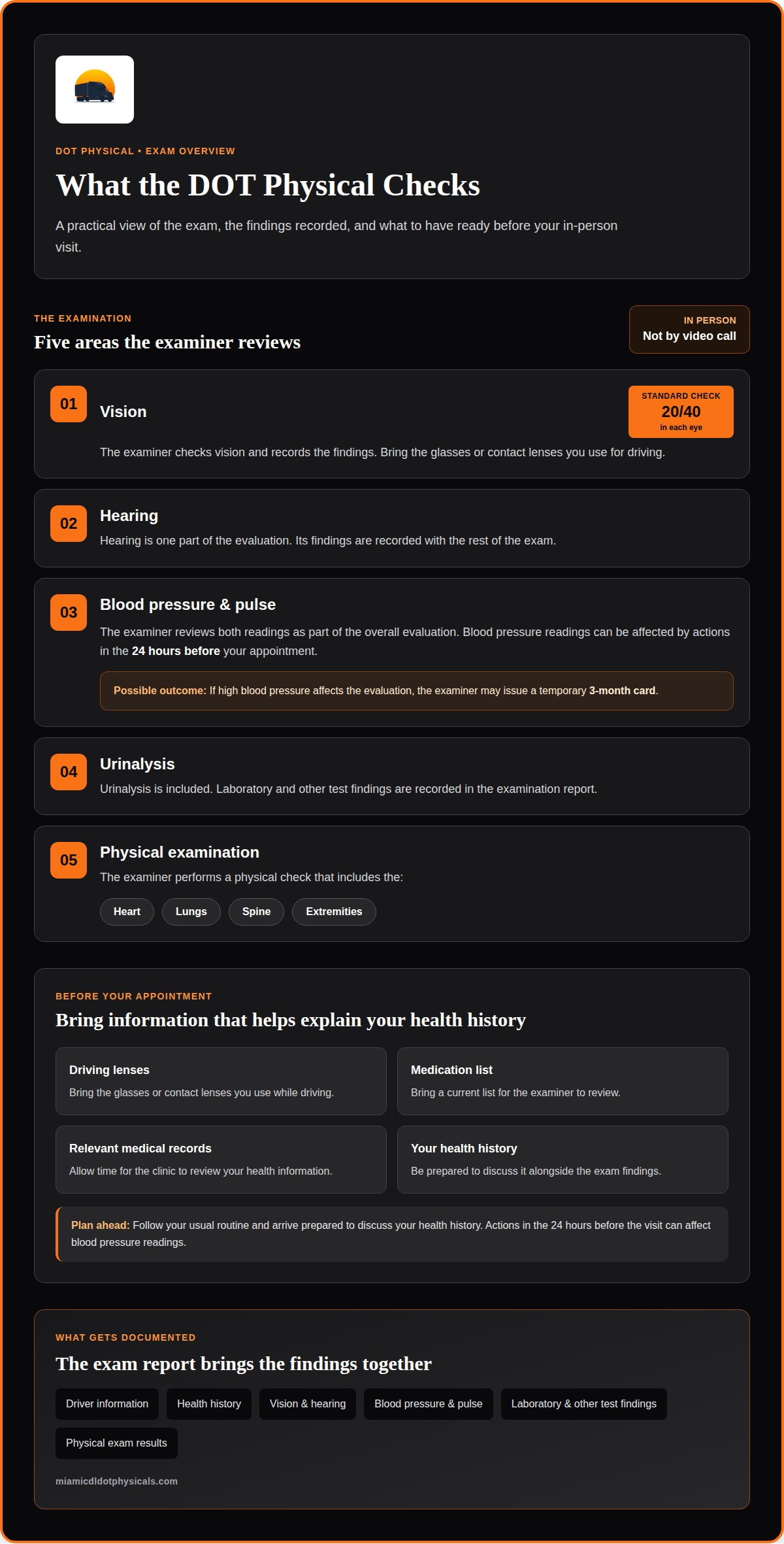
A DOT physical is an in-person examination, not a video appointment. The examiner’s report records driver information, health history, vision, hearing, blood pressure and pulse, laboratory and other test findings, and physical exam results. Bring relevant records and allow time for the clinic to review your health information.
A medical examiner’s certificate can be valid for up to 24 months, according to the Federal Motor Carrier Safety Administration. The examiner may issue a shorter certificate based on the medical evaluation and health information reviewed during the exam.
If you don’t pass, ask which finding needs follow-up and what information or assessment could help complete the evaluation. An examiner may record an exam as pending while awaiting additional information or completion, within 45 days. A pending exam is not the same as receiving a completed certificate, so clarify the next step before leaving.
Before choosing a clinic, consider its location, appointment process, and fit with your route and schedule. If time is limited, you might plan the visit around a stop you already need to make. If you have medical records to discuss, allow time for the clinic to review them. Check the examination process before you travel.
DOT physical prices vary, and the clinic can explain its pricing before your visit. The exam and any additional testing required may affect the cost. Compare what the visit covers with your needs, rather than making a decision on price alone.
If you need a DOT physical, schedule a DOT physical exam as the next step toward completing your medical evaluation.
Appointments are recommended during busy times. Truck-stop clinics may let drivers complete a physical during a 30-minute break or a 10-hour reset.
Vision, hearing, blood pressure, and other exam checks
A DOT physical exam assesses whether your health supports safe commercial driving. The examiner checks vision, hearing, blood pressure, pulse, urine test findings, and physical health. Bring information that helps explain your medical history, since the results are recorded as part of the examination.
For vision, the standard check includes seeing 20/40 in each eye. Bring the glasses or contact lenses you use for driving. The examiner records vision findings as part of the physical exam, so make sure corrective lenses are available during testing.
The hearing check is one part of the evaluation. The examiner also reviews blood pressure and pulse, then performs a physical examination of the heart, lungs, spine, and extremities. These checks assess different aspects of health relevant to driving, rather than relying on a single measurement.
Urinalysis is included in a DOT physical exam. The examination report also records driver information, health history, laboratory and other test findings, and physical exam results. Bring a current medication list and relevant medical records so the examiner can review them alongside the test results.
Blood pressure readings can be affected by actions in the 24 hours before your appointment. Plan ahead, follow your usual routine, and arrive prepared to discuss your health history. If high blood pressure affects the evaluation, an examiner may issue a temporary 3-month card.
For sleep apnea, bring a CPAP data printout showing consistent use for at least 30 days. This gives the examiner information to consider during the physical. A clear record can help connect your treatment history with the exam findings. Keep your glasses, medication list, and relevant records together before leaving for the clinic.
A medical examiner certificate may be valid for 12 months or less for drivers with conditions such as high blood pressure, diabetes, or sleep apnea, depending on the examiner's determination. This means the listed conditions do not, by themselves, establish a single certificate period; the examiner's determination applies in each case. When discussing one of these conditions, provide relevant health information and answer questions clearly, so the examiner can make that determination using the circumstances presented during the evaluation.
Examiner experience and timely reporting
Relevant experience includes familiarity with DOT examination records and commercial drivers’ needs. An urgent care setting alone does not establish that an examiner is qualified to conduct a DOT physical. Verify the examiner’s National Registry listing, then consider whether the appointment process clearly explains the exam and reporting. For a carrier coordinating driver exams, for example, clear information about how results are handled after each visit can help with planning.
For interstate commercial motor vehicle exams, the examiner submits results to FMCSA. The Federal Motor Carrier Safety Administration requires submission by midnight local time on the next calendar day after the examination. That deadline is separate from the certification decision. An examiner may record an exam as pending while awaiting additional information or completion, within 45 days.
You don’t transfer exam results to FMCSA or your state driver-licensing agency yourself. The U.S. Government Publishing Office explains that FMCSA’s electronic system transmits medical certification information for drivers who need a commercial learner’s permit or commercial driver’s license from the National Registry to state driver-licensing agencies. Keep your own exam paperwork and note the examiner’s name and examination date for your records.
At your appointment, ask how the clinic will communicate the exam’s status and what steps follow if it remains pending. Keep any requested follow-up documents together, so you can respond efficiently. If your need is separate from a medical exam, such as managing Clearinghouse compliance, an FMCSA Clearinghouse Consortium may be relevant.
Miami CDL/DOT Physical Exam Center: DOT Physical Exam
Miami CDL/DOT Physical Exam Center provides comprehensive DOT Physical Exams for commercial drivers nationwide who need a certified medical evaluation. Once you’ve confirmed the examiner’s National Registry listing and reviewed what the exam covers, you can arrange the physical exam here. The visit includes the required DOT examination process and its thorough documentation.
Drivers and employers with separate compliance needs can also utilize the FMCSA Clearinghouse Consortium. The consortium supports ongoing Clearinghouse compliance, while the DOT Physical Exam addresses the driver’s medical examination. Choose the service that matches your immediate requirement to keep your compliance process clear and straightforward.
For your professional DOT physical or Clearinghouse needs, visit Miami CDL/DOT Physical Exam Center.
Take the next step toward compliance
Finding a DOT certified medical examiner is one step in keeping your medical qualification process on track. Next, address the requirement you have now, whether that means an examination or testing. Keeping those needs distinct helps you arrange the right service and prepare the appropriate records.
Miami CDL/DOT Physical Exam Center offers DOT Physical Exams, DOT Drug Testing, and Non-DOT Drug Testing. Each service serves a different need, so identify the one that matches your current requirement before reaching out.
For help with your next step, contact Miami CDL/DOT Physical Exam Center. A clear plan can make the process easier to manage and help you move forward with confidence.
Frequently Asked Questions
What if I Have a Condition Like Diabetes or Sleep Apnea?
A diagnosis doesn’t by itself determine your certification; the examiner considers relevant medical information and applicable qualification standards. Drivers with insulin-treated diabetes must meet 49 CFR 391.46, including a treating clinician’s Form MCSA-5870 and an examination at least annually. If you use CPAP for sleep apnea, bring a data printout showing consistent use for at least 30 days. Keep treatment records ready for review.
How do I verify a medical examiner is listed on the FMCSA National Registry?
Look up the examiner in the National Registry and confirm that the directory lists that specific person as a certified medical examiner. Don’t treat a Registry number alone as proof of active certification: receiving a number is only the first step and does not authorize examinations. Before proceeding, make sure the listed name and business details match your appointment.


