

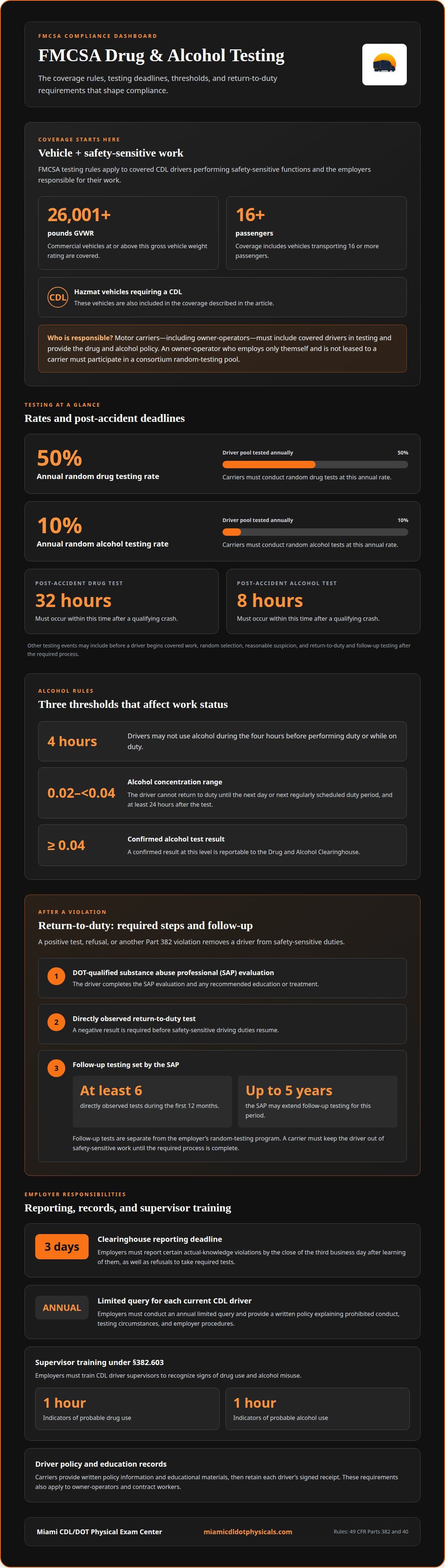
Coverage starts with the vehicle and the driving role, not just the employer’s size. FMCSA drug and alcohol testing rules apply to covered CDL drivers and their employers; according to the Federal Motor Carrier Safety Administration, covered commercial motor vehicles include those with a gross vehicle weight rating of 26,001 pounds or more and vehicles transporting 16 or more passengers. The rules are set out in 49 CFR Part 382, while 49 CFR Part 40 establishes DOT testing procedures, according to the Electronic Code of Federal Regulations. This FMCSA drug testing regulations summary explains how those rules work in practice.
Testing may seem like a routine workplace requirement, but FMCSA rules also define which drivers and carriers are covered, when tests are required, and what happens after a violation. This FMCSA drug testing regulations summary explains the key responsibilities for employers and drivers before a test or compliance issue arises.
This article covers who is subject to the rules, the main testing requirements, and the return-to-duty process after a violation. It also explains how an FMCSA Clearinghouse Consortium can support owner-operators and fleets with federal compliance requirements.
Key Takeaways
- See how 49 CFR Part 382, according to the Electronic Code of Federal Regulations, frames FMCSA drug and alcohol testing requirements.
- Learn which CDL drivers and commercial vehicles may fall under the rules, including the vehicle factors that affect coverage.
- Understand when testing may be required and how a violation can affect a driver’s ability to return to safety-sensitive work.
- Find out how a DOT Drug Test or FMCSA Clearinghouse Consortium can support testing and compliance needs.
What are DOT drug and alcohol testing requirements?
FMCSA rules specify who must be tested, when testing applies, and how employers manage results. This FMCSA drug testing regulations summary explains coverage, testing events, alcohol restrictions, and Clearinghouse reporting.
Who Must Follow FMCSA Testing Rules
FMCSA testing rules apply to CDL drivers performing safety-sensitive functions and the employers responsible for their work. Covered employers include motor carriers, including owner-operators, and may also engage contract or staffing-service drivers. Coverage matters because employers must include covered drivers in testing and provide them with the drug and alcohol policy. An owner-operator who employs only themself and is not leased to a carrier must participate in a consortium random-testing pool.
Rules Under Parts 40 and 382
Part 382 sets FMCSA’s controlled-substances and alcohol-use rules, while Part 40 sets procedures for DOT-required testing. According to the Electronic Code of Federal Regulations, FMCSA’s regulations are found at 49 CFR Part 382, and 49 CFR Part 40 establishes procedures for specimen collection, testing, and reporting results. Testing may be required before a driver begins covered work, through random selection, after qualifying crashes, or when reasonable suspicion arises. Return-to-duty and follow-up tests apply after the required process. According to the Federal Motor Carrier Safety Administration, post-accident drug testing must occur within 32 hours, and post-accident alcohol testing within 8 hours. Carriers must conduct random drug tests at an annual rate of 50% of the driver pool and random alcohol tests at an annual rate of 10% of the driver pool, according to the Federal Motor Carrier Safety Administration.
Prohibitions and Testing Thresholds
Part 382 prohibits controlled-substance use and restricts alcohol use around safety-sensitive duties. Drivers may not use alcohol during the four hours before performing duty or while on duty. A driver with an alcohol concentration from 0.02 to below 0.04 cannot return to duty until the next day or next regularly scheduled duty period, and at least 24 hours after the test. A confirmed alcohol test result of 0.04 or higher is reportable to the Clearinghouse. These thresholds affect work status and employer response.
Clearinghouse Reporting and Access
The Drug and Alcohol Clearinghouse records specified violations and helps employers review driver status. Employers must report certain actual-knowledge violations by the close of the third business day after learning of them, as well as refusals to take required tests. Employers must also conduct an annual limited query for each current CDL driver. A written policy must explain prohibited conduct, testing circumstances, and employer procedures. Employers provide educational materials and retain signed receipts confirming drivers received the policy.
Consequences of violations and return-to-duty requirements
A positive test, a refusal, or another violation of Part 382’s prohibitions removes a driver from safety-sensitive duties. Returning to commercial driving after a violation generally requires completing a return-to-duty process. The return-to-duty process includes an evaluation by a DOT-qualified substance abuse professional (SAP), completion of any recommended education or treatment, and a directly observed return-to-duty test. A negative result is required before driving duties resume.
After the return-to-duty test, the SAP sets follow-up testing requirements. FMCSA rules require at least six directly observed tests during the first 12 months. The SAP may extend follow-up testing for up to five years. These tests are separate from an employer’s random testing program, so completing one does not replace the other. A carrier must also keep the driver out of safety-sensitive work until the required process is complete.
Supervisors have a defined role before a violation occurs. Under §382.603, employers must train CDL driver supervisors to recognize signs of drug use and alcohol misuse. The training includes one hour on indicators of probable drug use and one hour on indicators of probable alcohol use. When a supervisor has reasonable suspicion, the employer’s procedures guide the testing response.
Driver education is part of the process. Motor carriers must provide written policy information explaining prohibited conduct and when testing can occur. They must also provide educational materials about the rules and company procedures, then retain each driver’s signed receipt. These requirements apply to owner-operators and contract workers as well as payroll employees.
An owner-operator who employs themself must meet the applicable employer and driver requirements. An owner-operator not leased to a carrier must participate in a consortium random-testing pool. An FMCSA Clearinghouse Consortium can support owner-operators with this testing-program requirement.
Covered CDL drivers and commercial motor vehicles
FMCSA testing compliance involves the motor carrier, any consortium pool, and each covered driver. The carrier manages required testing and policy records; a consortium supports random-pool participation, and drivers must follow testing procedures and the written policy.
Coverage depends on the commercial motor vehicle and the work performed. According to the Federal Motor Carrier Safety Administration, the rules apply to vehicles with a gross vehicle weight rating of 26,001 pounds or more and vehicles transporting 16 or more passengers. They also cover hazmat vehicles requiring a CDL. Drivers performing safety-sensitive functions in covered vehicles are subject to the drug and alcohol testing program.
Drivers should understand the policy before testing begins. A motor carrier must provide its DOT drug and alcohol policy to each driver before testing starts, including new hires and employees transferring into safety-sensitive positions. The policy describes when testing occurs and the procedures drivers must follow. Drivers sign a receipt acknowledging the information, and the carrier keeps a copy.
Parts 40 and 382 shape how the testing program works: Part 382 sets FMCSA requirements, and Part 40 establishes DOT testing procedures. That distinction helps drivers understand that coverage and employer duties come from FMCSA rules, while testing procedures follow DOT requirements. Testing information also receives privacy protections, which restrict employers and service agents from using or releasing sensitive records improperly.
Owner-operators who employ themselves as drivers have responsibilities on both sides of the process. If they are not leased to a motor carrier, they must participate in a consortium random-testing pool. The carrier remains responsible for its program obligations, while each driver must receive the policy, acknowledge receipt, and comply with applicable tests. Clear records document that the policy was distributed before testing began.
FMCSA-regulated employers and covered commercial motor vehicles
Employer coverage depends on the commercial motor vehicle and the transportation work it supports. According to the Federal Motor Carrier Safety Administration, FMCSA drug-testing requirements apply to commercial motor vehicles with a GVWR of 26,001 pounds or more. The Federal Motor Carrier Safety Administration also includes vehicles transporting 16 or more passengers. These thresholds help employers identify which operations may bring drivers under federal testing rules.
Passenger capacity matters even when a vehicle weighs less than the stated GVWR threshold. A vehicle transporting 16 or more passengers can meet a coverage criterion independently. Hazmat vehicles requiring a CDL are also included. Employers should consider vehicle use, passenger capacity, weight rating, and whether the operation requires a CDL, rather than relying on the company’s size or name.
FMCSA-regulated employers include interstate and intrastate motor carriers operating covered vehicles on public roads. Coverage may also include civic organizations transporting groups such as disabled veterans or Boy and Girl Scouts. An organization’s purpose alone does not determine whether the rules apply. Its vehicle and driving operation matter.
Once covered, an employer’s responsibilities go beyond arranging drug and alcohol tests. The motor carrier must implement its program, explain the policy to drivers, and maintain required testing records. Supervisors also need training to recognize signs of impairment. These duties apply to the covered transportation operation, whether it uses employees, contract workers, or owner-operators.
For fleets and owner-operators, the practical takeaway is to assess each vehicle and role together. A CDL license alone does not describe every coverage factor; vehicle weight, passenger capacity, hazmat use, and safety-sensitive duties also matter. If an owner-operator needs support with Clearinghouse and consortium compliance, use the FMCSA Clearinghouse Consortium.
Miami CDL/DOT Physical Exam Center: DOT Drug Test
Miami CDL/DOT Physical Exam Center supports commercial drivers and employers nationwide with DOT Physical Exams and an FMCSA Clearinghouse Consortium. The consortium assists owner-operators and fleets across the country with random-testing pool participation and Clearinghouse responsibilities. A DOT Physical Exam addresses the separate medical examination requirement for commercial drivers.
These services support distinct parts of compliance: a physical exam concerns medical qualification, while a consortium supports Clearinghouse and testing-program obligations. Identifying the requirement that applies helps drivers and employers choose the right next step without confusing medical certification with drug-testing compliance.
For a DOT Physical Exam or nationwide support through the FMCSA Clearinghouse Consortium, contact Miami CDL/DOT Physical Exam Center.
Put Your Next Compliance Step in Motion
Use this FMCSA drug testing regulations summary to build a clear process for your driving role or operation. Keep testing, policy communication, and recordkeeping aligned with the responsibilities that apply to you. This helps you identify the right next step without confusing medical qualification with drug-testing or Clearinghouse requirements.
Miami CDL/DOT Physical Exam Center offers DOT Physical Exams, DOT Drug Tests, Non-DOT Drug Tests, and an FMCSA Clearinghouse Consortium. Choose the service that matches your requirement: a medical exam, a DOT or non-DOT test, or consortium support for Clearinghouse participation.
Contact Miami CDL/DOT Physical Exam Center to discuss the service that fits your need. Take the next step with a clearer plan and steady support for your compliance responsibilities.
Frequently Asked Questions
Who's Impacted?
The rules affect CDL drivers performing safety-sensitive work in covered commercial motor vehicles and the employers responsible for those operations. For example, a carrier’s compliance duties can extend to a contract driver, not just someone on its payroll. Owner-operators have obligations, too: an owner-operator who employs only themself and is not leased to a motor carrier must participate in a consortium random-testing pool.
Which FMCSA regulations govern drug and alcohol testing for commercial drivers?
FMCSA’s controlled-substances and alcohol-use testing rules are in 49 CFR Part 382, according to the Electronic Code of Federal Regulations. DOT-required testing procedures are established in 49 CFR Part 40, including specimen collection, testing, and results reporting. In practice, Part 382 addresses who and when FMCSA requires testing, while Part 40 describes how DOT tests are carried out.
Which drivers and employers are subject to FMCSA drug testing requirements?
Coverage generally includes CDL drivers performing safety-sensitive functions in commercial motor vehicles that meet FMCSA criteria, as well as the motor carriers employing or engaging them. Vehicle use matters: a qualifying passenger or hazardous-materials vehicle requiring a CDL can bring a driver under the rules. An organization’s business type alone does not determine coverage; the vehicle, operation, and driving role are relevant.
What drugs are included in the FMCSA DOT drug testing panel?
The DOT drug-testing panel screens for marijuana, cocaine, opioids, PCP, and amphetamines. These are the five drug categories covered by the panel. DOT drug tests follow federal procedures, so do not assume a separate workplace screening panel matches the DOT panel. The applicable test depends on whether the driver is subject to DOT rules or a non-DOT workplace program.
What are the current FMCSA random drug and alcohol testing rates?
FMCSA-regulated carriers must conduct random drug tests at an annual rate of 50% of the driver pool and random alcohol tests at an annual rate of 10% of the driver pool, according to the Federal Motor Carrier Safety Administration. Random selections occur throughout the year rather than on a predictable schedule. A driver selected for testing must follow the employer’s testing instructions.
How does the FMCSA Drug and Alcohol Clearinghouse work, and what must employers report or check?
The Clearinghouse records specified drug and alcohol violations for CDL drivers and allows employers to query driver records. Employers must report certain actual-knowledge violations by the close of the third business day after learning of them, as well as refusals to take required tests. They must also conduct an annual limited query for each current CDL driver. Queries help employers identify records that may affect a driver’s eligibility for safety-sensitive work.


