

A failed drug test doesn’t automatically appear on every background check. How long a failed drug test stays on your record depends on whether it was a DOT test. A DOT violation can remain in the FMCSA Clearinghouse while the return-to-duty process and required follow-up testing are incomplete. The record is retained for five years from the violation date. Non-DOT workplace test results are handled differently and generally aren’t part of the Clearinghouse.
It’s understandable to worry that one result could affect every future job application. This article explains what may appear on an employment background check, how DOT and non-DOT records differ, and what drivers can do if a Clearinghouse entry contains an administrative error or false information. It also explains why requesting a correction differs from disputing the test result itself, and what the rules allow when an accurate record still affects your ability to work.
Key Takeaways
- Learn why DOT and non-DOT test results are recorded differently and what that means for future employment checks.
- Understand how the Clearinghouse retention period relates to the violation date and completion of follow-up testing.
- Find out which Clearinghouse errors drivers can ask FMCSA to correct, and which disputes the correction process does not cover.
- See how employer records and background-check disclosures may affect failed pre-employment test results.
How long do failed drug screens stay on record?
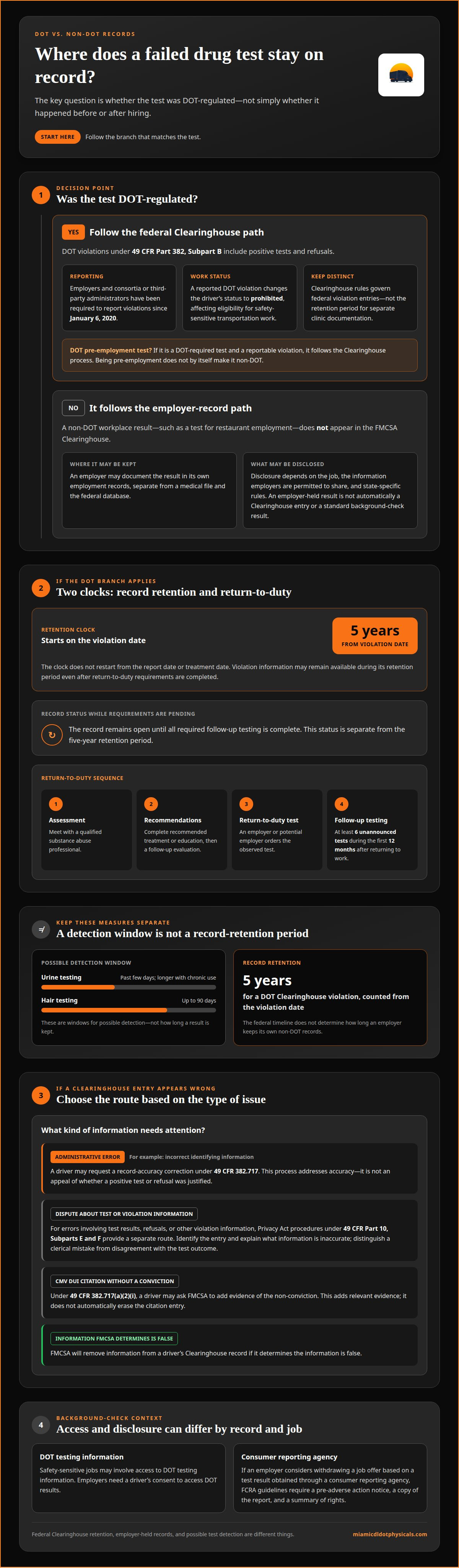
For CDL drivers, DOT drug and alcohol violations are recorded in the FMCSA Drug and Alcohol Clearinghouse. A separate medical record is different: Clearinghouse retention rules govern federal violation entries, not the retention period for clinic documentation.
Clearinghouse Violation Reporting and Retention
The Clearinghouse records violations of drug and alcohol prohibitions under 49 CFR Part 382, Subpart B, including positive tests and refusals. Employers and consortia or third-party administrators have been required to report these violations since January 6, 2020. A reported DOT violation changes the driver’s status to prohibited, which affects eligibility for safety-sensitive transportation work.
The record remains open until all required follow-up testing is complete, and the retention period is five years from the violation date, not the report or treatment date. The Clearinghouse may still contain violation information after a driver completes the return-to-duty requirements and follow-up testing.
Pre-Employment Test Records
A failed pre-employment test for a non-DOT job, such as restaurant employment, does not appear in the FMCSA Clearinghouse. An employer may document the result in its own employment records, separate from a medical file and the federal database. Future access depends on the job and the information employers are permitted to disclose.
For a DOT-regulated role, a failed pre-employment test is a DOT violation and follows the Clearinghouse process. The distinction matters: whether the test is DOT-regulated, not simply whether it happened before hiring, determines if it belongs in that system.
State and Industry Retention Differences
Yes. DOT-regulated transportation jobs follow federal Clearinghouse rules, while non-DOT workplace testing involves employer records and state-specific disclosure laws. State rules can affect whether employers disclose information. A result held by one employer is not automatically a Clearinghouse entry or a standard background-check result.
After a DOT violation, the return-to-duty process includes an assessment with a qualified substance abuse professional, recommended treatment or education, and a follow-up evaluation. An employer or potential employer orders the observed return-to-duty test. According to the Federal Motor Carrier Safety Administration, follow-up testing includes at least six unannounced tests during the first 12 months after returning to work.
How long failed drug screens remain on record
A drug-test detection window and a record-retention period measure different things. Urine testing can show use from the past few days, or longer with chronic use, while hair testing can show use for up to 90 days. Those windows describe possible detection, not how long an employer or the FMCSA Drug and Alcohol Clearinghouse keeps a result. If you’re asking, “How long does a failed drug test stay on your record?” first identify which record you mean.
For a DOT violation, the Clearinghouse retention period is five years from the violation date. The record remains open until required follow-up testing is complete, and reporting or treatment dates don’t restart that clock. Completing the return-to-duty process doesn’t immediately erase violation information. The entry may remain available during its retention period.
A non-DOT employment drug test follows a different record path. An employer may document a failed pre-employment result in its own records, but that result doesn’t appear in the Clearinghouse unless it was a DOT-required test and a reportable violation. The federal Clearinghouse timeline doesn’t determine how long an employer retains its own record.
Disclosure rules also vary by state. In most cases, a former private employer may not share specific drug-test details in a background check, though it may say the employee didn’t meet company standards. Safety-sensitive jobs may involve access to DOT testing information, and employers need a driver’s consent to access DOT results.
If an employer uses a consumer reporting agency and considers withdrawing a job offer based on a test result, FCRA guidelines require a pre-adverse action notice, a copy of the report, and a summary of rights. Review the report for incorrect information and use its dispute process if something is inaccurate. If you’re asking, “How long does a failed drug test stay on your record?” the answer also depends on whether the record is an employer file or a Clearinghouse entry.
Driver requests to correct or remove records
A driver can request a correction when a Clearinghouse entry contains an administrative error, such as incorrect identifying information. Under 49 CFR 382.717, the correction process addresses record accuracy, not whether a positive drug test or refusal was justified. That distinction matters: a correction request is not an appeal of the underlying drug-and-alcohol testing decision or related conduct.
For errors involving test results, refusals, or other violation information, drivers may use Privacy Act procedures under 49 CFR Part 10, Subparts E and F. These procedures provide a separate route for requesting correction of information in a federal record. Identify the entry at issue and explain what information is inaccurate; a driver seeking a correction should distinguish a clerical mistake from disagreement with the test outcome.
There is also a specific provision for a CMV DUI citation that did not result in conviction. Under 49 CFR 382.717(a)(2)(i), a driver may ask FMCSA to add evidence of that non-conviction to the Clearinghouse record. This request adds relevant evidence; it does not erase the citation entry automatically. Keeping supporting records together can help clarify what the driver is asking FMCSA to update.
Removal depends on whether the information is false. FMCSA will remove information from a driver’s Clearinghouse record if it determines that the information is false. A request to correct an administrative error therefore differs from asking to delete an accurate violation. The process under 49 CFR 382.717 cannot be used to challenge the accuracy or validity of a test result, refusal, or other violation itself.
Before taking action, identify whether the issue is an incorrect record, missing evidence, or disagreement with a positive result. For example, a driver with proof that a reported violation belongs to someone else is raising a record-accuracy issue. A driver who disputes the test’s validity is challenging the result, which the correction process does not cover. Clear records and a precise explanation help define the request.
How long does a failed pre-employment drug test stay on your employment record?
A failed pre-employment result may be documented in an employer’s records, but it is generally kept confidential. There isn’t one retention period that applies to every employer record. Workplace policies and state disclosure rules affect how the information is handled and whether it may be shared later.
An employer file is different from the FMCSA Clearinghouse and a medical record. A non-DOT employment test, such as a screening for a restaurant job, doesn’t appear in the Clearinghouse. A test for a safety-sensitive transportation position may have different consequences if it is DOT-required and reported as a violation. The test’s regulatory status determines which record system applies.
For a future background check, a former private employer may generally disclose that an employee didn’t meet company standards without giving specific drug-test details. Government positions may seek information about failed tests. DOT testing results also have specific access rules: an employer must have the driver’s consent to access them. A past result therefore doesn’t automatically appear in every employment screening.
If an employer uses a consumer reporting agency and considers withdrawing a job offer based on a drug-test report, the Fair Credit Reporting Act requires a pre-adverse action notice, a copy of the report, and a summary of rights. Review the report for incorrect information and use its dispute process if something is inaccurate. This addresses a reporting problem; it doesn’t determine how long an employer keeps its internal file.
For drivers preparing for a transportation role, get support with required testing as part of planning the next employment step.
Miami CDL/DOT Physical Exam Center
Miami CDL/DOT Physical Exam Center helps commercial drivers with testing and compliance needs as they plan their next employment step. Its FMCSA Clearinghouse Consortium supports owner-operators and fleet companies with federal compliance requirements, including the Clearinghouse program discussed above.
Turn to the center for a DOT physical exam or Clearinghouse compliance support for your driving work or fleet. These services support practical steps related to commercial driving requirements, but they don’t replace FMCSA’s record-correction process or determine whether a disputed test result is accurate.
For a DOT physical exam or Clearinghouse Consortium support, contact Miami CDL/DOT Physical Exam Center.
Take the Next Step With Confidence
Knowing how long a failed drug test stays on your record can help you plan your next move, but the right step depends on your immediate goal. If you’re preparing for a commercial driving role, keep employment screening and medical qualification needs separate from any request to correct a record. Each serves a different purpose, and addressing the right need can help you move forward with greater clarity.
Miami CDL/DOT Physical Exam Center offers DOT physical exams and DOT and non-DOT drug testing for drivers and employers. These services support testing and qualification needs, while Clearinghouse record corrections remain a separate process.
For help with your next testing or physical exam step, contact Miami CDL/DOT Physical Exam Center. Take the next step when you’re ready.
Frequently Asked Questions
Failed Drug Test: Does It Show on a Background Check?
Usually, a failed workplace drug test doesn’t appear on a standard background check as a criminal record. Employment screening can include different reports, however, and safety-sensitive positions may involve access to DOT testing information. A government position may also seek information about failed tests. Check which type of report is being used: an employer’s internal file, a consumer report, and a criminal-record search are different records.
What happens if a candidate fails a pre-employment drug test?
A candidate may lose a job opportunity if passing the test is a condition of employment. For some regulated roles, a candidate may need to complete a return-to-duty process before returning to safety-sensitive work. For a non-DOT position, the employer’s written policy and applicable state rules shape the response. A candidate disputing a consumer report can use the report’s dispute process.
Why Can't I Drive Right Now?
If you’re a CDL driver with prohibited status in the FMCSA Clearinghouse, you can’t perform commercial driving duties. Since November 18, 2024, drivers with prohibited status also can’t obtain a CDL until that status is cleared. A DOT violation can trigger removal from safety-sensitive work. The next step is completing the applicable Return to Duty process; a correction request applies to record errors, not a challenge to the test itself.
How long does a failed DOT drug test stay on the FMCSA Drug and Alcohol Clearinghouse?
A DOT violation is retained for five years from the violation date. The entry remains open until required follow-up testing is complete, so finishing the initial Return to Duty steps doesn’t by itself close the violation. For example, a driver whose follow-up plan is still underway may have an open record even after returning to work. The violation date, not the reporting date, starts the retention period.
Do failed drug tests appear on criminal background checks or consumer reports?
A failed test alone generally isn’t a criminal conviction, so it usually won’t appear as one in a criminal-record search. A test connected to a criminal conviction may be found through public records. A consumer report is different: depending on the report and circumstances, it may contain employment-related information. If a report affects a hiring decision, review it for errors and use the provided dispute process.
Can an employer share failed drug test results with future employers?
For DOT testing results, an employer needs your consent to access them. In most cases, a former private employer may say you didn’t comply with company standards, but may not provide specific drug-test details in a background check. Disclosure rules vary by state, and government or safety-sensitive roles may involve different access. What is shared can depend on the record type, job, consent, and applicable state rules.


