

A failed DOT drug test can affect your Clearinghouse record and your eligibility to drive commercially. A reported violation may place you in prohibited status, barring safety-sensitive work until you complete the required return-to-duty process. To understand how to challenge a failed DOT drug test, first identify what the result means and which steps can address it.
It’s understandable to worry that one result could end your driving career. But a reported violation, your Clearinghouse status, and the consequences for your CDL are related, not identical. Challenging a result also does not bypass the required return-to-duty steps.
This article explains how test-result terminology affects your record, what may happen to your CDL and commercial driving eligibility, and how the SAP and return-to-duty process works. It also explains how drug testing and Clearinghouse support can help you understand your compliance obligations and next steps.
Key Takeaways
- Learn how result terminology affects what a DOT drug test outcome means for your record.
- Understand why a verified positive means you must stop safety-sensitive work while the required process is underway.
- See how a Clearinghouse violation and CDL consequences relate, and why they are not the same thing.
- Recognize the key return-to-duty steps that affect eligibility to resume commercial driving.
Stopping safety-sensitive work after a verified positive
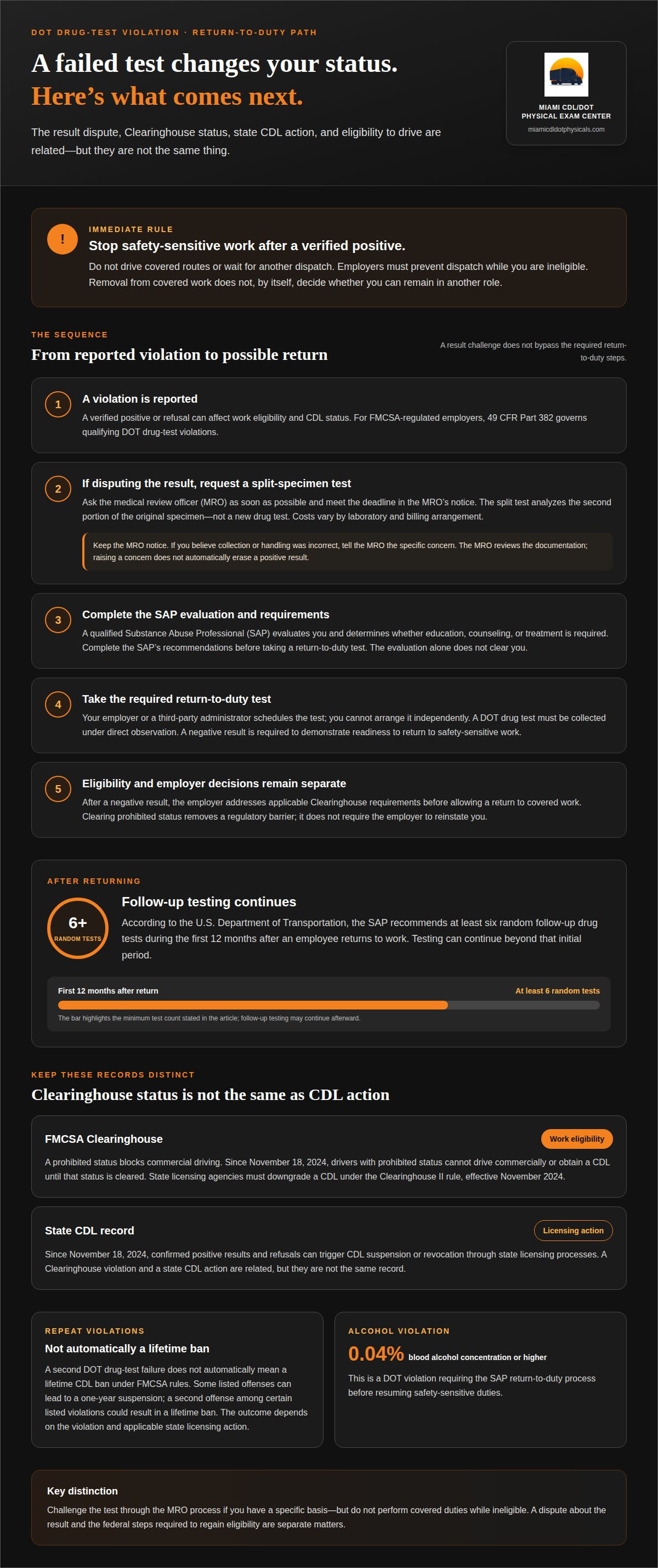
A verified positive DOT drug test requires immediate removal from safety-sensitive functions. For a commercial driver, that means stopping covered driving work, not changing routes or waiting for another dispatch. Federal testing rules treat the result as a violation that must be addressed before you can return to those duties. Employers must prevent dispatch while you remain ineligible.
Removal from work and a decision about your future employment are separate matters. The immediate restriction applies to safety-sensitive work, such as operating a commercial motor vehicle under DOT rules. It does not determine whether your employer will keep you in another role or reinstate you later. Do not perform covered duties while the required process is incomplete.
The next step is an evaluation by a qualified Substance Abuse Professional, or SAP. The SAP assesses you and determines what education or treatment you need before a return-to-duty test. Completing the evaluation alone does not clear you. You must complete the SAP’s requirements and meet the return-to-duty testing requirement before resuming safety-sensitive work.
After a negative return-to-duty test, the SAP sets follow-up testing requirements. According to the U.S. Department of Transportation, a SAP recommends at least six random follow-up drug tests during the first 12 months after an employee returns to work. Follow-up testing can continue beyond that initial period, so a return is not the end of the monitoring process.
Employers should confirm your eligibility before dispatch and maintain required follow-up testing records. The FMCSA Drug and Alcohol Clearinghouse also affects your status after a reported violation. If you have not completed the SAP process, you remain ineligible for covered safety-sensitive duties. When considering how to challenge a failed DOT drug test, separate a dispute about the result from the federal steps required to regain eligibility.
CDL consequences of a failed DOT drug test
A confirmed positive or refusal can affect both work eligibility and CDL status. For FMCSA-regulated employers, 49 CFR Part 382 governs handling qualifying DOT drug-test violations. Since November 18, 2024, confirmed positive results and refusals can trigger CDL suspension or revocation through state licensing processes. A Clearinghouse violation and a state CDL action are related, but they are not the same record.
After notification, request a split-specimen test through the medical review officer (MRO) as soon as possible. Your request must meet the deadline in the MRO’s notice. A split test analyzes the second portion of the original specimen, not a new drug test. Costs vary by laboratory and billing arrangement, so confirm how payment is handled when you make the request.
Act promptly: do not perform safety-sensitive driving, keep the MRO’s notice, and request a split-specimen test within the stated deadline. Then follow your employer’s instructions for the SAP evaluation and return-to-duty process. The carrier must address applicable reporting and Clearinghouse requirements before you return to covered work.
If you believe collection or handling procedures were incorrect, tell the MRO the specific concern, such as a collection-procedure issue or a discrepancy in the records. The MRO reviews the test documentation and determines whether the reported result stands under applicable procedures. Raising a concern does not automatically erase a positive result; the details and records matter.
Repeat violations can bring further consequences, but a second DOT drug-test failure does not automatically mean a lifetime CDL ban under FMCSA rules. Some listed offenses can lead to a one-year CDL suspension, while a second offense among certain listed violations could result in a lifetime ban. The outcome depends on the violation and applicable state licensing action, not simply on the number of positive results. Keep your Clearinghouse status separate from your state CDL record when assessing the consequences.
DOT prohibited status and commercial driving eligibility
A prohibited status in the FMCSA Drug and Alcohol Clearinghouse blocks commercial driving. Since November 18, 2024, drivers with prohibited status cannot drive commercially or obtain a CDL until that status is cleared. This makes the Clearinghouse record more than an employer file. State driver licensing agencies must downgrade a CDL under the Clearinghouse II rule, effective November 2024.
To clear prohibited status after a DOT violation, you must complete the SAP return-to-duty process. A qualified Substance Abuse Professional evaluates you and determines whether education, counseling, or treatment is required. Complete the SAP’s recommendations before taking a return-to-duty test. You must have a negative result to demonstrate readiness to return to safety-sensitive work.
Your employer or a third-party administrator schedules the return-to-duty test; you cannot arrange it independently. A DOT drug test must be collected under direct observation. After a negative result, your employer addresses applicable Clearinghouse requirements before allowing you to return to covered work. Completing the program removes a regulatory barrier, but does not require your employer to reinstate you.
Alcohol testing can also lead to prohibited status. A blood alcohol concentration of 0.04% or higher is a DOT violation requiring the SAP return-to-duty process. A driver must complete the required process before resuming safety-sensitive duties, whether the violation involved drugs or alcohol. A Clearinghouse status change and an employer’s hiring decision remain separate issues.
Follow-up testing remains part of your eligibility obligations after you return. A positive result or refusal during follow-up testing counts as a new violation and is reported separately in the FMCSA Clearinghouse. That entry can affect your commercial driving eligibility again. Drivers and employers should treat each status update as a separate compliance event, rather than assuming an earlier negative return-to-duty test resolves later violations.
DOT drug test result terminology
For transportation workers, “positive,” “verified,” and “reported” describe different stages, not interchangeable outcomes. Knowing who reviews each result can help you understand what you can dispute and what affects safety-sensitive work.
MRO Review of Positive Results
A medical review officer (MRO) reviews a laboratory-positive result before reporting it as a verified positive. The MRO may determine that a legitimate medical explanation changes the final result, but cannot cancel a positive simply because you disagree.
This review matters because an initial laboratory finding and a verified result are not identical. The MRO considers the relevant medical explanation and test information, then reports the determination through the required process. DOT rules set MRO qualification requirements under § 40.121. If a driver believes the result is wrong, raising that concern through the MRO process is more directly relevant than treating an employer conversation as a formal reversal.
You can also raise a concern with your employer or union representative. These conversations may help address workplace procedures, but they do not change the MRO’s result or replace the applicable testing process.
Medications and Positive Test Results
A prescription or other medication may be relevant to the MRO’s review of a positive drug test. It does not automatically make the result negative; the MRO evaluates whether the medical explanation accounts for the finding.
Provide accurate medication information through the MRO’s review process rather than assuming a prescription alone resolves the result. An alcohol test is separate from a drug test, so medication information does not explain every drug or alcohol violation. The key question is whether the MRO verifies the finding after considering the information you provide.
“Positive” refers to a test finding, while “verified positive” reflects the MRO’s determination. A reported violation can affect your driving eligibility and Clearinghouse status. The terminology helps explain how a case moves from testing to employment consequences.
For help with DOT drug testing and result questions, get support with DOT testing.
Miami CDL/DOT Physical Exam Center
Miami CDL/DOT Physical Exam Center helps commercial drivers and fleets address testing and Clearinghouse compliance needs nationwide. If a failed result raises questions about your status, its FMCSA Clearinghouse Consortium supports owner-operators and fleet companies across the country with federal compliance requirements. It does not replace the MRO’s review, the SAP process, or an employer’s return-to-duty decisions.
Turn to the center for a DOT Physical Exam or support with Clearinghouse compliance regardless of your location. Its DOT Drug Test and Non-DOT Drug Test services also address testing needs, but a new test does not undo a prior verified positive. Identifying the issue helps you choose the relevant service and next step.
Contact Miami CDL/DOT Physical Exam Center for help with your testing or Clearinghouse needs.
Make your next move with a clear record
Keep questions about the test result separate from the steps needed to restore work eligibility. This distinction helps you direct each issue to the right part of the process instead of treating one conversation as a complete appeal. If you are considering how to challenge a failed DOT drug test, focus on the specific concern, such as the result review, collection procedure, or record status.
Gather the notices and communications you have received, and keep their dates and details together. Clear records make it easier to explain your concern and identify what remains to be addressed. Do not assume that a new test or discussion with your employer alone changes an existing result or status.
For help with your DOT-related needs, contact Miami CDL/DOT Physical Exam Center. Take the next step with a clear understanding of the issue, and move forward one part of the process at a time.
Frequently Asked Questions
Does a failed DOT drug test go on your record?
A DOT drug-test violation can be reported to the FMCSA Drug and Alcohol Clearinghouse, where it affects your status. Information about a violation and the return-to-duty process remains there for five years from the violation date or until all required follow-up testing is completed, whichever is later. This is a federal compliance record, not the same thing as a criminal record.
What Happens When a CDL Driver Fails a Drug Test?
A CDL driver with a verified positive result or test refusal must stop safety-sensitive work, and the violation can affect Clearinghouse status and CDL eligibility. The driver must complete the SAP return-to-duty process before returning to covered duties. For example, you cannot keep operating a commercial vehicle while waiting for the required evaluation, even if your employer has not made a separate employment decision.
What is the Return to Duty process?
The return-to-duty process is the required path for a driver with a DOT violation to become eligible for safety-sensitive work again. A Substance Abuse Professional evaluates the driver, sets any required education or treatment, and determines when the driver may take the return-to-duty test. The employer or its third-party administrator schedules the test. A negative result is required before the driver returns to covered duties.
Can You Retake a Drug Test After Failing?
A new test does not erase or replace a verified positive DOT result. If you dispute a positive drug test, you may request testing of the split specimen through the medical review officer, following the deadline in the notice. This tests the second portion of the original specimen, not a fresh collection. The return-to-duty test comes later, after you complete the SAP’s required steps.
Why Can't I Drive Right Now?
You may be unable to drive commercially because a DOT violation placed you in prohibited status in the FMCSA Clearinghouse. Since November 18, 2024, prohibited drivers cannot drive commercially or obtain a CDL until the status is cleared. Check whether the required return-to-duty steps are complete and whether the Clearinghouse status has changed. A completed process does not require an employer to reinstate you.
What counts as a failed DOT drug test under federal regulations?
A verified positive drug-test result or a refusal to test can count as a DOT violation. A refusal may include failing to appear for a directed collection, delaying without a valid reason, or leaving before the test is complete. DOT alcohol-test violations are distinct from drug-test results; a blood alcohol concentration of 0.04% or higher is also a violation requiring the SAP return-to-duty process.


