

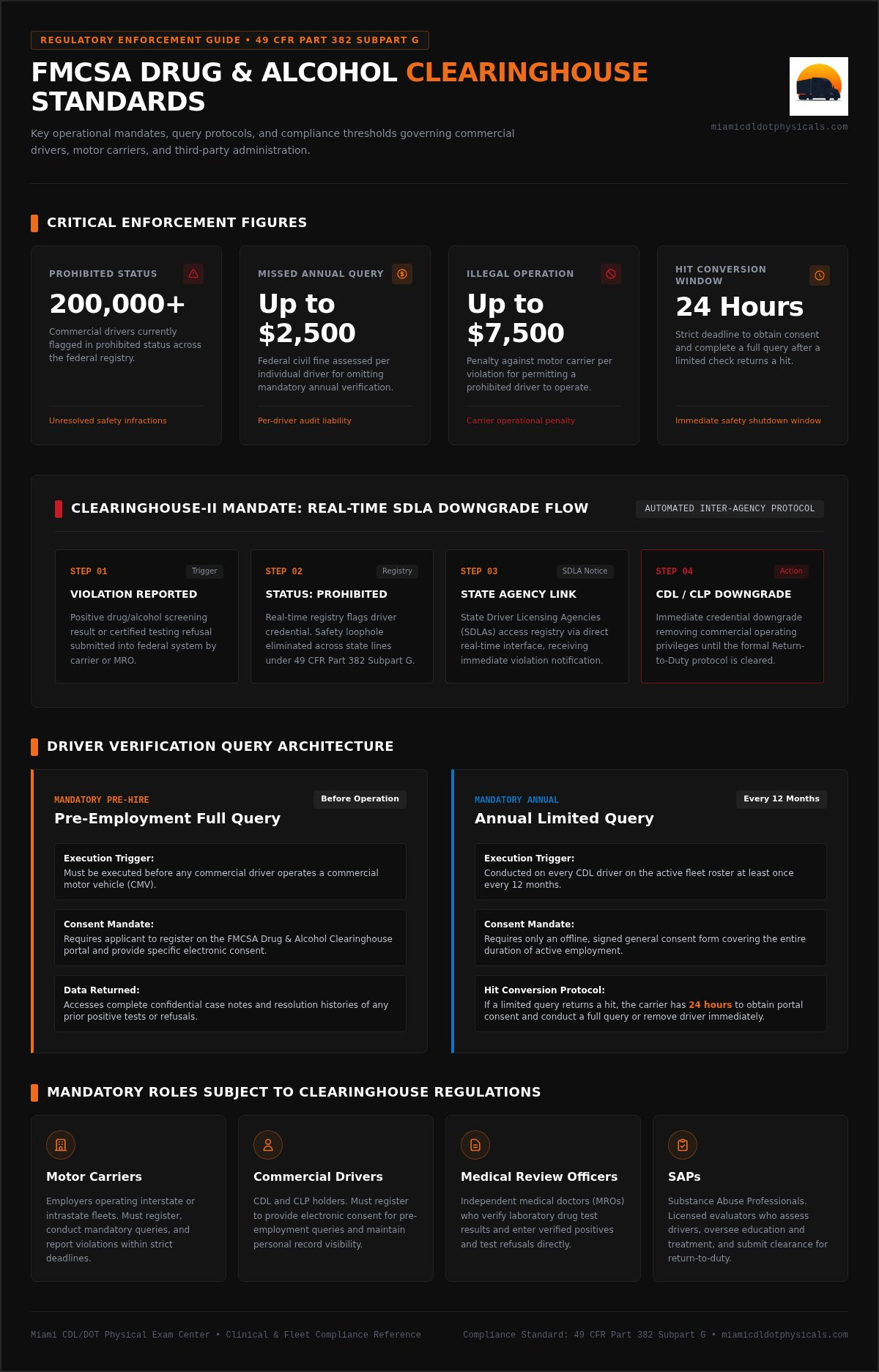
Over 200,000 commercial drivers currently sit in prohibited status, and missing a single mandatory annual query can trigger federal fines of up to $2,500 per driver. Managing driver verification, reporting deadlines, and random testing pools often feels like an endless administrative burden that drains valuable fleet resources. Whether you oversee nationwide fleet safety operations or coordinate interstate routes across the country, relying on reactive manual paperwork leaves your business vulnerable to severe audits and immediate CDL downgrades.
True Clearinghouse compliance succeeds through automated consortium workflows, not disorganized recordkeeping. You don't have to tackle these complex federal mandates alone or stress over missed 24-hour reporting windows. This guide delivers an actionable compliance roadmap to help you master pre-employment checks, mandatory reporting schedules, and third-party administration. Here is everything you need to establish an airtight verification protocol and keep your qualified drivers safely on the road.
Key Takeaways
- Understand the operational differences between mandatory pre-employment full queries and annual checks to protect your commercial operating authority.
- Streamline your FMCSA Clearinghouse compliance Miami protocols or nationwide fleet workflows by leveraging an automated consortium model that handles routine verification.
- Identify mandatory reporting deadlines for drug and alcohol violations, refusals, and testing records to avoid severe federal penalties.
- Clarify dual-registration requirements for owner-operators and learn how designated third-party administrators keep independent drivers compliant.
- Master the structured Return-to-Duty and Substance Abuse Professional process to safely navigate violations and clear prohibited driver statuses.
What Is the FMCSA Clearinghouse and Who Must Comply?
The Drug and Alcohol Clearinghouse is a centralized federal database that tracks commercial drivers who test positive for prohibited substances or refuse a test. Established under 49 CFR Part 382 Subpart G, this real-time registry eliminates a long-standing safety loophole. In the past, a driver could fail a drug screening with one carrier and secure employment with another simply by omitting past employment history. Today, the platform ensures that safety violations follow the driver, preventing anyone with an unresolved infraction from operating a commercial motor vehicle.
Maintaining complete regulatory standing is essential for fleets of every size. Whether you manage a nationwide logistics fleet or handle operational oversight for Federal Motor Carrier Safety Administration (FMCSA) Clearinghouse compliance Miami networks, staying ahead of federal registry protocols protects your business from devastating operational disruptions.
Mandatory Roles Subject to Clearinghouse Regulations
Federal law places strict responsibilities on every party operating within commercial transportation:
- Motor Carriers: Employers operating interstate or intrastate commercial fleets must register, conduct mandatory driver queries, and report violations within strict deadlines.
- Commercial Drivers: CDL and commercial learner's permit (CLP) holders must register to provide electronic consent for pre-employment queries and track their own status.
- Medical Review Officers (MROs): Independent medical professionals verify laboratory drug test results and directly enter verified positives and test refusals into the system.
- Substance Abuse Professionals (SAPs): Licensed evaluators guide drivers through assessment, education, treatment plans, and return-to-duty clearance.
The Consequences of Non-Compliance and CDL Downgrades
Federal oversight has entered a far stricter enforcement era. Under the Clearinghouse-II mandate, State Driver Licensing Agencies (SDLAs) have direct, real-time access to the registry. The moment an unresolved violation is entered, the driver is flagged in "prohibited" status. SDLAs are federally required to initiate an immediate downgrade of the driver's CDL or CLP credential, removing their commercial operating privileges on the spot.
Carriers face severe civil penalties if they ignore these mandates. Under updated federal guidelines, failing to conduct a required annual query carries fines up to $2,500 per driver. Permitting a driver with a prohibited status to operate can result in employer penalties up to $7,500 per violation. Partnering with a dedicated service model ensures seamless FMCSA Clearinghouse compliance Miami protocols and safeguards interstate operations against unexpected administrative shutdown.
The Core Pillars of Clearinghouse Compliance: Queries and Reporting
Operating a compliant commercial fleet demands a reliable system for two primary operational activities: conducting driver background checks and submitting violation data. A single missed filing can halt a driver's career or expose an employer to substantial audit penalties. Managing FMCSA Clearinghouse compliance Miami standards or nationwide carrier protocols requires your safety department to execute each step with precision.
Pre-Employment vs. Annual Driver Queries
Every motor carrier must execute specific types of queries depending on the driver's employment stage:
- Pre-Employment Full Queries: Before any commercial driver operates a vehicle, you must conduct a full query. This requires the applicant to register on the FMCSA Drug & Alcohol Clearinghouse official website and grant specific electronic consent within the portal.
- Annual Limited Queries: Employers must run a check on every CDL driver on their roster at least once every 12 months. This query confirms whether records exist without displaying confidential case notes. You only need an off-line, signed general consent form covering the duration of employment.
- Limited-to-Full Conversions: If an annual limited query returns a "hit" indicating violation records, you have exactly 24 hours to conduct a full query. The driver must log into the portal to provide electronic consent. If consent is refused or not completed within that window, you must immediately remove the driver from safety-sensitive functions.
Employer Reporting Obligations and Strict Deadlines
Motor carriers hold direct legal accountability for submitting specific violations into the registry. MROs report confirmed laboratory failures, but employers must report real-world behavioral non-compliance:
- Alcohol test results confirming a blood alcohol concentration of 0.04 or higher.
- On-duty alcohol use, pre-duty alcohol use within four hours of dispatch, and post-accident alcohol consumption before testing.
- Test refusals, including failing to show up at a collection facility or providing an adulterated specimen.
- Actual knowledge violations where a supervisor directly observes drug or alcohol use on duty.
- Negative return-to-duty test completions and ongoing follow-up testing schedules.
Enforcement guidelines enforce strict reporting turnaround. Employers must submit substantiated non-compliance events within three business days of receiving verified details. Once a driver completes an evaluation program, safety managers must log the negative return-to-duty result before scheduling dispatch. To eliminate these administrative burdens and keep your testing rosters up to date, consider working with a qualified FMCSA Clearinghouse Consortium to manage your queries, documentation, and federal reporting workflows automatically.
Owner-Operators vs. Fleet Employers: Compliance Management Models
Fleets with multiple drivers often operate differently than single-truck businesses, yet both face identical federal scrutiny. While large carriers typically maintain internal safety departments, independent drivers face distinct statutory limits. Securing reliable FMCSA Clearinghouse compliance Miami frameworks or nationwide program oversight depends entirely on choosing the right administrative model for your business structure.
The Federal C/TPA Mandate for Owner-Operators
A widespread misconception exists among independent truckers: many assume an owner-operator can manage their own Clearinghouse portal tasks entirely alone. Federal regulations strictly forbid this. Under 49 CFR Part 382, any driver who is also the employer must designate a Consortium/Third-Party Administrator (C/TPA) within the portal before operating a commercial motor vehicle.
Independent operators can't legally manage their own random drug testing pools or report their own violations, test refusals, or actual knowledge events. You can't act as an impartial referee for your own testing program. Your designated C/TPA conducts random selections through a pooled group of drivers, submits required reports, and assists in tracking compliance should a driver ever need to enter the federal Return-to-Duty (RTD) process. Operating without an active, portal-linked C/TPA invalidates your compliance status immediately during a safety audit.
Comparing Internal DER Administration vs. Full Consortium Management
Medium and large fleets usually choose between appointing an in-house Designated Employer Representative (DER) or delegating routine tasks to an experienced third-party administrator:
- Internal DER Model: Your safety staff tracks query consent, purchases portal query plans, monitors 24-hour conversion deadlines, and schedules random testing internally. This approach keeps control inside your company, but it creates heavy administrative overhead and exposes your team to direct liability if a staff member misses a strict deadline.
- Turnkey Consortium Model: An outsourced partner automates annual queries, manages random testing pools, tracks consent documentation, and handles complex reporting tasks on schedule.
Delegating operational management through an established consortium eliminates the guesswork from federal mandates. It dramatically cuts administrative burdens while ensuring your FMCSA Clearinghouse compliance Miami fleet standards remain audit-ready year-round.
A Step-by-Step Clearinghouse Compliance Checklist for Fleets
Establishing an audit-ready compliance framework protects your motor carrier authority from surprise enforcement penalties. Safety managers need a clear, repeatable process rather than reactive record-scrambling when investigators arrive. Following a structured roadmap ensures complete FMCSA Clearinghouse compliance Miami protocols and nationwide regulatory alignment across every terminal you manage.
Initial Portal Registration and Role Designation
Building your operational foundation begins directly within the federal clearinghouse system. Complete these critical administrative actions before placing any driver behind the wheel:
- Establish Login.gov Credentials: Register your motor carrier portal account using verified organizational credentials, linking your USDOT and Motor Carrier (MC) identification numbers.
- Authorize Internal Personnel: Designate your primary Designated Employer Representative (DER) and invite secondary staff as Clearinghouse Assistants to oversee routine tasks.
- Formally Designate Your C/TPA: Search for your third-party consortium partner within the portal directory and assign their specific user permissions, authorizing them to run queries and submit mandatory reports on your behalf.
- Acquire Government Query Bundles: Purchase sufficient federal query plans directly through the system so your administrative team never faces hiring delays due to a zero balance.
Ongoing Fleet Auditing and Record Retention
Federal audits focus heavily on your historical documentation and operational routines. 49 CFR Part 382 mandates that motor carriers retain complete records of all queries conducted, along with signed general consent forms, for a minimum of three full years. Storing these records securely in digital driver qualification files proves continuous oversight during official reviews.
Establish automated recurring reminders across your calendar system to execute annual driver roster checks before the 365-day mark expires. Failing to run an annual query on just a few drivers quickly turns routine compliance reviews into devastating financial liabilities. Integrating your required DOT physicals, random testing pools, and Clearinghouse query schedules under a single workflow keeps your driver files pristine.
Ready to automate your regulatory workload? Join our FMCSA Clearinghouse Consortium today to secure comprehensive oversight, reliable driver screening, and total audit confidence for your fleet.
Navigating Violations: The Return-to-Duty and SAP Process
A positive test or test refusal halts a driver's commercial career instantly, but it doesn't have to end it permanently. When a driver enters prohibited status, strict federal rules dictate how carriers and drivers must proceed. Executing this recovery sequence correctly protects fleet safety while preserving FMCSA Clearinghouse compliance Miami standards and nationwide motor carrier operations.
The Step-by-Step Return-to-Duty Sequence
Resolving a prohibited record requires a methodical, federally supervised progression:
- Immediate Removal: The employer must immediately pull the driver from all safety-sensitive functions upon receiving notice of a violation. Allowing a prohibited driver to operate triggers massive federal fines.
- SAP Designation: The driver selects and designates a DOT-qualified Substance Abuse Professional (SAP) through the federal portal. The SAP must accept the request electronically before proceeding.
- Evaluation and Education: The SAP conducts a face-to-face clinical evaluation, prescribes an appropriate treatment or educational program, and monitors completion.
- Follow-Up Evaluation: After the driver completes the program, the SAP conducts a follow-up evaluation to determine readiness to resume safety-sensitive work.
- Directly Observed RTD Test: Once the SAP submits the notice of eligibility, the employer orders a directly observed return-to-duty drug or alcohol test. Safety managers must log the negative result in the portal before dispatching the driver.
Managing Mandatory Follow-Up Testing and Status Reinstatement
A negative return-to-duty test restores the driver to an active, eligible status, but regulatory monitoring continues. The SAP establishes a mandatory follow-up testing plan requiring a minimum of six unannounced, directly observed tests during the first 12 months back on the job. Depending on the clinical assessment, this follow-up schedule can extend up to 60 months. Employers and consortium administrators must track and log each completed test to close out the driver's program successfully.
Partnering with Certified DOT Testing Professionals
Handling observed collections and strict testing chains requires specialized clinical oversight. Flawed chain-of-custody paperwork or testing delays leave your business exposed to non-compliance penalties. Working with certified examiners who handle DOT Physical Exam requirements, DOT Drug Test protocols, and consortium reporting in a unified environment removes administrative chaos. Choosing certified professionals guarantees accurate test execution, safeguards CDL credentials, and maintains seamless FMCSA Clearinghouse compliance Miami protocols for long-term fleet success.
Take Control of Your Fleet Compliance and Protect Your Operating Authority
Maintaining federal clearinghouse compliance doesn't have to strain your fleet's daily schedule. Staying ahead of mandatory full pre-employment queries, conducting automated annual roster checks, and preserving organized digital qualification files for three full years protects your business against severe audit penalties. Whether coordinating interstate carrier routes or strengthening your FMCSA Clearinghouse compliance Miami systems, proactive management keeps your commercial drivers qualified and dispatched without disruption.
Our FMCSA-certified medical examiners and testing specialists provide total regulatory confidence under one roof. From certified DOT Physical Exam services and DOT Drug Test screenings to complete FMCSA Clearinghouse Consortium administration, our turnkey programs remove administrative friction for both multi-truck fleets and independent owner-operators. Partner with our consortium team today to streamline your testing workflows, protect your CDL credentials, and keep your commercial fleet moving forward with total peace of mind.
Frequently Asked Questions
How often must motor carriers query the FMCSA Clearinghouse for current drivers?
Employers must conduct a Clearinghouse query for each employed CDL driver at least once every 12 months. Carriers typically run a limited query for these annual checks. If that limited check reveals a record hit, the employer has 24 hours to conduct a full query with electronic driver consent. Establishing automated annual scheduling is vital for maintaining the reliable FMCSA Clearinghouse compliance Miami fleets and nationwide motor carriers require.
Can an independent owner-operator manage their own FMCSA Clearinghouse compliance?
No, federal regulations strictly forbid owner-operators from self-managing their own compliance program. Under 49 CFR Part 382, an owner-operator must designate an authorized Consortium/Third-Party Administrator (C/TPA) directly inside the federal portal before operating. Independent drivers can't legally manage their own random testing pools or submit their own violation reports. Your designated C/TPA handles these mandatory administrative responsibilities to maintain your legal operating authority.
What happens if an employer fails to conduct mandatory Clearinghouse queries?
Employers face steep federal civil penalties, potential safety rating downgrades, and severe liability risks. Failing to execute a mandatory annual query carries civil fines of up to $2,500 per driver. Permitting a driver with an unresolved prohibited status to operate can result in penalties up to $7,500 per incident. Federal auditors routinely review query logs during compliance reviews, and missing records quickly lead to formal enforcement actions.
How long do drug and alcohol violations remain visible in the Clearinghouse?
Violations remain visible to prospective employers for five years or until the driver completes the Return-to-Duty process, whichever is later. A violation doesn't simply disappear after five years if a driver hasn't resolved the issue. Both the five-year timeline and successful completion of the Substance Abuse Professional evaluation, return-to-duty test, and follow-up testing plan must occur before records drop from standard employer query results.
What is the exact difference between a limited query and a full query?
A limited query only confirms whether violation records exist for a driver, without displaying specific details. Full queries reveal complete violation data, including test dates, substance types, and return-to-duty status. Limited queries rely on an off-line, signed general consent form and suit annual reviews. Full queries are mandatory prior to employment and require the driver to log into the federal portal to provide electronic consent directly.
Does a standard DOT physical examination automatically satisfy Clearinghouse query requirements?
No, a DOT physical examination is a separate regulatory requirement and does not fulfill Clearinghouse obligations. The physical exam certifies physical and medical qualification, while the Clearinghouse tracks drug and alcohol violations. However, bundling your DOT Physical Exam, DOT Drug Test, and consortium administration under a single provider simplifies operations, streamlining your FMCSA Clearinghouse compliance Miami workflows and fleet qualification files under one cohesive system.
How does the FMCSA Clearinghouse-II rule impact a driver’s commercial driver’s license?
The Clearinghouse-II mandate gives State Driver Licensing Agencies direct, real-time access to the federal violation database. If a commercial driver receives a violation or test refusal, their record immediately switches to prohibited status. State agencies are legally mandated to downgrade the driver's commercial credential to a standard non-commercial license. The driver cannot legally drive any commercial vehicle until they complete the entire return-to-duty sequence.


