

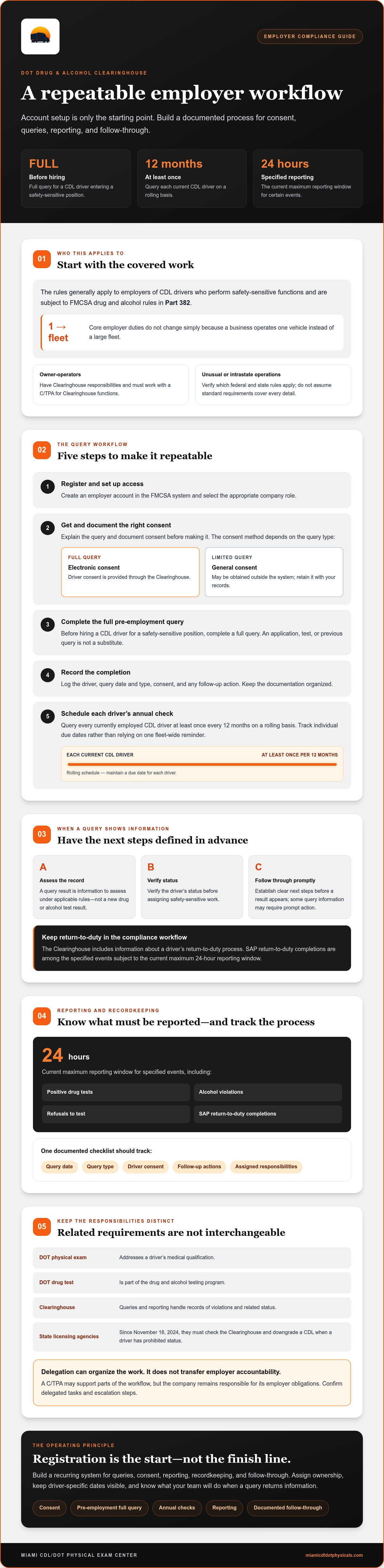
A Clearinghouse account does not keep your company compliant by itself. The DOT Clearinghouse requirements for employers call for a repeatable process: complete a full query before hiring a CDL driver for a safety-sensitive position, then query each current CDL driver at least once every 12 months. Consent, reporting, and follow-through matter just as much as registration.
It can be difficult to know where the employer’s duties end and a C/TPA’s, MRO’s, or SAP’s responsibilities begin. Delegating tasks can help organize the work, but employers remain responsible for meeting their obligations. A query result that shows information may also require prompt action, so establish clear next steps before that situation arises.
This 2026 checklist explains when to run limited and full queries, how to obtain driver consent, what to do when a violation appears, and how the return-to-duty process fits into compliance. It also covers reporting deadlines, recordkeeping, and delegation, so you can build a consistent workflow and identify which responsibilities stay with your company.
Key Takeaways
- Use the DOT Clearinghouse requirements for employers to build a recurring process, not treat account setup as a one-time task.
- Set a consistent workflow for driver consent, pre-employment full queries, and annual checks.
- Know how to respond to query information and verify a driver’s status before assigning safety-sensitive work.
- Track query dates, consent, follow-up actions, and assigned responsibilities in one documented checklist.
- A C/TPA may support parts of your process, but your company retains its employer responsibilities. Confirm delegated tasks and escalation steps.
DOT Clearinghouse requirements for employers: who must comply and why
The FMCSA Drug and Alcohol Clearinghouse is a secure federal database that records drug and alcohol program violations for commercial driver’s license (CDL) and commercial learner’s permit holders. It helps employers check a driver’s record and meet their responsibilities under federal drug and alcohol rules. The DOT Clearinghouse requirements for employers include querying drivers and reporting certain violations. Registration is only the starting point.
Which employers and drivers fall under the Clearinghouse rules?
Coverage generally applies to employers of CDL drivers who perform safety-sensitive functions and are subject to the Federal Motor Carrier Safety Administration’s drug and alcohol rules in Part 382. Part 382 sets requirements for these programs, including employer query and reporting duties. The core duties do not change just because a business operates one vehicle instead of a large fleet.
Owner-operators have responsibilities too and must work with a consortium/third-party administrator (C/TPA) for Clearinghouse functions. If your operation is intrastate or has an unusual operating arrangement, verify which federal and state rules apply rather than assuming the standard requirements cover every detail.
What information does the FMCSA Clearinghouse track?
The system holds records of reportable drug and alcohol program violations and information about a driver’s return-to-duty process. Authorized employers use it to check for relevant records when required. A query result is information to assess under the applicable rules, not a new drug or alcohol test result.
Employers also have reporting duties. The current maximum reporting window is 24 hours for specified events, including positive drug tests, alcohol violations, refusals to test, and SAP return-to-duty completions. A Clearinghouse check does not replace the employer’s broader drug and alcohol program.
How Clearinghouse duties differ from other requirements
Keep these responsibilities distinct. A DOT physical exam addresses a driver’s medical qualification. A DOT drug test is part of the testing program. Clearinghouse queries and reporting handle records of violations and related status. State driver licensing agencies have separate responsibilities. Since November 18, 2024, they must check the Clearinghouse and downgrade a CDL when a driver has prohibited status.
These steps work together, but completing one does not satisfy the others. Build a recurring process for queries, reporting, and recordkeeping instead of treating account registration as the finish line. A C/TPA may support parts of that workflow, but the employer remains responsible for its own compliance.
Employer query checklist: registration, consent, pre-employment, and annual checks
A reliable query process starts before a driver begins safety-sensitive work and continues throughout employment. These steps turn the DOT Clearinghouse requirements for employers into a repeatable workflow.
- Register and set up access. Create an employer account in the FMCSA system and select the appropriate company role. Check the FMCSA Drug & Alcohol Clearinghouse for current registration and identity-verification instructions.
- Get the right consent. Explain the query to the driver and document consent before making it. A full query requires the driver’s electronic consent in the Clearinghouse. A limited query uses general consent, which can be obtained outside the system and should be retained with your records.
- Run a full pre-employment query. Before hiring a driver for a safety-sensitive position, complete a full query. Do not treat an application, test, or previous query as a substitute for this required check.
- Record completion. Log the query date, type, driver, consent, and any follow-up action. Keep the documentation organized so your team can confirm completion and manage upcoming deadlines.
- Schedule annual queries. Query each currently employed CDL driver at least once every 12 months on a rolling basis. Assign someone to track each driver’s due date rather than relying on a single calendar reminder for the whole fleet.
Pre-employment queries: use a full query
A full query provides details about information in a driver’s record. The driver must provide electronic consent through the Clearinghouse before you can complete it. Build time for consent and the query into onboarding, and confirm completion before the driver performs safety-sensitive functions. Follow current FMCSA instructions for account access and consent steps.
Annual queries: limited first, full if needed
A limited query checks whether information exists without displaying its details. It can satisfy the annual query requirement when you have the driver’s general consent. If the result indicates that information is present, conduct a full query within 24 hours. The driver must provide electronic consent for that full query. Record the result and next action. A limited-query result is not the same as a new test result.
For owner-operators, a consortium/third-party administrator can support parts of the Clearinghouse workflow. Confirm which tasks are included and keep responsibility for obligations that remain with you. Employers who want to explore this type of support can ask about the FMCSA Clearinghouse Consortium.
What employers must do when a Clearinghouse query shows a violation
Act on the driver’s current Clearinghouse status, not on assumptions about what a record means. If the system shows a driver in prohibited status, you must not allow that driver to perform safety-sensitive functions. Stop covered work and follow the applicable process before considering a return.
A query result is not a new drug or alcohol test. It may reveal a reportable violation or related return-to-duty information, and records can reflect different circumstances or stages in the process. Review the result, confirm the driver’s status, and do not treat every record as if it signals the same event. The DOT Clearinghouse requirements for employers call for action based on the applicable rules and the information shown.
What prohibited status means for an employer
A prohibited status means the driver is not eligible to perform safety-sensitive functions under the applicable federal drug and alcohol requirements. Do not rely on a verbal explanation or a separate test result to override that status. Verify the Clearinghouse record and keep the driver out of covered duties unless the required return-to-duty process is completed and the status permits a return.
State driver licensing agencies must check the Clearinghouse and downgrade a CDL when the driver has prohibited status. This licensing consequence is separate from the employer’s duty to prevent prohibited work. Check current FMCSA guidance for details that apply to a specific record or status.
Return-to-duty: follow the required sequence
The employer cannot replace the required Substance Abuse Professional (SAP) process or independently decide that a driver is ready to return. In general, the process involves a SAP evaluation, completion of the education or treatment the SAP prescribes, and a follow-up evaluation. The driver must then complete a negative return-to-duty test before resuming safety-sensitive work. Return-to-duty tests must be directly observed.
- Keep the driver out of safety-sensitive functions while prohibited.
- Track required milestones and confirm completion through the appropriate Clearinghouse records.
- Verify current reporting and follow-up duties against the Clearinghouse Learning Center and applicable FMCSA guidance.
Reporting duties depend on the event and the role responsible for entering it. Employers must report applicable drug and alcohol program violations. MROs and SAPs have reporting responsibilities for matters within their roles. The maximum reporting window is 24 hours for specified events, including positive drug tests, alcohol violations, refusals to test, and SAP return-to-duty completions. Confirm who handles each report in your workflow, and make sure delegation does not leave a reporting gap.
A practical DOT Clearinghouse compliance checklist for daily operations
A written routine makes the DOT Clearinghouse requirements for employers easier to manage across hiring, annual reviews, and follow-up. Use this checklist as a starting point, then confirm current FMCSA rules for your operation.
- ☐ Assign ownership: Name a person responsible for monitoring Clearinghouse tasks and keeping the driver roster current.
- ☐ Record query deadlines: Track each covered driver’s last query date and schedule the next annual check within the required 12-month period.
- ☐ Confirm consent: Keep evidence of general consent for limited queries and verify electronic consent before completing a full query.
- ☐ Document query completion: Note the driver, query type, date, result, and any required next step.
- ☐ Check status before covered work: Follow up on information shown in a query and ensure a driver in prohibited status does not perform safety-sensitive functions.
- ☐ Track open actions: Record who will handle required reports or follow-up, and confirm each action is completed.
- ☐ Review access and records: Limit access to staff who need it and store Clearinghouse records separately from drug-testing program files.
What should an employer document for an audit?
Keep query completion records, consent evidence, and notes showing how your team handled results that required follow-up. Employers must retain evidence of a driver’s limited-query consent for three years. Violation information remains in the Clearinghouse for five years from the violation determination or until successful completion of the follow-up testing plan, whichever is later. These periods apply to the specified records. Verify current requirements for other employer files, access controls, and retention duties before setting your schedule.
How can employers reduce missed steps?
Maintain one roster for covered drivers, a calendar for annual query deadlines, and a consistent onboarding checklist for pre-employment queries. Review the roster whenever a driver joins or leaves so reminders stay tied to active employment. Small fleets need the same dependable tracking approach as larger ones, even if one person manages several responsibilities.
A C/TPA may assist with designated Clearinghouse tasks when properly authorized, but delegation does not remove the employer’s responsibility to oversee its process. Confirm exactly which tasks are included, who reviews results, and how unresolved issues are escalated. For more detail, see this FMCSA Clearinghouse consortium compliance guide. Employers and owner-operators can also learn about FMCSA Clearinghouse Consortium support as they organize their workflow.
Choosing Clearinghouse support and taking the next compliance step
Some employers manage Clearinghouse tasks internally. Others work with a consortium/third-party administrator (C/TPA) to support parts of the process. The right approach depends on your staffing and workflow, but neither option removes the employer’s responsibility to understand and oversee its duties. Support should make your process clearer, not leave uncertainty about who acts next.
What should employers ask a consortium or C/TPA?
Before enrolling or delegating tasks, get the provider’s scope in writing. Services vary, so do not assume every consortium handles the same work. Ask:
- Which enrollment, query, and administrative tasks do you handle, and which remain with our company?
- Who tracks due dates, manages consent steps, and records query completion?
- How will results or issues be escalated, and who is responsible for timely follow-up?
- What records will we receive, and how can we access them for our own files?
- What must our team approve, monitor, report, or document directly?
Use the answers to map responsibilities from start to finish. A C/TPA may support a documented employer workflow, but delegation does not transfer every employer obligation or guarantee compliance with the DOT Clearinghouse requirements for employers.
How can an employer get started with dependable support?
Prepare a current roster of covered drivers, your query schedule, and a short list of known gaps, such as missing consent evidence or unclear ownership of follow-up tasks. This gives you a practical starting point for deciding what to manage internally and what support may help.
Keep Clearinghouse administration distinct from drug testing. A DOT drug test is part of an employer’s testing program. It does not replace required queries, reporting, or recordkeeping. For information about the testing side, review this DOT drug testing compliance reference.
If you are considering outside support, ask about the FMCSA Clearinghouse Consortium and confirm which specific tasks are included. Keep your company’s responsibilities visible in the process, even when a provider assists with administration.
Make your Clearinghouse process part of daily operations
The DOT Clearinghouse requirements for employers are best managed as an ongoing workflow, with clear ownership for queries, consent, reporting, and follow-up. A consistent recordkeeping routine helps your team spot upcoming deadlines and respond appropriately when a query calls for action.
Choose whether to manage tasks internally or use C/TPA support, then confirm in writing what the provider handles and what your company must still oversee. Delegation can help organize the work, but it does not transfer every employer responsibility. Keep your process aligned with current FMCSA guidance.
The center offers an FMCSA Clearinghouse Consortium and DOT drug testing services. These are distinct forms of support, so ask which consortium tasks are included and how they fit your existing workflow. Ask about FMCSA Clearinghouse Consortium support to plan your next steps. With a clear process and defined responsibilities, you can manage compliance with greater confidence.
Frequently Asked Questions
Who is required to use the FMCSA Clearinghouse?
Employers of CDL drivers subject to applicable FMCSA drug and alcohol rules in Part 382 must meet Clearinghouse query and reporting duties. This includes employers with a single covered vehicle as well as larger fleets. Owner-operators also have responsibilities and must work with a consortium/third-party administrator (C/TPA) for Clearinghouse functions. If your operation is intrastate or has unusual circumstances, verify which federal and state requirements apply.
Do employers have to run an annual Clearinghouse query?
Yes. Employers must query each currently employed CDL driver at least once every 12 months on a rolling basis. A limited query can meet this annual requirement, provided the employer has the driver’s general consent. Keep a record of each query date and track deadlines for every covered driver. If a limited query indicates that information exists, the employer must conduct a full query within 24 hours.
Is a full Clearinghouse query required before hiring a CDL driver?
Yes. Before hiring a driver for a safety-sensitive position, an employer must complete a full Clearinghouse query. The driver must provide electronic consent through the Clearinghouse before the full query can be completed. Build consent and the query into your onboarding steps, and confirm they are complete before the driver performs safety-sensitive functions. A limited query does not replace this pre-employment full query.
Can a C/TPA complete Clearinghouse tasks for an employer?
A C/TPA can assist with Clearinghouse tasks when authorized, but the exact delegated work depends on the arrangement. Confirm in writing which query or administrative tasks the C/TPA handles, what your company must still approve or complete, and how results or urgent issues are escalated. Delegation can support an organized workflow, but it does not transfer every employer responsibility or remove the need to monitor the process.
What should an employer do if a Clearinghouse query shows a violation?
Review the result and the driver’s current status. If the driver is in prohibited status, do not allow them to perform safety-sensitive functions. A query record is not the same as a new test result, and records can reflect different circumstances. Follow applicable reporting and return-to-duty requirements. The process may include SAP evaluation, prescribed education or treatment, and a negative, directly observed return-to-duty test before covered work resumes.
How often should employers check a driver’s Clearinghouse record?
Run a full query before hiring a covered driver for a safety-sensitive position, then query each currently employed CDL driver at least once every 12 months. A limited query is sufficient for the annual check when the driver has given general consent. If it indicates that information exists, conduct a full query within 24 hours and obtain the driver’s electronic consent before completing it.
Does joining a drug consortium make an employer Clearinghouse-compliant?
No. A consortium may support parts of an employer’s drug and alcohol compliance workflow, but membership alone does not fulfill every Clearinghouse duty or guarantee compliance. Confirm the services included, the tasks your company retains, and how you will document and monitor query deadlines, consent, and follow-up. An FMCSA Clearinghouse Consortium is available; verify the specific delegated tasks before enrolling.


