

What if your first covered driver is ready to roll, but your testing program isn’t? The DOT drug testing requirements for new trucking companies involve more than arranging a pre-employment test. Before a covered driver operates, you need a reliable system for testing, Clearinghouse duties, records, and program oversight.
It can be difficult to know where federal rules apply, which testing events to plan for, or whether to manage random testing yourself or join a consortium. This practical 2026 checklist explains the core program elements, how to choose an administration approach, and what to prepare before operations begin.
We’ll cover who may be subject to FMCSA testing rules, the six testing events, the role of your designated employer representative, and key Clearinghouse responsibilities. You’ll also learn how a consortium or third-party administrator can support program administration without taking over your company’s compliance responsibilities. Use these steps to build clear procedures before launch and keep them consistent as your fleet grows.
Key Takeaways
- Check whether FMCSA testing rules apply based on drivers’ duties and applicable regulations, not simply on company size.
- Use the DOT drug testing requirements for new trucking companies checklist to organize program ownership, procedures, and testing arrangements before drivers operate.
- Understand how the six required testing events differ and what to consider for Clearinghouse checks.
- Build repeatable routines for records, random selections, training, and internal reviews.
- Compare self-administration with consortium support, while keeping clear that the carrier remains responsible for compliance.
DOT drug testing requirements: determine whether FMCSA rules apply to your new company
The FMCSA drug and alcohol testing program sets requirements for covered employers and drivers who perform safety-sensitive functions in commercial motor vehicles subject to its rules. When reviewing DOT drug testing requirements for new trucking companies, start with the current text of 49 CFR Part 382 and the related CDL rules in Part 383. Applicability depends on the vehicle, operation, and driver’s duties, not the age or size of the company.
Safety-sensitive work can include driving and certain tasks connected to operating a commercial motor vehicle. A job title alone doesn’t determine coverage. Some maintenance duties may fall within covered functions, while an office employee who doesn’t perform them may not be covered. For broader context on the safety issue, see this overview of drug-impaired driving regulations. Use the federal regulations, rather than a general overview, to determine your obligations.
Which drivers and operations should a new carrier assess?
Review each operation and driver against the applicable federal definitions. Don’t assume every vehicle used for business is covered, or that a driver is exempt because they work part-time or through a lease arrangement. Check the current CDL and commercial motor-vehicle thresholds in Parts 382 and 383, then document how each driver’s actual duties affect the decision.
Pay particular attention to mixed fleets, leased drivers, and operations that may change as the company grows. Record the facts behind each determination and revisit it when vehicles, routes, or work assignments change. If a case is unusual or unclear, consult current FMCSA resources or qualified regulatory counsel.
What must be ready before a covered driver starts work?
Set up the program before assigning covered safety-sensitive work. Prepare these operational basics:
- A written drug and alcohol testing policy and a process for communicating it to drivers.
- A designated employer representative (DER) to coordinate the employer’s program and handle relevant notices.
- Testing arrangements, including a plan for required testing events and record handling.
- A procedure for completing applicable pre-employment checks at the required time.
Sequence matters. A covered driver must have a negative pre-employment drug test result before operating a commercial motor vehicle, and required Clearinghouse checks must be completed as applicable. Confirm current requirements and timing before dispatch. Don’t treat a scheduled test or pending result as clearance to operate.
This checklist is operational guidance, not legal advice. For more background on testing obligations, review the DOT drug testing compliance reference. Testing or consortium support can help with administration, but your company remains responsible for its compliance decisions and procedures.
Set up the DOT drug-testing program: policy, DER, and testing arrangements
Build the program in a clear order: assign responsibility, write procedures, choose how testing will be administered, and explain the process to covered drivers. The DOT drug testing requirements for new trucking companies include ongoing employer duties. A provider or consortium can assist with administration, but it can’t take the carrier’s responsibilities off its hands.
Create a usable policy and assign a designated employer representative
Name a designated employer representative (DER) to coordinate the program. The DER is the employer’s point of contact for relevant testing communications and program actions, including coordinating follow-up when needed. The role itself can’t be outsourced. Identify a backup contact to maintain continuity, and check current FMCSA rules for the required designation and responsibilities.
Write the policy in plain language. Explain prohibited conduct, how testing is arranged, what drivers should expect, and the consequences of a violation. Tell covered drivers how to contact the DER and what to do when they receive testing instructions. Keep acknowledgments, training records, and other program documents organized. Verify applicable retention requirements before setting a schedule.
Choose in-house administration or consortium support
Internal administration gives the carrier direct control, but the company must be ready to coordinate selections, communications, testing logistics, records, and required actions. A consortium or third-party administrator may help with administrative tasks. This can be useful for an owner-operator or small fleet with limited staff, but confirm eligibility, responsibilities, and any applicable exceptions before enrolling. The FMCSA drug and alcohol testing program resource is a useful starting point for checking employer requirements.
Whichever approach you choose, document who performs each task and who checks that it was completed. The employer remains accountable for its program, including required decisions and timely action. Consortium participation doesn’t replace understanding the rules or maintaining oversight.
For related administration considerations, read the FMCSA Clearinghouse consortium guide. You can also review DOT drug testing and consortium support as an option for program administration.
Compare the required testing events and Clearinghouse checks
FMCSA-regulated employers must arrange testing for six events, each with a different trigger and next step. The Overview of Drug and Alcohol Rules explains how DOT-wide procedures in 49 CFR Part 40 work alongside FMCSA-specific requirements. Use the table to assign coordination tasks, then verify details and exceptions against current rules.
| Testing event | Trigger | Coordinator and next action |
|---|---|---|
| Pre-employment | Before a covered driver begins safety-sensitive work. | The employer or DER arranges the test. Do not permit covered driving until the required negative result is received. |
| Random | A driver is selected through the company’s compliant random program. | The employer or its administrator manages selections and communicates instructions. Follow the selection and testing process promptly. Don’t substitute informal manager choice. |
| Post-accident | A qualifying accident occurs. Not every crash requires testing. | The employer or DER assesses the regulatory criteria, arranges required testing, and documents the decision and actions. |
| Reasonable suspicion | A trained supervisor has the required basis to suspect alcohol or drug use. | The supervisor alerts the DER and follows the policy and applicable procedures for directing the driver to testing. |
| Return-to-duty | A driver who violated testing rules seeks to return to safety-sensitive work. | The employer confirms required steps, including SAP evaluation and a negative return-to-duty test, before the driver resumes covered duties. |
| Follow-up | A SAP’s return-to-duty process requires follow-up testing. | The employer coordinates the prescribed testing schedule and maintains appropriate records. |
For 2026, FMCSA’s random testing rates are 50% for drugs and 10% for alcohol. Apply the correct rate to the covered driver pool and use a valid selection process. Post-accident testing depends on specific conditions, including accident severity and whether the driver receives a moving-violation citation. Check the applicable criteria before deciding whether testing is required.
Keep Clearinghouse checks separate from testing
A drug test and a Clearinghouse query are separate compliance steps. Register the employer account, identify covered CDL drivers, obtain required consent, and complete applicable pre-employment and recurring queries. Employers also have reporting duties for specified violations and actual knowledge events. Check current official FMCSA Clearinghouse guidance for query frequency, consent type, reporting deadlines, and portal procedures.
These steps form the working core of the DOT drug testing requirements for new trucking companies. Assign a responsible person to track each test event and query, record completion, and promptly follow up on results or notices. A testing administrator or consortium may assist with coordination, but the employer remains responsible for meeting its obligations.
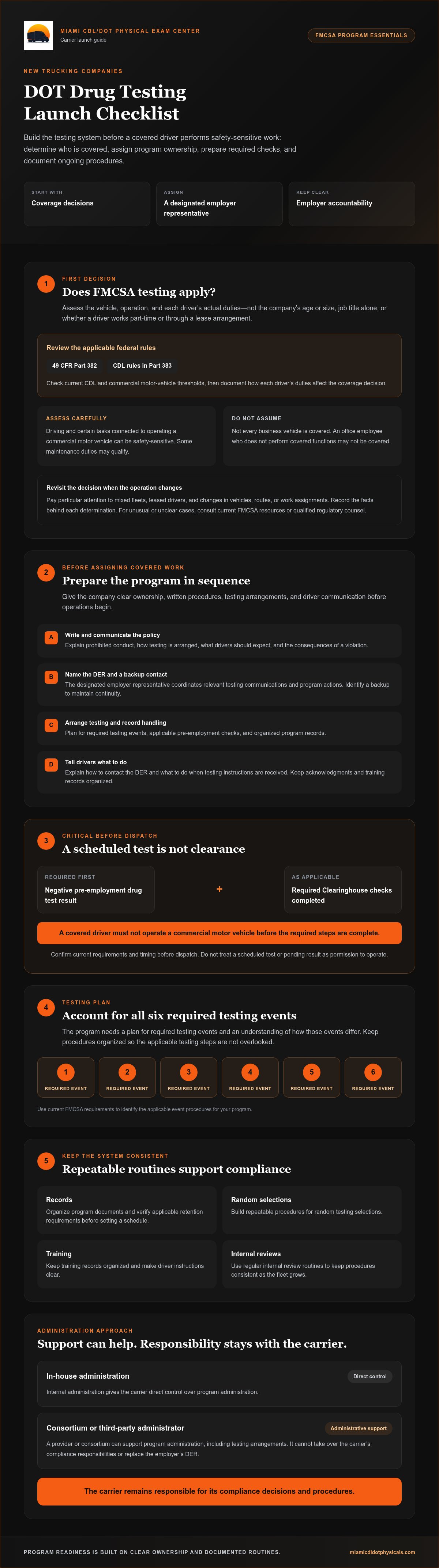
Use this launch checklist to document testing, records, and ongoing compliance
A checklist is useful only when it shows who completed each task and when. For DOT drug testing requirements for new trucking companies, create a launch record before dispatch and keep it current as drivers, vehicles, and operations change.
What should the company verify before dispatch?
Work through these steps for each covered operation. Save the result or note where the supporting record is stored.
- Confirm applicability. Document which drivers and operations are covered, including the facts behind any uncertain or mixed-fleet determinations.
- Prepare and deliver the policy. Record when each covered driver received the policy and any required program instructions.
- Assign program contacts. Name the DER and identify who handles testing coordination, Clearinghouse tasks, and follow-up notices.
- Verify testing arrangements. Confirm how the company will coordinate required tests and track completion through the appropriate process.
- Complete pre-work checks. Verify required pre-employment testing and applicable Clearinghouse queries before the driver performs covered work. Don’t rely on a verbal assurance that a step is complete.
If eligibility or applicability remains unclear, resolve the question with current FMCSA guidance or qualified compliance counsel before assigning covered duties.
How can a small carrier maintain the program over time?
Use a secure compliance file with access limited to people who need the information. Organize policy acknowledgments, testing and query completion records, notices, and follow-up documentation. Confirm which records you must retain, how long to keep them, what confidentiality safeguards apply, and what must be available for inspection under current rules.
Set recurring calendar reminders instead of relying on memory. Include random-program administration, required Clearinghouse queries, supervisor training obligations, and periodic reviews of procedures and records. Assign an owner and backup for each reminder, then log the completion date and any action taken. A calendar helps manage obligations, but it doesn’t replace checking current rules for required timing.
Review the applicability assessment whenever the fleet, driver duties, or operating authority changes. For example, adding a vehicle or shifting an employee into driving duties can prompt a fresh review. A qualified administrator may help coordinate testing or program tasks, but the carrier should verify completion and retain oversight.
For help organizing testing or consortium support, review DOT drug testing and consortium support.
Get DOT drug-testing support and keep employer responsibilities clear
Choose a support model based on the work your company can reliably manage, not just the size of your fleet. The DOT drug testing requirements for new trucking companies still apply to the employer even when a provider or consortium helps coordinate parts of the program. Keep a clear record of who handles each task and who verifies completion.
Which support model fits a new trucking company?
Self-administration gives you direct control, but your company needs the time and procedures to manage every applicable administrative obligation. That includes tracking assignments, deadlines, records, and required follow-up. Choose this route only if a responsible person can maintain the process consistently, including when that person is unavailable.
Consortium participation may be worth exploring for an eligible owner-operator or small fleet that needs help coordinating random testing. Third-party coordination can also support selected administrative tasks. These arrangements differ, so don’t assume that a consortium or provider handles every requirement. Confirm eligibility, included services, each party’s responsibilities, and current enrollment steps before deciding.
DOT drug testing and FMCSA Clearinghouse Consortium support are available as program-administration options. Confirm the current service scope and how the arrangement fits your company’s obligations. Support can help with coordination, but it doesn’t guarantee compliance or replace employer oversight.
What should you ask before selecting a testing provider?
Get specific answers before relying on an outside service. Ask:
- Who coordinates test scheduling, random selections, and communications, and which tasks are included?
- Who receives time-sensitive notices, and how will the employer be alerted when action may be needed?
- What records or completion documentation will the company receive, and how can it access them?
- Which Clearinghouse-related tasks are supported, and which queries, consents, or reports must the employer handle?
- Who is the employer contact for questions, and what process should the company follow if a task appears incomplete?
Write the answers into your internal procedures. Assign an employer contact to review documentation and track open items rather than treating a provider’s confirmation as proof that every company duty is complete. This division of work helps you understand where support ends and your responsibility continues.
To discuss your company’s testing needs or ask about consortium support, discuss DOT drug testing and consortium support.
Put your compliance plan in place before launch
A reliable program starts with knowing which drivers are covered, assigning clear ownership, and documenting how testing and Clearinghouse tasks will be handled. Use the DOT drug testing requirements for new trucking companies checklist to turn those decisions into procedures your team can follow as the business grows.
Outside support can make parts of program administration more manageable, but your company remains responsible for oversight and compliance. DOT drug testing and FMCSA Clearinghouse Consortium support are available for owner-operators and fleets. Confirm the available services and enrollment steps that fit your needs.
Discuss DOT drug testing and consortium support as you prepare your program. Clear responsibilities and a documented process can help your company approach launch with greater confidence.
Frequently Asked Questions
Do all new trucking companies need a DOT drug-testing program?
No. A new carrier needs a program if its operations and drivers are covered by FMCSA regulations. The DOT drug testing requirements for new trucking companies depend on applicable vehicle and operation criteria and whether drivers perform covered safety-sensitive functions, not simply on company size. Review each role and vehicle, including leased drivers and mixed fleets. If coverage is unclear, consult current FMCSA guidance or qualified compliance counsel.
Which DOT drug tests must a new trucking company arrange?
Covered employers must arrange pre-employment, random, reasonable-suspicion, post-accident, return-to-duty, and follow-up testing when each event applies. Pre-employment testing occurs before covered work, while random testing follows a compliant selection process. Reasonable-suspicion and post-accident tests depend on specific criteria, so not every concern or crash triggers one. Return-to-duty and follow-up tests apply to drivers in the relevant violation and return-to-work process.
When must a new driver complete a pre-employment DOT drug test?
A covered driver must receive a negative pre-employment drug test result before performing safety-sensitive work that includes operating a commercial motor vehicle. Scheduling or completing a collection isn’t enough if the result is still pending. Treat this test as separate from applicable Clearinghouse queries, and verify both steps are complete before dispatch. Check current FMCSA rules for any exception that may apply to a specific driver or circumstance.
Does a new trucking company need to join a drug-testing consortium?
Not every carrier must join a consortium. A company may administer its program internally if it can meet all applicable duties, while eligible owner-operators and small fleets may use a consortium to help coordinate random testing. The right arrangement depends on the company’s setup and applicable rules. Confirm eligibility, included tasks, and which responsibilities remain with the employer before enrolling.
What does the FMCSA Drug and Alcohol Clearinghouse require from employers?
Employers of covered CDL drivers must register as applicable, conduct required pre-employment and recurring queries, obtain required driver consent, and report specified violations to the Clearinghouse. A query is distinct from a drug test, so completing one doesn’t replace the other. Check current FMCSA instructions for query types, consent, reporting duties, and portal procedures, then document completion and follow up on relevant results.
Can a trucking company use a third-party administrator for DOT drug testing?
Yes. A carrier can use a third-party administrator or consortium for agreed program tasks, such as coordinating random selections or testing logistics. Before choosing one, confirm who handles each task, how notices and records reach the employer, and what the arrangement doesn’t cover. Using outside support doesn’t transfer the carrier’s legal responsibilities. The employer must maintain oversight and act on required notices or results.
What records should a new trucking company keep for DOT drug testing?
Organize the current policy and driver acknowledgments, testing and query documentation, consent records, random-program records, relevant notices, and required training or follow-up documentation. Protect confidential information and limit access to people who need it for program duties. Retention periods and inspection requirements vary by record type, so verify current FMCSA and DOT rules before setting retention schedules. Keep a completion log that shows who handled each task and when.


