

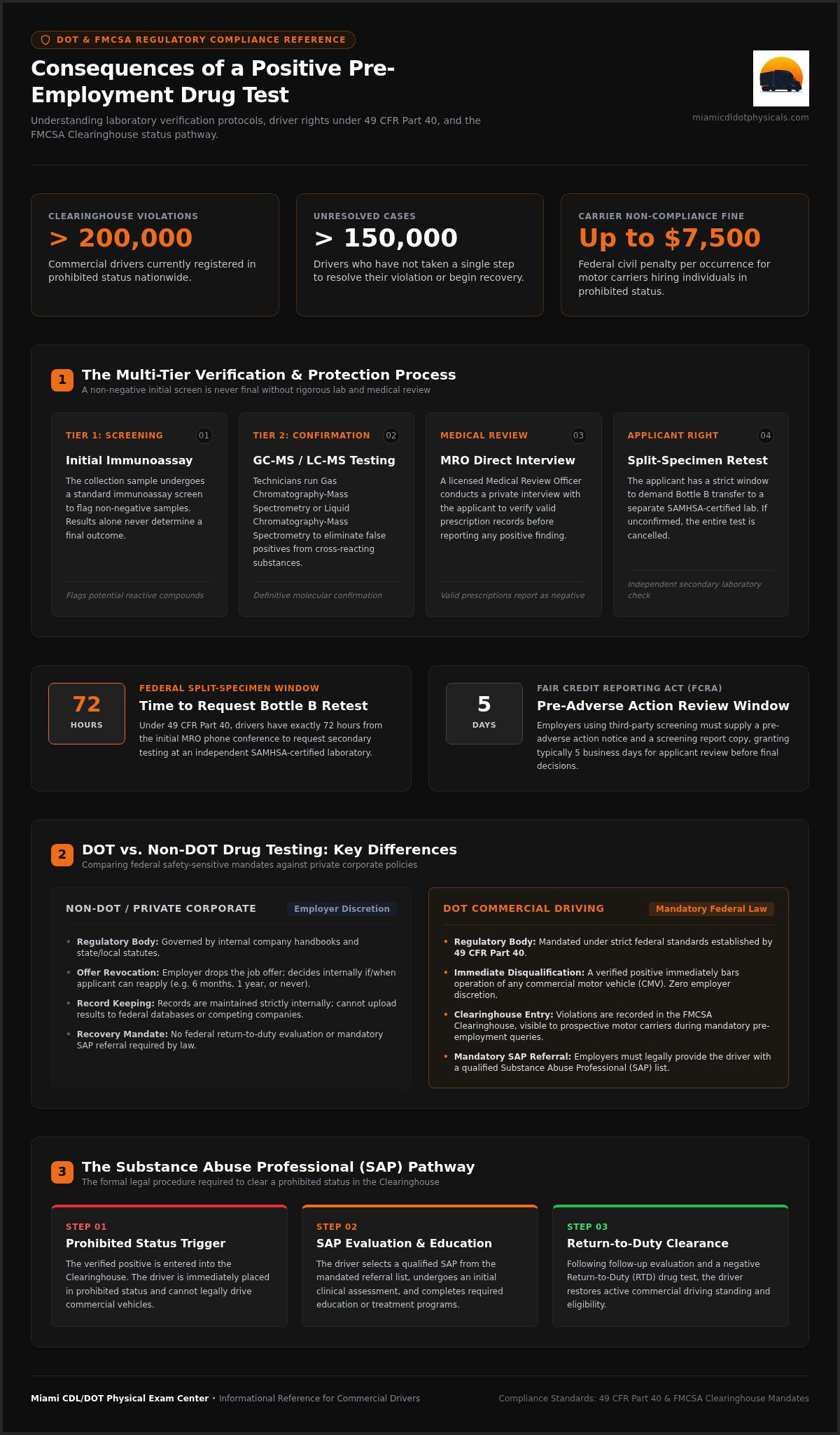
Over 200,000 commercial drivers currently sit in prohibited status inside the federal Clearinghouse, and more than 150,000 haven't taken a single step to fix it. Facing the consequences of a positive pre-employment drug test feels like an immediate career dead end. It's completely normal to feel overwhelmed by the fear of losing your commercial driver's license or wondering if a rescinded job offer will follow you permanently.
A non-negative result halts the hiring process instantly, but federal regulations also establish a clear legal pathway to recovery. You'll learn the immediate notification obligations employers must follow, what really happens during the Medical Review Officer interview, and how the formal return-to-duty process clears your record. Below, we provide the straightforward compliance steps you need to protect your credentials, satisfy federal mandates, and regain your professional driving eligibility.
Key Takeaways
- Understand the immediate hiring consequences of a positive pre-employment drug test and how confirmatory lab analysis verifies non-negative results before decisions become final.
- Discover the critical legal differences between employer-specific non-DOT workplace policies and mandatory federal testing governed by 49 CFR Part 40.
- Learn federal reporting mandates for prospective employers and how Clearinghouse violation records affect commercial driving eligibility.
- Follow the exact step-by-step Substance Abuse Professional evaluation process required to complete return-to-duty testing and restore your standing.
- Implement proactive disclosure tactics and compliance best practices to protect your professional credentials during future job applications.
Immediate Consequences of a Positive Pre-Employment Drug Test
Receiving a non-negative result instantly disrupts your job search. Under standard workplace drug testing protocols, an initial positive screen almost universally triggers the prompt revocation of a conditional employment offer. Labs don't rely on initial numbers alone. When an initial immunoassay screening flags a sample, technicians run a definitive confirmatory test using gas chromatography-mass spectrometry (GC-MS) or liquid chromatography-mass spectrometry (LC-MS). This two-tiered analysis eliminates false positives from cross-reacting compounds.
Beyond laboratory verification, federal law protects applicants through the Fair Credit Reporting Act (FCRA). Employers using third-party screening agencies must provide a pre-adverse action notice alongside a copy of the screening report. They must grant a reasonable window, typically five business days, allowing you to review the findings before issuing a final decision. Understanding these initial consequences of a positive pre-employment drug test prevents panic and helps you exercise your legal rights immediately.
The Medical Review Officer (MRO) Verification Process
A laboratory positive never goes straight to a hiring manager. Instead, a licensed Medical Review Officer (MRO) acts as an independent gatekeeper. The MRO contacts you directly for a private medical interview to investigate whether an alternative medical explanation exists. If you hold a legitimate, active prescription for the flagged substance, you must submit pharmacy records or physician documentation promptly. Once validated, the MRO reports the result as negative. If you cannot provide verified medical documentation, the physician issues a verified positive finding.
Split-Specimen Retesting Rights and Protocols
When an MRO confirms a positive screen, your legal protections don't vanish. Under federal guidelines, you have exactly 72 hours from the initial MRO phone conference to request a split-specimen analysis. During collection, your urine sample was divided into Bottle A and Bottle B. Your request compels Bottle B to transfer to an entirely different SAMHSA-certified laboratory for independent reconfirmation. If the secondary facility fails to reconfirm the presence of the drug or metabolite, the entire test is cancelled. Knowing these rights is essential when confronting the harsh consequences of a positive pre-employment drug test.
DOT vs. Non-DOT Drug Testing: Key Regulatory Differences
The legal fallout from a failed screen depends entirely on whether your position falls under federal oversight. While a standard office role answers to internal company handbooks, commercial driving operations answer to federal law. Across non-regulated workplaces, businesses design their own drug-free workplace programs under the umbrella of local and state statutes. In contrast, safety-sensitive roles across commercial trucking, aviation, maritime, railroad, transit, and pipeline operations must follow strict testing protocols established under 49 CFR Part 40. The consequences of a positive pre-employment drug test diverge significantly based on this fundamental regulatory boundary.
Private Employer Policies in Non-Regulated Workplaces
Non-regulated employers possess broad discretion regarding how they handle applicant results. If you test positive for a standard corporate position, the employer simply drops the job offer. Company policy dictates whether you can reapply in six months, a year, or never. Private companies maintain these records internally. They cannot upload non-regulated test results to federal reporting repositories or publish your status to competing employers.
Federal Department of Transportation Safety Mandates
Federally regulated positions offer zero corporate discretion. Under standard DOT drug test regulations, a verified positive immediately bars you from operating any commercial motor vehicle. Prospective motor carriers cannot simply look past the violation or choose to hire you anyway. In fact, hiring an individual in prohibited status exposes carriers to federal civil penalties reaching up to $7,500 per occurrence. When an applicant fails, the employer must refuse placement and legally hand over a list of qualified Substance Abuse Professionals (SAPs).
Because federal oversight requires flawless execution, both carriers and independent contractors must rely on certified collection sites and robust compliance management. Ensuring exact adherence from collection to reporting protects your professional standing. If you need reliable screening services or guidance through federally mandated programs, connect with Miami CDL/DOT Physical Exam Center to keep your fleet operations fully compliant.
FMCSA Clearinghouse Reporting and Commercial Driver Disqualifications
For commercial operators, the consequences of a positive pre-employment drug test extend far beyond a rescinded hiring offer. Once an MRO verifies a non-negative result, the prospective motor carrier faces a strict federal deadline. Carriers must report verified test positives, along with refusals to test, to the FMCSA Drug and Alcohol Clearinghouse within three business days. More than 320,000 commercial drivers have recorded at least one violation in this centralized database. Every motor carrier is federally mandated to run pre-employment queries on applicants before placing them in safety-sensitive positions, making an unaddressed violation visible to every prospective employer nationwide.
Automatic CDL Privilege Downgrades
A positive pre-employment screen does not stay contained inside the federal database. The Clearinghouse electronically communicates directly with State Driver Licensing Agencies (SDLAs). Once a drug violation flags an account as "prohibited," state agencies initiate an administrative downgrade of the driver's commercial credentials. Your commercial driving privileges remain revoked until you complete the full FMCSA return-to-duty (RTD) process. Getting behind the wheel of a commercial motor vehicle while carrying a downgraded license triggers severe roadside enforcement, personal citations, and crushing corporate fines up to $6,000 per violation incident.
Impact on Owner-Operators and Fleet Hiring
Owner-operators carry dual responsibilities under federal safety rules. As both employer and employee, independent drivers cannot self-manage their compliance records. Federal law explicitly requires owner-operators to designate an approved third-party administrator to handle their mandated database reporting, random testing pools, and pre-employment queries. Partnering with a dedicated FMCSA clearinghouse consortium ensures ongoing regulatory compliance, automated record updates, and professional screening oversight.
Fleet safety managers review electronic Clearinghouse reports with zero tolerance. With federal investigators citing drug and alcohol non-compliance in nearly a quarter of all carrier audits, safety directors refuse to risk their safety scores by hiring prohibited personnel. Understanding the direct consequences of a positive pre-employment drug test empowers operators to resolve violations correctly before attempting to secure their next haul.
Restore Your Driving Career: SAP Return-to-Duty Process
Facing the consequences of a positive pre-employment drug test doesn't mean your commercial driving career is over. While your commercial privileges are downgraded immediately, federal regulations provide an established recovery pathway. You must designate and hire a DOT-qualified Substance Abuse Professional (SAP). This specialist must be officially credentialed and registered within the Clearinghouse, as standard counselors or general therapists cannot clear you for safety-sensitive duty.
Step 1: Clinical Evaluation and Prescribed Rehabilitation
The SAP process begins with a comprehensive, face-to-face clinical evaluation. The SAP reviews your screening records, assesses your history, and determines whether you need an educational program or formal substance abuse treatment. Once the clinician assigns a plan, compliance is mandatory. You cannot shop around for a different evaluation if you dislike the recommendation; the assigned SAP holds exclusive jurisdiction over your return-to-duty pathway.
Step 2: Follow-Up Evaluation and Direct Observation Testing
After completing your prescribed education or treatment program, you attend a secondary evaluation with the same SAP. If the specialist confirms satisfactory progress, they submit an official completion update to the Clearinghouse and authorize your return-to-duty test. This return-to-duty drug test requires a strictly observed collection under direct visual supervision by a collector of the same sex. Once an employer runs this screening and receives a verified negative result, your status transitions out of "prohibited."
Step 3: Unannounced Follow-Up Testing Schedules
Clearing your initial prohibited status doesn't end federal monitoring. Your SAP designs a confidential follow-up testing schedule, requiring at least six unannounced, directly observed drug tests across your first twelve months back on the road. The testing plan can extend up to five full years. Throughout this return period, keeping your medical credentials current with a certified DOT physical exam ensures you remain fully road-ready. If you're navigating compliance requirements or need certified screening support, schedule your commercial driver exam today to keep your credentials intact.
Future Employment Strategies and Workplace Screening Best Practices
Securing safety-sensitive employment after a screening violation demands complete transparency and organized documentation. Prospective motor carriers respect applicants who take ownership of their compliance history rather than those who hope an old violation slips by unnoticed. Before applying for new roles, log in to your federal Clearinghouse driver portal to confirm your status officially reflects your completed return-to-duty milestones. Carrying certified documentation of your completed program and your negative return-to-duty screen eliminates friction during applicant vetting. Mitigating the career consequences of a positive pre-employment drug test starts with taking command of your screening profile.
Managing Prescriptions and Over-the-Counter Compounds
Many screening flags stem from entirely avoidable mistakes with everyday wellness supplements. Steer clear of unregulated hemp derivatives, CBD oils, and herbal sleep aids before providing a sample. The FDA does not certify the purity or chemical composition of over-the-counter hemp products, meaning they frequently contain enough trace THC to exceed federal confirmatory cutoffs. Keep valid prescription labels and pharmacy receipts accessible whenever you report to a collection site. Always consult certified medical examiners regarding therapeutic medications to protect your credentials against inadvertent non-negative findings.
Professional Compliance Support for Drivers and Fleets
Specimen collection standards play an essential role in legally defensible screenings. Professional facilities follow strict chain-of-custody protocols that safeguard specimen integrity from initial collection through laboratory transport. For owner-operators and growing motor carriers, managing ongoing testing obligations alongside driving schedules presents a constant operational challenge. Enrolling in an established compliance program removes the administrative guesswork and maintains automated compliance across every stage of hiring.
Working alongside experienced occupational health professionals ensures your tests remain accurate, private, and fully compliant with DOT mandates. Protect your professional driving career by scheduling your screenings with Miami CDL/DOT Physical Exam Center. With certified examiners and reliable collection management, you can tackle federal standards with total confidence and avoid the damaging consequences of a positive pre-employment drug test.
Take Control of Your Commercial Driving Career
Facing the consequences of a positive pre-employment drug test presents serious hurdles, but it doesn't close the door on your professional future. Navigating mandatory laboratory confirmations, understanding the Medical Review Officer verification process, and following the formal Substance Abuse Professional pathway restore your standing methodically. With strict Clearinghouse reporting rules actively enforcing CDL downgrades, taking prompt, structured action is the only reliable way to regain your driving status.
Whether you're an individual driver working through return-to-duty requirements or a fleet manager maintaining regulatory readiness, professional testing support makes all the difference. Our certified collection protocols ensure strict chain-of-custody standards for every screen. From thorough DOT physical exams to complete testing administration and consortium enrollment, reliable compliance keeps your operations moving safely.
Don't let administrative confusion stall your livelihood on the road. Schedule your compliant DOT drug testing and medical certification today to protect your driving privileges and step forward with confidence.
Frequently Asked Questions
Does a positive pre-employment drug test show up on a standard background check?
No, standard criminal or consumer background checks do not display drug test results. Traditional pre-employment background checks cover criminal histories, credit checks, and state driving records. Drug screening results are protected medical records. For commercial operators, however, prospective motor carriers must run an FMCSA Clearinghouse query, which directly discloses unresolved safety violations. Understanding this distinction clarifies the practical consequences of a positive pre-employment drug test across different industries.
How long does a positive drug test stay on an FMCSA Clearinghouse record?
A positive drug test remains visible in the FMCSA Clearinghouse for five years, or until you successfully complete the return-to-duty process and follow-up testing plan, whichever is later. If you never complete the designated SAP steps, the violation stays on your electronic record indefinitely. You remain in prohibited status perpetually until those milestones are verified, preventing any commercial carrier from hiring you.
Can you reapply for another commercial driving job immediately after failing a pre-employment test?
You cannot legally accept or perform safety-sensitive driving duties for another motor carrier until you clear the violation. While you can technically submit job applications, any prospective motor carrier must run a mandatory pre-employment Clearinghouse query. Seeing your prohibited status legally bars them from putting you behind the wheel. You must complete the SAP evaluation, recommended treatment, and a verified return-to-duty drug test before regaining commercial hiring eligibility.
What happens if a pre-employment drug test result is deemed a false positive?
If confirmatory mass spectrometry testing or split-specimen analysis fails to verify the presence of a prohibited substance, the test is cancelled. When an initial immunoassay screen flags cross-reactive compounds, advanced confirmatory testing typically clears the issue before reporting. If a laboratory error occurs or the secondary split specimen doesn't match the original finding, the Medical Review Officer cancels the screening. No adverse violation enters your record, leaving your eligibility intact.
Is an employer legally obligated to pay for an applicant's SAP program?
No, prospective employers are under no legal obligation to pay for your SAP evaluation, treatment courses, or follow-up tests. Federal regulations only mandate that the motor carrier provide you with a comprehensive list of qualified Substance Abuse Professionals. Unless specified in an employment agreement or corporate benefit policy, the financial responsibility of completing rehabilitation falls entirely on the driver navigating the consequences of a positive pre-employment drug test.
Can valid prescription medications cause a positive pre-employment drug test result?
Legitimate prescription medications can trigger an initial laboratory screen, but they won't result in a reported positive if properly verified. During the verification interview, you provide valid prescription details and treating physician contact information to the Medical Review Officer. Once the MRO confirms you hold a lawful, current prescription used according to medical directions, the final laboratory determination is officially overturned and delivered to the employer as a negative test result.
What constitutes a refusal to test during a pre-employment drug screening?
A refusal to test includes leaving the collection facility before finishing the screening, failing to provide a sufficient specimen without a documented medical basis, or attempting to adulterate the sample. Refusing to cooperate with collection personnel or failing to appear promptly after dispatch also qualifies. Under DOT regulations, an official refusal carries the identical regulatory penalty as a verified positive, prompting immediate reporting to the federal Clearinghouse and license downgrades.


