

A failed medical exam is rarely the end of your driving career; in reality, it is almost always a temporary regulatory pause. The fear of walking out of an exam room without a valid medical card is real, especially when an unexpected spike in blood pressure threatens your income and livelihood. Understanding the common reasons for failing a DOT physical puts control back in your hands, allowing you to address red flags before they lead to an unexpected disqualification.
Staying compliant with complex FMCSA standards shouldn't feel like a guessing game. You know the pressure of keeping your commercial driver's license active, and nobody wants their livelihood sidelined by confusing paperwork or an unmanaged chronic condition. In this guide, you will identify the top medical disqualifiers under current federal guidelines and learn actionable steps to protect your CDL. We break down the exact disqualification benchmarks, explain how to manage common health issues for full compliance, and walk you through the essential waiver pathways to keep your truck moving.
Key Takeaways
- Identify the common reasons for failing a DOT physical, from high blood pressure thresholds to vision and hearing deficits, so you can address issues before stepping into the exam room.
- Understand how the FMCSA regulates prescription medications and learn the critical difference between routine urinalysis and federal drug testing.
- Implement practical 48-hour pre-exam adjustments and gather essential medical clearance letters to avoid preventable delays or temporary certificate downgrades.
- Explore your options if an examiner pauses your certification, including the 45-day determination pending window and federal exemption programs designed to keep you on the road.
Understanding DOT Physical Disqualification: Medical Standards in 2026
Every commercial driver knows that the Department of Transportation (DOT) physical is a mandatory federal safety requirement under FMCSA Part 391. Its core objective is establishing a baseline of physical capability, ensuring that operating a commercial motor vehicle does not endanger you or the motoring public. Operating within federal commercial driver's license medical standards protects your livelihood and mitigates severe commercial insurance liabilities for motor carriers. Certified Medical Examiners (CMEs) do not view the exam simply as a pass-fail hurdle. Modern regulatory guidance prioritizes proactive chronic disease management, shifting the focus toward verifiable, long-term control of health risks rather than snapshot evaluations.
A failed exam often catches drivers off guard. However, examining the common reasons for failing a DOT physical reveals that many disqualifications stem from unmanaged chronic conditions rather than sudden catastrophic illnesses. The role of the CME is not to find ways to pull you off the road. Instead, an FMCSA-certified examiner acts as a regulatory partner, interpreting federal guidelines to confirm that underlying conditions are safely controlled before signing off on your credentials.
The Purpose of FMCSA Medical Certification
Public safety hinges on preventing sudden incapacitation behind the wheel. The FMCSA establishes medical qualification baselines specifically to mitigate high-risk medical events such as unexpected seizures, cardiac arrest, or severe diabetic episodes. When an interstate driver operates an 80,000-pound vehicle, unmonitored cardiovascular or neurological risks elevate commercial carrier liability and put public safety at risk.
Temporary vs. Permanent Disqualification
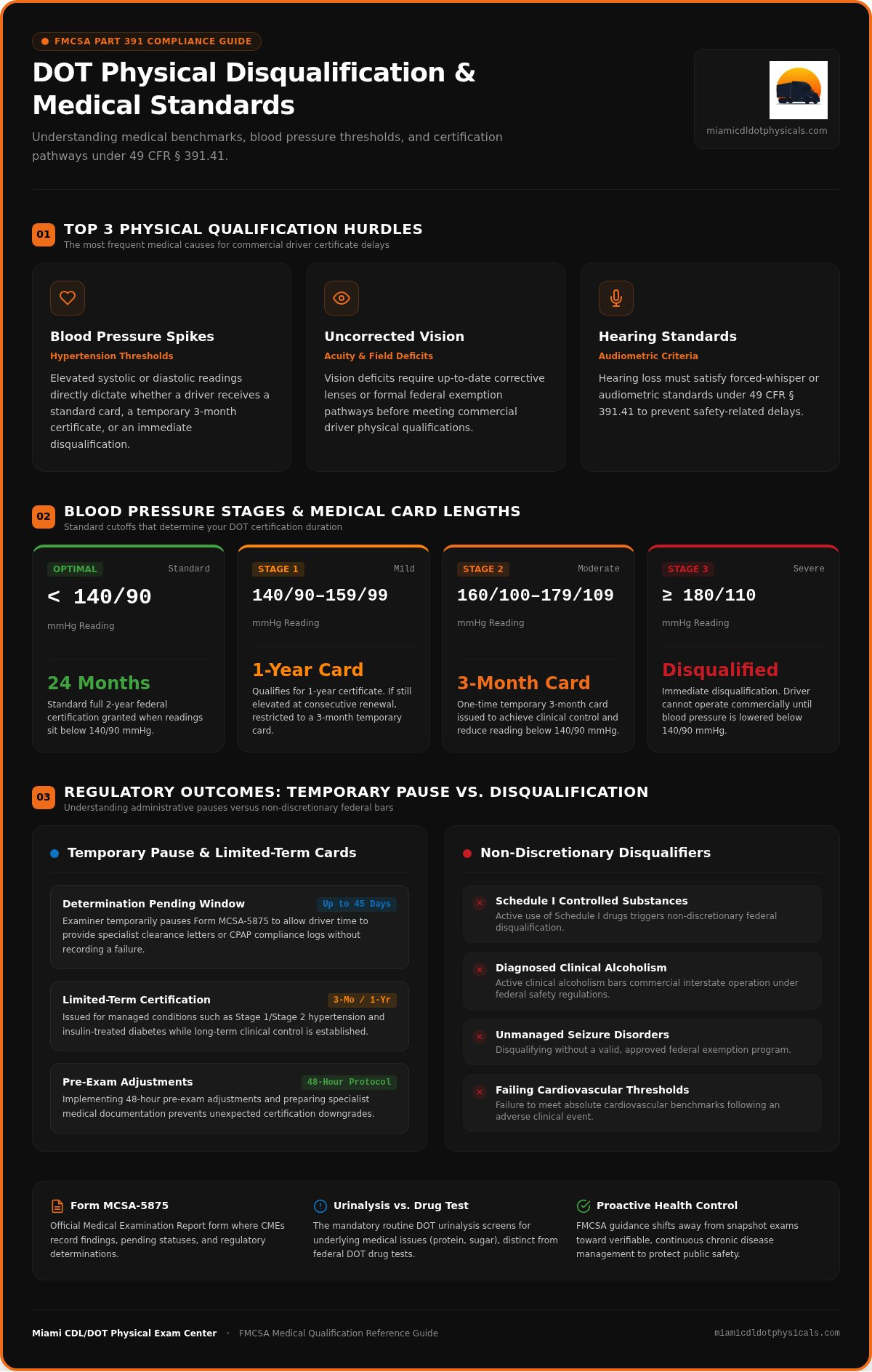
Receiving an adverse finding on Form MCSA-5875 does not automatically mean your driving career is over. It is essential to distinguish between a temporary pause and an outright disqualification:
- Determination Pending (Temporary Pause): A CME can issue a determination pending status for up to 45 days. This provides a clear window to submit additional documentation, like a specialist clearance letter or CPAP compliance log, without recording an outright failure.
- Limited-Term Certification: Stage 1 or Stage 2 hypertension and insulin-treated diabetes often trigger temporary 3-month or 1-year medical cards while you work to achieve full clinical control.
- Permanent Disqualifiers: True non-discretionary automatic disqualifications are limited under federal law. These include active Schedule I drug use, diagnosed clinical alcoholism, an unmanaged seizure disorder without a federal exemption, or failing to meet absolute cardiovascular thresholds after an adverse event.
Recognizing the difference between these regulatory outcomes helps you manage chronic conditions early. Proactive preparation keeps simple, temporary health issues from turning into the common reasons for failing a DOT physical that jeopardize your commercial standing.
The Top 3 Medical Failures: Blood Pressure, Vision, and Hearing
High blood pressure, uncorrected vision, and hearing loss represent the most common reasons for failing a DOT physical. Federal regulations leave no room for guesswork regarding these physical baselines. Certified examiners must measure your results against strict numerical benchmarks under the 49 CFR § 391.41 physical qualification criteria. Understanding these specific cutoffs before your appointment keeps you from being blindsided by an unexpected disqualification or card reduction.
Hypertension and the DOT Card
Blood pressure readings directly dictate the length of your medical card. To secure the standard 24-month certification, your reading must sit below 140/90 mmHg. If your numbers exceed that baseline, examiners apply federal staging criteria:
- Stage 1 (140/90 to 159/99 mmHg): You qualify for a 1-year certificate. If your reading stays in this range at your next renewal, you are restricted to a one-time, 3-month temporary card to achieve control.
- Stage 2 (160/100 to 179/109 mmHg): You cannot receive a 1-year card. The examiner may issue a one-time, 3-month temporary certificate to lower your numbers below 140/90 mmHg.
- Stage 3 (180/110 mmHg or higher): This reading triggers an immediate disqualification. You cannot drive until your pressure drops below 140/90 mmHg, and you will face mandatory 6-month recertification intervals once controlled under medication.
Exam room anxiety, known as White Coat Syndrome, frequently causes temporary spikes into Stage 1 or Stage 2 ranges. If you struggle with exam nerves, bring a 7-day blood pressure log from home or your treating physician. Request that the examiner take your reading toward the end of your appointment after you have settled into the room.
Vision and Hearing Benchmarks
Sensory benchmarks are non-negotiable for commercial motor vehicle operation. For vision, you must demonstrate at least 20/40 distant visual acuity in each eye individually and both eyes together, whether using corrective lenses or not. Your horizontal peripheral vision must span at least 70 degrees in each eye, and you must correctly identify standard traffic signals: red, green, and amber.
Hearing requires passing one of two checks. You must either perceive a forced whisper in your better ear at a distance of five feet or pass an audiometric test showing an average hearing loss of 40 decibels or less across 500 Hz, 1,000 Hz, and 2,000 Hz. If you wear hearing aids, bring fresh batteries to ensure you meet the whisper test threshold.
Managing these vitals before your renewal date protects your credentials. Partnering with a dedicated clinic simplifies the process, so consider booking your DOT physical exam with certified providers who understand federal guidelines and help you plan around borderline readings.
Medication and Substance Use: When Prescriptions Lead to Disqualification
Prescription medications and controlled substances represent another major category among the common reasons for failing a DOT physical. Many drivers assume that having a legal prescription from a doctor automatically protects their commercial driver's license. Under federal regulations, that assumption is incorrect. The FMCSA maintains strict prohibitions against medications that impair central nervous system function, cause daytime drowsiness, or alter reaction times behind the wheel.
Federal rules outline four primary medication classes that trigger automatic medical disqualification or intense scrutiny:
- Schedule I Controlled Substances: This includes marijuana in all forms. Regardless of state-level recreational or medical legalization, federal law enforces complete zero tolerance. Confirmed positive screens for cannabis metabolites account for 55% to 60% of all violations reported to the federal Clearinghouse. CBD products that result in a positive test also trigger disqualification.
- Methadone: The FMCSA considers methadone an absolute disqualifier for commercial operation due to its sedative properties.
- Anti-Seizure Medications: Anticonvulsants used to manage epilepsy or seizure disorders prevent standard certification unless granted relief through official FMCSA Driver Exemption Programs.
- Sedating Antidepressants and Anxiolytics: Certain psychiatric medications that cause marked sedation or cognitive impairment require extensive psychiatric clearance before a certificate can be issued.
Problematic Prescription Medications
Using prescribed narcotics, opioids, or benzodiazepines creates complex certification hurdles. Habit-forming pain medications and anxiety treatments like Xanax or Valium carry severe residual sedative effects. If you take these medications, you must present formal documentation from your prescribing physician. The medical provider must complete a Driver Medication Form (such as Form MCSA-5895) or provide a written letter confirming your exact dosage, the underlying condition being treated, and an explicit clinical statement affirming that the drug does not impair your ability to safely operate a commercial vehicle. The certified medical examiner must review this documentation and independently agree that the medication poses no safety risk.
The Role of the FMCSA Clearinghouse
Failing an employer-mandated DOT drug test is entirely separate from the diagnostic urine test conducted during your physical exam. When a verified positive test or refusal occurs, a Medical Review Officer (MRO) logs the violation into the national database. State Driver Licensing Agencies now actively downgrade CDLs for any driver showing a "prohibited" status. Over 190,000 drivers currently sit in prohibited status, and returning to the road requires completing a formal Return-to-Duty (RTD) protocol with a qualified Substance Abuse Professional. Owner-operators and independent carriers must maintain active oversight through an FMCSA Clearinghouse Consortium to manage random testing pools and maintain seamless federal compliance.
Preparation Checklist: How to Prevent a Failed DOT Physical
Walking into your exam unprepared is one of the most common reasons for failing a DOT physical. Most disqualifications do not happen because a driver is fundamentally unfit to drive. They occur because the driver arrived without proper paperwork for an existing condition or triggered avoidable spikes in blood pressure. Taking deliberate control of your documentation and daily habits before your appointment protects your CDL credentials from preventable delays.
The Chronic Condition Paperwork Trail
Arrive with complete clinical records if you manage an ongoing health condition. Certified medical examiners must verify stable control before signing your medical card. Bring these specific records to avoid an automatic determination pending status:
- Diabetes: Provide a laboratory HbA1c report from the past 90 days, ideally showing a level below 8%. If you use insulin, bring a completed Form MCSA-5870 signed by your treating clinician within the last 45 days.
- Sleep Apnea: Studies indicate that 28% to nearly 50% of commercial drivers experience sleep apnea. If you have an OSA diagnosis, download and print a 90-day CPAP compliance log. The data must show at least 4 hours of use per night on 70% or more of nights.
- Cardiovascular History: Bring the results of your most recent exercise stress test, echocardiogram, or EKG clearance letter if you have a history of heart attack, stent placement, or bypass surgery.
Physical Prep for the Day of the Exam
Simple routine adjustments over the 48 hours leading up to your appointment keep your vitals stable. Reduce dietary sodium and cut out high-stimulant energy drinks, excessive coffee, and heavy nicotine use. These substances spike resting blood pressure into Stage 1 or Stage 2 ranges. Drink plenty of water so your kidney health screen does not show elevated protein or specific gravity. Remember that the in-office urinalysis is a diagnostic health screen, not a drug test; it checks for protein, blood, and glucose to spot early kidney disease or uncontrolled diabetes.
Complete the health history section of Form MCSA-5875 with complete honesty. Omitting previous surgeries, medications, or chronic diagnoses can invalidate your certificate and create federal compliance issues. For a comprehensive walkthrough of testing strategies, review our guide on how to pass your DOT physical. When you are ready to get certified without unnecessary delays, schedule your DOT physical exam with our certified medical team today.
Steps to Take After Failing a DOT Physical: Waivers and Recertification
Receiving an adverse decision at the end of an examination can feel devastating, but it rarely ends a commercial driving career permanently. Resolving the common reasons for failing a DOT physical often comes down to taking swift, methodical action through established FMCSA channels. When an examiner identifies an unmanaged condition or missing test result, federal regulations provide structured pathways to help compliant drivers return to service safely.
The FMCSA Waiver and Exemption Programs
Federal programs exist to accommodate drivers with stable, non-progressive conditions that do not compromise commercial vehicle safety. Depending on the reason for your certification pause, you can utilize several regulatory avenues:
- The 45-Day Determination Pending Window: If you need additional tests, a medication adjustment, or a clearance letter from a treating specialist, examiners can place your certification in a "determination pending" status. You have up to 45 days to provide the required records and complete the exam without receiving a formal disqualification.
- The Alternative Vision Standard (49 CFR § 391.44): Monocular drivers or those unable to meet the 20/40 acuity benchmark in one eye no longer have to wait months for a federal exemption. An eye specialist simply completes the FMCSA Vision Evaluation Report (Form MCSA-5871) within 45 days before your physical, clearing the examiner to issue a 12-month certificate.
- Skill Performance Evaluation (SPE) Certificate: Drivers with missing, impaired, or amputated limbs can apply for an SPE certificate through their regional FMCSA service center. This process evaluates your physical ability to control a commercial motor vehicle safely using adaptive equipment or specialized driving techniques.
- Hearing Exemptions: Drivers unable to pass the forced whisper or audiometric screening can apply directly through the FMCSA Hearing Exemption Program.
Navigating the Second Opinion
When faced with a failed exam, some drivers attempt "doctor shopping" by visiting another clinic in hopes of an easy pass. Avoid this tactic entirely. Certified medical examiners submit every exam determination directly to the FMCSA National Registry. Concealing a previous disqualification on Form MCSA-5875 constitutes federal falsification, which can invalidate your medical card, trigger severe fines, and jeopardize your CDL.
A legitimate second opinion is acceptable when you believe an examiner misapplied regulatory criteria or after your treating specialist officially stabilizes an underlying issue. You must present your prior paperwork honestly and disclose the previous evaluation to the new examiner. Transparent compliance keeps your medical card legally sound and protects your long-term standing on the road.
Protect Your CDL and Stay on the Road
Staying ahead of regulatory medical requirements gives you full control over your commercial driving career. Navigating the common reasons for failing a DOT physical comes down to steady vitals, complete clinical records, and honest communication with your provider. Whether you manage high blood pressure or need to submit specialized medical paperwork, being organized keeps temporary health hurdles from stopping your career.
Your commercial driver's license is your livelihood, and your medical exam should be a smooth, predictable milestone rather than a source of stress. When you need national compliance expertise, choose providers who understand the nuances of federal regulations and work with you directly. Ready for your exam? Schedule your professional DOT Physical today with our FMCSA-certified examiners to get certified quickly and drive forward with total confidence.
Frequently Asked Questions
Can I pass a DOT physical with high blood pressure?
Yes, you can pass a DOT physical with high blood pressure, provided your reading stays below 180/110 mmHg. If your reading falls between 140/90 and 159/99 mmHg (Stage 1), examiners can issue a one-year medical certificate. Readings between 160/100 and 179/109 mmHg (Stage 2) qualify for a one-time, three-month temporary card to reduce your numbers. Stage 3 results in an immediate disqualification until your pressure drops below 140/90 mmHg under active medical treatment.
What medications are automatic disqualifiers for a CDL?
Schedule I controlled substances, medical marijuana, and methadone are automatic disqualifiers under federal safety standards. Anticonvulsant medications prescribed for seizure disorders also trigger disqualification unless you hold an FMCSA exemption. Other controlled prescriptions, such as narcotics, benzodiazepines, or amphetamines, require formal written documentation from your prescribing physician. The treating doctor and the medical examiner must both verify in writing that the medication will not impair your ability to safely operate a commercial motor vehicle.
Does the DOT physical include a drug test?
No, the standard DOT physical does not include a federal drug test. The urine sample collected during your physical is a clinical health screen. Examiners test this sample for glucose, protein, blood, and specific gravity to detect underlying kidney disease or uncontrolled diabetes. A DOT drug test is a separate procedure conducted under 49 CFR Part 40. Employers frequently schedule both tests during the same clinic visit, but they remain entirely distinct regulatory procedures.
What happens if I fail the vision test in one eye?
You can still qualify for a CDL under the FMCSA Alternative Vision Standard if you fail the vision test in one eye. Under 49 CFR § 391.44, you no longer need an exemption from federal headquarters. Instead, your ophthalmologist or optometrist must complete Form MCSA-5871 within 45 days before your DOT physical. As long as your better eye achieves at least 20/40 acuity and a 70-degree field of view, your examiner can issue a 12-month certificate.
Can I get a CDL if I have Type 2 diabetes?
Yes, you can qualify for a CDL with Type 2 diabetes as long as the condition is well-managed. Drivers managing diabetes through diet or non-insulin oral medications can receive up to a standard 24-month medical card. If you use insulin, you qualify under 49 CFR § 391.46 by having your treating clinician complete Form MCSA-5870 within 45 days prior to your exam. Insulin-treated drivers receive a maximum 12-month certification provided their blood sugar remains safely controlled.
How long does a failed DOT physical stay on my record?
A failed DOT physical is transmitted to the FMCSA National Registry within 24 hours and remains permanently archived in federal records. However, a medical failure does not permanently ban you from commercial driving. Once you correct the underlying medical condition or obtain the necessary clearance letters, you can undergo a new examination. The certified examiner can issue a valid medical certificate immediately upon confirming you meet federal requirements. Always disclose your prior physical to prevent falsification penalties.
What is the most common reason for failing a DOT physical?
Uncontrolled hypertension ranks among the leading common reasons for failing a DOT physical or receiving a temporary card reduction. Studies show that over 60% of commercial drivers experience elevated blood pressure, often exacerbated by stress, poor sleep, or high sodium intake. Uncorrected vision deficiencies and missing medical records for chronic conditions like sleep apnea or diabetes follow closely behind. Taking proactive steps to stabilize these health metrics before testing prevents examiners from pausing your certification.
Can I drive if my DOT medical card is expired but I have an appointment scheduled?
No, you cannot legally operate a commercial motor vehicle if your DOT medical card has expired. Federal regulations provide zero grace period for expired medical certifications, regardless of whether you have an upcoming appointment scheduled. Driving with an expired card places you out of service during roadside inspections and exposes your carrier to severe regulatory fines. Furthermore, state licensing agencies will downgrade your CDL to a standard driver's license if an updated certificate is not uploaded promptly.


