

A single oversight in your records can trigger civil penalties of up to $7,155 per occurrence, making the DER responsibilities for DOT drug testing one of the most critical roles in your company. For many fleet managers, this position feels like a high-stakes balancing act between federal law and operational reality. It's stressful to manage the FMCSA Clearinghouse while keeping your drivers on the road. You likely feel the weight of responsibility every time a random testing notification arrives or a driver tests positive. We understand that regulatory compliance often feels like a moving target, especially with over 190,000 drivers currently in prohibited status nationwide.
This 2026 guide simplifies your requirements so you can manage your fleet with total confidence. You'll master every regulatory requirement and operational duty needed to ensure your drivers stay compliant and road-ready. We'll provide a clear checklist of your daily duties, explain the latest FMCSA Clearinghouse reporting windows, and clarify the current operational status of oral fluid testing. By the end of this guide, you'll have a reliable roadmap to navigate 2026 federal standards without the fear of unexpected audit fines or business disruptions.
Key Takeaways
- Identify the primary authority of the DER to remove drivers from safety-sensitive functions immediately upon receiving a verified positive test result.
- Master the DER responsibilities for DOT drug testing to maintain a compliant random testing pool and avoid significant civil penalties.
- Learn the strict FMCSA Clearinghouse reporting timelines, including the three-business-day window for submitting drug and alcohol violations.
- Discover how partnering with a Clearinghouse Consortium can offload administrative burdens and ensure your fleet remains road-ready.
- Understand the legal requirement to provide drivers with Substance Abuse Professional (SAP) resources regardless of your company's termination policy.
What is a Designated Employer Representative (DER)?
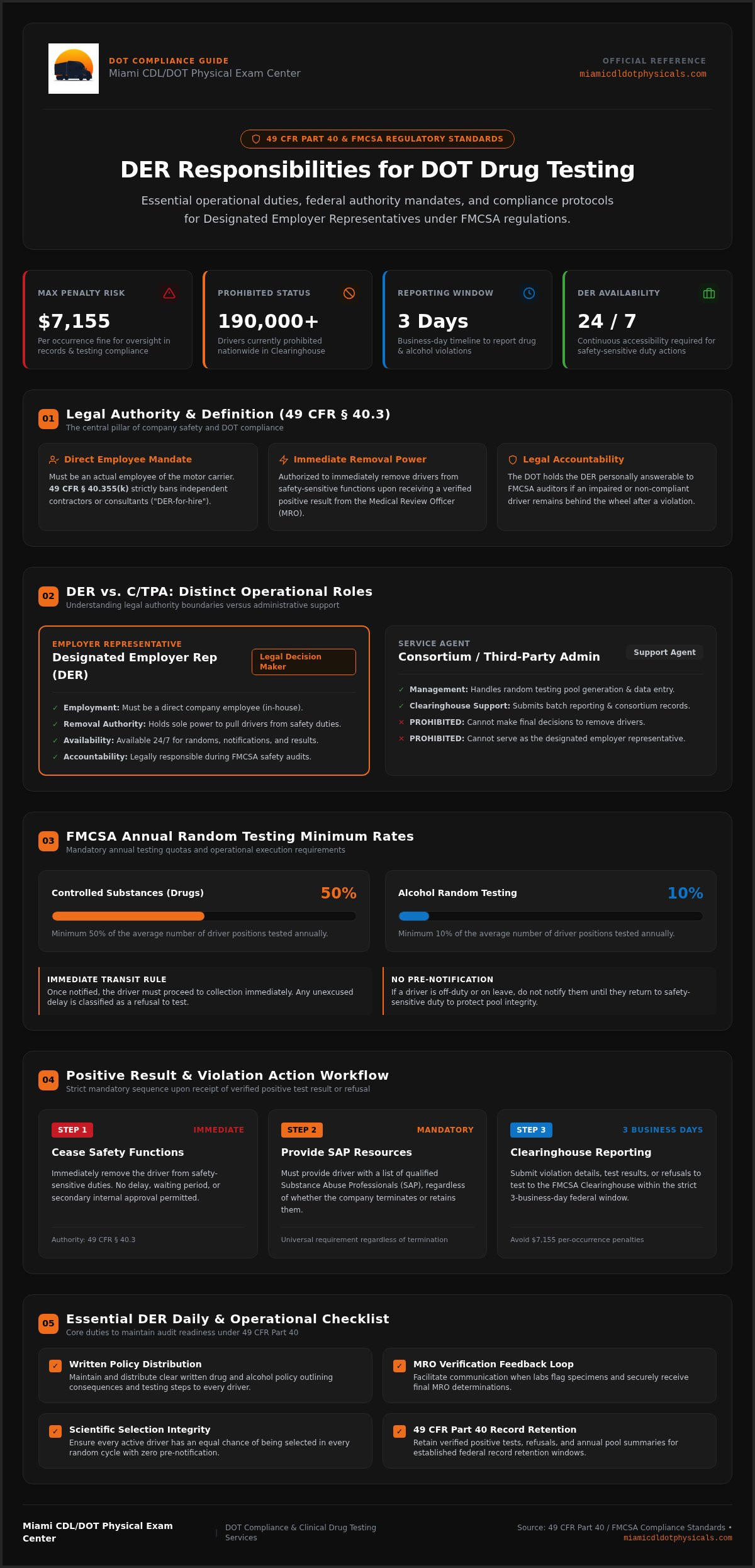
A Designated Employer Representative (DER) acts as the central pillar of your company's safety program. According to 49 CFR § 40.3, a DER is an employee authorized by the employer to take immediate action to remove drivers from safety-sensitive duties. This role is not merely administrative; it is a position of significant authority. When a Medical Review Officer (MRO) reports a verified positive result, the DER doesn't wait for permission or further discussion. They act instantly. Mastering DER responsibilities for DOT drug testing ensures that your company remains compliant with federal mandates and keeps dangerous situations off the road.
The DOT holds the DER legally accountable for the integrity of the testing program. If an FMCSA auditor finds that a driver remained behind the wheel after a violation, the DER is the one who must answer for that failure. You're responsible for ensuring every step of the process follows established workplace drug testing protocols. This includes everything from the initial selection for a random screen to the final reporting of a violation in the federal database. It's a role that requires precision, speed, and a firm grasp of safety regulations.
DER vs. C/TPA: Understanding the Difference
It's easy to confuse a DER with a Consortium/Third-Party Administrator (C/TPA), but their roles are distinct. A C/TPA is a service agent that provides administrative support. They help you manage the technical side of the random pool and maintain records. However, a service agent is strictly prohibited from acting as the DER. They cannot make the final decision to remove a driver from duty. Many carriers choose to work with an FMCSA Clearinghouse Consortium to handle the heavy lifting of data management. This partnership is highly effective, as the consortium provides the data while the DER retains the legal authority to act on it.
Who Can Serve as a DER?
To serve in this capacity, you must be an actual employee of the motor carrier. The DOT is very clear on this: you cannot use an independent contractor or a consultant as your DER. This "DER-for-hire" model is a violation of 49 CFR § 40.355(k). The individual chosen must have a thorough knowledge of 49 CFR Part 40 and the specific DER responsibilities for DOT drug testing required for their mode of transportation. Because safety-sensitive functions happen at all hours, the DER must be available 24/7. If a driver is selected for a random test at 2:00 AM, someone must be authorized to receive the results and take action immediately if a problem arises. Clear communication and constant availability are non-negotiable for this position.
Core DER Responsibilities in DOT Drug Testing
The foundation of a safe fleet starts with a clear, written policy. As the Designated Employer Representative, you're responsible for maintaining and distributing this document to every driver. It must outline the consequences of prohibited conduct and the specific steps for testing. Beyond the paperwork, DER responsibilities for DOT drug testing involve a constant feedback loop with the Medical Review Officer (MRO). When a lab flags a specimen, the MRO conducts a verification interview to determine if there is a legitimate medical explanation. Your job is to facilitate this communication and receive the final determination securely.
Managing these moving parts requires a partner who understands the urgency of your schedule. You can streamline your compliance by scheduling a DOT drug test through a certified provider to ensure fast, accurate results for your records.
Random Testing Pool Management
For 2026, the FMCSA has maintained the minimum annual random testing rates at 50% for controlled substances and 10% for alcohol. You must ensure your selection process is scientifically valid and gives every driver an equal chance of being picked in every cycle. Once you notify a driver, they must proceed to the collection site immediately. Any unnecessary delay can be classified as a refusal to test. If a driver is off-duty or on extended leave when their name is drawn, do not notify them until they return to safety-sensitive duty. This prevents "pre-notification" and maintains the integrity of the random process.
Record Keeping and Audit Readiness
Auditors look for a well-organized system when they inspect your Drug and Alcohol files. Under DOT 49 CFR Part 40 regulations, you must retain specific records for set periods to stay compliant. Records of verified positive results, refusals to test, and SAP reports must stay in your files for at least five years. Negative results only require one year of retention. Keep these documents in a locked, secure location with restricted access to protect driver privacy. During an inspection, having a clearly organized file for each driver proves you take your DER responsibilities for DOT drug testing seriously and can prevent costly acute safety rating violations.
The DER’s Role in the FMCSA Clearinghouse
Managing the FMCSA Drug and Alcohol Clearinghouse is one of the most time-sensitive DER responsibilities for DOT drug testing. You're the gatekeeper for driver eligibility. Since January 2023, you no longer need to conduct manual three-year safety history checks for FMCSA-regulated employers; the Clearinghouse has become the single source of truth. You must ensure that every new hire has a clean record before they touch a steering wheel. Failure to conduct these queries is a major audit risk. Data shows that query non-compliance accounts for 48.4% of all Part 382 violations found during federal investigations.
Query Management and Consent
You must run a full query for every prospective driver. This requires the driver to register and grant electronic consent within the portal. For your existing fleet, you'll conduct a limited query at least once every 12 months. Limited queries only require a signature on a general consent form kept in your internal files. If a limited query shows a "hit," you must upgrade to a full query within 24 hours to see the violation details. If a driver refuses to provide consent for a full query, you must remove them from safety-sensitive functions immediately. Linking your company account to a trusted DOT drug test provider ensures that your testing data flows correctly and remains accessible for these mandatory reports.
Reporting Violations and SAP Progress
While Medical Review Officers (MROs) report positive lab results, the DER has unique reporting duties. You must report specific violations to the Clearinghouse by the close of the third business day after you receive the information. These reportable events include:
- Alcohol confirmation tests with a concentration of 0.04 or higher.
- Employer-determined refusals to test, such as a driver walking away from a collection site before the test is complete.
- "Actual knowledge" violations, which include observing a driver using alcohol on duty or receiving a traffic citation for DUI in a commercial vehicle.
- Negative return-to-duty (RTD) test results and the successful completion of all SAP-mandated follow-up tests.
With over 190,000 drivers currently in prohibited status, your role in tracking the return-to-duty process is vital. You don't just report the initial violation; you also record when a driver successfully completes their testing plan. This accuracy is essential because these reports now trigger automatic CDL downgrades at the state level. Handling these DER responsibilities for DOT drug testing with precision protects your company from civil penalties that can reach $7,155 per occurrence.
Handling Positive Results and Refusals to Test
Receiving a verified positive test result or a "refusal to test" notification requires immediate, decisive action. You don't have the luxury of debating the result or waiting for a second opinion. Under federal law, your first priority is to stop the driver from performing any safety-sensitive functions. This isn't just a company policy; it's a core component of DER responsibilities for DOT drug testing that protects the public and your business from liability. The law is clear. You must act the moment you receive notice.
Even if your company has a zero-tolerance policy that leads to termination, you still have a legal obligation to provide the driver with resources. You must give them a list of qualified Substance Abuse Professionals (SAPs). This list must include names, addresses, and telephone numbers. You aren't required to pay for the evaluation, but you must provide the information. Failing to provide this list is a common mistake that can lead to fines during a compliance review.
The Protocol for Immediate Removal
When the MRO calls with a verified positive, the driver must be pulled from the truck immediately. If they're currently on the road, you must instruct them to stop at the nearest safe location. You'll need to arrange for another driver to pick up the load or have the vehicle towed. You don't wait for a split-specimen test result to act. Federal regulations protect you from legal blowback when you remove a driver based on an MRO-verified result. Document the exact time and date of the removal to keep your records audit-ready. This documentation is your best defense against claims of wrongful removal.
The Return-to-Duty (RTD) Workflow
If you decide to keep the driver or hire someone who previously tested positive, you must manage the RTD process. This starts only after the SAP confirms the driver has completed the required education or treatment. You must then order a Return-to-Duty test, which must be conducted under direct observation. Once the driver returns, the SAP will provide a specific follow-up testing plan that you are legally required to execute.
- Conduct a minimum of 6 unannounced, observed tests in the first 12 months.
- Continue testing for up to 60 months if the SAP deems it necessary.
- Keep all follow-up tests separate from the standard random testing pool.
Navigating these high-stress situations is easier with a dedicated compliance partner. You can manage your DOT drug testing program with us to ensure every positive result or refusal is handled according to 2026 federal standards.
DER Training and Compliance Support
Professional training provides the legal shield you need during a DOT investigation. While the regulations outline your specific tasks, understanding the logic behind DER responsibilities for DOT drug testing helps you defend your decisions in court or during a compliance review. If a driver is involved in a serious crash, plaintiff attorneys often look for any crack in your safety history. Having a certified training record proves you've followed federal standards to the letter. It shows you aren't just checking boxes; you're actively managing a culture of safety. Staying updated on 2026 FMCSA regulatory changes is also vital. With the full implementation of Clearinghouse II, the link between your reports and state licensing agencies is now instantaneous, leaving no room for clerical errors.
Choosing a Compliance Partner
You need a partner that understands the high stakes of your role. Look for a one-stop-shop that handles both DOT physicals and drug screenings. This consolidation reduces the risk of lost paperwork and ensures that medical examiner data matches your testing records perfectly. Evaluate the expertise of your Medical Review Officer (MRO) to ensure they have a track record of fast, accurate result verification. A high-quality provider will also offer digital result reporting and secure record storage. Digital systems eliminate the delays associated with manual data entry and provide a searchable archive for your annual audits. When you simplify the CDL medical exam and testing process, you free up time to focus on moving freight.
Maintaining Long-Term Compliance
Long-term compliance isn't a one-time setup. You should conduct internal mock audits at least once a year to verify your documentation is complete. Check your DER responsibilities for DOT drug testing against the latest federal standards, specifically ensuring your Clearinghouse reporting dates are accurate and your driver consent forms are signed. Periodic policy reviews with legal counsel are also essential to account for changes in state laws or federal updates. Leveraging consortium resources is the most efficient way to manage your random pool. A consortium acts as a professional buffer, ensuring your selections remain scientifically valid and that your fleet stays above the mandatory 50% drug and 10% alcohol testing rates for 2026. This partnership reduces your administrative burden while keeping you audit-ready at all times.
Securing Your Fleet’s Compliance for 2026 and Beyond
Managing a fleet requires constant vigilance, but you don't have to navigate these complex regulations alone. Mastering the DER responsibilities for DOT drug testing is about more than just avoiding fines; it's about building a safer environment for your drivers and the public. You now have the tools to handle immediate removals, manage the FMCSA Clearinghouse with precision, and maintain a robust random testing pool. Each of these steps ensures your operation remains audit-ready and resilient against regulatory changes.
Partnering with an expert team makes this process seamless. Our FMCSA Certified Medical Examiners provide fast results for DOT and non-DOT screenings, ensuring your records stay up to date without the usual administrative headaches. We specialize in complete drug and alcohol consortium management, allowing you to focus on your core business while we handle the technical compliance details. Simplify your DER duties with our FMCSA Clearinghouse Consortium and testing services. Taking these proactive steps protects your company's safety rating and provides much-needed peace of mind. Your fleet is ready for the road, and we're here to help you keep it that way.
Frequently Asked Questions
Does every company need a Designated Employer Representative (DER)?
Yes, every employer subject to DOT drug and alcohol testing must have at least one DER. This individual is the only one authorized to receive communications from service agents like MROs and take immediate action. Without a DER, your company cannot legally comply with removal requirements. Smaller fleets often assign this role to a safety manager or HR professional to ensure someone is always available to handle testing results.
Can a DER also be the company's owner or a driver?
Yes, a company owner can serve as the DER, which is common in small businesses or owner-operator setups. However, a driver should generally not be the DER for their own testing program if others are available. The DER must have the authority to remove any driver from safety-sensitive duties immediately. In owner-operator scenarios, the individual often joins a consortium to handle the random pool management and administrative reporting requirements.
What training is required for a DER under DOT rules?
DOT regulations don't mandate a specific certification course for a DER, but they do require the individual to have a thorough knowledge of 49 CFR Part 40. You must understand the specific DER responsibilities for DOT drug testing for your agency. Many professionals choose formal training to learn how to handle refusals, manage the Clearinghouse, and defend the company during a compliance review or in the event of litigation.
What happens if a DER fails to remove a driver after a positive test?
Failing to remove a driver immediately after a verified positive result is a critical violation that carries heavy penalties. The FMCSA can issue civil penalties of up to $16,864 per day for allowing a prohibited driver to operate a commercial vehicle. This mistake often triggers an automatic acute safety rating violation, which can lead to an out-of-service order for the entire fleet and creates massive legal liability if an accident occurs.
How does a DER report a drug test refusal to the FMCSA Clearinghouse?
You must report a refusal through the FMCSA Clearinghouse portal by the close of the third business day after the event. You'll need to document the specific details, such as the driver's name, CDL information, and the nature of the refusal. This includes situations where a driver fails to show up for a test or leaves the collection site before the process is complete. Accurate reporting is essential for maintaining your safety records.
Can a DER delegate their responsibilities to a TPA or Consortium?
No, the DER cannot delegate the final authority to remove a driver to a service agent. While you can use an FMCSA Clearinghouse Consortium to manage the technical aspects of the random pool and data reporting, the DER must remain an employee of the company. A "DER-for-hire" model is strictly prohibited under federal law because the employer must retain the legal power to act immediately when a violation is reported.
Is the DER responsible for paying for the driver's SAP program?
No, DOT regulations don't require the employer to pay for the Substance Abuse Professional (SAP) evaluation or any subsequent treatment. The DER's only legal obligation is to provide the driver with a comprehensive list of qualified SAPs. Whether the driver or the employer pays for the program is typically determined by company policy or collective bargaining agreements. You must provide this list regardless of whether you terminate the driver's employment.
How often should a DER review the company’s drug testing policy?
You should review your policy at least once a year or whenever federal regulations change. For 2026, it's essential to ensure your policy reflects current FMCSA Clearinghouse reporting requirements and the full implementation of CDL downgrades for prohibited drivers. Regular reviews with legal counsel help ensure your DER responsibilities for DOT drug testing are clearly defined and that your fleet remains fully compliant with the latest safety standards and federal oversight.


