

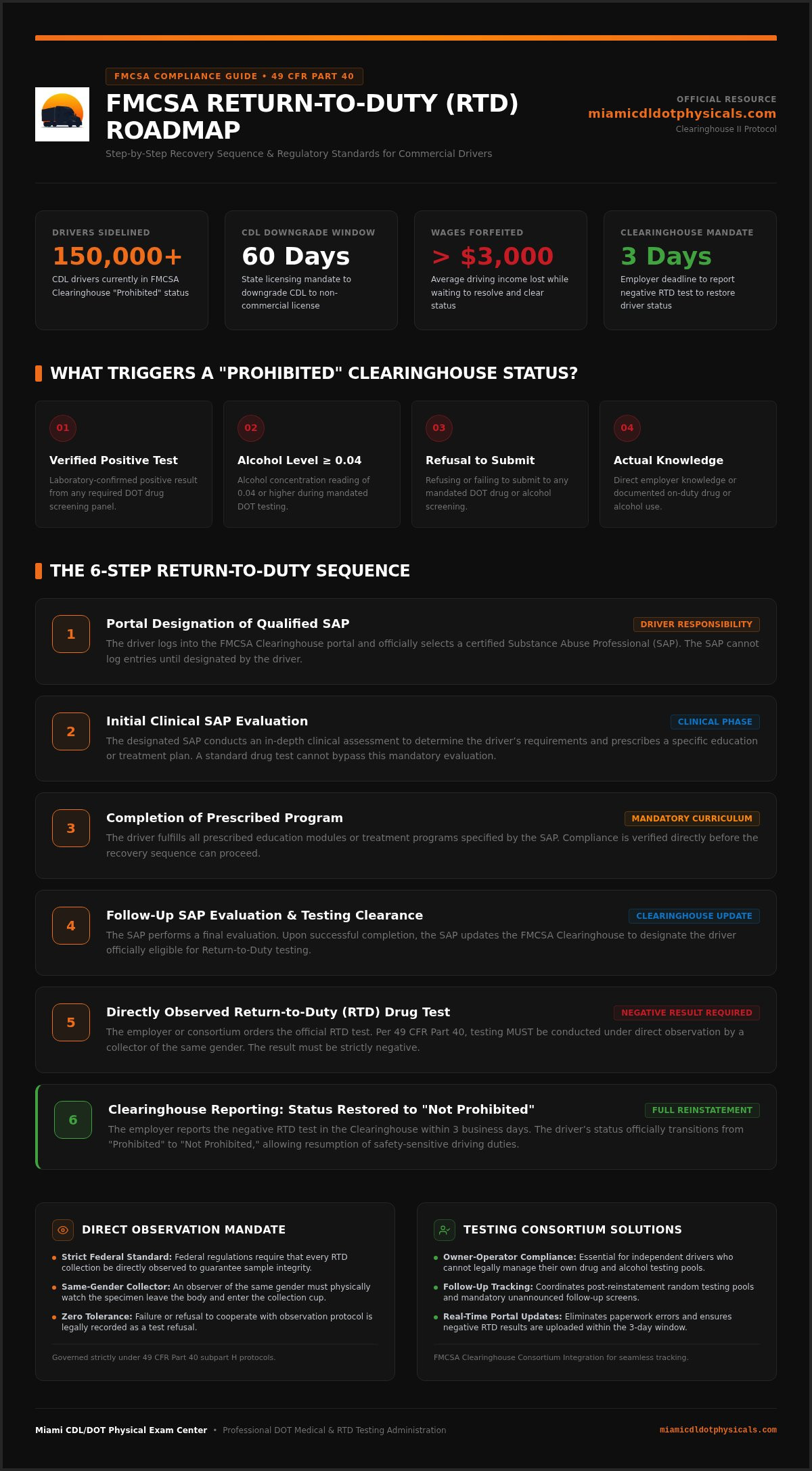
Over 150,000 CDL drivers currently hold a prohibited status in the FMCSA Clearinghouse, which means thousands of professionals are sidelined and unable to earn. Since the 2024 mandate required state licensing agencies to downgrade CDLs within 60 days of a violation, the stakes for compliance have never been higher. If you're looking for a return to duty drug test or trying to manage federal requirements from any location, you're likely feeling the pressure of lost wages. Most drivers lose over $3,000 in income while waiting to clear their status, and the confusion of the multi-step process only adds to that stress.
You deserve a straightforward path back to the driver's seat without the guesswork. This 2026 compliance guide helps you master the FMCSA Return-to-Duty process, understand the investment required for SAP programs, and clear your prohibited status safely. We'll preview the six essential steps of the recovery sequence, explain the mandatory direct observation rules for testing, and show you how to manage your Clearinghouse records effectively. By the end of this article, you'll have a professional roadmap to resume your commercial driving duties and maintain long-term compliance.
Key Takeaways
- Learn the specific 6-step sequence required to transition from "prohibited" to "not prohibited" status in the FMCSA Clearinghouse.
- Review the current 2026 cost breakdown for SAP evaluations and treatment courses to effectively budget for your return to work.
- Identify the criteria for selecting a qualified Substance Abuse Professional and learn how to schedule a return to duty drug test Miami to satisfy federal safety requirements.
- Explore how a testing consortium provides a long-term solution for owner-operators by managing follow-up tests and random selections automatically.
- Master the documentation and reporting requirements that allow you to regain your CDL and protect your livelihood after a violation.
Understanding the Return-to-Duty Process and Clearinghouse Status
The Return-to-Duty (RTD) process is a strictly regulated sequence defined under 49 CFR Part 40. It's designed to ensure that any commercial driver who violates drug and alcohol regulations is properly evaluated and rehabilitated before returning to safety-sensitive functions. When a violation is reported, your status in the FMCSA Clearinghouse changes to "Prohibited." This isn't just a label; it's a legal barrier that stops you from operating a commercial motor vehicle anywhere in the country. Following Federal Motor Carrier Safety Administration regulations, this status remains until you successfully complete each step of the mandated recovery program.
A Substance Abuse Professional (SAP) plays the most critical role in this journey. They act as an independent evaluator who determines what education or treatment you need. It's a common mistake to think that simply taking a standard drug test will fix the problem. A regular screen won't clear your record. You must undergo a specific return to duty drug test Miami or at a certified facility only after your SAP has officially marked you as eligible in the Clearinghouse.
What Triggers an RTD Requirement?
Several specific events can trigger a "Prohibited" status. These include:
- A verified positive drug test result.
- An alcohol concentration of 0.04 or higher.
- A refusal to submit to a required DOT drug or alcohol test.
- Actual knowledge by an employer of drug or alcohol use while on duty.
The Consequences of Prohibited Status
The impact of being "Prohibited" is immediate and severe. Under the Clearinghouse II regulations active in 2026, state licensing agencies must downgrade your CDL to a non-commercial license within 60 days of the violation. You're removed from all safety-sensitive duties right away. This leads to a total loss of driving income, which research shows can exceed $3,000 for most drivers. Beyond the immediate paycheck, a prohibited status makes you nearly uninsurable for many carriers. This makes it vital to start the return to duty drug test Miami process as quickly as possible to restore your professional standing and regain your commercial privileges.
The 6 Steps of the Return-to-Duty Journey
The journey back to the road follows a strict federal sequence. Missing a single entry in the Clearinghouse can stall your progress for weeks, so it's vital to follow the order exactly. The process begins when you log into your portal to select a professional who meets the DOT Substance Abuse Professional guidelines. Once designated, your SAP performs an initial evaluation to create your custom treatment or education plan. You can't skip this step; even if you feel a mistake was made, the SAP evaluation is the only legal starting point.
After you finish your assigned program, the SAP conducts a final evaluation. They'll then update the Clearinghouse to show you're eligible for testing. At this point, your employer or consortium orders the return to duty drug test Miami. This test is unique because it requires a negative result before you can touch a steering wheel. Once the lab returns that negative result, your employer must report it to the Clearinghouse within three business days. This final reporting step is what officially restores your "Not Prohibited" status and allows you to resume safety-sensitive duties.
Navigating the FMCSA Clearinghouse Portal
Your portal is the only source of truth for your eligibility. You must actively designate your SAP so they have the authority to upload your progress. Many drivers face long delays because they assume the SAP handles the designation for them. It's your responsibility to check your status updates in real-time to ensure every milestone is recorded correctly. If you're an owner-operator, joining an FMCSA Clearinghouse Consortium can simplify these entries and prevent the common reporting errors that keep drivers sidelined.
Direct Observation Requirements
Federal law requires all RTD tests to be conducted under direct observation. This means a collector of the same gender must physically watch the specimen enter the collection cup. This protocol exists to ensure the integrity of the sample and prevent any attempt to subvert the test. While the process is highly structured, it's a mandatory part of the safety-sensitive return process. You have the right to be treated with professional respect throughout the collection, but you also have the responsibility to follow all observer instructions. Any failure to cooperate during an observed return to duty drug test Miami is treated as a refusal to test, which starts the entire violation process over again.
Evaluating the Cost of Return to Duty SAP Programs in 2026
Returning to work is a significant investment in your professional future. The total cost isn't just a single fee; it's a combination of professional evaluations, prescribed programs, and administrative requirements. Most drivers find that the largest financial impact comes from lost wages. According to 2026 industry reports, nearly 70% of sidelined professionals lose over $3,000 while in prohibited status. You also need to account for smaller administrative costs, such as mandatory query fees in the FMCSA Drug and Alcohol Clearinghouse. Understanding these price structures helps you budget effectively and avoid delays in your return to duty drug test Miami.
Average Price Ranges for SAP Services
Most Substance Abuse Professionals offer their services as a bundle to simplify the process. This bundle usually includes the initial assessment, the required federal reporting, and the final follow-up evaluation. In 2026, a comprehensive SAP program bundle typically costs between $450 and $600, excluding any additional treatment fees. If your SAP recommends a simple educational course, you might pay an additional $150 to $300. However, if clinical outpatient treatment is required, those costs can rise significantly. These clinical programs often range from $1,000 to over $3,000 depending on the intensity of the care required.
Long-term Costs: The Follow-up Testing Plan
Clearing the initial return to duty drug test Miami is only the beginning of your financial commitment. Once you're back on the road, you must follow a SAP-mandated testing schedule. Federal law requires a minimum of six unannounced, directly observed tests within the first 12 months of safety-sensitive duty. These requirements ensure that you remain compliant while performing safety-sensitive functions. Because these tests must be performed under direct observation, they often require specific collection protocols that can influence your overall compliance budget.
Your SAP has the authority to extend this testing window for up to 60 months. Budgeting for these ongoing expenses is crucial for maintaining your "not prohibited" status over several years. Each DOT drug test performed during this period must be reported correctly to the federal database. While these costs add up, they're a fraction of the income lost during a license downgrade. A structured compliance plan is the most cost-effective way to protect your CDL and your livelihood.
How to Choose a Qualified Substance Abuse Professional
Selecting the right Substance Abuse Professional is the most critical decision you'll make after a violation. If you choose an unqualified individual or someone who doesn't understand the Clearinghouse interface, your return to duty drug test Miami could be delayed by weeks. Don't settle for SAP mills that promise instant results for a low fee. These operations often lack the rigorous documentation required by the FMCSA, which can leave your status in limbo even after you've completed your education. You need a partner who is responsive and proficient in federal reporting to ensure your timeline stays on track.
Credential Verification Checklist
A qualified SAP must hold specific professional licenses. These include licensed physicians (MD or DO), licensed psychologists, or clinical social workers (LCSW). In addition to their base license, they must complete at least 12 hours of DOT-specific qualification training and pass a nationally recognized exam. Every three years, they're required to complete 12 continuing education units (CEUs) to stay current with 49 CFR Part 40 regulations. Before you pay an evaluation fee, ask for proof of these credentials. It's also wise to ask how quickly they typically upload eligibility notices to the Clearinghouse after the final evaluation.
The SAP-Driver Relationship
Transparency is essential throughout your rehabilitation. Your SAP should provide a clear timeline for when they'll report your progress to the Clearinghouse. One of the most important rules to remember is the prohibition of conflicts of interest. Under federal law, the SAP who evaluates you cannot be the same person or organization that provides your prescribed treatment or education. This separation ensures that recommendations are based on safety and clinical needs rather than financial gain. If an SAP tries to refer you to their own private counseling practice, it's a major red flag that could jeopardize your compliance.
Once you've completed your program and received a successful follow-up evaluation, you'll be ready for the next phase. Ensuring your documentation is handled by experts is the fastest way to get back to work. For reliable compliance support, you can register with an FMCSA Clearinghouse Consortium to manage your final testing steps and ongoing requirements. This professional partnership helps you clear your prohibited status and prevents future reporting errors from derailing your career.
Ensuring Long-Term Compliance with a Testing Consortium
Passing your initial return to duty drug test Miami marks the end of your sidelined status, but it also initiates a long-term compliance window. This period requires constant vigilance to ensure you never slip back into a prohibited status. For owner-operators and small fleets, managing this manually is nearly impossible. You need a structured system that tracks your follow-up testing plan and ensures every result reaches the Clearinghouse on time. This is where a professional consortium becomes your most valuable asset in 2026.
A consortium acts as your third-party administrator. It handles the automated random selection process, which is essential for preventing future violations. By removing the manual element of scheduling, you ensure that you remain in full compliance with federal safety standards at all times. The Medical Review Officer (MRO) also plays a vital role during this time. They review every laboratory result to verify its accuracy and ensure that any legitimate medical explanations are considered before a result is finalized. This layer of professional oversight protects both your career and public safety.
Benefits of a Clearinghouse Consortium
A consortium provides centralized record-keeping for your entire follow-up testing plan. Instead of juggling paperwork from different clinics, all your data lives in one secure portal. This organization is crucial because the SAP-mandated testing schedule can last up to five years. The consortium also handles automatic reporting to the federal database, ensuring your "not prohibited" status remains active without any administrative gaps. You can learn more about FMCSA Clearinghouse Consortium services to see how they streamline these complex requirements for independent drivers.
Preparing for Your Next DOT Physical
Your drug and alcohol history has a direct impact on your medical certification. When you sit down for your next exam, your history of a return to duty drug test Miami will be part of the clinical conversation. It's essential to be transparent with your FMCSA medical examiner about your RTD status and the successful completion of your SAP program. A past violation doesn't automatically disqualify you from getting a medical card, but the examiner needs to see that you've followed the federal rehabilitation process to the letter. Moving forward with a clean record in 2026 is about proactive monitoring and professional documentation. By staying ahead of your testing schedule and maintaining open communication with your compliance partners, you can protect your livelihood for the long haul.
Take Control of Your Career and Return to the Road
Restoring your commercial driving status in 2026 requires a disciplined approach to federal regulations. By following the standardized six-step sequence and choosing a qualified Substance Abuse Professional, you can effectively clear your prohibited status and protect your future income. Remember that a return to duty drug test Miami is a specialized procedure that demands direct observation and precise Clearinghouse reporting. Maintaining this compliance long-term is much simpler when you partner with a professional consortium that handles the administrative burden for you.
Our team provides the expertise you need to navigate these high-stakes requirements with confidence. With FMCSA-Certified Medical Examiners and Expert Clearinghouse Consortium Management, we offer Same-Day Compliance Support to help you move forward. Don't let a violation define your career; take the necessary steps to prove your commitment to safety today.
Get Back on the Road with Professional RTD Testing and Consortium Services
Frequently Asked Questions
How long does the return-to-duty process typically take?
The timeline for the return-to-duty process varies based on your individual treatment plan. While some educational courses take only a few days, intensive outpatient programs can last several weeks or months. Once your SAP confirms eligibility, scheduling a return to duty drug test Miami can happen quickly. The overall speed depends entirely on your commitment to the program requirements and the SAP's reporting schedule in the federal portal.
Can I drive while I am completing the SAP program?
No, you cannot perform any safety-sensitive functions while you hold a prohibited status. Federal law requires your employer to remove you from driving duties immediately after a violation is recorded. You must complete the entire SAP process and receive a negative result on your return to duty drug test Miami before your status transitions to not prohibited. Attempting to drive during this time leads to severe legal penalties and vehicle impoundment.
Who pays for the return-to-duty drug test and SAP fees?
Under 49 CFR Part 40, the responsibility for payment is not federally mandated. In most cases, the driver is responsible for all costs associated with SAP evaluations, prescribed education, and testing. While some unions or employers might cover these expenses as part of an employee assistance program, it's rare. You should expect to pay these fees out of pocket and verify all payment terms with your SAP before your initial assessment.
What happens if I fail my return-to-duty drug test?
Failing an RTD test is treated as a new violation in the federal system. This result is reported to the Clearinghouse and your prohibited status remains active. You'll be required to start the entire process over again, beginning with a new initial SAP evaluation and a potentially more intensive treatment plan. It's critical to be fully compliant with your rehabilitation program before attempting the observed collection to avoid damaging your commercial driving career.
Do I need a new DOT physical after completing the RTD process?
You often need a new medical exam because a drug violation can impact your physical qualification. If your CDL was downgraded by the state during your prohibited status, you'll definitely need a valid medical certificate to reinstate your commercial privileges. Even if your card is still active, many employers require a fresh exam to ensure you meet all health standards before returning to safety-sensitive duties after a significant gap in employment.
How many follow-up drug tests are required after returning to duty?
The SAP must mandate a minimum of six unannounced, directly observed follow-up tests during the first 12 months back on the job. However, the SAP has the legal authority to extend this testing schedule for up to 60 months. These tests are in addition to any random testing conducted by your employer or consortium. All follow-up tests must be conducted under direct observation to maintain compliance with federal safety regulations and preserve your license.
Can a previous employer refuse to report my RTD test to the Clearinghouse?
No, employers and third-party administrators are legally required to report negative RTD test results by the close of the third business day after receiving the result. If an employer fails to report this information, they're in violation of FMCSA regulations. If you're an owner-operator, you must designate a consortium to handle these entries for you. Proper reporting is the only way to move your status from prohibited to not prohibited in the system.
Is the return-to-duty drug test different from a regular pre-employment test?
Yes, the primary difference is the mandatory requirement for direct observation. While a standard pre-employment test is usually unobserved, every return-to-duty test must be physically watched by a collector of the same gender. Additionally, the test must be specifically coded as a Return-to-Duty test in the Clearinghouse. A negative pre-employment result cannot be used as a substitute for the mandatory RTD test result required to clear your prohibited status and return to work.


