

Your CDL is your livelihood, and the DOT drug testing panel isn't designed to be a trap; it's a standardized safety shield for the entire industry. It's completely normal to feel a spike of anxiety when a random test is called. Many professionals worry about how their legal prescription medications might affect their results or feel overwhelmed by the strict reporting rules of the FMCSA Clearinghouse. We understand that your career depends on staying compliant, and the best way to reduce that stress is through clear, accurate information.
This 2026 compliance guide will help you master the technical requirements of the federal DOT drug testing panel so you can maintain your record with confidence. You'll gain a clear understanding of the specific substances included in the 5-panel screen, including the latest updates on synthetic opioids. We'll also walk you through the Medical Review Officer process and explain exactly how DOT requirements differ from standard workplace testing. By the end of this article, you'll have the knowledge you need to navigate every screening with ease and keep your fleet moving forward.
Key Takeaways
- Understand the federal regulations under 49 CFR Part 40 that define the DOT drug testing panel and which safety-sensitive roles require it.
- Identify the five specific substance categories tested in the standard screen, including the federal zero-tolerance stance on marijuana.
- Learn the critical differences between federal DOT tests and company-specific non-DOT screenings to avoid confusion during your next appointment.
- Master the step-by-step collection and Medical Review Officer (MRO) process to ensure your testing experience is efficient and stress-free.
- Discover how to maintain your professional standing by properly reporting and managing your results within the FMCSA Clearinghouse.
What is the DOT Drug Testing Panel? Regulations and Standards
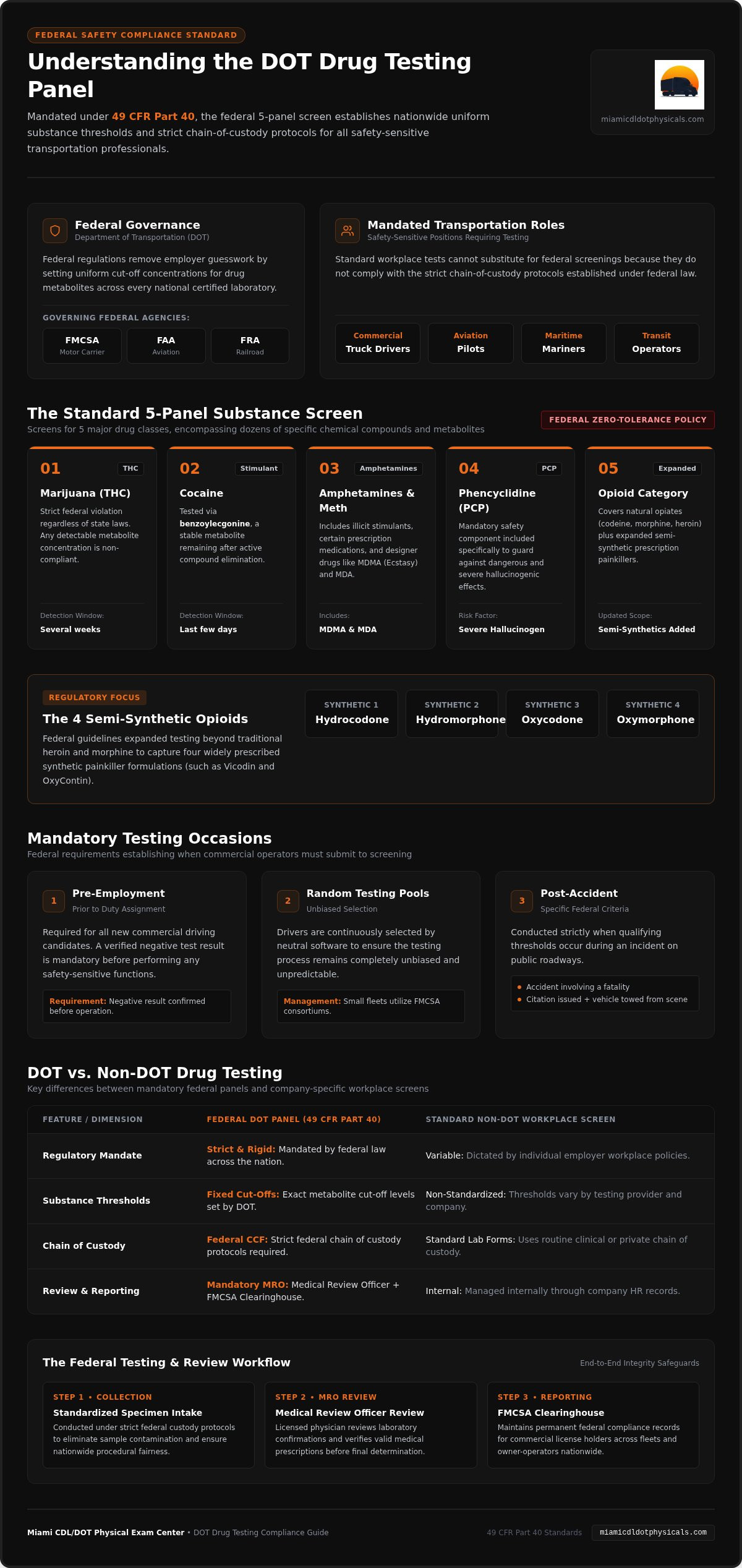
The DOT drug testing panel is a specific set of procedures and substance checks mandated by the federal government under 49 CFR Part 40. This regulation ensures that every safety-sensitive employee in the transportation industry meets the same high standards for sobriety and public safety. For a broader drug testing overview, it's helpful to see how these federal requirements fit into the wider context of occupational health. Unlike standard workplace tests, which can vary between companies, the DOT panel is rigid and consistent across the entire country.
This testing is required for a variety of professionals, including truck drivers, pilots, mariners, and transit operators. The primary purpose of this standardization is to ensure safety across the national transportation infrastructure. By using a uniform system, the government prevents inconsistencies that could lead to safety gaps. A standard workplace test cannot substitute for a federal DOT drug testing panel because it doesn't follow the strict "chain of custody" or the specific substance thresholds required by the Department of Transportation.
The Role of the Department of Transportation (DOT)
The DOT dictates the exact threshold levels for what constitutes a "positive" result. This eliminates guesswork for employers and ensures fairness for drivers. Several agencies are governed by these rules, including the Federal Motor Carrier Safety Administration (FMCSA), the Federal Aviation Administration (FAA), and the Federal Railroad Administration (FRA). The DOT panel is a federally mandated safety protocol for commercial licensing. By setting these cut-off levels, the DOT ensures that every lab across the nation is looking for the same concentration of metabolites.
Mandatory Testing Occasions
Compliance isn't just about a single test; it's about staying ready for several specific scenarios throughout your career. Pre-employment screenings are the first step for anyone entering a new commercial driving position. You must receive a negative result before you're allowed to perform any safety-sensitive duties. Post-accident testing is also required, but only when specific federal criteria are met, such as a fatality or a citation issued for a vehicle that must be towed from the scene.
Random testing pools are another critical component of the program. Drivers are selected by neutral software to ensure the process remains unbiased and unpredictable. For owner-operators and small fleets, joining an FMCSA Clearinghouse consortium Florida is the most efficient way to manage these random requirements. This ensures you remain in good standing with the federal database while focusing on your daily operations.
The Standard 5-Panel Screen: What Substances Are Tested?
While people often refer to the DOT drug testing panel as a "5-panel" screen, that name is slightly misleading. It actually screens for five major classes of drugs, which include dozens of specific substances and their metabolites. The federal government maintains a strict zero tolerance stance on these substances to ensure that every driver behind the wheel is fully alert and capable. Staying informed about these categories helps you maintain a clean record and avoid the stress of an unexpected positive result.
- Marijuana (THC): Even as state laws change, federal law remains firm. The DOT considers any detectable THC a violation. Detection windows can last several weeks depending on the individual's metabolism.
- Cocaine: Labs test for benzoylecgonine, a metabolite that stays in the system longer than cocaine itself. This indicates usage within the last few days.
- Amphetamines and Methamphetamines: This category includes illicit stimulants and certain prescription medications. It also covers "designer" drugs like MDMA (Ecstasy) and MDA.
- Phencyclidine (PCP): Though less common than in previous decades, PCP remains a mandatory part of the screen due to its severe hallucinogenic effects.
- Opioids: This category has seen the most significant changes in recent years, moving far beyond simple heroin or morphine detection.
The Expanded Opioid Category
The federal panel was updated to address the national opioid crisis by including four semi-synthetic opioids. In addition to natural opiates like codeine and morphine, labs now specifically test for Hydrocodone, Hydromorphone, Oxycodone, and Oxymorphone. These are common ingredients in prescription painkillers like Vicodin and OxyContin. If you have a valid prescription for these, the Medical Review Officer will verify it during the review process. If you're unsure about your current medications, it's wise to consult with a certified examiner before your next scheduled test.
A Word on CBD and Marijuana
The DOT "Safety First" policy is clear: the use of marijuana is a permanent disqualifier, regardless of state-level legality or medical cards. This policy extends to CBD products. Because the CBD industry is largely unregulated, many oils and gummies contain trace amounts of THC that can trigger a positive result on a DOT drug testing panel. As we move through 2026, the DOT has also fully integrated oral fluid testing as an alternative to urine collection. This provides a shorter detection window but offers a more direct look at recent usage, making it harder to mask substance use.
DOT vs. Non-DOT Drug Testing: Key Differences
Understanding the difference between these two types of screenings is essential for any commercial driver. While a non-DOT test is governed by individual company policy, the DOT drug testing panel is strictly regulated by the federal government. This means an employer can't simply decide to change the rules or thresholds on a whim. This regulatory oversight ensures that every driver, regardless of who they work for, is treated with the same level of scrutiny and fairness.
In a non-DOT environment, employers have significant flexibility. They might choose to add benzodiazepines, barbiturates, or other substances to their screen based on their specific safety concerns. However, for a federal DOT drug testing panel, the substance list is locked. You won't face surprise additions that aren't part of the 49 CFR Part 40 guidelines. The paperwork is also distinct. Every federal test requires a specific 7-part Federal Drug Testing Custody and Control Form (CCF). This form tracks the sample from the moment it leaves your sight until the final result is recorded, providing a legal trail that standard workplace tests don't always require.
The consequences of a failed test represent the biggest difference. If you fail a non-DOT test, your consequences are determined by your employee handbook. If you fail a DOT test, federal law takes over. You're immediately removed from safety-sensitive duties. You must then complete the formal Substance Abuse Professional (SAP) return-to-duty process before you can ever get back behind the wheel. It's a high-stakes process that emphasizes the importance of staying clean.
The Split Sample Requirement
One major protection for drivers is the split sample requirement. Every time you provide a sample for a federal screening, the collector must divide it into two separate bottles. Bottle A is tested immediately at the lab. Bottle B is held in reserve. If Bottle A returns a verified positive result, you have the legal right to request that Bottle B be sent to a completely different certified laboratory for testing. This protocol serves as a vital safeguard against laboratory errors or cross-contamination. It ensures that one mistake doesn't unfairly end your career.
Laboratory Certification Standards
Not just any lab can process these samples. All facilities must be certified by the Department of Health and Human Services (HHS). When you go for a DOT drug test Miami, you're benefiting from these national standards. These labs undergo rigorous "blind" testing where the government sends them known samples to ensure their accuracy remains perfect. This level of oversight provides a layer of validation that standard workplace testing often lacks, giving you confidence in the results.
The Testing Process: From Collection to MRO Review
The journey of a sample through the DOT drug testing panel is a highly structured process designed to protect both the driver and the public. It begins at the collection site, where a certified technician follows a strict protocol to maintain the chain of custody. You'll be asked to provide a sample in a private area, but the technician will check the temperature of the urine within four minutes to ensure it's between 90 and 100°F. Once the sample is split and sealed with tamper-evident tape, you'll sign the Federal Custody and Control Form to verify the specimen is yours and that it remained in your sight until sealed.
The laboratory then performs an initial immunoassay screening. This is a fast, preliminary test to see if any drug classes are present. If the sample clears this stage, it's reported as negative. If it flags for a substance, the lab moves to confirmatory testing using Gas Chromatography/Mass Spectrometry (GC/MS). This advanced technology acts like a molecular fingerprint, identifying the exact chemical structure of the drug. This two-step process ensures that any potential false positives from the initial screen are caught and corrected before they ever reach your record.
What Happens During an MRO Review?
The Medical Review Officer (MRO) is a licensed physician who serves as an independent gatekeeper between the laboratory and your employer. If the lab reports a positive result, the MRO doesn't immediately notify your company. Instead, they'll contact you for a private interview. This is your opportunity to provide a legitimate medical explanation for the result. If you have a valid prescription for a substance like an opioid or amphetamine, the MRO will verify the details with your pharmacy or prescribing doctor. Legitimate medical prescriptions must be verified by the MRO before a test is marked negative. If the MRO determines the medication is used as prescribed, they'll report the final result to your employer as "negative," protecting your professional standing.
Common Myths About Failing the Panel
Many drivers worry about accidental exposures, but the DOT drug testing panel is calibrated to avoid these pitfalls. The "poppy seed" defense is largely a thing of the past because the federal government raised the cutoff levels for opiates specifically to account for normal food consumption. Similarly, you won't fail a test from simply being in a room where someone else is smoking marijuana. The cutoff levels are set high enough that second-hand exposure is extremely unlikely to trigger a positive result. To ensure your testing experience is handled with professional care and efficiency, schedule your DOT drug test with an FMCSA-certified center that understands these nuances.
Maintaining Compliance with the FMCSA Clearinghouse
The FMCSA Clearinghouse acts as a digital ledger that tracks drug and alcohol violations for all commercial drivers. Once the laboratory and MRO complete their review of a DOT drug testing panel, any verified positive result is reported directly to this database. This system ensures that a driver cannot simply move to a different company to escape a violation. For fleet managers, this transparency is a vital tool for hiring. It provides a real-time look at a driver's eligibility, helping you maintain a safe and compliant team.
The reporting process generally follows a strict timeline to ensure the database remains accurate. The Medical Review Officer reports verified positive results, while employers are responsible for reporting alcohol violations or refusals to test. This centralized data protects the public by ensuring that only qualified, sober drivers are operating heavy equipment on national highways.
If a violation is recorded, the driver's status in the Clearinghouse changes to "prohibited." This status remains until the driver completes the mandatory Return-to-Duty process. This involves working with a Substance Abuse Professional (SAP) and successfully passing a return-to-duty drug screen. Staying organized during this time is critical. A professional compliance partner can help you track these steps, ensuring that every document is filed correctly so you can return to work as soon as possible.
The Clearinghouse and Owner-Operators
Independent drivers face unique challenges when it comes to federal regulations. As an owner-operator, you're required to be part of a random testing pool consortium. You cannot manage your own random testing because the selection process must be completely neutral. Additionally, you must conduct an annual query on yourself within the Clearinghouse to remain compliant. Managing these requirements while also keeping your CDL medical card Miami up to date can feel like a full-time job. Partnering with a consortium simplifies this by handling the administrative heavy lifting for you.
Choosing a Certified Testing Center
Not all testing facilities offer the same level of expertise. When selecting a partner, look for a facility that prioritizes speed and FMCSA accuracy. You need a provider that understands the full scope of your requirements, including how to pass DOT physical exams and the nuances of the DOT drug testing panel. A specialized center reduces driver downtime by getting results processed and reported quickly. Ensure your fleet stays compliant with our professional DOT drug testing services.
Secure Your Professional Future with Expert Compliance
Mastering the technicalities of the DOT drug testing panel is one of the most effective ways to protect your commercial license and your livelihood. By understanding the specific substances screened and the rigorous MRO review process, you can approach every testing scenario with total confidence. Compliance doesn't have to be a source of anxiety when you have the right information and a reliable partner by your side. Whether you're an owner-operator managing a consortium or a fleet manager overseeing a team, staying proactive is the key to longevity in this industry.
Our FMCSA-certified medical examiners specialize in providing fast, professional results that keep you in good standing with federal regulators. We provide expert Clearinghouse consortium management to take the administrative burden off your shoulders so you can focus on the road. Schedule Your Compliant DOT Drug Test Today to ensure your records remain spotless and your vehicles stay moving. You've worked hard to earn your place in the transportation industry; let's work together to keep your professional journey safe and successful.
Frequently Asked Questions
What drugs are in the DOT 5-panel drug test?
The standard DOT drug testing panel screens for five primary drug classes: marijuana (THC), cocaine, amphetamines (including methamphetamines and MDMA), phencyclidine (PCP), and opioids. The opioid category is comprehensive, covering natural opiates like codeine and morphine alongside semi-synthetic opioids like oxycodone and hydrocodone. This standardized approach ensures that all safety-sensitive employees meet the same federal safety requirements, regardless of their specific role in the transportation industry.
Can a DOT drug test detect synthetic opioids like Oxycodone?
Yes, the modern DOT drug testing panel specifically includes testing for four semi-synthetic opioids: oxycodone, oxymorphone, hydrocodone, and hydromorphone. These substances are common ingredients in prescription painkillers like OxyContin and Vicodin. If you have a legitimate prescription for these medications, the Medical Review Officer will verify your medical records. This verification process ensures that drivers using legally prescribed medications for valid health reasons aren't unfairly penalized for their results.
What happens if I test positive on a DOT drug testing panel?
If you test positive on a DOT drug testing panel, you'll be immediately removed from safety-sensitive duties. Your employer is required to report this violation to the FMCSA Clearinghouse, which makes you ineligible to drive commercially. To return to work, you must complete the formal Return-to-Duty process with a Substance Abuse Professional (SAP). This involves an evaluation, a prescribed treatment or education program, and a successful follow-up drug screen before you can resume driving.
Can I use CBD oil if I am a CDL driver?
Using CBD oil is extremely risky for CDL drivers because the federal government maintains a zero-tolerance policy for THC. Many CBD products are unregulated and contain trace amounts of THC that can trigger a positive result on a DOT drug testing panel. The DOT doesn't accept CBD use as a valid medical explanation for a positive test. To protect your career and your license, it's best to avoid all hemp-derived products entirely.
How long do drugs stay in your system for a DOT test?
Detection windows vary significantly based on the substance, the individual's metabolism, and the type of test performed. Marijuana can stay in your system for several weeks, while substances like cocaine, amphetamines, and opioids typically remain detectable for two to four days in urine. However, the introduction of oral fluid testing in 2026 provides a shorter but more immediate detection window. It's always safer to remain drug-free than to guess how long a substance might linger.
What is the role of a Medical Review Officer (MRO)?
The Medical Review Officer (MRO) is a licensed physician who acts as an independent gatekeeper between the laboratory and your employer. Their primary job is to review laboratory results and ensure they're accurate. If a test returns a positive result, the MRO interviews the driver to determine if there's a legitimate medical explanation, such as a valid prescription. They protect the driver's rights by verifying medical facts before any negative report reaches the employer.
Does a DOT drug test include alcohol testing?
A standard DOT drug testing panel specifically screens for controlled substances, not alcohol. However, alcohol testing is a separate requirement under DOT regulations and is typically conducted using a breathalyzer or saliva swab. Alcohol tests are mandatory after certain accidents and during random screening cycles. While the drug panel and alcohol test use different collection methods, both are critical components of maintaining your compliance with federal safety-sensitive duty standards.
Is oral fluid testing allowed for DOT drug panels in 2026?
Yes, oral fluid testing is a fully authorized method for DOT drug panels in 2026. This method involves collecting a saliva sample under direct observation, which makes it much harder to tamper with than traditional urine samples. Employers now have the flexibility to choose between urine or oral fluid collection depending on their specific needs. Oral fluid testing is particularly effective at detecting very recent drug use, providing an additional layer of safety for the transportation industry.


