

A DOT drug test isn't a simple pass or fail coin flip. It's a precision-engineered safety net designed to protect your CDL by virtually eliminating the risk of a false positive. You likely worry that a poppy seed bagel or a common over-the-counter cold medicine could end your career overnight. It's a valid concern for any professional driver who depends on a clean record to keep their livelihood secure. This guide will help you master the 2026 DOT drug test cutoff levels so you can understand exactly how labs determine your results with scientific accuracy.
By the time you finish reading, you'll have a clear understanding of the specific ng/mL thresholds for every substance on the panel. We'll explain the critical two-tier testing process that separates initial screenings from confirmatory results. You'll also learn how 2026 updates to testing methods affect your compliance requirements. This knowledge gives you the confidence to approach any scheduled or random screen with total peace of mind. We're here to help you manage these technical standards and keep your commercial driving career on the right track.
Key Takeaways
- Understand how nanograms per milliliter (ng/mL) define drug concentrations and why these precise measurements protect you from false positives.
- Learn the difference between initial screening and confirmatory testing to see how the DOT uses a two-tier system for maximum accuracy.
- Master the 2026 DOT drug test cutoff levels for the standard 5-panel test, including specific thresholds for marijuana and cocaine.
- Discover why oral fluid testing uses significantly lower cutoff levels than traditional urinalysis and how this impacts your detection window.
- Identify the critical role of the Medical Review Officer (MRO) in validating your results and how legitimate prescriptions can protect your CDL.
What Are DOT Drug Test Cutoff Levels?
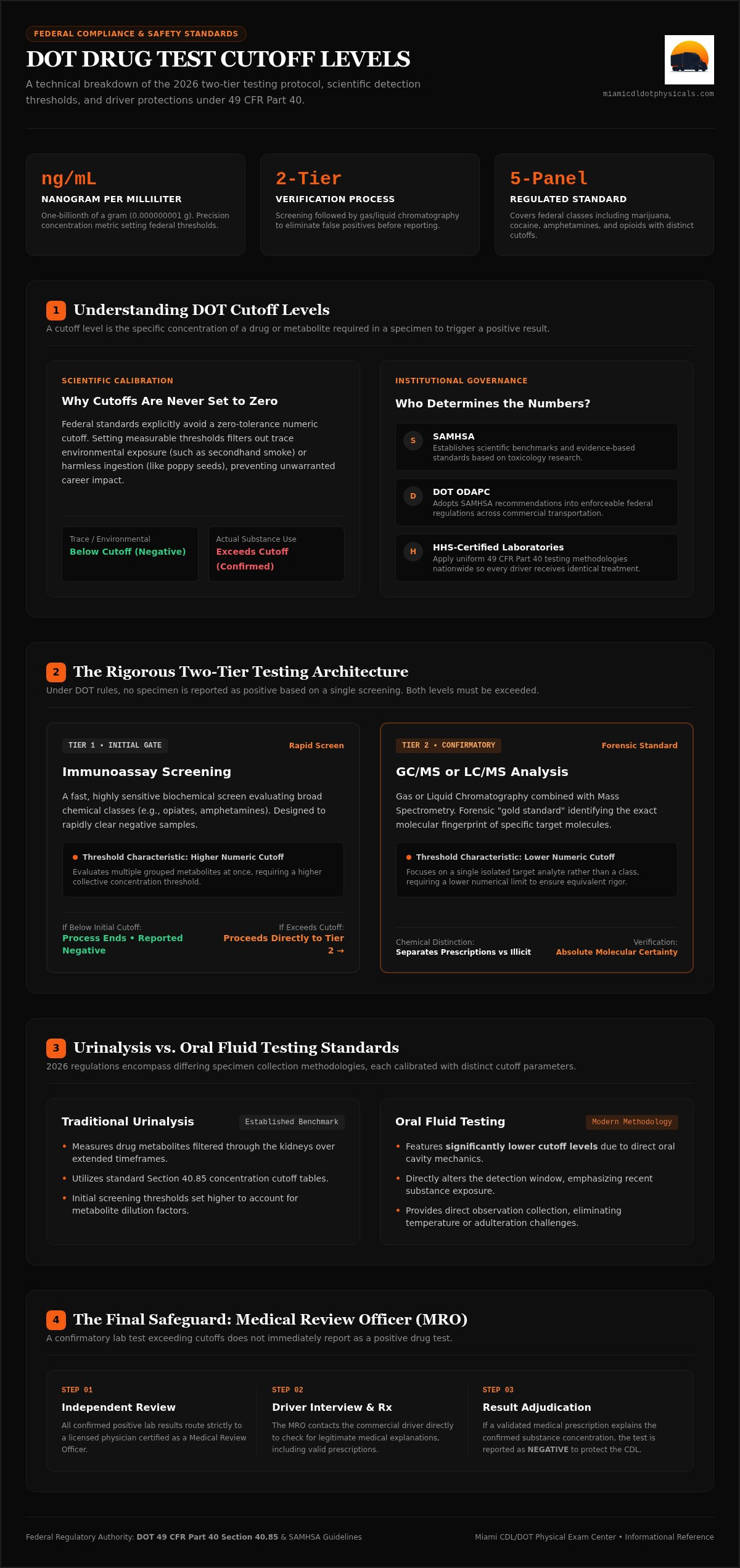
In the commercial driving industry, a cutoff level is the specific concentration of a drug or its metabolites that must be present in a sample to trigger a positive result. These measurements use nanograms per milliliter (ng/mL) to ensure extreme precision. Understanding the current DOT drug test cutoff levels is essential for any driver who wants to stay compliant. Think of a nanogram as one-billionth of a gram. It's a tiny amount, but it’s enough for modern labs to detect substance use with high accuracy.
The DOT establishes these uniform national standards so every driver is treated exactly the same, whether they're in Maine or California. These thresholds aren't set at zero. Instead, they're high enough to filter out trace amounts from environmental exposure, such as being in a room where someone else was smoking. This protects you from losing your CDL over accidental contact or passive inhalation.
The Purpose of Standardized Thresholds
Consistency is the backbone of federal compliance. By using standardized thresholds, the DOT ensures that every HHS-certified laboratory follows identical drug testing methodologies and confirmation procedures. This eliminates the risk of inconsistent results across different facilities. It's a fair system that provides a level playing field for every professional on the road.
These levels balance public safety with your individual rights. While the goal is to keep roads safe, the system also protects you from false positives caused by insignificant trace amounts. It’s a well-oiled process that prioritizes accuracy over speed. This ensures that a positive result is backed by solid scientific evidence rather than a simple "trace" detection.
Who Sets These Levels?
The technical work happens at the Substance Abuse and Mental Health Services Administration (SAMHSA). They determine the scientific benchmarks for what constitutes a positive result based on current medical research. The DOT Office of Drug and Alcohol Policy Compliance (ODAPC) then takes those benchmarks and implements them into the regulations you follow daily. It's a partnership between scientists and regulators to keep the industry safe.
As we move through 2026, these levels undergo periodic reviews to account for new substances and improved testing technology. This ongoing oversight ensures that the DOT drug test cutoff levels remain both fair and effective. When you step into a clinic for a screen, you aren't just facing a random test; you're participating in a highly regulated federal program designed to keep you legal and your career moving forward.
The Two-Tier Testing Process: Screening vs. Confirmation
The DOT doesn't rely on a single test to determine your career's future. It uses a rigorous two-tier process. This system ensures that no driver is penalized for a "false positive" or a simple lab error. For a result to be legally considered "positive," it must exceed the DOT drug test cutoff levels in both the initial screen and the confirmatory test. This double-check provides the scientific certainty required by federal law.
Initial Screening (Immunoassay)
The first step is a rapid screening process called an immunoassay. Labs use this stage to look for broad classes of drugs, such as opioids or amphetamines. It's designed to be highly sensitive. This means it can quickly identify any sample that might contain a substance. If your sample falls below the initial cutoff, the process stops immediately. Your test is reported as negative, and no further action is taken. This high sensitivity ensures that the lab doesn't miss potential use, but it's only the first gatekeeper.
Confirmatory Testing (GC/MS)
If a sample exceeds the initial threshold, it moves to the second stage: Gas Chromatography/Mass Spectrometry (GC/MS) or Liquid Chromatography/Mass Spectrometry (LC/MS). This is the "gold standard" of forensic toxicology. Unlike the broad screening, GC/MS identifies the specific molecular "fingerprint" of a drug metabolite. This precision eliminates confusion between similar chemical structures. It can distinguish between a specific prescription medication and an illegal substance with absolute certainty.
You might notice that confirmation levels are almost always lower than screening levels. This is intentional. The initial screen looks for a group of related metabolites, while the confirmation test looks for one specific target molecule. Because the second test focuses on a single substance rather than a group, the numerical limit is naturally lower to maintain the same level of strictness. You can view the specific federal requirements in the DOT 49 CFR Part 40 Section 40.85 cutoff concentrations table.
A test is only reported as positive to the Medical Review Officer (MRO) after it passes both tiers. This thorough validation process is what keeps the system fair for every professional on the road. If you are an owner-operator or fleet manager, staying ahead of these requirements is easier when you partner with an expert in DOT drug test compliance. This two-tier approach is your best defense against inaccuracies, ensuring that only true violations affect your driving record.
2026 DOT Cutoff Levels for the 5-Panel Test
The standard 5-panel test is the cornerstone of federal safety. For 2026, the DOT drug test cutoff levels follow strict thresholds for the most common substances. Marijuana (THC) remains a primary focus with an initial screening level of 50 ng/mL and a confirmatory level of 15 ng/mL. Cocaine testing uses a screening threshold of 150 ng/mL and a confirmation limit of 100 ng/mL. Phencyclidine (PCP) is unique because its cutoff stays consistent at 25 ng/mL for both stages of testing. These numbers are part of the broader FMCSA controlled substances testing requirements that keep the national transportation network secure.
Expanded Opioids and Synthetic Standards
The 2026 standards for synthetic opioids target hydrocodone, hydromorphone, oxycodone, and oxymorphone. Each of these substances uses a screening threshold of 300 ng/mL and a confirmation level of 100 ng/mL. These levels evolved to address the national opioid crisis by ensuring that high-potency painkillers are accurately detected. Heroin testing focuses on the 6-acetylmorphine (6-AM) metabolite. Because this metabolite is unique to heroin, it has a specific protocol with a cutoff of 10 ng/mL. This ensures that poppy seed consumption or standard morphine prescriptions don't trigger a false heroin positive. This precision helps you stay legal while managing legitimate medical needs under professional supervision.
Amphetamine and Methamphetamine Nuances
Amphetamine and methamphetamine testing both use a 500 ng/mL screening cutoff and a 250 ng/mL confirmation cutoff. Labs also test for MDMA and MDA at these same levels. To ensure accuracy, technicians perform a chiral analysis to distinguish between the D-isomer and L-isomer of methamphetamine. This distinction is critical because some over-the-counter nasal inhalers contain the L-isomer, while illicit substances consist of the D-isomer. In 2026, the confirmatory cutoff level for methamphetamine remains strictly set at 250 ng/mL. Understanding these DOT drug test cutoff levels helps you stay prepared for any random screen. It's about knowing the science that protects your career and keeps you moving forward without unnecessary stress.
Oral Fluid vs. Urine: Understanding Different Cutoffs
The year 2026 marks a significant era for oral fluid testing in the transportation industry. This method is now a fully authorized alternative to traditional urinalysis, offering a collection process that is directly observed and difficult to tamper with. However, you shouldn't compare the numerical values of a saliva test directly to a urine test. They measure different things. Because saliva contains much lower concentrations of substances, the DOT drug test cutoff levels are set at significantly lower thresholds to maintain the same level of safety and accuracy for every professional driver.
Oral Fluid Thresholds
The technical difference lies in what the lab is looking for during the analysis. Urine tests primarily detect metabolites, which are the chemical waste products created as your body processes a substance. Oral fluid tests look for the "parent drug" itself, which is the actual substance you consumed. For example, the THC screening cutoff in oral fluid is only 4 ng/mL, while the confirmation level is 2 ng/mL. This is a massive numerical difference from the 50/15 ng/mL levels used in urine testing. These lower thresholds allow for pinpoint accuracy in detecting recent use, providing a clear picture of a driver’s current state without the need for invasive collection procedures.
Choosing the Right Test for Compliance
Employers choose between these two methods based on the specific compliance need. Oral fluid is an excellent tool for post-accident testing because it can detect substances almost immediately after use. This helps investigators determine if a driver was impaired at the exact time of an incident. Urine testing remains the industry standard for pre-employment screens because it offers a longer detection window, typically covering use that happened several days prior. Both methods are legally valid and follow the same two-tier verification process to ensure your rights are protected.
Many professional drivers rely on DOT drug test Miami resources to stay informed about which method their specific carrier or consortium prefers. Whether you're facing a swab or a cup, the goal remains the same: proving you're fit for duty and keeping your career on track. To stay ahead of these regulatory changes, you can book your DOT drug test with an FMCSA-certified examiner who understands the latest 2026 standards and can guide you through the process with ease.
Protecting Your Career: Compliance and the MRO
The Medical Review Officer (MRO) serves as the essential human element in the testing process. While the lab handles the chemistry, the MRO handles the context. This person is a licensed physician with specialized training in substance abuse and federal regulations. When a lab confirms a result that exceeds the DOT drug test cutoff levels, the MRO acts as an independent gatekeeper. They review the chain of custody to ensure every procedure was followed perfectly. Their goal isn't just to report a positive result, but to verify that the result is legally and medically valid before it ever reaches your employer.
The MRO Interview Process
If your sample is confirmed positive at the lab, the MRO will contact you for a private interview. This is a critical protection for your career. If you're taking a medication that was legally prescribed by a healthcare provider, this is when you provide that documentation. When the MRO verifies a legitimate medical explanation for a level above the cutoff, they'll report the final result as negative. This ensures that drivers aren't penalized for following a doctor's orders. If you suspect a lab error, you have exactly 72 hours from the time of this interview to request a "Split Specimen" test. This allows the second bottle from your original collection to be tested at a different HHS-certified laboratory to verify the findings.
FMCSA Clearinghouse Integration
In 2026, the integration between testing results and the federal database is more seamless than ever. Once a positive result is verified by the MRO, it's reported directly to the FMCSA Clearinghouse. This record stays with you and is visible to any carrier that performs a required query. For owner-operators and small fleets, managing these records can be a heavy administrative burden. Partnering with a FMCSA Clearinghouse Consortium Florida ensures that your records are managed correctly and that you stay in full compliance with federal law.
A positive result in the Clearinghouse requires you to complete a formal Return-to-Duty process with a Substance Abuse Professional (SAP) before you can drive a commercial vehicle again. It's a long and often expensive road back to the driver's seat. Protecting your career starts with knowing the DOT drug test cutoff levels and being proactive about your health. Always keep your prescriptions up to date and communicate openly with your MRO if you're contacted. This transparency is your best tool for maintaining a clean record and ensuring your long-term employability in the trucking industry.
Stay Road-Ready with Proactive Compliance
Mastering the technical side of DOT drug test cutoff levels is your best defense against career-ending surprises. You now understand that federal testing is a precise science designed to ensure fairness through a rigorous two-tier validation process. Whether you're facing a traditional urine screen or a modern oral fluid test; the system relies on specific ng/mL thresholds and expert MRO oversight to protect your professional record. Staying informed about these 2026 standards keeps you in the driver's seat of your own career.
Don't leave your compliance to chance. Our team provides FMCSA-certified examiners and nationwide compliance management to help you navigate every regulation with ease. We offer expert MRO oversight to ensure your results are handled with the highest level of professional care. Stay compliant and keep your CDL active. Join our FMCSA Clearinghouse Consortium today and focus on what you do best; keeping the country moving. We're here to help you succeed on the road.
Frequently Asked Questions
Can second-hand marijuana smoke cause me to fail a DOT drug test?
No, you won't fail from incidental exposure. The 50 ng/mL screening threshold is high enough to differentiate between passive inhalation and active use. Federal research confirms that even being in a room with heavy smoke won't push your levels high enough to trigger a positive result. This buffer protects you from losing your CDL due to environmental factors, ensuring that only actual substance use leads to a violation.
What is the cutoff level for alcohol in a DOT breath test?
The DOT uses a two-tier threshold for alcohol. A breath alcohol concentration (BrAC) of 0.02 or higher requires you to be removed from safety-sensitive duties for a specific period. If your level reaches 0.04 or higher, it's considered a DOT violation and requires a formal Return-to-Duty process. These strict limits ensure that every commercial driver on the road is completely sober and fit for duty at all times.
Why is the confirmation cutoff lower than the screening cutoff?
Confirmation levels are lower because they target one specific molecule rather than a broad group of metabolites. During the initial screen, the lab looks for a whole class of chemicals, which requires a higher numerical threshold. In the confirmatory stage, technicians use advanced equipment to find the exact "fingerprint" of a single substance. Because the focus is much narrower, the DOT drug test cutoff levels for confirmation are naturally more precise.
Will CBD oil show up on a DOT drug test even if it has low THC?
Yes, it's possible. Many CBD products contain trace amounts of THC that aren't listed on the label. Over time, these small amounts can build up in your body and exceed the 15 ng/mL confirmatory threshold. The DOT doesn't accept "CBD use" as a valid medical excuse for a positive THC result. It's best to avoid these products entirely to protect your commercial driving career and keep your record clean.
How long do drugs stay in your system above the DOT cutoff levels?
Detection times vary based on the substance and the testing method used. In 2026, oral fluid tests can detect use within minutes but usually only for up to 48 hours. Urine tests have a longer window, often showing substances for several days or even weeks in the case of heavy marijuana use. Your metabolism and hydration levels also play a role in how long substances stay above the DOT drug test cutoff levels.
What happens if my drug test result is "dilute"?
A "negative-dilute" result means your sample had more water than usual, making it hard to measure drug concentrations. Depending on your employer's policy, you might be required to take a second test immediately. If the MRO determines the dilution was intentional, it could be treated as a refusal to test. Always follow the instructions of the collection site staff to ensure your sample meets the required creatinine and specific gravity standards.
Can I fail a DOT drug test for taking prescription painkillers?
You can fail if you don't have a valid prescription in your name. If the lab detects opioids like oxycodone or hydrocodone, the MRO will contact you for a medical interview. You must provide a current prescription from a healthcare provider who's aware of your safety-sensitive duties. If the medication is deemed a safety risk, the MRO may still report that you're medically unqualified even if the drug test itself is cleared.
Is the cutoff level different for a random test versus a pre-employment test?
No, the standards are identical for every type of screen. Whether you're taking a pre-employment test, a random screen, or a post-accident test, the labs use the same thresholds. The federal government maintains these uniform standards to ensure that every driver is treated fairly across the entire industry. Consistency is the key to federal compliance, so you don't have to worry about shifting rules depending on the reason for your test.


