

Clerical accuracy on Form MCSA-5875 is just as critical for your CDL as your blood pressure reading. You might have the health of an athlete, but one missed checkbox in 2026 can still park your truck for weeks. Many drivers inadvertently trigger delays by overlooking common mistakes on DOT physical form sections that seem straightforward but require precise detail. These administrative errors remain the single biggest hurdle to getting your medical card issued on the same day.
It's frustrating to face a potential loss of income just because of a paperwork technicality. You want to get through the clinic and back on the road without a second thought. This guide will show you how to accurately complete the driver's portion of the form to ensure a smooth certification process. We'll break down exactly which "Yes" answers require additional documentation and provide a clear checklist to help you get your medical card issued on your first try without any follow-up visits.
Key Takeaways
- Eliminate clerical errors by verifying that your personal information matches your current commercial driver's license exactly.
- Master the health history section by understanding why honesty about past medical events is safer than leaving gaps.
- Learn to avoid the most common mistakes on DOT physical form by providing complete medication lists, including dosages and prescribing physician names.
- Arrive prepared with specific documentation, such as CPAP compliance logs or surgery dates, to ensure your medical card is processed without delay.
Understanding Form MCSA-5875: The Foundation of Your CDL
The MCSA-5875 is the official Medical Examination Report Form used by the FMCSA to determine if you are physically fit to operate a commercial vehicle. It isn't just a simple health survey; it's a legal document that stays on your permanent record. In 2026, accuracy is more critical than ever. Digital database syncing between medical examiners and state licensing agencies means that errors are caught almost instantly. A single inconsistency between your license data and your form can trigger a "Determination Pending" status or even a full audit of your medical history. Learning to avoid common mistakes on DOT physical form entries is the best way to ensure your certification remains valid and your truck stays on the road.
Who Fills Out Which Part of the Form?
The form is clearly partitioned to maintain the integrity of the exam. Section 1 is the driver's territory. This is where you provide your personal information, license number, and a detailed health history. You should complete this part with extreme care before you even step into the exam room. Sections 2 through 5 are reserved exclusively for the Certified Medical Examiner. Don't make the mistake of filling out these sections yourself. It can look like you're trying to influence the medical findings, which may lead to a disqualification.
When you sign the driver certification line at the end of Section 1, you're making a legal statement. This signature confirms that your answers are complete and true to the best of your knowledge. Because this is a federal document, your signature carries the weight of law. Accuracy here isn't just about passing a test; it's about maintaining your professional standing and legal compliance.
The Consequences of Paperwork Errors
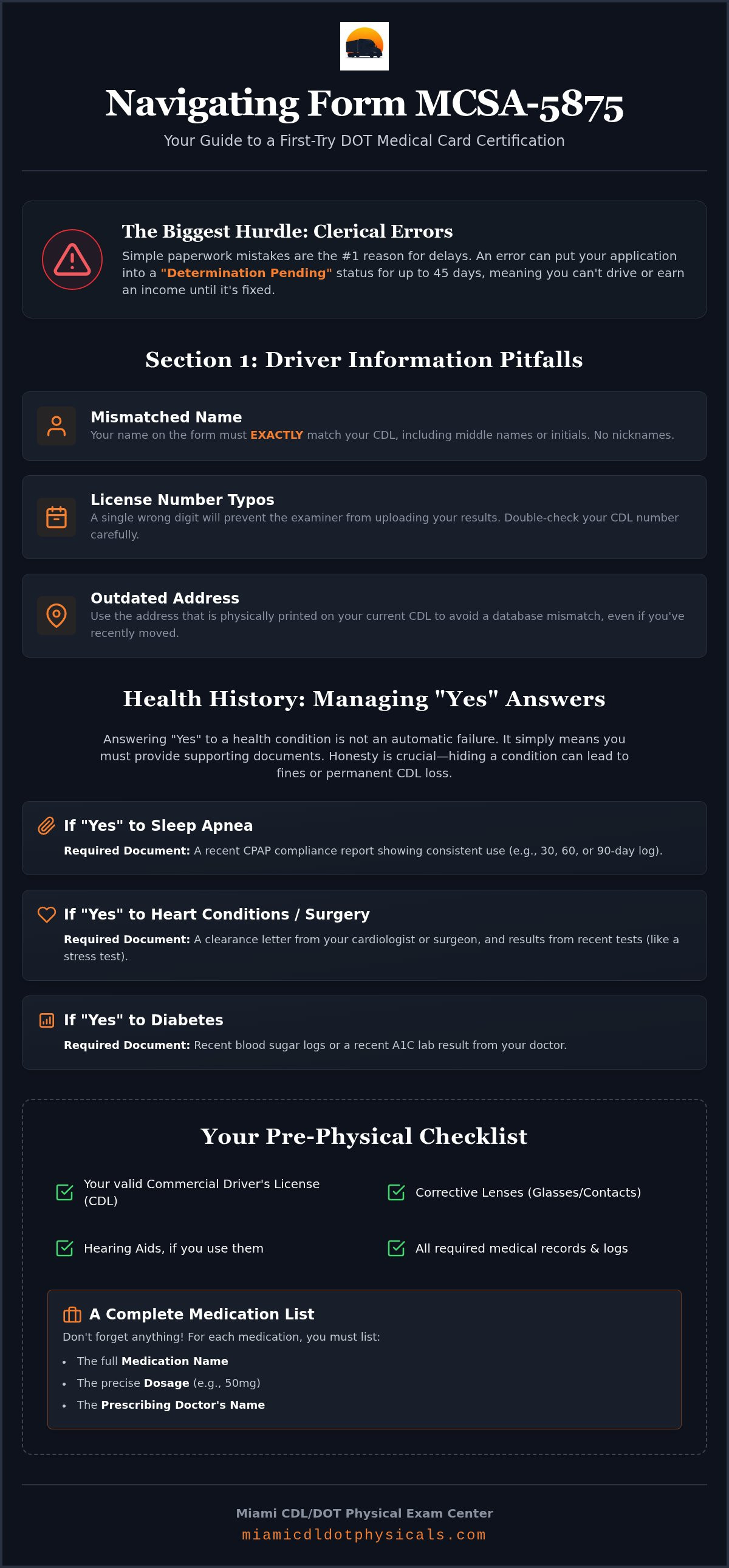
The most immediate result of a paperwork error is a time delay. If an examiner finds a mistake, they might place your application into "Determination Pending" status. This gives you up to 45 days to fix the issue, but it often means you can't drive until the correction is finalized. If your current medical card expires during this window, you lose your ability to earn a living until the paperwork clears. This is one of the most common mistakes on DOT physical form processing that catches drivers off guard.
Financial and legal risks also come into play. You'll likely pay additional fees for follow-up appointments to correct simple clerical errors. More importantly, the "willful omission" of medical facts is a serious offense. If you're found to have hidden a medical condition, you could face federal fines or permanent loss of your CDL. Being thorough and honest from the start protects your wallet and your future in the industry.
Common Mistakes in Section 1: Driver Information
Many drivers assume the medical exam only starts once they are on the exam table. In reality, the certification process begins the moment you pick up the pen to fill out Section 1. Administrative errors in this initial portion are among the most frequent common mistakes on DOT physical form submissions. These clerical blunders can pause your application before the examiner even checks your pulse. In the digital landscape of 2026, the FMCSA systems are designed to flag inconsistencies instantly, so getting the basics right is your first step toward a successful day.
Matching Your License Details Exactly
Your examiner is required to verify your identity against official state records. This means the information you provide must be an exact mirror of your current Commercial Driver’s License (CDL). If your license includes your full middle name, you must include it on the form. If you've moved recently but haven't updated your license with the DMV, you should still use the address listed on your physical card to avoid a database mismatch.
Typos in your driver license number are a leading cause of "Determination Pending" statuses. Even a single transposed digit prevents the examiner from uploading your results to the National Registry. To ensure a smooth process, double-check these specific areas:
- Legal Name: Use your full name as it appears on your CDL, not a nickname.
- License Number: Read the number back to yourself digit by digit to catch errors.
- Issuing State: Ensure you list the state where your current license was actually issued.
- Contact Info: Don't leave phone numbers or email fields blank, as these are vital if the state needs to contact you for clarification.
Interstate vs. Intrastate Confusion
Choosing the correct type of operation is vital for your legal compliance and your ability to work. Interstate drivers cross state lines or handle cargo that originated in or is destined for another state. Intrastate drivers stay strictly within a single state's borders. Checking the wrong box doesn't just create paperwork friction; it can legally restrict where you are allowed to haul. If you're unsure which category fits your specific route, it's best to consult with specialists in transportation compliance who can guide you through the classification before you sign.
Correcting a classification error after the form is submitted is a major hurdle. It often requires a new exam or a formal amendment process through your state's licensing agency. Taking an extra sixty seconds to verify your operation type and ensuring every required field is filled will save you hours of administrative headaches later. Treat Section 1 with the same focus you give to your pre-trip inspection.
The Health History Section: Managing the "Yes" Answers
The health history section of the MCSA-5875 is often the most stressful part for drivers. Many feel that checking a "Yes" box is an automatic disqualification. This fear leads to one of the most common mistakes on DOT physical form completion: providing a "clean" but inaccurate history. In reality, a "Yes" answer simply signals to the examiner that a condition needs to be discussed. It's the lack of detail, not the condition itself, that usually causes the delay. If you've had a major surgery or a chronic condition, you must provide the approximate date of the event. Leaving dates blank forces the examiner to pause the exam while you search for records, which can prevent same-day certification.
Consistency is your best ally during the exam. If you tell the examiner you had knee surgery five years ago but didn't list it on the form, you create a red flag. Examiners are trained to look for these inconsistencies. They'll also perform a physical check that might reveal surgical scars or signs of managed conditions. When your written form doesn't match your physical reality or your verbal story, it suggests you're hiding information, which can lead to a much deeper investigation of your records.
How to Explain Medical Conditions Clearly
The comment box at the bottom of the health history section is your chance to provide context. Don't leave it empty if you've checked "Yes" for any condition. Use this space to state that a condition is "well-controlled" or "managed with medication." For example, if you have high blood pressure, noting that you take your medication daily and see your doctor regularly helps the examiner feel confident in your fitness. Avoid vague phrases like "it was a long time ago." FMCSA standards require specific details, so listing the year and the outcome of the treatment is much more effective for a fast approval.
The Risk of Omission
Omitting a medical condition is a gamble that rarely pays off. If an examiner discovers an undisclosed condition, it can lead to a "Determination Pending" status or a permanent mark on your driving record regarding your medical certification. Modern digital records in 2026 make it easier for state agencies to cross-reference your history. If you realize you forgot a detail after handing in the form, tell the examiner immediately. Most will allow you to amend the form before the final submission. It's always better to correct a mistake voluntarily than to have it discovered during the physical exam.
Medication and Surgery Reporting: The Accuracy Trap
Precision is the difference between leaving the clinic with a medical card and leaving with a request for more records. When you reach the medication section of the MCSA-5875, simply writing down the name of a drug is not enough. Listing a medication name without the accompanying details is one of the most common mistakes on DOT physical form documents. The FMCSA requires a complete picture of how you manage your health, which includes the dosage, the frequency of use, and the name of the provider who wrote the prescription. If any of these pieces are missing, the examiner cannot verify that your condition is stable enough for commercial driving.
Many drivers also overlook "as needed" (PRN) medications and over-the-counter supplements. If you take a prescription for occasional anxiety or a supplement to help manage your heart rate, these must be reported. You should also explain the specific trigger for using "as needed" meds in the comments. For example, if you take a muscle relaxant only for back spasms that occur once or twice a year, that context helps the examiner understand that the medication doesn't interfere with your daily driving duties. Failing to mention these items can lead to a positive drug screen or an unexpected blood pressure reading that you can't explain.
Creating a Complete Medication List
The best way to avoid delays is to arrive with a pre-written list. Don't rely on your memory while sitting in the waiting room. Saying "I take a little white pill for my heart" is not an acceptable entry and will immediately halt your progress. Use the following template to organize your information before your appointment:
- Medication Name: Use the exact name printed on the pharmacy label.
- Dosage: Include the strength, such as 20mg or 50mcg.
- Frequency: Note how often you take it, such as "once daily" or "twice a day."
- Prescribing Physician: List the full name of the doctor who manages this specific medication.
If your doctor recently changed your dosage, make sure you list the new amount. It's also helpful to bring the actual prescription bottles with you. This allows the examiner to verify the data quickly and move you through the process without needing to call your primary care doctor for clarification.
Documenting Recent Surgeries
Reporting surgeries is another area where drivers often stumble. You must report almost all surgical procedures, even those that seem minor or happened years ago. One of the biggest common mistakes on DOT physical form entries is failing to bring a "return to work" release from your surgeon for any procedure performed within the last year. Without this formal clearance, the medical examiner cannot legally certify you, regardless of how well you feel.
Distinguish clearly between minor procedures, like a simple mole removal, and major medical events like a joint replacement or heart surgery. Major events require much more documentation, including recent stress tests or clearance letters from specialists. If you are unsure about how your current prescriptions or recent procedures might impact your exam, schedule your DOT physical exam with a certified examiner who can review your documentation in advance.
How to Arrive Prepared: A Pre-Physical Checklist
Arriving at the clinic with everything in hand is the fastest way to get back behind the wheel. While the medical exam itself is straightforward, the logistical preparation is where many drivers face hurdles. Preparation is the best defense against common mistakes on DOT physical form entries that could otherwise sideline your career. Before you leave for your appointment, verify that your CDL information and current home address match exactly. Any discrepancy between your physical license and what you write on the form can halt the digital upload process in 2026.
If you manage chronic conditions, your documentation must be current and specific. For those with sleep apnea, a CPAP compliance report is mandatory. Most examiners look for a report showing at least 70% usage over the most recent 30-day period. Additionally, bring a printed list of all medications as discussed in previous sections. Having this list ready ensures you don't forget dosages or prescribing physician names while filling out your paperwork under pressure.
The Specialist Clearance Letter
This is a critical area where many drivers experience delays. If you have a history of heart issues, neurological conditions, or vision impairment, a general note from your doctor saying "you are healthy" is not sufficient for FMCSA standards. The medical examiner needs a clearance letter that explicitly states you are "fit to drive a commercial vehicle safely." This specific phrasing provides the examiner with the legal assurance they need to certify you.
Timing is also vital. Your clearance letter must be dated within the last 90 days to be considered valid. If the letter is older, the examiner may require you to return to your specialist for an updated evaluation. This is a primary reason why drivers end up in a "Determination Pending" status. Ensure your specialist understands the physical demands of your job so their letter accurately reflects your ability to handle long hours and heavy equipment.
Final Review: The "Second Set of Eyes" Strategy
Before you hand your completed Section 1 to the medical assistant, take two minutes for a final review. This is your last chance to catch common mistakes on DOT physical form sections before they become part of your permanent record. Read through every question one more time. It is easy to accidentally skip a checkbox or forget to provide a date for a past surgery. Every "Yes" answer must have a corresponding explanation in the comment box to avoid immediate follow-up questions.
Think of this review as your administrative pre-trip inspection. Our FMCSA-certified examiners are experts in identifying and correcting driver form errors before they become compliance issues. They act as a second set of eyes to ensure your paperwork is flawless. By following this checklist and reviewing your work, you significantly increase your chances of walking out with your new medical card the same day.
Secure Your Medical Certification with Confidence
Administrative precision is the primary key to maintaining your livelihood in 2026. By ensuring your personal data matches your CDL exactly and providing detailed explanations for your health history, you remove the roadblocks that lead to a "Determination Pending" status. Avoiding common mistakes on DOT physical form entries isn't just about following complex rules; it's about respecting your own time and protecting your income from unnecessary processing delays. When you arrive with your medication lists and specialist letters ready, you turn a stressful requirement into a routine check-in.
Don't let a simple paperwork error keep you off the road. Our team of FMCSA-Certified Examiners and national compliance experts is here to partner with you for a seamless experience. We specialize in identifying clerical issues before they cause delays, helping you secure your same-day medical certificates with ease. You've done the hard work of staying healthy and maintaining your equipment; let us help you finalize the paperwork with the same level of professional care. Schedule your professional DOT physical exam today and keep your career moving forward without the wait.
Frequently Asked Questions
What happens if I make a mistake on my DOT physical form?
A mistake typically results in a "Determination Pending" status, which can pause your certification for up to 45 days. You won't receive your medical card until the error is corrected. This is one of the most common mistakes on DOT physical form processing that leads to lost driving time. Always review your personal details and health history checkboxes before handing the paperwork to the medical assistant to avoid these preventable administrative holds.
Can I leave a section blank if it does not apply to me?
No, you should never leave required fields blank. If a section doesn't apply to you, write "N/A" or check the "No" box as appropriate. Blank spaces are often interpreted as accidental omissions or an attempt to hide information. Examiners cannot finalize your report with missing data, so filling every field ensures the digital upload to the National Registry happens without technical glitches or manual reviews.
Should I list medications I only take occasionally on the MCSA-5875?
Yes, you must list all medications, including those you only take "as needed" or PRN. This includes seasonal allergy pills, occasional muscle relaxants, or even high-dose supplements. Provide the medication name, the dosage, and the specific reason you take it. Omitting these is a frequent error because drivers assume only daily medications matter, but "as needed" drugs can still impact your physical readiness and drug screen results.
What if I forgot to mention a surgery from ten years ago?
You should disclose the surgery as soon as you realize it was missed. If the exam is still in progress, ask the examiner to help you amend Section 1. While a ten-year-old surgery might seem irrelevant, an undisclosed scar found during the physical exam can cause trust issues and lead to a more intensive medical review. Honesty is always the fastest path to certification, even for older procedures.
Do I need to list my primary care doctor on the DOT form?
Yes, the form requires the contact information for the healthcare provider who manages your primary care or chronic conditions. This allows the medical examiner to reach out if they need to verify a specific diagnosis or treatment plan. Providing this information upfront prevents delays that occur when an examiner has to wait for you to look up a doctor's phone number or address during your appointment.
Can I fill out the DOT physical form online before my appointment?
Many clinics allow you to download and print Form MCSA-5875 to complete Section 1 before you arrive. This is an excellent way to avoid common mistakes on DOT physical form entries because it gives you time to look up surgery dates and medication dosages at home. However, you must still sign the form in the presence of the medical staff to verify that the information provided is accurate and current.
What is the most common reason for a DOT medical card being delayed?
The most frequent cause of delay is missing documentation for "Yes" answers in the health history section. If you check "Yes" for a heart condition or sleep apnea but don't have a recent specialist clearance letter or CPAP report, the examiner cannot legally issue your card. Arriving without these supporting documents forces a "Determination Pending" status, which is the single biggest hurdle for drivers seeking same-day certification in 2026.
Is my medical history on the DOT form kept private?
Your medical history is protected under federal privacy laws, including HIPAA, but it is not entirely confidential from regulatory bodies. The information on Form MCSA-5875 is shared with the FMCSA and your state's driver licensing agency to verify your fitness to drive. While your employer may receive a copy of the final certificate, they do not typically see the detailed health history section unless you provide separate written consent.


