

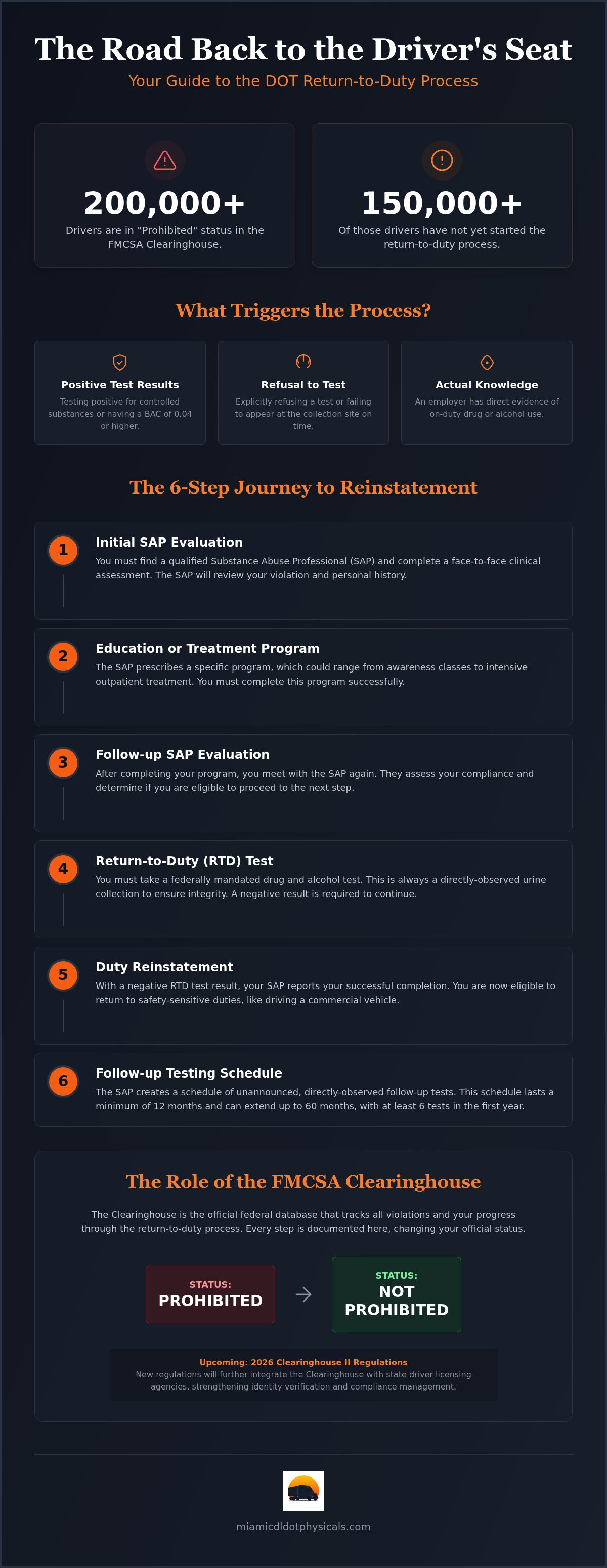
Over 200,000 drivers are currently in "prohibited" status in the FMCSA Clearinghouse, and more than 150,000 of them haven't yet started the steps to fix it. If you're currently sidelined, you know the intense anxiety of watching your income vanish while you struggle to understand the DOT return to duty process. It's a high-stakes situation where a single documentation error can delay your career for months. You're likely feeling overwhelmed by the technical requirements and the pressure to find a qualified Substance Abuse Professional (SAP) who can help you clear your record.
We understand that your commercial license is your livelihood. You need a clear path forward that removes the guesswork and gets you back on the road. This guide promises to help you navigate every federal compliance step with total confidence so you can return to work legally and efficiently. We'll provide a complete roadmap to "not prohibited" status, including a breakdown of the latest 2026 Clearinghouse II regulations. You'll learn exactly what to expect from SAP evaluations, understand the typical timelines, and discover how to successfully manage your required follow-up testing schedule.
Key Takeaways
- Master the six essential steps of the DOT return to duty process to move from a "prohibited" status to being back behind the wheel.
- Understand the critical role of the Substance Abuse Professional (SAP) as an independent gatekeeper for your career restoration.
- Prepare for the mandatory return-to-duty drug test and learn why direct-observation urine screens are a non-negotiable federal requirement.
- Navigate the 2026 FMCSA Clearinghouse updates, including the latest identity verification steps required to manage your status.
- Learn how to maintain long-term compliance by automating your follow-up testing schedule through a specialized Clearinghouse Consortium.
What is the DOT Return to Duty Process?
The DOT return to duty process is a mandatory safety protocol designed to evaluate and rehabilitate commercial drivers who've violated federal drug and alcohol regulations. It isn't a permanent ban, but rather a structured path back to the driver's seat. This system finds its legal roots in the Drug-Free Workplace Act of 1988, which established the framework for maintaining substance-free environments in safety-sensitive industries. Governed by 49 CFR Part 40, the process ensures that every driver on the road meets strict health and safety standards before they resume their professional duties.
The process begins the moment a violation is recorded. This trigger shifts your status in the FMCSA Clearinghouse to "prohibited." In this state, you're legally barred from performing any safety-sensitive functions, which effectively pauses your driving career. You cannot operate a commercial motor vehicle on public roads until you complete specific remedial steps. The DOT return to duty process is the only legal way to move your status back to "not prohibited" and regain your eligibility for employment.
Violations That Require Return-to-Duty
Not every mistake leads to a violation, but specific actions will trigger the mandatory protocol. These violations are reported directly to the federal database and stay there until the process is complete. Common triggers include:
- Positive Test Results: Testing positive for controlled substances or having a breath alcohol concentration of 0.04 or higher.
- Refusal to Test: Explicitly saying no to a test or failing to show up at a collection site in a timely manner.
- Actual Knowledge: When an employer has direct evidence of drug or alcohol use while on duty, even without a formal test result.
The Immediate Consequences of a Violation
Once a violation occurs, the impact is immediate and significant. You'll be removed from all safety-sensitive tasks right away. This means you can't drive a commercial motor vehicle, load cargo, or perform inspections. Your employer must report the violation to the FMCSA Clearinghouse within three business days. This record is visible to current and future employers, which often complicates background checks and insurance renewals. Clearing this record requires a disciplined approach to the federal requirements. It's a partnership between you and your Substance Abuse Professional to prove you're ready for the responsibility of the road.
The 6 Essential Steps of the Return-to-Duty Process
The DOT return to duty process follows a rigid, six-step sequence designed to ensure you're fit to resume safety-sensitive work. This isn't just a series of meetings; it's a coordinated effort between you, your employer, and federal regulators. Each step must be documented accurately in the FMCSA Clearinghouse to move your status from "prohibited" to "not prohibited."
- Step 1: Initial SAP Evaluation. You'll meet with a qualified professional for a clinical assessment.
- Step 2: Education or Treatment. You must complete the specific program your SAP prescribes.
- Step 3: Follow-up SAP Evaluation. The SAP reviews your progress and determines if you've complied with the plan.
- Step 4: Return-to-Duty (RTD) Test. You'll undergo a supervised drug and alcohol screen.
- Step 5: Duty Reinstatement. After a negative RTD result, you're eligible to return to safety-sensitive functions.
- Step 6: Follow-up Testing Schedule. You'll complete a series of unannounced tests over a 12 to 60-month period.
Navigating the Initial Assessment Phase
Finding a provider is your first priority. You can search the FMCSA database or use professional networks to locate a qualified individual. Once you've chosen, you must register your selection in the FMCSA Clearinghouse portal. This allows the SAP to upload reports and track your progress. During the face-to-face clinical interview, the SAP will review your history and the specific violation. This meeting is crucial for defining the Role of the Substance Abuse Professional (SAP) as your primary guide through the federal requirements.
Treatment vs. Education: Understanding Your Path
The SAP has the final authority to decide whether you need a simple education course or a more intensive treatment program. Education usually involves drug and alcohol awareness classes. Treatment might include intensive outpatient programs or counseling. Timelines vary based on the SAP's findings; some programs take a few weeks, while others last several months. You'll need to keep detailed documentation of your attendance to present during your follow-up evaluation. Once the SAP clears you to test, you'll need a reliable facility for the screen. You can schedule your DOT drug test at a certified center to ensure the results are reported to the Clearinghouse without delay. This DOT return to duty process requires patience, but following the steps exactly is the only way to protect your CDL.
The Role of the Substance Abuse Professional (SAP)
The Substance Abuse Professional (SAP) serves as the primary gatekeeper for public safety within the DOT return to duty process. They aren't just counselors; they're clinical evaluators with the power to determine when a driver is safe to return to the road. One of the most critical aspects of this role is independence. Federal law requires that the SAP remains neutral. They don't work for the driver and they don't work for the employer. This ensures their recommendations are based solely on safety and clinical data rather than company pressure or personal bias. This structure is a cornerstone of the FMCSA Drug & Alcohol Testing Program, which aims to keep impaired drivers off national highways.
To hold this position, a professional must possess specific credentials. A legitimate DOT SAP must be a licensed physician, social worker, psychologist, or a certified employee assistance professional. They also need to complete specialized DOT qualification training and pass a comprehensive exam. The SAP acts as the central hub for communication. They notify the employer when you've started the process and send a final report when you've finished. While they don't share your private therapy notes, they do provide the specific roadmap that the employer and the Medical Review Officer (MRO) must follow to reinstate your status.
How to Choose a Qualified SAP
You're responsible for finding and paying for your SAP services. It's vital to verify their credentials through national certification databases before your first meeting. Ask if they've completed their required continuing education for 2026 to ensure their qualification is current. Don't fall for "SAP mills" that promise a fast pass without a thorough clinical interview. If the FMCSA audits a provider and finds they didn't follow federal guidelines, your entire DOT return to duty process could be voided. This would force you to start the steps over from the beginning, wasting both time and money. Research shows that a complete SAP evaluation in 2026 typically costs between $450 and $650, so view this as an investment in your career's future.
The SAP’s Report and Recommendations
After your treatment or education is complete, the SAP performs a follow-up evaluation. They'll issue a "Notice of Compliance" if you've met all requirements. This document is the legal green light that allows an employer to order your return-to-duty test. If you've failed to participate or haven't met the clinical goals, they'll issue a "Notice of Non-Compliance," which keeps you in "prohibited" status. The SAP’s clinical determination carries immense legal weight. Their decision cannot be overturned by your employer, a doctor, or even another SAP. You must follow their specific plan to the letter to regain your livelihood.
Return-to-Duty Testing and Follow-Up Requirements
The Return-to-Duty (RTD) test is the final hurdle in the initial DOT return to duty process. This isn't a test you can simply go out and take on your own. Your employer, or a prospective employer, must order this specific test after receiving the SAP's compliance report. It's a high-stakes moment because a negative result is the only thing standing between you and your "Not Prohibited" status. If you're currently between jobs, a new employer can order this test as part of your pre-employment screening once they've verified your SAP compliance in the Clearinghouse.
The Direct Observation Requirement
Federal law dictates that every RTD test must be conducted under direct observation. This means a collector of the same sex must physically watch the specimen leave the body to prevent any attempt at cheating or substitution. While this can feel intrusive, it's a non-negotiable requirement for career restoration. In 2026, federal law requires a same-sex collector to witness the urine sample leaving the body to ensure the specimen's integrity for every Return-to-Duty test. You should arrive at the collection site prepared for this level of scrutiny and follow all instructions from the staff to avoid a "refusal to test" charge, which would restart your violation clock.
Long-Term Monitoring and Consistency
Once you pass the RTD test and return to work, you enter the follow-up testing phase. The SAP creates a personalized testing plan that includes a minimum of six unannounced tests during the first 12 months of your return. These tests are separate from, and in addition to, the standard random testing pool. Your employer is responsible for ensuring these tests happen on the schedule the SAP provided. These tests are always unannounced, and you'll have no advance notice of when you'll be called to the clinic.
The monitoring doesn't stop after the first year. The SAP has the authority to extend the follow-up testing period for up to five years. During this time, any second violation will likely result in a permanent loss of your commercial driving privileges. Consistency is your best ally here. If you're an owner-operator, managing this schedule can be complex and stressful. You can join an FMCSA Clearinghouse Consortium to automate your testing schedule and ensure you never miss a required window. Passing these tests is how the Clearinghouse eventually moves your record to a fully cleared status, signaling to the industry that you're a safe, compliant professional.
Managing Compliance Through the FMCSA Clearinghouse
The FMCSA Clearinghouse is the digital record of your professional standing. It tracks every stage of the DOT return to duty process, and understanding how to manage your portal is vital for staying employed. Once you complete your SAP requirements and pass the return-to-duty test, your employer must report the negative result to the database. This action is what finally triggers the change from "Prohibited" to "Not Prohibited." It's a significant milestone, but it doesn't mean your record is wiped clean. Your violation history remains visible to any employer who performs a full query, which costs $1.25 per request in 2026. Future employers will conduct annual queries to ensure you're maintaining compliance with your follow-up testing plan.
Since the Clearinghouse II rule took full effect on November 18, 2024, state licensing agencies now receive immediate notification of your status. If you're in "Prohibited" status, your CDL or CLP will be downgraded or removed entirely by your state. Regaining your license depends on the Clearinghouse reflecting your successful completion of the federal steps. This makes the accuracy of your digital profile just as important as the medical tests themselves.
Clearinghouse Identity Protection in 2026
The FMCSA has implemented stricter security protocols for 2026 to protect driver data. You must now use a verified Login.gov account with enhanced multi-factor authentication to access your records. To clear a "Prohibited" tag, you'll need to link your CDL information precisely to your Clearinghouse profile. If your names don't match exactly between your license and the portal, the system won't update your status. Common login issues often stem from outdated contact information or expired passwords. Resolve these by updating your profile via the secure web application before you reach the final testing phase. This ensures that when your negative result is uploaded, the status change happens instantly.
Automating Follow-Up with a Consortium
If you're an owner-operator, the rules for the DOT return to duty process are even more specific. Federal law prohibits you from managing your own random or follow-up testing pools. You cannot be the person who decides when you get tested. You must designate a third-party administrator to handle these logistics. A Consortium acts as this administrator, taking the burden of scheduling off your shoulders. They ensure that all six mandatory tests in the first year are completed on time and reported correctly. Missing a single follow-up window can reset your entire five-year monitoring period. Join our FMCSA Clearinghouse Consortium for seamless compliance. This partnership ensures you stay on the road while meeting every federal requirement without the stress of manual tracking.
Take Control of Your Career Restoration
The DOT return to duty process is a rigorous journey, but it's the only legal way to reclaim your commercial driving privileges. Success depends on following the six essential steps and adhering to the SAP's specific recovery roadmap. Remember that the FMCSA Clearinghouse is the final authority on your license status, so precise documentation is vital during every phase of your return. Don't let a single violation sideline your future permanently; treat this protocol as a professional reset that prioritizes both your livelihood and national road safety.
Our team provides the reliable support you need to cross the finish line. We feature FMCSA-certified medical examiners and fast, professional drug testing services to handle your return-to-duty screens. For owner-operators, our full Clearinghouse Consortium management automates your follow-up testing schedule so you never miss a deadline. Get compliant today with our DOT testing and Clearinghouse services. You've worked hard for your CDL, and we're ready to help you get back behind the wheel with confidence.
Frequently Asked Questions
How long does the DOT return to duty process take?
The timeline for the DOT return to duty process varies significantly based on individual circumstances. It typically ranges from a few weeks to several months. This duration depends on the specific education or treatment program prescribed by your Substance Abuse Professional (SAP). Your own commitment to completing these requirements quickly also plays a major role. Once you finish treatment, the final return-to-duty test and employer reporting usually happen within a few business days.
Can I drive while completing the return to duty process?
You cannot legally operate a commercial motor vehicle while you are in "prohibited" status. Federal regulations require your immediate removal from all safety-sensitive functions after a violation is recorded. This restriction remains in place until you successfully complete the initial SAP evaluation, the required treatment program, and a return-to-duty drug test. Attempting to drive during this period can lead to permanent license disqualification and heavy fines for both you and your employer.
Who pays for the SAP evaluation and the return to duty drug test?
Federal law does not specify who must pay for these services, so it's typically the driver's responsibility. Some collective bargaining agreements or specific employment contracts might require the employer to cover the costs, but this is rare. You should expect to pay for the SAP evaluation, any required treatment programs, and the return-to-duty drug test yourself. It's best to clarify payment terms with your SAP and testing facility before your first appointment starts.
What happens if I fail my return to duty drug test?
Failing a return-to-duty drug test is considered a new violation and keeps you in "prohibited" status. You'll be required to start the DOT return to duty process over from the beginning. This includes a new initial evaluation with an SAP and a fresh treatment or education plan. Because the FMCSA Clearinghouse tracks these results in real time, a second failure significantly damages your professional reputation and makes future employment in the industry much harder to secure.
How many follow-up tests are required after returning to duty?
The SAP must schedule at least six unannounced follow-up tests during your first 12 months back on the job. These tests are mandatory and are conducted in addition to any standard random testing. Depending on your clinical progress, the SAP has the authority to extend this testing period for up to five years. Missing or refusing any of these follow-up tests is treated as a new violation and will immediately return you to "prohibited" status.
Does a return to duty violation stay on my record forever?
A violation record remains in the FMCSA Clearinghouse for five years or until you successfully complete the entire return-to-duty process, whichever is later. Once you finish the multi-year follow-up testing plan, the violation is no longer visible to employers during standard queries. However, if you never complete the required steps, the "prohibited" status stays on your record indefinitely. This ensures that only drivers who have proven their commitment to safety can return to the road.
Can I choose my own SAP for the evaluation?
You have the right to select any SAP you prefer, provided they meet strict DOT qualification standards. The professional must hold specific licenses or certifications and have completed the required federal training. You must also register your chosen SAP in the FMCSA Clearinghouse portal so they can upload your progress reports. It's a good idea to verify their credentials and 2026 certification status through a national database before you pay for an initial assessment.
What is the difference between a random test and a return to duty test?
A return-to-duty test is a specific, one-time requirement to clear a violation, while random tests are ongoing pool-based selections. The most critical difference is that every return-to-duty test must be conducted under direct observation by a collector of the same sex. Random tests do not require observation unless there is a specific suspicion of tampering. Additionally, an employer cannot order a return-to-duty test until the SAP has officially documented your compliance in the federal portal.


