

What if the urine sample you provide during your medical exam has nothing to do with a drug screening? It’s a common misconception that causes unnecessary stress for thousands of commercial drivers every year. You likely feel that familiar spike of anxiety when you're handed a specimen cup, wondering if a simple misunderstanding could jeopardize your career. It's completely normal to feel this way when your livelihood depends on strict federal compliance. One of the most frequent questions we address is, does a DOT physical include a drug test?
The short answer is no, but the full reality is a bit more nuanced. While the physical requires a urine sample, its purpose is to check for underlying medical conditions like diabetes or kidney issues rather than controlled substances. We're here to help you navigate these regulations with ease and professional authority. This 2026 guide clarifies the critical distinctions between medical urinalysis and federal drug testing protocols. You'll learn exactly what your examiner is looking for, when an employer must order a separate screen, and how to stay ahead of the latest FMCSA Clearinghouse requirements. Let's get you prepared for a stress-free certification and a clear path forward on the road.
Key Takeaways
- Learn the definitive answer to "does a DOT physical include a drug test" and why the standard medical exam focuses on health diagnostics rather than substance screening.
- Understand the specific medical indicators, such as glucose and protein levels, that examiners look for during a mandatory urinalysis to ensure you're safe behind the wheel.
- Identify the specific scenarios, including pre-employment and random selections, where a separate federal drug screen is legally required to maintain compliance.
- Discover how the FMCSA Clearinghouse tracks violations and what you need to know about 2026 reporting rules to protect your CDL and livelihood.
- Get a practical checklist for your appointment, from documenting medications to proper hydration, so you can complete your certification without unnecessary delays.
Does a DOT Physical Include a Drug Test? The Definitive Answer
If you're heading into a medical clinic for your certification, you're likely asking: does a DOT physical include a drug test? The simple, definitive answer is no. A standard DOT physical exam focuses entirely on your physical health and fitness to operate a commercial vehicle. While you will be asked to provide a urine sample, that sample is used for a medical urinalysis rather than a drug screen. It's a diagnostic tool to ensure your body is functioning correctly, not a search for controlled substances.
The Difference Between Part 391 and Part 382 Regulations
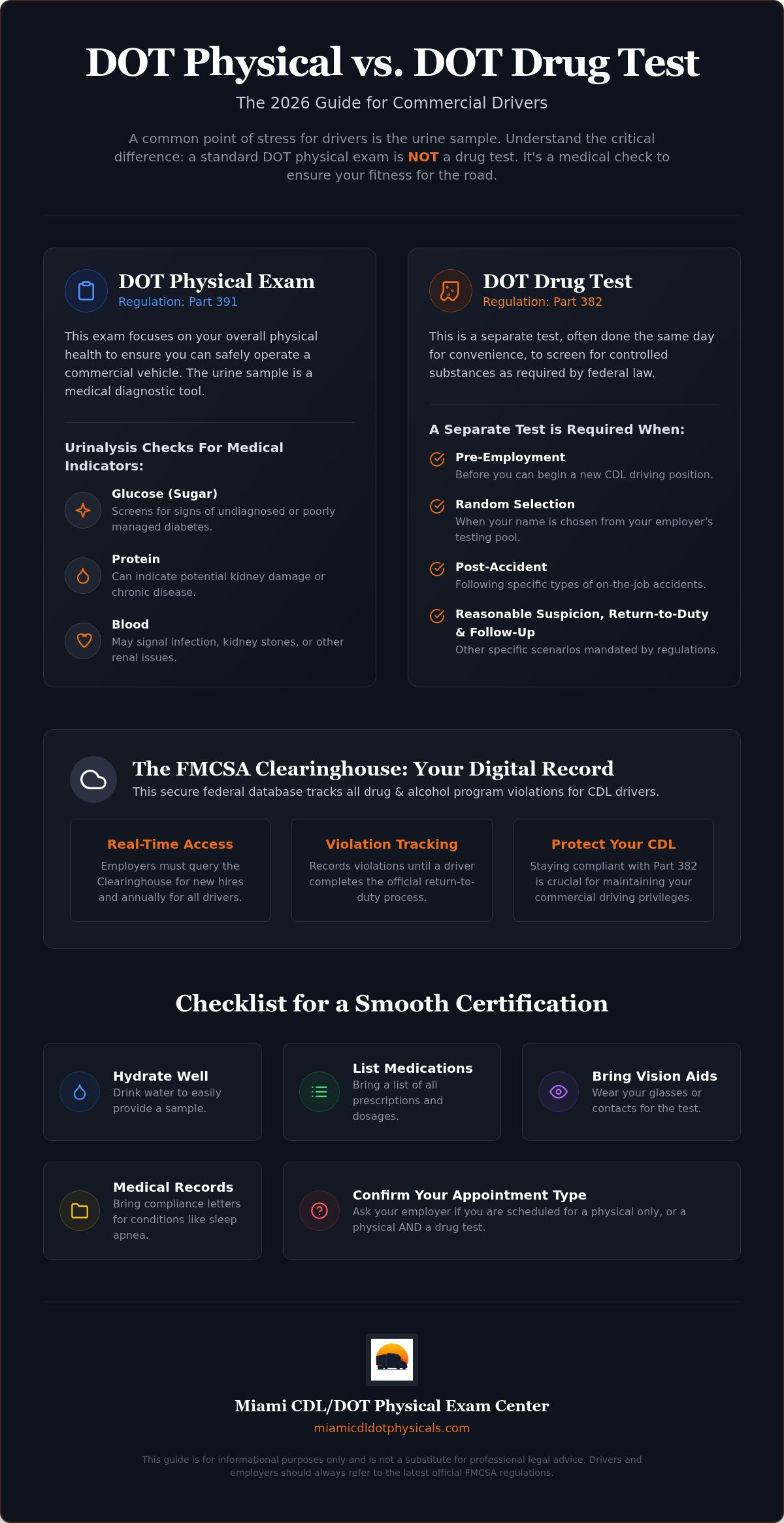
Federal regulations separate these requirements into two distinct categories. Understanding this split helps you stay compliant and reduces anxiety during your visit. Part 391 covers the physical qualification standards for drivers. It ensures you don't have conditions like high blood pressure, vision loss, or uncontrolled diabetes that could make driving dangerous. In contrast, Part 382 governs the controlled substances and alcohol testing rules. These are two separate federal mandates with different triggers. A physical is required every two years for most drivers, while drug testing is triggered by pre-employment, random selection, or post-accident protocols.
Why Your Employer Might Require Both on the Same Day
Many drivers experience confusion because employers often schedule these two separate events for the same day. This is a "combined appointment." It's an efficient way to handle paperwork, especially for new hires or drivers up for their biennial renewal. If your employer asks for a drug test alongside your physical, the clinic will typically collect separate samples or use distinct chains of custody for the paperwork. This one-stop-shop approach saves you time, but it's vital to recognize that they are independent services being performed during the same visit.
It's easy to feel a spike of worry when you're handed a specimen cup. However, the urine test during a physical is a "dipstick" test. It checks for glucose, protein, and blood. These are indicators of underlying health issues, not drug use. If your employer hasn't specifically ordered a Part 382 test, the examiner isn't screening that specific sample for narcotics. You can verify this by checking your paperwork before you sign in. A standard physical will be marked as a "DOT Physical," while a drug screen will be clearly labeled as a "DOT Drug Test" or "5-Panel Screen." Knowing exactly what's on your authorization form ensures you're prepared for the specific requirements of your visit.
The Purpose of the Urine Sample in a DOT Physical
When you provide a urine sample during your appointment, it's natural to wonder: does a DOT physical include a drug test? While it feels like a drug screen, this specific test is actually a "dipstick" urinalysis. Urinalysis is a diagnostic tool for kidney function and glucose levels. The medical examiner uses a chemically treated strip to check for immediate health indicators that could impact your safety on the road. Unlike laboratory-based drug testing, these results are available to your examiner within seconds. This allows for an efficient review of your health status during the exam itself.
What the Medical Examiner Is Looking For
The dipstick test monitors three primary markers to validate your physical fitness. First, the examiner looks for protein (proteinuria). Presence of protein can indicate potential kidney damage or chronic disease that requires further investigation. Second, they check for blood (hematuria). While this might suggest a simple infection, it can also point to underlying renal issues or stones that could cause sudden pain while driving. Finally, the test screens for glucose (glycosuria). High sugar levels in the urine often signal undiagnosed or poorly managed diabetes. Detecting these issues early helps you manage your health before a condition becomes a safety hazard.
How Urinalysis Results Impact Your Medical Card
Abnormal results don't necessarily mean you lose your CDL. Instead, they often lead to a shorter certification period. For example, if your glucose is high, the examiner might issue a 3-month certificate instead of a full 2-year card. This gives you time to visit your primary care physician for a formal diagnosis or treatment plan. You may need to provide a clearance letter or additional lab work before receiving a longer-term card. If you're concerned about your upcoming exam, you can schedule a DOT physical with a certified examiner to discuss your health history and stay ahead of compliance needs.
Remember that a "fail" on this medical urinalysis is not a drug test violation. It won't be reported as a substance abuse issue. It's simply a medical finding that needs clinical attention. While FMCSA regulations require you to be physically fit, they also provide pathways for drivers to manage health conditions and stay employed. Being proactive about your health ensures that when you ask "does a DOT physical include a drug test," you're prepared for the diagnostic health screening that actually takes place.
When Commercial Drivers Are Required to Take a DOT Drug Test
Understanding the triggers for a federal drug screen helps you maintain compliance without surprises. While the answer to "does a DOT physical include a drug test" is generally no, you'll certainly face a drug test at other critical points in your career. These tests are mandatory for all drivers operating vehicles that require a CDL. They ensure that safety-sensitive employees are clear of controlled substances while on duty. Federal law defines specific scenarios where testing is non-negotiable.
- Pre-employment: You must receive a verified negative drug test result before a motor carrier allows you to operate a commercial motor vehicle for the first time.
- Random Testing: Drivers are placed in a selection pool. In 2026, the FMCSA requires a random drug testing rate of 50% of the average number of driver positions.
- Post-Accident: Testing is required if a crash involves a human fatality. It's also triggered if you receive a citation following an accident that required a vehicle to be towed or medical treatment away from the scene.
- Reasonable Suspicion: If a trained supervisor observes signs of impairment, such as slurred speech or unsteady movements, they can require an immediate test.
The 5-Panel DOT Drug Test Components
The standard DOT drug test uses a 5-panel screen to identify specific substances. Even with changing state laws, marijuana remains a Schedule I drug under federal law and is strictly prohibited for commercial drivers. The lab will screen your sample for THC and cocaine metabolites. It also checks for amphetamines, including methamphetamine and MDMA. The final panels look for opiates like codeine, morphine, and heroin, as well as phencyclidine, also known as PCP. These tests are highly accurate and reviewed by a Medical Review Officer to ensure validity.
Return-to-Duty and Follow-Up Testing
If a driver violates drug and alcohol regulations, they can't return to safety-sensitive duties until they complete a specific recovery process. This begins with an evaluation by a Substance Abuse Professional (SAP). The SAP determines what education or treatment is necessary for the driver's specific situation. Once the SAP clears the driver, they must take a return-to-duty test under direct observation. Following a successful return, the driver is subject to a follow-up testing schedule. This includes at least six unannounced tests in the first 12 months, though the SAP can extend this schedule for up to five years.
Staying informed about these requirements reduces the stress of random selections. If you need to manage your fleet's compliance or schedule an individual test, our team provides certified DOT drug testing services. We handle the process efficiently to get you back on the road safely and legally.
FMCSA Regulations and the Drug and Alcohol Clearinghouse
The confusion regarding whether a DOT physical includes a drug test often stems from the overlapping federal rules. While your medical exam falls under FMCSA Part 391, drug and alcohol testing is governed by Part 382. This regulatory split is critical. The FMCSA Drug and Alcohol Clearinghouse acts as a secure, online database that provides real-time information about commercial driver drug and alcohol program violations. Employers are required to query this system during the hiring process and at least once annually for all current drivers. This ensures that a driver with a violation in one state cannot simply move to another to hide their record.
A key figure in this process is the Medical Review Officer (MRO). The MRO is a licensed physician responsible for receiving and reviewing laboratory results. If a test comes back positive, the MRO contacts the driver to determine if there's a legitimate medical explanation, such as a valid prescription. Once a violation is confirmed, it's reported to the Clearinghouse. It's also vital to understand that a refusal to test carries the same legal weight as a positive result. If you walk away from a collection site or fail to provide a sample without a medical reason, it's recorded as a violation.
How Violations Are Reported and Tracked
Reporting happens quickly. As of 2026, employers and MROs must report violations to the Clearinghouse within three business days. This fast-paced reporting prevents prohibited drivers from staying on the road. A violation on your record remains "prohibited" until you complete the return-to-duty process with a Substance Abuse Professional. Drivers have the right to access their own records at any time. You should register for a Clearinghouse account to monitor your status and ensure your employment history is accurate.
The Importance of a Drug Testing Consortium
If you're an owner-operator, federal law requires you to be part of a random testing pool. You cannot manage your own random selections. This is where a consortium becomes essential. A consortium manages the selection process, ensures you meet the 50% annual testing rate, and handles the required Clearinghouse reporting. For those operating in the Southeast, you can find specific management details in our FMCSA clearinghouse consortium Florida guide.
Staying compliant doesn't have to be complicated. Our team helps drivers and fleets stay current with all federal mandates. If you need help with your records or testing, contact our FMCSA Clearinghouse experts today for professional support.
How to Prepare for Your DOT Medical Exam and Drug Screening
Preparation is the key to a smooth certification process and a stress-free day at the clinic. While you now know the answer to the question, does a DOT physical include a drug test, you should still arrive ready for both possibilities. Start by gathering your essential documents. You'll need a government-issued photo ID and your current medical examiner's certificate if you're renewing. Bring a complete list of all current medications, including the specific dosages and the names of your prescribing doctors. This level of detail helps the examiner validate your health status quickly and efficiently.
Your physical habits on the morning of the exam matter. Avoid drinking excessive caffeine or using nicotine immediately before your appointment. These substances can temporarily spike your blood pressure and heart rate, which might lead to a shorter certification period or a delayed result. Instead, focus on hydrating properly with water. Proper hydration ensures you can provide a urine sample as soon as you arrive, preventing long waits in the lobby. If your employer has ordered a combined appointment, you'll need to provide enough of a sample for both the medical urinalysis and the federal drug screen.
Disclosing Medications and Medical History
Honesty is your best policy when discussing your medical history. Disclose all chronic conditions, such as sleep apnea, and bring compliance data if you use a CPAP machine. Failing to mention these details can lead to a denial of your medical card if they're discovered later. Some prescriptions require a clearance letter from your treating physician to prove the medication doesn't impair your ability to drive. If you're concerned about specific substances, review our guide on medications that disqualify CDL medical card status to see how your current treatment might affect your certification.
What Happens During the Appointment
The appointment follows a methodical flow designed to get you back on the road. After checking in, you'll provide your urine sample. It's important to remember that the collection procedure for a medical urinalysis is less stringent than a DOT drug test. A drug test requires a specific temperature check and a sealed chain-of-custody form, while the medical sample is often tested immediately with a dipstick. Once the sample is collected, the examiner will check your vision, hearing, and blood pressure before performing a physical check of your neurological and musculoskeletal systems.
After the exam is complete, the examiner will discuss the findings with you. If you meet all federal standards, you'll receive your medical examiner's certificate (MEC) on the spot. If a drug test was also performed, those results are sent to a lab and reviewed by an MRO before being reported to your employer and the Clearinghouse. By following these preparation steps, you'll ensure your visit is productive and your compliance remains intact. When you're ready to get started, book your DOT physical with our certified team to experience a fast and professional certification process.
Stay Compliant and Road-Ready for 2026
Navigating federal regulations doesn't have to be a source of stress when you understand the specific purpose of each test. While the answer to does a DOT physical include a drug test is a clear no, remembering that your medical urinalysis screens for safety indicators like glucose and protein is vital for your health management. Whether you're a new hire facing a pre-employment screen or a veteran driver in a random pool, knowing the difference between Part 391 and Part 382 rules keeps your record clean and your career moving forward.
Schedule your compliant DOT physical and drug test with our certified examiners today. Our center provides FMCSA-Certified Medical Examiners, same-day CDL medical cards, and full-service DOT drug and alcohol testing to get you back on the road quickly. Stay proactive with your health and documentation to ensure you're always ready for the next haul. We're here to partner with you in maintaining your professional requirements with ease and efficiency. Safe travels on the road ahead.
Frequently Asked Questions
Does the DOT physical urine test check for marijuana or CBD?
No, the medical urinalysis performed during your physical is a dipstick test for health markers like glucose, protein, and blood. It doesn't screen for THC or CBD metabolites. However, marijuana is still federally prohibited for drivers. If your employer orders a separate DOT drug test on the same day, that specific test will screen for marijuana using a laboratory analysis rather than a simple dipstick.
Can I fail my DOT physical if I have sugar in my urine?
You won't fail in the sense of a drug violation, but sugar in your urine can delay your certification. The examiner uses this as a screen for undiagnosed or poorly managed diabetes. If glucose is present, you'll likely receive a short-term medical card, such as for three months. You'll need to see your primary care physician for blood work and a clearance letter before receiving a full certificate.
Will my employer see the results of the medical urine test?
No, your employer typically only receives the Medical Examiner's Certificate, which states whether you're qualified, qualified with restrictions, or disqualified. The specific details of your medical urinalysis, such as protein or glucose levels, remain part of your private medical record at the clinic. This is different from a DOT drug test, where the employer is notified of a positive or negative result through the Medical Review Officer.
How is a DOT drug test different from a non-DOT drug test?
A DOT drug test follows strict federal procedures outlined in 49 CFR Part 40, including specific collection protocols and a 5-panel lab screen. It must be reviewed by a Medical Review Officer and reported to the FMCSA Clearinghouse. A non-DOT drug test is governed by company policy rather than federal law. It may use different panels, such as a 10-panel screen, and isn't reported to the federal database.
What should I do if I am taking prescription opioids and need a DOT physical?
You must disclose all prescription medications to your medical examiner during your appointment. If you take opioids, you'll need a letter from your prescribing doctor stating that the medication doesn't impair your ability to safely operate a commercial motor vehicle. The examiner will review this safety-sensitive letter to determine if you can be certified. Taking these medications without a valid prescription or doctor's clearance leads to a disqualification.
Is a hair follicle test required for a DOT physical in 2026?
No, the DOT physical doesn't require a hair follicle test in 2026. While some private carriers use hair testing for their own internal hiring policies, the FMCSA only recognizes urine and oral fluid testing for federal compliance. If you're asked does a DOT physical include a drug test via hair sample, the answer is currently no. Federal regulations still prioritize the 5-panel urine screen for all official reporting.
Do I have to take a drug test every time I renew my CDL medical card?
Not necessarily. Federal law doesn't require a drug test as part of the biennial medical recertification process. You're only required to take a DOT drug test during specific triggers like pre-employment, random selection, or post-accident scenarios. However, many employers choose to schedule a drug test on the same day as your physical for convenience. When asking does a DOT physical include a drug test, always check your specific company's requirements.
What happens if I can't provide a urine sample during the exam?
This is known as a shy bladder and starts a specific protocol. You'll be given up to 40 ounces of fluids and three hours to provide a sufficient sample. If you still can't provide one after this period, you'll be referred for a medical evaluation to determine if there's a physical or psychological condition preventing it. If no medical reason is found, it may be recorded as a refusal to test.


