

A complete stack of test results doesn’t prove your program is audit-ready. A useful DOT drug and alcohol audit checklist connects each required step to a current driver roster and a complete record trail. If driver lists, random selections, test results, or Clearinghouse records don’t line up, it may be harder to show how your process works.
It’s common to be unsure which records an FMCSA review may examine, how long to retain them, and which duties remain with your company when a consortium supports your program. Use this checklist to organize applicable policies, testing records, procedures, and Clearinghouse documentation, then flag inconsistencies before responding to an audit request. The steps also show where consortium support can fit into your workflow while employer oversight remains essential.
Key Takeaways
- Use a DOT drug and alcohol audit checklist to organize program evidence and identify gaps before an FMCSA review.
- Compare written policies with driver files, testing records, and actual procedures to flag inconsistencies.
- Reconcile the eligible driver roster, random selections, notifications, completed tests, and Clearinghouse records.
- Follow a step-by-step pre-audit workflow with assigned owners, due dates, and completion evidence.
- Turn checklist findings into recurring tasks, and use consortium support as part of compliance while retaining employer oversight.
DOT Drug and Alcohol Audit Checklist: Define the Program and Its Scope
Start your DOT drug and alcohol audit checklist by defining what your program covers. A clear scope helps you organize evidence, identify gaps, and prepare a consistent response if the FMCSA requests records. Requirements depend on your operations, the work your drivers perform, and the federal rules that apply. Don’t assume every carrier has the same obligations.
A DOT drug and alcohol program is more than a folder of test results. It includes applicable policies, covered drivers, required testing activities, supporting records, and follow-up responsibilities. Audit readiness means being able to connect applicable requirements to responsible people, covered drivers, and records that show what took place.
Use the review to find and address inconsistencies, not to assume every requirement has been met. A checklist helps you assess records and prepare for review, but it can’t guarantee compliance or predict an audit outcome.
Identify which rules and drivers apply
Review 49 CFR Part 382 for FMCSA drug and alcohol program requirements and 49 CFR Part 40 for testing procedures. Determine which drivers and operations fall under the applicable rules based on the carrier’s work and driver functions. Document the reasoning behind your decision, including which roles you included and why. Revisit that decision when operations or driver responsibilities change, and keep a dated record of each review.
For example, a change in a driver’s work may require the employer to reassess whether that driver is covered. Don’t rely on an old roster or a general assumption. Record the basis for the decision and connect it to current operations.
Assign program roles before reviewing records
List the people and organizations involved, then assign an owner to each responsibility. The employer remains accountable for its program. A designated employer representative (DER) handles assigned employer-side duties, while a consortium or C/TPA may support administration. Testing personnel perform their specific roles in the testing process.
- Employer: Maintain oversight, confirm responsibilities, and ensure the program reflects current operations.
- DER: Coordinate assigned program actions and know how to access relevant records.
- Consortium or C/TPA: Support delegated administrative tasks, with responsibilities clearly documented.
- Testing personnel: Complete their testing-related functions and provide applicable records through established channels.
Specify who maintains each record, who can retrieve it, and who checks that delegated tasks are complete. Outsourcing administration doesn’t automatically transfer the employer’s duties. A written responsibility map gives your review team a practical starting point and helps keep records accessible.
Review DOT Drug and Alcohol Policies, Driver Files, and Required Records
Build a master index for the audit period before checking individual files. A well-organized DOT drug and alcohol audit checklist shows what exists, what’s missing, and where each record is maintained. Core record groups generally include the written policy and acknowledgments, covered-driver documentation, testing records, required education or follow-up documentation, and corrective-action records. The exact file set depends on the requirements that apply to your operation.
For each item, record its location, date range, responsible owner, and access status. Check that records are legible, dated, connected to the correct driver or event, securely stored, and retrievable by authorized personnel. An incomplete or unreadable document can leave a gap even if the underlying task was completed.
Check the policy and driver documentation
Compare the current written policy with the procedures your team follows and the applicable requirements. Confirm that the policy was distributed and required driver acknowledgments are documented. Reconcile the covered-driver list with employment and operating records for the audit period. Note hires, departures, role changes, and any program updates they prompted.
For each covered driver, organize documentation of applicable education, referrals, and follow-up actions. Not every driver’s file will contain identical records. Mark items as applicable, not applicable, missing, or under review, and document the reason for each status.
Organize test and retention records
Group testing documentation by driver and event, preserving dates and status changes that show what happened from start to finish. Depending on the driver and circumstances, inventory pre-employment, random, post-accident, reasonable-suspicion, return-to-duty, and follow-up records. A DOT drug test record supports the testing trail, but the employer should also be able to connect it to the relevant selection or triggering event and any required next step.
Use 49 CFR Part 40 procedures as a primary reference for DOT testing requirements. Verify current retention timelines against the applicable rules before setting a destruction schedule, since different record types may have different requirements. Protect confidential information, limit access to authorized personnel, and confirm that records held by service agents can be retrieved through your established process.
- Policy records: Current policy versions, distribution evidence, and acknowledgments.
- Driver records: Coverage basis and applicable education or follow-up documentation.
- Testing records: Event details, results or status, and supporting documentation.
- Program records: Corrective actions and evidence that identified issues were addressed.
If the index reveals a testing-record gap, use a documented testing process to support the record trail. A DOT drug testing service can be part of that process. The employer remains responsible for program oversight and applicable records.
Reconcile Random Testing, Alcohol Testing, and Clearinghouse Records
Use the DOT drug and alcohol audit checklist to trace each requirement from the eligible driver pool or triggering event to the record that shows what happened. Compare rosters, selection logs, notifications, test completion, and unresolved selections. A selection without a documented outcome needs follow-up, not an assumption that the test occurred.
For calendar year 2026, FMCSA’s minimum random testing rates are 50% for drugs and 10% for alcohol. Confirm the rates and program-year guidance against current FMCSA information, and check that your records reflect the correct eligible pool and calendar year.
Trace random selections from pool to completion
Compare each selection roster with the employer’s covered-driver records for the same period. Check selection dates, driver notifications, test completion, cancellations, and documented follow-up. If a selection remains unresolved, record the reason and steps taken. Don’t silently alter historical rosters or selection records to make totals appear consistent.
| Event or record | Trigger or scope | Evidence to reconcile | Record location |
|---|---|---|---|
| Random drug or alcohol selection | Selection from the applicable eligible pool | Pool roster, selection date, notification, completion or unresolved status | Random testing file or consortium record |
| Pre-employment test | Applicable hiring or covered-driver entry | Test documentation and result status before the driver performs covered work | Driver file and testing records |
| Post-accident or reasonable-suspicion test | Applicable event or documented basis | Event documentation, testing record, timing, and outcome | Driver and event files |
| Clearinghouse activity | Query or report required for the employer’s circumstances | Query evidence, reporting record, and completion status | Clearinghouse records and compliance file |
Cross-check alcohol testing and Clearinghouse activity
Match alcohol test records to the event and the employer’s procedures. For each Clearinghouse action, identify the applicable driver, reason, date, responsible person, and retained evidence. Query and reporting obligations depend on the action and circumstances, so don’t treat one query schedule as universal. Use the FMCSA Drug & Alcohol Clearinghouse and current guidance to verify what applies.
Keep a discrepancy log instead of overwriting history. Note the mismatch, source records reviewed, assigned owner, and resolution or next step. This preserves the audit trail and makes it easier to explain corrections, incomplete selections, or missing documentation.
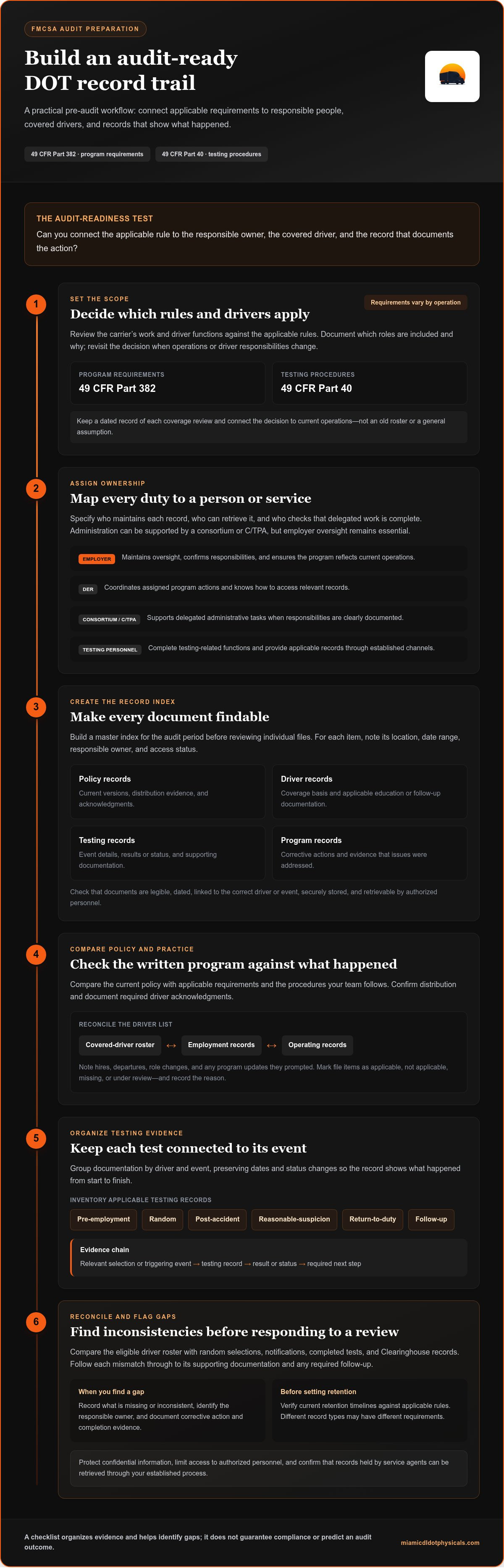
Use a Step-by-Step Pre-Audit Review to Find and Fix Gaps
Turn the DOT drug and alcohol audit checklist into a controlled review, not a last-minute document hunt. Choose a defined audit period and use one calendar and status tracker to manage findings. For each item, record an owner, due date, status, and evidence of completion.
- Confirm the scope. Set the review period and identify the applicable program requirements, covered drivers, and records to examine.
- Assign owners. Name the person responsible for each record group or review task, including work supported by a consortium or other service agent.
- Inventory records. Compare checklist items with source files. Note what is present, missing, or not applicable, and document the reason.
- Reconcile information. Compare driver and testing records across systems. Record mismatched dates, names, statuses, or event details for investigation.
- Resolve and document gaps. Assign follow-up actions, deadlines, and completion evidence. Escalate uncertain regulatory interpretations for qualified compliance review instead of guessing.
- Preserve the evidence. Keep original records and document legitimate corrections, explanations, and follow-up without backdating or concealing information.
Run a controlled internal file review
Review each checklist item against the source record for the selected period. Classify findings so the response fits the issue: missing documentation, inconsistent entries, late actions, or a process failure. For every finding, record the affected driver or process, what you reviewed, who owns the next step, and its due date. This creates a clear trail from discovery to resolution.
If two records conflict, don’t overwrite one to make the file appear consistent. Preserve both, investigate the discrepancy, and document the explanation and any correction separately. This maintains the record history and shows what changed and why.
Document corrective actions and audit responses
Track each corrective action to completion and retain evidence of the change, such as an updated procedure or a completed follow-up record. Keep the original material intact. If a correction is appropriate, add a dated explanation identifying the source, reason, and person responsible.
Before responding to an audit request, run a final retrieval check. Use consistent file names, confirm secure access for authorized personnel, and make sure the index points to the right records. A teammate should be able to locate requested evidence without relying on undocumented knowledge.
If your review identifies a testing-process gap, arrange DOT drug testing as part of your documented follow-up. Keep employer oversight and program records in your compliance workflow.
Maintain Ongoing Compliance With Testing and Consortium Support
Keep your program current between reviews. Turn findings from the DOT drug and alcohol audit checklist into recurring calendar tasks for roster updates, random selections, record reviews, and applicable follow-up. Assign an owner and due date to each task, then save evidence of completion so routine work builds a traceable record.
Choose a sustainable program-management workflow
A designated employer representative (DER) can coordinate schedules, communications with service agents, and access to program records. With in-house administration, the employer manages these tasks directly and needs a dependable process for deadlines, documentation, and coverage when responsibilities change. Consortium support can assist with program administration, but the employer still needs clear oversight, access to records, and a way to confirm assigned tasks are complete.
Make roster reconciliation a recurring task, not a one-time audit exercise. Review the covered-driver list when a driver joins or leaves, changes functions, or otherwise affects program coverage. Compare it with records used for testing and consortium administration. Schedule periodic reviews of upcoming selections, completed testing, unresolved items, and required follow-up. Adjust the workflow as operations change.
Get practical support for testing and Clearinghouse tasks
DOT drug testing supports a fleet’s documented testing process, while an FMCSA Clearinghouse Consortium can support relevant consortium administration. Treat each as one part of the program workflow, not a substitute for employer accountability or a guarantee of audit readiness. Keep responsibilities, record access, and follow-up ownership clear even when administrative tasks are supported externally.
As part of your ongoing program review, use the DOT drug test compliance reference and FMCSA Clearinghouse Consortium guide. Keep a short action plan: update the roster, assign recurring owners and due dates, review open findings, and retain completion evidence. This helps maintain continuity when staff or operations change.
Arrange DOT drug testing or FMCSA Clearinghouse Consortium support to help keep your fleet’s documented process organized. Your employer team remains responsible for oversight and applicable compliance decisions.
Keep Your Fleet’s Compliance Process Moving
A useful DOT drug and alcohol audit checklist helps you define which requirements apply, organize program records, and trace testing and Clearinghouse activity to the right drivers and responsibilities. Regular reviews help your team find mismatches, document corrections, and keep records ready for retrieval.
Make the checklist part of your ongoing workflow. Assign owners to recurring tasks, update driver rosters when operations change, and track follow-up through completion. Consortium support can assist with administration, but your employer team remains responsible for oversight and applicable compliance decisions.
Our center provides DOT and non-DOT drug testing and FMCSA Clearinghouse Consortium support for owner-operators and fleets. Get support with DOT drug testing and consortium services to build a clear, consistent compliance workflow. Organized records and defined responsibilities can help your team prepare with greater confidence.
Frequently Asked Questions
What documents should I have ready for a DOT drug and alcohol audit?
The exact request depends on the audit and the rules that apply to your operation. Common file groups include the written policy and driver acknowledgments, covered-driver records, testing and random-selection documentation, applicable Clearinghouse evidence, and required follow-up records. Verify each category and its retention period against current FMCSA regulations. Use an index to organize records by type, driver, or event, and keep original documents intact so you can retrieve evidence without changing its history.
How far back can a DOT drug and alcohol audit review records?
The review period and required retention depend on the record type and applicable rule, so there isn’t one retention period for every document. Check each category against current requirements in 49 CFR Parts 40 and 382, and preserve records for the applicable period. Organize historical records by audit period, driver, and event. This structure helps your team retrieve requested evidence, including records maintained with administrative support.
Does a consortium or C/TPA make an employer compliant with DOT drug testing rules?
No. A consortium or third-party administrator can support designated testing and administrative tasks, but outsourcing doesn’t automatically remove the employer’s oversight responsibilities. Document who handles each task, review reports and unresolved items, and make sure authorized staff can access relevant records. Confirm your obligations under the FMCSA rules that apply to your operation. Consortium support can strengthen a workflow, but it can’t guarantee compliance or prevent audit findings.
What should a fleet safety manager check in a random testing program?
Reconcile the eligible-driver roster with selection records, notifications, completed tests, cancellations, and unresolved selections. Confirm that the roster reflects the relevant period, and document the program year and selection process used. Investigate gaps rather than changing historical records to make totals match. Random testing rates and requirements can change, so check current official FMCSA guidance for the applicable year instead of relying on an old checklist or assumed rate.
Do all employers have the same FMCSA Clearinghouse audit requirements?
No. Clearinghouse duties depend on the employer’s role, the driver, and the specific query or reporting event, so one workflow may not fit every situation. Review current FMCSA instructions for your circumstances and retain evidence of required queries and reports. Document who performs each action and who checks completion. A consortium may support applicable tasks, but the employer should maintain oversight and access to records.
What should I do if I find missing or inconsistent records before an audit?
Document the finding, identify the affected driver or process, and assign a responsible person and corrective action. Preserve original records. If a legitimate correction or explanation is needed, date it and keep it with the original evidence. Never backdate or conceal information. Escalate uncertain regulatory questions for qualified compliance review, then retain evidence showing what corrective steps were completed and when.
Can a DOT drug testing provider help my fleet prepare for an audit?
Yes. A provider can support testing workflows and, where applicable, consortium administration, while your employer team remains responsible for appropriate oversight. Include provider records in an indexed file alongside policies, driver information, and employer-controlled documentation. Our center provides DOT drug testing and FMCSA Clearinghouse Consortium support for owner-operators and fleets. These services can support your process, but they don’t guarantee an audit outcome.


