

Employers searching for workplace drug testing need a clear process that fits the job and the rules that apply. A program is only as reliable as the policy behind it: choosing the wrong testing framework or applying procedures inconsistently can create confusion for employers and employees.
DOT requirements apply to covered transportation roles, while non-DOT testing follows a different framework. The right approach depends on the position, the reason for testing, the employer’s policy, and applicable law.
This guide explains the main testing options and how to build a consistent process for 2026. You’ll learn how to distinguish DOT from non-DOT testing, match the framework to the role and purpose, and set expectations employees can understand. We’ll also cover employer responsibilities, policy basics, and how DOT drug testing, non-DOT drug testing, and an FMCSA Clearinghouse Consortium can support transportation screening workflows.
Key Takeaways
- Identify why testing is needed and which roles it applies to, then match the process to that purpose.
- Distinguish DOT requirements for covered safety-sensitive transportation roles from non-DOT workplace policies.
- Set a consistent process for communicating expectations, arranging tests, and handling follow-up.
- Use a clear written policy and the testing framework that fits each role.
- DOT and non-DOT drug testing, along with an FMCSA Clearinghouse Consortium, can support employer and fleet workflows.
Workplace Drug Testing: What Employers Need to Decide First
Before arranging a test, define its purpose and the rules that apply. Workplace drug testing is screening conducted under an employer’s written policy or an applicable regulation. It may support workplace safety, regulatory compliance, hiring procedures, and consistent expectations. The right approach depends on the role, the employer’s policy, applicable law, and whether the position is federally regulated.
General workplace testing follows an employer’s policy and relevant employment laws. DOT testing follows federal requirements for employees in covered transportation roles. DOT rules don’t automatically apply to every worker at a transportation company. The first decision is not simply which test to arrange, but why testing is needed and which employees the policy covers.
Which workplace situations may lead an employer to test?
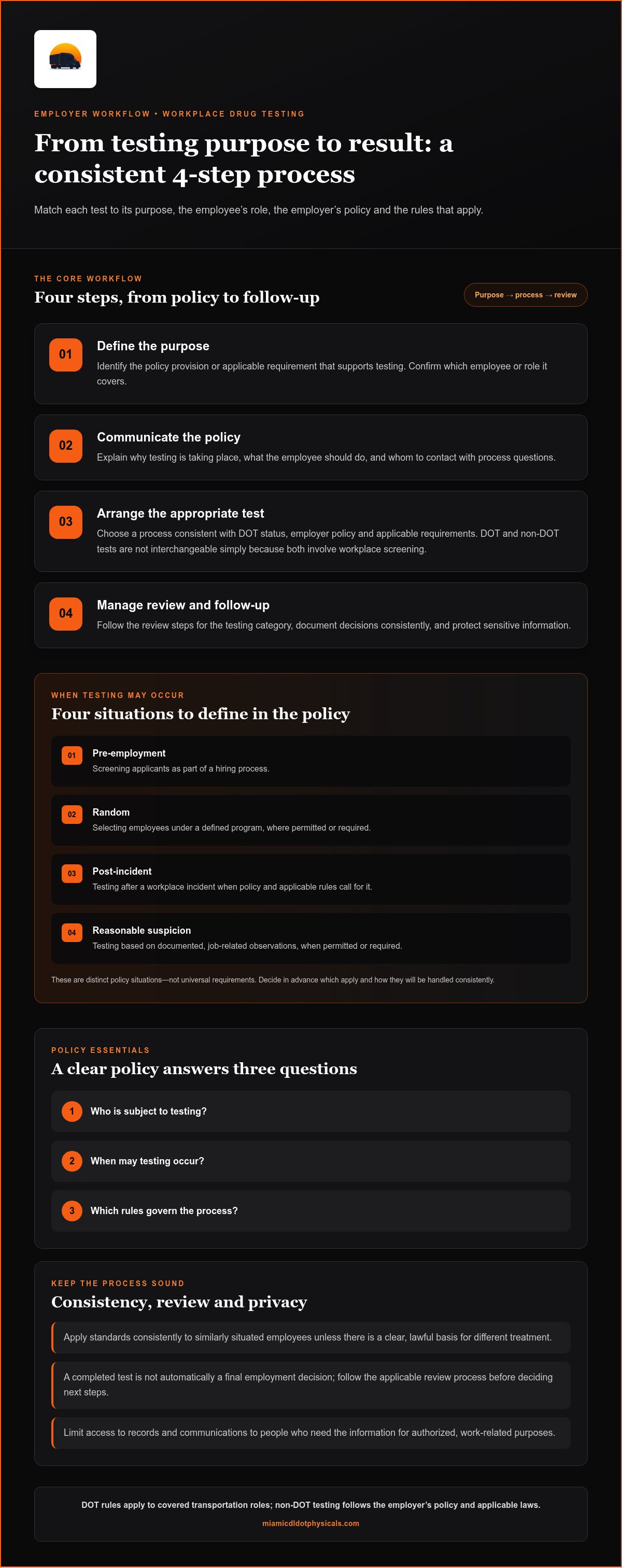
Testing may occur at different points in the employment relationship, depending on the policy and applicable requirements:
- Pre-employment: Screening applicants as part of a hiring process.
- Random: Selecting employees for testing under a defined program, where permitted or required.
- Post-incident: Testing after a workplace incident when the policy and applicable rules call for it.
- Reasonable suspicion: Testing based on documented, job-related observations, when permitted or required.
These are distinct policy situations, not universal requirements. Decide in advance which apply, what steps employees and supervisors should follow, and how the rules will be applied consistently. For general background on how drug tests work, including common testing methods, see the overview of drug testing.
What should a written drug-testing policy explain?
A useful policy answers three questions: who is subject to testing, when testing may occur, and which rules govern. It should describe procedures, explain how employees receive relevant information about their rights, and outline how results and follow-up will be handled. Clear language helps employees understand expectations before a testing situation arises.
Keep the policy aligned with the work being performed. A covered DOT-regulated role may require a federally prescribed process, while a non-DOT policy must reflect the employer’s rules and applicable employment laws. Avoid applying different standards to similarly situated employees without a clear, lawful basis. Have qualified employment counsel review jurisdiction-specific requirements before putting the policy into practice.
How Workplace Drug Testing Works from Policy to Result
A sound employer workflow defines the reason for testing, explains the policy, arranges the appropriate test, and handles the result under the applicable rules. The details depend on whether the employee is subject to DOT requirements, the employer’s policy, and applicable law. For example, a pre-employment screen under a non-DOT policy may follow a different process from testing required for a covered transportation role.
Use these steps to keep the process organized:
- Define the purpose. Identify the policy provision or applicable requirement that supports the test, and confirm which employee or role it covers.
- Communicate the policy. Explain the reason for testing, what the employee should do, and whom to contact with process questions.
- Arrange the appropriate test. Select a process consistent with DOT status, employer policy, and applicable requirements. DOT and non-DOT tests aren’t interchangeable simply because both involve workplace screening.
- Manage review and follow-up. Follow the review steps for that testing category, document decisions consistently, and protect sensitive information.
Privacy matters throughout the process. Limit access to testing records and communications to people who need the information for authorized, work-related purposes. Define record-handling expectations in the employer’s procedures, and don’t share sensitive details more broadly than necessary.
What employers should prepare before arranging a test
Identify the employee or role, the policy-based reason for testing, and whether DOT rules apply. Provide instructions that match the policy and applicable requirements, including any steps the employee needs to follow. Keep records and communications focused on the work-related purpose, and limit access to authorized personnel. This preparation helps prevent confusion and supports consistent handling.
How employers should handle a completed test
A completed test is not automatically a final employment decision. Result review and follow-up depend on the test category and governing rules, so follow the applicable review process before deciding next steps. Record relevant actions consistently, including the basis for follow-up, while safeguarding sensitive information. If a result or procedure raises a question, use the designated review process and seek qualified guidance as appropriate.
Employers developing workplace drug testing Miami workflows can connect policy decisions to practical screening support. DOT and non-DOT drug testing serve different needs. A clear process helps keep each test aligned with its purpose and requirements.
DOT vs. Non-DOT Workplace Drug Testing: Choose the Right Framework
The right testing framework follows the job, not simply the employer’s industry. DOT testing applies to employees in roles covered by federal transportation rules. It doesn’t automatically cover every employee at a motor carrier or transportation business. Non-DOT testing follows an employer’s policy and applicable federal, state, and local laws.
| Category | DOT testing | Non-DOT testing |
|---|---|---|
| Purpose | Meet applicable federal transportation testing requirements. | Support an employer’s screening or workplace policy. |
| Covered roles | Employees whose specific functions fall under an applicable DOT agency rule, including some commercial driving roles. | Employees covered by the employer’s policy, within applicable law. |
| Governing rules | Federal DOT agency requirements for the covered role. | Employer policy and relevant federal, state, and local laws. |
| Employer responsibilities | Use the required DOT process and follow the applicable agency rules. | Set and communicate a lawful, consistent policy and follow its procedures. |
Don’t substitute a non-DOT process when a DOT test is required. The test category, procedures, and follow-up must match the applicable framework. For 2026 planning, verify current requirements with the U.S. Department of Transportation and the relevant agency, such as the Federal Motor Carrier Safety Administration (FMCSA). Determine a role’s status before arranging workplace drug testing Miami or elsewhere.
When does an employer need DOT drug testing?
DOT coverage depends on an employee’s duties and the rules of the relevant transportation agency, not just a job title or employer type. FMCSA-regulated commercial driving is one example, but not every driver or transportation worker is covered. Review current U.S. DOT and FMCSA requirements to determine whether a specific role is subject to testing, and follow the required process if it is.
How does a non-DOT testing program differ?
Employers establish non-DOT procedures through workplace policy, subject to applicable laws. The policy framework is separate from the collection or laboratory process: selecting a test procedure doesn’t establish which employees may be tested or when. Legal requirements vary by jurisdiction and circumstance, so avoid assuming one policy fits every workforce. Review the program for relevant employment-law requirements before implementation.
Build a Consistent Workplace Drug-Testing Program with These Steps
A dependable program gives employees and managers the same clear expectations. Use this checklist to build or review yours, keeping regulated roles, general workforce policies, and owner-operator needs distinct.
A practical checklist for launching or reviewing a program
- Identify covered roles. Determine which positions are subject to DOT requirements and which fall under a general employer policy. Don’t assume everyone at a transportation company has the same status.
- Define the purpose and circumstances. Specify why testing is used and which situations the policy covers. Make sure each circumstance aligns with applicable rules.
- Assign internal points of contact. Name who communicates instructions, coordinates testing, handles records, and directs follow-up. Limit sensitive information to authorized people with a work-related need.
- Write plain-language procedures. Explain who may be tested, when testing may occur, what employees should expect, and how questions or results are handled.
- Communicate before implementation. Share the policy with affected employees and managers, and explain where to find instructions. Consistent communication helps prevent teams from applying different standards.
- Document and review. Keep appropriate records of policy decisions and follow-up. Review the program periodically with qualified advisers, especially when job duties, operations, or applicable requirements change.
Apply the checklist to each employee group instead of forcing one process across roles with different obligations. For general workforce policies, review relevant employment-law requirements. For regulated employees, follow the rules that apply to their specific roles.
How fleets and owner-operators can manage regulated testing
Applicable owner-operators and fleets can use an FMCSA Clearinghouse Consortium to help manage regulated testing responsibilities. Consortium participation supports compliance management, but it doesn’t erase an employer’s or motor carrier’s own duties. Define who is responsible for each task and keep the arrangement aligned with current FMCSA requirements. The FMCSA Clearinghouse Consortium Florida guide offers related information about this option.
A consistent program turns policy into a repeatable process: define coverage, assign responsibility, communicate clearly, document actions, and review as circumstances change. Employers comparing workplace drug testing Miami options can align DOT or non-DOT testing with their program’s needs. Explore DOT and non-DOT drug testing and FMCSA consortium support for employer and fleet screening workflows.
Workplace Drug Testing Support for Employers and Commercial Fleets
Testing support works best when it fits the employer’s established policy and the role being screened. DOT drug testing addresses applicable requirements for covered transportation roles. Non-DOT testing supports employer policies for other positions, subject to applicable laws. Keeping these needs separate helps employers and fleets select the appropriate service without confusing workplace policy with federal requirements.
An occupational health testing provider can support an employer’s screening workflow by providing a service that matches the employer’s stated need. That support doesn’t replace the organization’s responsibility to determine which rules apply, maintain a compliant policy, communicate expectations, and make employment decisions consistently. Keep those responsibilities clear as you coordinate testing.
When workplace testing support can simplify administration
For an applicable commercial-driver role, DOT testing can support the employer’s regulated testing workflow. For roles covered by a general workplace policy, non-DOT testing serves a different purpose. Miami CDL/DOT Physical Exam Center provides both DOT and non-DOT drug testing, as well as an FMCSA Clearinghouse Consortium for drivers and fleets. Match the service to the role and governing framework.
What to do next if your organization needs testing
Identify whether your need is DOT testing, non-DOT testing, or consortium participation. Gather the relevant role information and the policy or requirement behind the request. These details help connect the testing need to the right service and keep it aligned with your established process.
For fleet and owner-operator needs, the FMCSA Clearinghouse Consortium is a separate compliance-management consideration for applicable participants. Consortium participation can support regulated testing responsibilities, but it doesn’t transfer or remove an employer’s own obligations. Keep responsibility for policies, role determinations, and follow-up assigned within your organization.
Employers looking for workplace drug testing Miami can use DOT or non-DOT testing to support distinct screening needs, while applicable fleets and owner-operators can use consortium support. Prepare the relevant role and policy details, then arrange DOT or non-DOT drug testing and FMCSA Clearinghouse Consortium support.
Put a Clear Testing Process into Practice
A dependable workplace drug-testing program starts with the role and the reason for testing. Decide whether DOT rules apply, set a non-DOT testing policy that reflects applicable requirements, and communicate expectations consistently. Clear procedures for arranging tests, reviewing results, and protecting sensitive information help employers apply their program fairly.
For employers researching workplace drug testing Miami, the central takeaway is straightforward: DOT and non-DOT testing serve different purposes, so match the service to the role and governing framework. Employers remain responsible for their policies and decisions, while testing services can support established screening workflows.
DOT and non-DOT drug-testing services support different workforce needs. For applicable owner-operators and fleets, an FMCSA Clearinghouse Consortium can provide compliance-management support. Prepare the relevant role and policy details, then arrange workplace drug testing with our team.
A clear, consistent process gives your organization a practical foundation for managing testing with confidence.
Frequently Asked Questions
Is workplace drug testing required for every employer?
No. Testing requirements depend on the employer, the role, applicable laws, and whether the position is covered by a federal program such as DOT rules. Some employers establish testing through a workplace policy, while certain regulated transportation roles have specific federal requirements. Before implementing a program, identify which employees are covered and review the rules that apply to them. Requirements can vary, so avoid assuming one approach fits every workplace.
What is the difference between DOT and non-DOT drug testing?
DOT testing follows federal requirements for employees in roles covered by a transportation agency’s rules. Non-DOT testing follows an employer’s policy and applicable federal, state, and local laws. The categories aren’t interchangeable: a non-DOT test process should not replace a required DOT process. Determine whether the specific role is federally covered before arranging a test, then follow the matching framework.
Can an employer require a drug test before hiring?
An employer may require pre-employment testing as part of its hiring policy, subject to applicable laws and any rules governing the position. The policy should explain which applicants are covered, when testing occurs, and how results are handled. Apply the stated process consistently to similarly situated applicants. Employers should also review jurisdiction-specific requirements with qualified employment counsel before implementing or changing a pre-employment testing policy.
What types of workplace drug tests do employers use?
Testing methods can include urine, hair, or oral-fluid testing, depending on the employer’s policy, the purpose of screening, and applicable requirements. The permitted method isn’t the same for every program. As of September 29, 2026, no HHS-certified laboratories were available for oral-fluid testing in federal workplace programs, so urine remained the only authorized specimen for DOT drug tests. Employers should verify current rules before selecting a method.
What happens after a workplace drug test result is reported?
Next steps depend on whether the test is DOT or non-DOT and on the applicable review process. Employers should follow the procedures established for that testing category, including any required result review, before deciding what action to take. Record relevant communications and follow-up consistently, while limiting access to sensitive information. Make sure the person responsible for handling results understands the policy and knows when to seek further review.
How should employers handle a positive drug test result?
Follow the applicable review process and written policy before making an employment decision. Don’t treat an initial result as a final determination without completing any required review. For DOT testing, follow the federal procedures that govern the result and subsequent steps. For non-DOT testing, apply the employer’s policy and applicable law consistently. Document the decision-making process, protect confidential information, and consult qualified employment counsel if legal questions arise.
Does an owner-operator need an FMCSA drug-testing consortium?
An owner-operator subject to FMCSA drug and alcohol testing requirements may need consortium support to participate in required testing program administration, depending on the operator’s circumstances and current rules. A consortium can support compliance management, but it doesn’t remove the owner-operator’s responsibilities. Determine which requirements apply to the operation and keep track of assigned duties. The FMCSA Clearinghouse Consortium supports applicable owner-operators and fleets with their compliance needs.


