

The quickest Clearinghouse query isn’t always the right one. Before hiring a CDL driver, employers need a full query; for an annual check, a limited query may be appropriate. Understanding FMCSA Clearinghouse query types explained in practical terms helps you match each query to the decision, consent, and record access required.
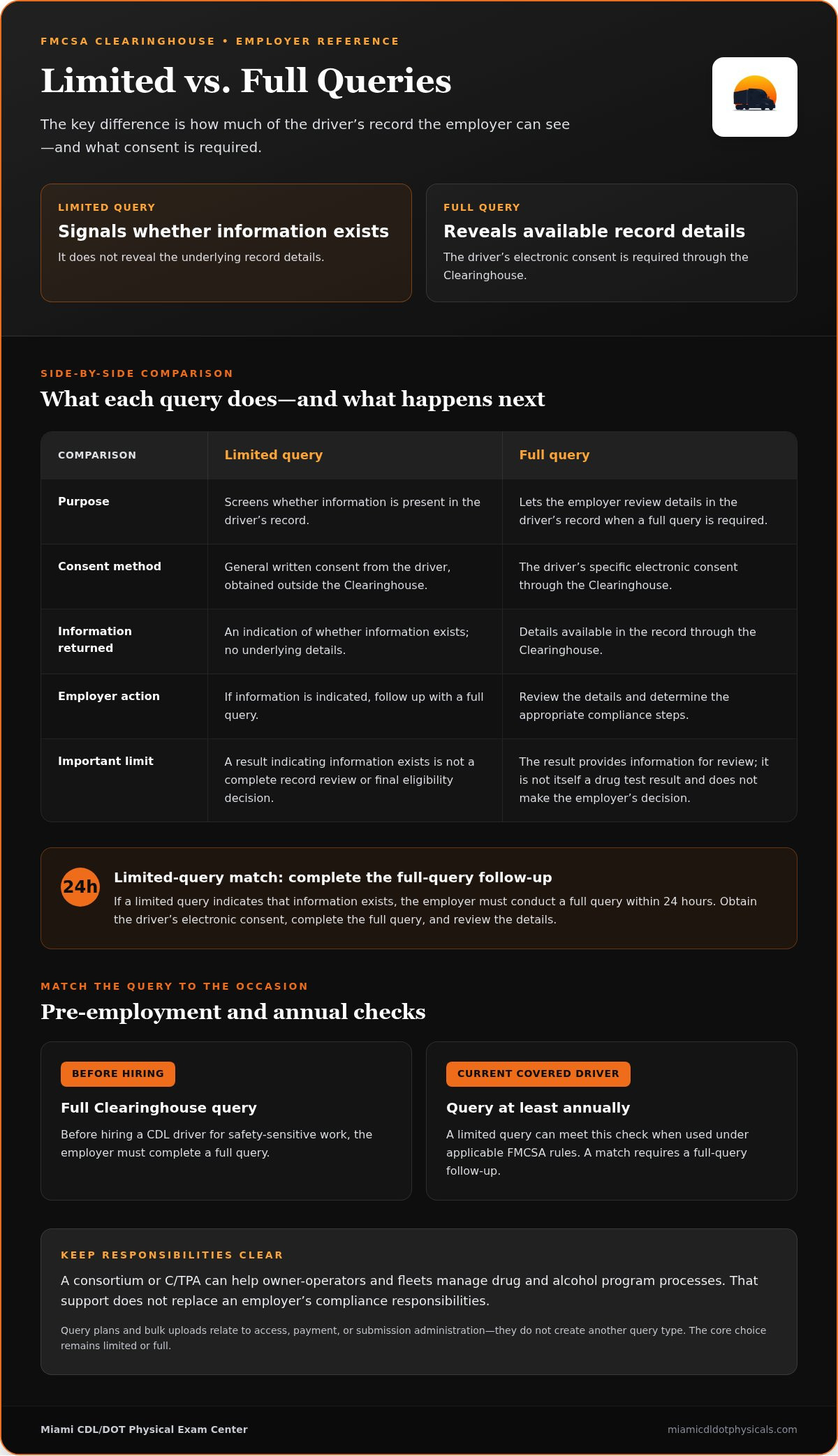
A limited query indicates whether information exists in a driver’s record. A full query reveals available details and requires the driver’s electronic consent through the Clearinghouse. If a limited query indicates that information exists, the employer must follow up with a full query.
This guide explains when to use each query, what consent is required, and what to do with the result. You’ll also learn how a consortium or C/TPA can help owner-operators manage drug and alcohol program processes, while employers remain responsible for their compliance duties. Use the right query for the situation, then document the result and complete any required follow-up.
Key Takeaways
- Choose a limited or full query according to the compliance decision and the record access needed.
- Understand the consent difference: limited queries use general written consent, while full queries require the driver’s electronic consent through the Clearinghouse.
- Match the query to the occasion: employers use full queries before hiring and conduct annual checks for current CDL drivers.
- Use a repeatable workflow to confirm access, obtain consent, submit the query, review the result, and document the process.
- A limited-query match requires a full-query follow-up. A C/TPA can assist with administrative tasks, but employers retain their compliance responsibilities.
FMCSA Clearinghouse query types: what limited and full queries mean
An FMCSA Clearinghouse query is an electronic check of a commercial driver’s drug and alcohol program record in the federal database. Employers use two query types: limited and full. The difference is how much information the result reveals, not whether the employer is checking the Clearinghouse.
A limited query is a screening step. It indicates whether information is present in the driver’s record but does not show the underlying details. A full query provides access to details available in the record, subject to the driver’s required electronic consent through the Clearinghouse. In short, a limited query shows whether information may need review; a full query lets the employer see the details.
What does a limited Clearinghouse query show?
A limited query indicates whether the driver’s record contains information. It does not disclose what that information is, so a positive indication is a prompt for further review, not a complete account of the record. Employers may use limited queries for required routine checks, including annual queries for current CDL drivers, when permitted under FMCSA rules.
If a limited query indicates that information exists, the employer needs a full query to see the details. Don’t treat the limited result as clearance or as a final eligibility decision.
What does a full Clearinghouse query reveal?
A full query gives the employer access to details in the driver’s Clearinghouse record. The driver must provide the required electronic consent through the Clearinghouse before the employer can access those details. Without consent, the full query cannot be completed.
The result provides information for the employer to assess and act on under applicable requirements. It is not itself a drug test result, and it doesn’t make the employer’s decision. Review the information, follow the relevant compliance steps, and keep appropriate records.
Keep query type separate from query administration. Query plans relate to access or payment arrangements, while bulk uploads help manage submissions. Neither creates a third query type. The core choice remains limited or full, based on the situation and the record access required. A limited query signals whether information exists; a full query reveals the details needed for review.
Limited vs. full FMCSA queries: consent, results, and next steps
The practical difference comes down to consent and visibility. A limited query provides an indication of whether information exists in a driver’s record. A full query lets the employer view record details after the driver gives electronic consent. Use the query required for the situation; consent requirements don’t make a required check optional.
| Comparison point | Limited query | Full query |
|---|---|---|
| Purpose | Check whether information exists in the record, including during applicable routine checks. | Review the details in a driver’s record when a full query is required. |
| Consent method | Obtain the driver’s general written consent outside the Clearinghouse. | Obtain the driver’s specific electronic consent through the Clearinghouse. |
| Information returned | An indication of whether information is present, without the underlying details. | Record details available through the Clearinghouse. |
| Employer action | If the result indicates information exists, proceed with the required full-query follow-up. | Review the details and determine the appropriate compliance steps. |
In brief: a limited query signals whether information exists; a full query reveals the record details. This distinction determines what the employer can learn and what action may be required next.
How does driver consent differ for each query?
For a limited query, the employer obtains general written consent from the driver outside the Clearinghouse. For a full query, the driver provides electronic consent in the Clearinghouse portal. Follow current FMCSA instructions for the consent process and retain required documentation. If a driver doesn’t consent to a required query, the employer can’t treat the missing result as a completed review.
What should an employer do when a limited query returns a record?
A limited result indicating that information exists does not reveal what the record contains. Under the follow-up requirement described by FMCSA, the employer must conduct a full query within 24 hours. Obtain the driver’s electronic consent, complete the full query, and review the details. Don’t treat the limited result as a complete record review or make an eligibility decision based on information it does not provide.
Owner-operators and fleets can use an FMCSA Clearinghouse Consortium for practical support with drug and alcohol program processes. Consortium support can help manage compliance tasks, but it doesn’t replace an employer’s responsibilities.
When employers need pre-employment and annual Clearinghouse queries
Choose the query according to the compliance occasion. Before hiring a CDL driver for safety-sensitive work, the employer must complete a full Clearinghouse query. For a current covered driver, the employer must query at least annually; a limited query can meet this check when used under applicable FMCSA rules. A Clearinghouse query is separate from drug testing, violation reporting, and any return-to-duty process.
| Driver status | Query occasion | Query and consent | Follow-up |
|---|---|---|---|
| Prospective CDL driver | Pre-employment investigation before safety-sensitive work | Full query; driver provides electronic consent through the Clearinghouse | Review the record details and complete applicable steps before permitting the driver to perform safety-sensitive functions. |
| Current covered CDL driver | At least annual check | Limited query may be used; obtain the driver’s general written consent | If information is indicated, conduct a full query within 24 hours and review the details. |
Which query applies before hiring a CDL driver?
Complete the full query as part of the pre-employment investigation before the driver performs safety-sensitive functions. The driver must give electronic consent through the Clearinghouse so the employer can access record details. If consent is not provided, the full query cannot be completed, and the employer must not treat an incomplete check as satisfying the requirement. Follow current FMCSA instructions for the query sequence and any applicable exceptions.
How do annual queries work for current drivers?
Schedule a Clearinghouse check at least annually for each covered current CDL driver. A limited query can be used for this routine review when permitted, provided the employer has the required written consent. If the result indicates that information exists, it does not show the details. Complete a full query within 24 hours, obtain electronic consent, and review the record before deciding on appropriate next steps.
Keep the query obligation in its proper place. A Clearinghouse search does not replace required drug and alcohol testing, violation reporting, or return-to-duty steps. Each process addresses a different compliance responsibility. For broader program context, read the FMCSA Clearinghouse consortium compliance guide. Matching the query to the driver’s status and the access needed helps keep these checks on track.
A practical Clearinghouse query workflow for employers and C/TPAs
A consistent process helps prevent missed checks and unclear follow-up. Use the same basic steps whether an employer submits a query directly or designates a qualified C/TPA to handle administrative work. The reason for the check and the access required determine the query type.
What employers should prepare before submitting a query
- Identify the occasion. Record the driver’s status and why the query is due, such as a pre-employment investigation or an annual check.
- Confirm account access. Make sure the employer account is set up and that any designated C/TPA has the necessary authorization. Query plans and bulk uploads can support access or administration, but they aren’t separate query types.
- Choose the required query. Match the query to the regulatory situation and the record information needed. Don’t substitute a limited query where a full query is required.
- Obtain consent. Follow the applicable consent process for the selected query, using current FMCSA instructions.
- Submit and review. Check that the query is associated with the correct driver, then review the result and complete any required follow-up.
- Document the process. Keep a record of the query, its outcome, consent, and follow-up actions so the employer can track completion.
What a C/TPA can do and what remains the employer’s duty
A designated C/TPA can perform administrative tasks, such as submitting queries and helping organize program records. Delegating that work doesn’t transfer the employer’s compliance responsibility. The employer remains responsible for ensuring required queries are completed, results are reviewed, and follow-up is handled. Account permissions and query-plan access enable the process; they don’t change who is accountable.
Owner-operators also need a workable way to manage drug and alcohol program responsibilities. Under FMCSA rules, an owner-operator generally designates a C/TPA to help administer required program processes. Follow current FMCSA requirements when setting up that arrangement. An FMCSA Clearinghouse Consortium can provide practical support with recurring program tasks, but it doesn’t replace employer duties or guarantee compliance.
Track queries alongside the wider drug and alcohol program. A Clearinghouse query is only one part of compliance, separate from testing and other program obligations. For more on those responsibilities, review this DOT drug testing compliance reference.
Use this query distinction as a starting point, then build a repeatable process around access, consent, review, and documentation. Owner-operators can explore an FMCSA Clearinghouse Consortium for support organizing required program processes.
What query results mean and how to keep the compliance process moving
A Clearinghouse result is one part of a driver’s compliance record, not a drug test result or a complete assessment of the employer’s drug and alcohol program. Interpret the result according to the query type, then follow current Clearinghouse instructions if anything is unclear or unexpected.
- No information indicated on a limited query: The query did not indicate information in the record. Keep the result with your records and continue other required compliance steps.
- Information indicated on a limited query: The limited result doesn’t reveal details. Obtain electronic consent and complete the required full-query follow-up within 24 hours under current FMCSA requirements.
- Details returned by a full query: Review the record and the driver’s status, then determine appropriate next steps under current rules. Don’t infer eligibility from a limited result alone.
- Unclear or unexpected result: Review current Clearinghouse instructions and resolve the question before treating the review as complete.
A limited query isn’t a full review. It indicates whether information exists but does not disclose the underlying details.
Does a Clearinghouse record automatically mean a driver is prohibited?
No. A limited-query indication alone doesn’t establish a driver’s status or explain the record. Employers need to review the available details through the appropriate full query and check the driver’s current Clearinghouse status. A driver in prohibited status cannot perform safety-sensitive functions until the applicable return-to-duty requirements are completed and the status is updated under FMCSA rules. Don’t make an eligibility decision based only on a limited result; follow current FMCSA guidance for the driver’s circumstances.
How consortium support can simplify ongoing responsibilities
An FMCSA Clearinghouse Consortium can support owner-operators and fleets with managing required program processes, while employers retain their responsibilities. DOT drug testing is also available. These services support compliance work but don’t replace required employer actions or guarantee a particular result.
For practical help organizing ongoing program responsibilities, explore Clearinghouse consortium support. Understanding the distinction between query types helps you interpret results carefully and keep the next compliance step clear.
Make every Clearinghouse query count
The right query depends on the compliance task: a full query supports pre-employment review, while a limited query may serve an annual check when permitted. Consent, result review, and follow-up all matter. Document each step, and don’t treat a limited result as a complete record review.
Employers remain responsible for compliance even when a C/TPA helps with administrative tasks. For owner-operators and fleets, consortium support can help organize Clearinghouse program responsibilities. DOT drug testing is also available as part of a broader screening process.
Explore FMCSA Clearinghouse Consortium support to learn about practical support for managing ongoing program tasks. A clear process and the right support can help you keep those responsibilities organized.
Frequently Asked Questions
What are the two types of FMCSA Clearinghouse queries?
The two employer query types are limited queries and full queries. Both check a driver’s drug and alcohol program record in the FMCSA Clearinghouse, but they provide different levels of access. A limited query indicates whether information exists. A full query allows the employer to view record details after the driver provides the required electronic consent. The right type depends on the reason for the check and the information needed.
What is the difference between a limited and full Clearinghouse query?
A limited query indicates whether the driver’s record contains information but doesn’t reveal what that information is. A full query returns available record details for the employer to review, subject to the driver’s electronic consent through the Clearinghouse. The essential difference is between an indication and access to the underlying details. If a limited query indicates that information exists, the employer must follow the required full-query process.
Does a limited Clearinghouse query require driver consent?
Yes. A limited query requires the driver’s general written consent, which the employer can obtain outside the Clearinghouse portal. A full query requires the driver’s specific electronic consent through the Clearinghouse. Keep consent documentation with the query records, and follow current FMCSA instructions for obtaining and retaining it. Consent doesn’t change which query is required for a particular compliance situation.
When is a full FMCSA Clearinghouse query required?
Employers must conduct a full query as part of the pre-employment investigation before a CDL driver performs safety-sensitive functions. A full query is also required when a limited query indicates that information exists in the driver’s record. For that follow-up, current FMCSA guidance requires the employer to conduct the full query within 24 hours. The driver must provide electronic consent before record details can be accessed.
How often must employers query the FMCSA Clearinghouse?
Employers must query at least annually for each current CDL driver covered by the rule. A limited query may be used for the annual check when permitted, provided the employer has the driver’s general written consent. If the result indicates that information exists, the employer must conduct a full query within the required timeframe and review the details. Track each driver’s annual check so a required query isn’t missed.
Can a C/TPA conduct Clearinghouse queries for an employer?
Yes. An employer can designate a C/TPA to conduct Clearinghouse queries and handle related administrative tasks within the authorized arrangement. The employer still retains responsibility for ensuring required queries are completed, results are reviewed, and follow-up actions are handled. A C/TPA can support the process, but delegation doesn’t transfer the employer’s compliance duties. Owner-operators should follow current FMCSA requirements for managing their drug and alcohol program.
Does a Clearinghouse query count as a DOT drug test?
No. A Clearinghouse query checks a driver’s drug and alcohol program record; a DOT drug test is a separate screening process. A query result isn’t a test result, and completing a query doesn’t replace any required testing or other drug and alcohol program responsibilities. Keep these processes distinct in your records and workflow. DOT drug testing and an FMCSA Clearinghouse Consortium are available for owner-operators and fleets.


