

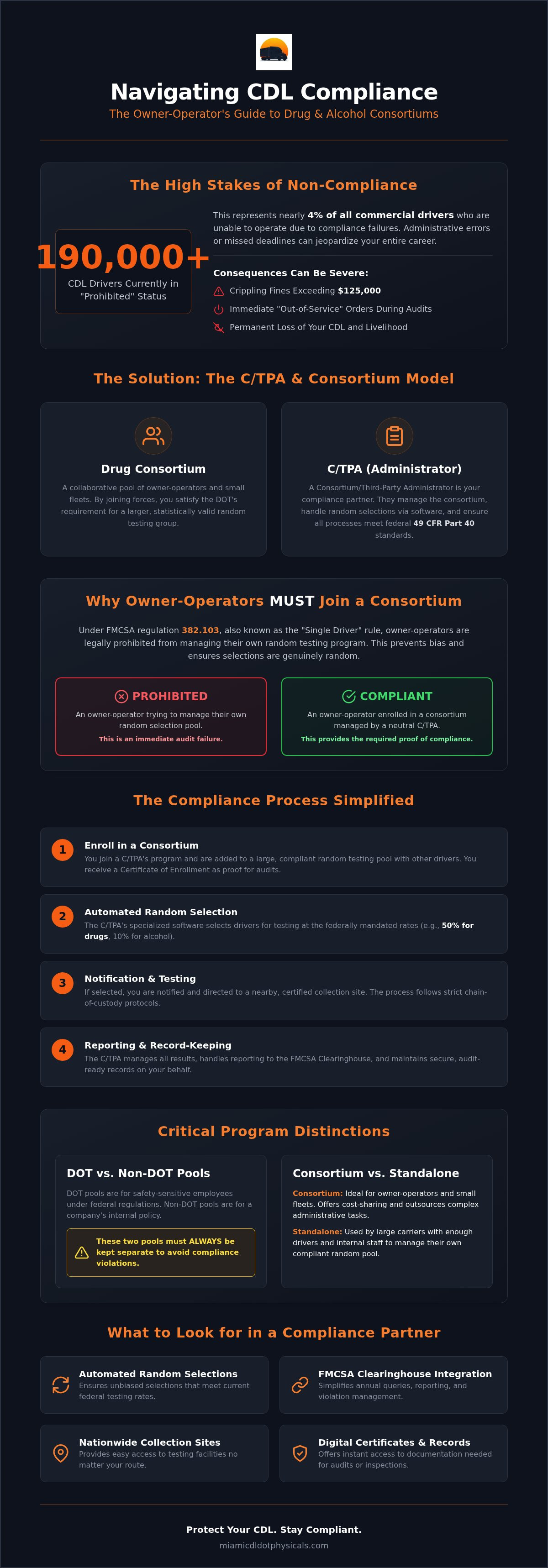
More than 190,000 CDL drivers are currently sitting in prohibited status within the FMCSA Clearinghouse. This represents nearly 4% of all commercial drivers who can't get behind the wheel because of compliance failures. You didn't start a trucking business to spend your days chasing down certified collection sites or wondering if your drug consortium is actually keeping you compliant. It's frustrating to feel like one administrative error or a missed 24-hour reporting window could jeopardize your entire career. We understand that your license is your livelihood and that the fear of a surprise audit is real.
This guide shows you how a compliance partner takes the weight off your shoulders. You'll learn exactly how these programs work, why federal law mandates them for owner-operators, and what to look for in a service provider. We'll preview the current 2026 requirements, including the 50% random drug testing rate, so you can manage your record-keeping with total confidence. By the end, you'll know how to protect your CDL with a partner that handles the random selections and paperwork for you.
Key Takeaways
- Understand how a C/TPA manages your regulatory burden to prevent costly administrative errors and audit failures.
- Learn why owner-operators must join a drug consortium to comply with the "Single Driver" rule and FMCSA Part 382.
- Discover how automated software handles random selections to accurately meet current federal drug and alcohol testing rates.
- Identify the essential tools for simplified record-keeping, including nationwide collection site access and instant digital certificates.
- See how to integrate your testing program with the FMCSA Clearinghouse for faster, more accurate annual queries and reporting.
Understanding the Drug Consortium and C/TPA Model
A drug consortium is a collaborative group of small companies and owner-operators who pool their employees together for random drug and alcohol testing. If you operate as a single driver, you can't legally manage your own random testing program. Federal law requires a neutral party to handle the selection process to ensure it remains truly random and unbiased. By joining a consortium, you become part of a larger collective that satisfies the Department of Transportation (DOT) requirements for annual testing percentages.
The entity that manages this pool is known as a Consortium/Third-Party Administrator (C/TPA). They act as your compliance partner, overseeing the administrative side of the testing process. This includes maintaining the list of active drivers, generating random selections using specialized software, and coordinating with laboratories. Their work is governed by 49 CFR Part 40. This federal regulation dictates the specific procedures for every drug test, ensuring that the collection, shipping, and testing of specimens are handled with total integrity.
The DOT mandates this third-party oversight to eliminate any chance of favoritism. An employer can't be the one who decides who gets tested and when. The C/TPA provides the necessary distance between the driver and the selection process. This protects the carrier from claims of bias and ensures the roads stay safe for everyone. It also means you don't have to worry about the logistics of the "randomness" yourself; the system handles it automatically.
The Difference Between a Consortium and a Standalone Program
Large trucking companies with hundreds of drivers often run standalone programs. These fleets have the internal staff and the volume of drivers needed to manage their own random pools. For smaller fleets and owner-operators, a drug consortium is the practical choice. It offers significant administrative relief and cost-sharing benefits. Instead of hiring a full-time compliance officer, you outsource those responsibilities to experts who understand the nuances of federal law.
DOT vs. Non-DOT Testing Pools
It's vital to distinguish between DOT and non-DOT testing. DOT pools are strictly regulated by agencies like the FMCSA and must follow federal guidelines for specimen collection and laboratory analysis. Non-DOT testing is based on an employer’s private workplace policy. You should never mix these two groups in the same random pool. Doing so can lead to compliance failures during an audit. Each pool has different requirements, and keeping them separate ensures your DOT records remain clean and accurate.
Why Owner-Operators and Small Fleets Must Join a Consortium
Many drivers think they can handle compliance on their own to save a few dollars. However, under FMCSA regulation 382.103, almost every driver who needs a CDL for their job must participate in a formal testing program. For owner-operators, the law is even more specific. You're legally prohibited from managing your own random selection pool. This is often called the "Single Driver" rule. If you were in charge of your own selections, there'd be no way to prove the process was truly random and unbiased. The DOT requires a barrier between the person being tested and the person choosing the names.
Joining a drug consortium solves this legal hurdle instantly. The consortium acts as the administrative "employer" for the purposes of drug and alcohol testing. They keep your name in a larger pool with other drivers, ensuring that selections are made by computer software without any human interference. When an auditor asks for proof of compliance, they won't just look for a negative test result. They'll demand your "Certificate of Enrollment" and a record of the random selection math. A reliable partner provides this documentation immediately, protecting your ability to stay on the road.
Federal Requirements for Single-Driver Operations
The government is very clear about the role of a Third-Party Administrator. According to the FMCSA definition of a C/TPA, these service agents handle the heavy lifting of your testing program. If you operate without a valid enrollment, you're essentially driving illegally in the eyes of the DOT. It doesn't matter if you're the safest driver on the highway. Without that paper trail, you're a liability. Enrolling in an FMCSA Clearinghouse Consortium is the fastest way to bridge this compliance gap and get back to focusing on your routes.
The Risks of Non-Compliance
The penalties for skipping this requirement are severe. In 2025, some fines for non-compliance with FMCSA regulations exceeded $125,000. Beyond the financial hit, a single violation can trigger an "out-of-service" order. This effectively parks your truck until the issue is resolved, costing you thousands in lost revenue. This also wreaks havoc on your CSA scores. Insurance companies monitor these ratings closely, and a poor score often leads to skyrocketing premiums. A drug consortium provides the expert guidance needed to avoid these pitfalls, acting as a shield for your business and your CDL.
How the Random Drug Testing Pool Operates
The math behind a drug consortium is designed to ensure every driver in the pool has an equal chance of being picked. Modern C/TPAs use computer-generated software to pull names randomly from the combined database. This isn't a manual process where someone picks a name out of a hat. The software ensures that even if you were tested last month, your name goes right back into the pool for the next drawing. Every driver's chance of selection remains the same during every cycle, which is the very definition of a fair and unbiased system.
As of 2026, the FMCSA requires specific annual testing rates to maintain safety on the highways. The minimum random drug testing rate is 50%, while the minimum alcohol testing rate is 10%. These percentages are based on the average number of driver positions in the pool throughout the year. If your consortium doesn't hit these numbers, the entire group faces regulatory scrutiny. This is why it's vital to partner with a provider that manages their pool with precision and reports data accurately to federal authorities.
Once a name is pulled, the lifecycle of the test begins. It moves from selection to notification, then to collection, and finally to laboratory analysis. Speed is essential at every stage. The DOT requires that once a driver is notified of their selection, they must proceed to the collection site immediately. Any delay provides an opportunity for tampering, which is why "immediate" means exactly that. There's no time for finishing a shift or heading home first.
The Selection and Notification Process
When your name is selected, the C/TPA notifies the employer or the owner-operator directly. This notification is usually sent via secure email or a digital portal. Once you're notified, the clock starts. You must report to a certified collection site without delay. If you fail to show up or leave the site before the process is finished, it's recorded as a "refusal to test." In the eyes of the FMCSA, a refusal is often worse than a positive result. It leads to an immediate "prohibited" status and requires a full return-to-duty process.
The Role of the Medical Review Officer (MRO)
Every result goes through a Medical Review Officer (MRO) before it's finalized. An MRO is a licensed physician with specialized training in substance abuse and drug testing. They act as a critical safeguard for the driver. If a test comes back positive for a specific substance, the MRO contacts the driver to see if there's a valid medical explanation, such as a legal prescription. This prevents a legitimate medication from unfairly ending your career.
The MRO ensures that no false positives are reported to the FMCSA Drug & Alcohol Clearinghouse. They protect your privacy and your career by verifying every laboratory result before it becomes part of your permanent record. If you have a legitimate prescription that explains the laboratory finding, the MRO can report the test as negative. This layer of professional review is a core benefit of a high-quality drug consortium, providing a necessary shield for drivers who follow their doctor's orders.
Criteria for Selecting a Reliable Compliance Partner
Choosing a drug consortium is about more than just checking a box for federal compliance. It's about finding a partner that stands by you when an auditor knocks on your door. Don't just settle for the lowest price you find online. Look for a provider that offers transparent pricing from the start. Some companies lure you in with low enrollment fees but then hit you with hidden charges for every random selection or Medical Review Officer (MRO) review. You need a clear cost structure so you can budget for your business without surprises.
Audit support is another non-negotiable feature. If the DOT conducts a safety audit, they'll ask for your random testing records and proof of enrollment. A reliable partner doesn't just send you a PDF and wish you luck. They provide real-time access to your compliance dashboard and can generate the necessary reports on demand. This saves you from the stress of hunting through paper files while an official is waiting. Your compliance partner should act as your outsourced administrative department, keeping your records organized and ready for inspection at any time.
Collection Site Network and Convenience
Driver downtime is expensive. Every hour your driver spends looking for a clinic is an hour they aren't moving freight. Select a partner with a nationwide collection site network. This ensures that no matter where your truck is, a certified facility is nearby. Modern programs use Electronic Custody and Control Forms (eCCF). These digital forms eliminate the need for paper tracking and speed up the reporting process significantly. Always verify that the sites in the network are strictly DOT-certified and follow the rigorous Part 40 procedures mentioned in previous sections.
Expertise in FMCSA Regulations
Federal laws change frequently. For example, the industry is currently adapting to new options like oral fluid testing and stricter identity verification requirements in the Clearinghouse. You need a partner that stays ahead of these shifts. Ask if they offer "live" support. Automated portals are great for routine tasks, but for complex compliance questions, you want to speak with a human expert who understands your specific situation. Learn more about FMCSA Clearinghouse Consortium services to see how an expert partner manages these details for you.
When you're ready to secure your business, choose a provider that values your time as much as you do. You can enroll in a DOT-compliant consortium today and stop worrying about the next surprise audit.
Navigating FMCSA Clearinghouse Integration and Enrollment
The FMCSA Clearinghouse is a secure online database that tracks drug and alcohol violations for CDL holders in real time. While the drug consortium manages your random testing pool, it also plays a vital role in keeping your Clearinghouse records accurate. As of 2026, the FMCSA enforces a strict 24-hour maximum reporting window for positive drug tests, alcohol violations, and refusals to test. Your consortium helps you meet these aggressive deadlines by handling the data upload on your behalf, ensuring you don't fall out of compliance due to an administrative delay.
Beyond reporting violations, your partner assists with mandatory queries. You're required to query the Clearinghouse when hiring a new driver and at least once a year for every existing driver on your team. In 2025, failures to run pre-employment or annual limited queries accounted for over 7,000 violations. A proactive consortium simplifies this by managing the query process for you, so you never miss a deadline. This integration creates a seamless loop of compliance between your internal records and the federal database.
Connecting the Consortium to the Clearinghouse
You must take one critical step after joining a drug consortium: designating your C/TPA within the FMCSA Clearinghouse portal. This official designation gives your partner the legal authority to report violations and conduct queries for you. It's not a "set it and forget it" process. You must work with your C/TPA to keep your driver list updated in both systems. If a driver leaves your company but remains on your active list, you might pay for unnecessary queries or random selections. Regular communication ensures your pool remains accurate and cost-effective.
Steps to Full Compliance
Getting your business fully compliant doesn't have to be a headache. If you're ready to protect your CDL and your business, follow this straightforward checklist to secure your operations:
- Complete the enrollment application and pay the membership fee to join the random testing pool.
- Designate your C/TPA in the federal Clearinghouse portal to allow for automated reporting and queries.
- Obtain your Certificate of Enrollment and keep a copy in your cab or office files for roadside inspections and audits.
- Schedule and pass a DOT-certified pre-employment drug test before you perform any safety-sensitive work.
Taking these steps today protects your livelihood and keeps your truck moving without the fear of a surprise audit. Don't wait for an enforcement officer to find a gap in your records. Enroll in our FMCSA Clearinghouse Consortium today to secure your compliance and gain the peace of mind that comes with expert oversight.
Secure Your Future on the Road
Regulatory compliance shouldn't be a source of constant anxiety. Enrolling in a drug consortium is the most effective way for owner-operators and small fleets to meet federal mandates while protecting their professional standing. By outsourcing the complexities of random selections and Clearinghouse reporting, you eliminate the risk of administrative errors that lead to prohibited status or heavy fines. You've worked hard to build your career; don't let a missed query or a late report put it all at risk.
Our team provides the specialized expertise you need to stay moving. We offer FMCSA-certified medical examinations and comprehensive DOT drug testing solutions designed specifically for the trucking community. With our full FMCSA Clearinghouse management, you can rest easy knowing your records are always audit-ready. Take the stress out of compliance and get back to what you do best. Join the FMCSA Clearinghouse Consortium and Protect Your CDL today. We're here to help you succeed every mile of the way.
Frequently Asked Questions
Is an owner-operator required to join a drug consortium?
Yes, federal law mandates that all single-driver owner-operators enroll in a random testing pool managed by a third party. You can't legally manage your own random selections because the DOT requires a neutral barrier to ensure the process isn't biased. Staying enrolled in a compliant program is a basic requirement for maintaining your authority.
What happens if I miss a random drug test selection?
Missing a scheduled test is usually classified as a "refusal to test," which carries the same weight as a positive result. You'll be placed in "prohibited" status in the FMCSA Clearinghouse and must complete a return-to-duty process with a Substance Abuse Professional. This mistake can sideline your business for weeks and lead to significant revenue loss.
How much does it typically cost to join a drug testing consortium?
Membership fees vary across the industry depending on the specific services and audit support included in the package. Most providers charge an annual fee to manage your enrollment and maintain your records in the random pool. It's important to choose a partner with a transparent fee structure so you don't get hit with hidden costs for MRO reviews.
Can I choose which driver gets tested in a random pool?
No, the employer has zero influence over who is selected for testing in a drug consortium. The selection process is handled by computer software that ensures every driver has an equal chance of being picked during every drawing. Any attempt to manually influence the list is a violation of federal law and will result in failed audits.
How long does it take for drug test results to be reported to the Clearinghouse?
Federal regulations require that positive results and refusals be reported within 24 hours of the final determination. Once the Medical Review Officer verifies a result, the data must be uploaded to the federal database immediately. This fast reporting window is designed to keep prohibited drivers off the road and maintain public safety.
What is the difference between a C/TPA and a drug consortium?
A consortium is the collective group of drivers pooled together for testing, while the C/TPA is the administrative body that runs the program. While people use the terms interchangeably, the C/TPA is the actual service agent that manages the drug consortium records, generates the random lists, and coordinates with laboratories to ensure your business stays compliant.
Do I need a new drug test if I switch to a different consortium?
You don't always need a new test if you can prove there was no gap in your random testing coverage. If you move directly from one compliant program to another, your enrollment history remains intact. However, if your previous membership lapsed for more than 30 days, you'll likely need a new pre-employment drug test to restart your eligibility.
Can a consortium help me with DOT physical requirements as well?
Many comprehensive compliance partners offer both drug testing management and medical certification services. While the random pool handles substance testing, a full-service partner can coordinate your DOT physical exams with certified medical examiners. This consolidated approach makes it much easier to manage your driver qualification file and stay current with all FMCSA medical standards.


