
How many "empty miles" is your fleet logging just to get drivers into a clinic chair for a mandatory exam? Most fleet managers know the frustration of losing a full day of productivity because of a scheduling conflict or a long wait at a crowded clinic. Implementing onsite dot physicals and drug testing for fleets isn't just a convenience; it's a strategic move to eliminate the high operational costs of driver downtime. You need your trucks on the road and your drivers focused on the job, not sitting in a waiting room.
We understand that staying on top of FMCSA Clearinghouse requirements and medical card expiration dates often feels like a second job. This guide shows you how onsite programs ensure 100% compliance while keeping your drivers behind the wheel. We'll explore how to streamline your testing standards, maintain audit-ready digital records, and prepare for upcoming regulatory shifts, such as the January 10, 2026, MEC waiver expiration. By the end, you'll have a clear path to a more efficient, compliant operation that respects your schedule and your bottom line.
Key Takeaways
- Bring certified medical examiners directly to your terminal to eliminate the wasted travel time and long clinic queues that keep your drivers off the road.
- Utilize onsite dot physicals and drug testing for fleets to manage vision, hearing, and blood pressure checks alongside random or pre-employment drug screens in a single visit.
- Calculate the true ROI of onsite programs by accounting for the "hidden costs" of missed dispatches and driver scheduling conflicts.
- Leverage a professional consortium and Medical Review Officer (MRO) to handle the complexities of random testing pools and FMCSA Clearinghouse reporting.
- Ensure your fleet is audit-ready for 2026 by digitizing driver qualification files and preparing for the transition to electronic medical certification verification.
The Strategic Value of Onsite DOT Physicals and Drug Testing for Fleets
Onsite DOT compliance isn't just a mobile service; it's a fundamental shift in how successful carriers manage their human capital. By bringing certified medical examiners and drug collectors directly to your terminal, onsite dot physicals and drug testing for fleets eliminate the logistical friction that traditionally slows down operations. In a market where the driver shortage was estimated at over 80,000 in late 2024, keeping your current team satisfied and productive is a top priority. Providing medical services at the terminal shows your drivers that you value their time and their health.
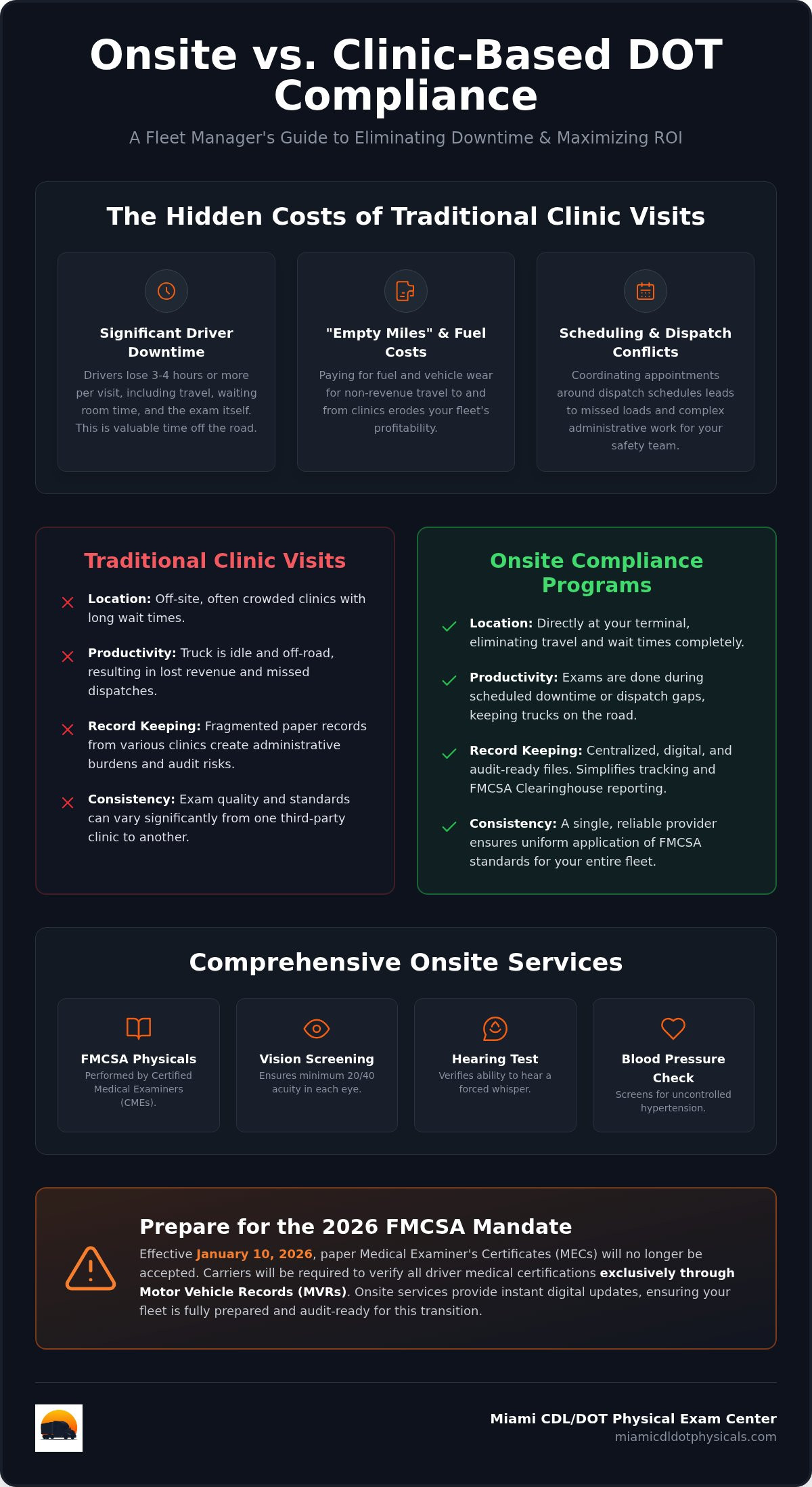
The logistics landscape of 2026 demands this agile approach. On January 10, 2026, the temporary waiver allowing carriers to accept paper Medical Examiner's Certificates (MECs) expires. After this date, motor carriers must verify all CDL driver medical certifications exclusively through Motor Vehicle Records (MVRs). Moving your compliance process onsite allows you to synchronize these medical updates with your internal digital systems instantly. This proactive stance ensures you are never caught off guard by an expired card or an unverified record during an audit.
Eliminating Driver Downtime and Travel Costs
When a driver spends three or four hours at a local clinic, your fleet loses more than just time. You're paying for "empty miles" and unnecessary fuel consumption while the vehicle sits in traffic or an overcrowded clinic parking lot. Onsite services allow you to maintain operational continuity; we define this as the ability to conduct required testing during natural dispatch gaps or scheduled downtime at the terminal. This keeps your equipment where it belongs: on the road and earning revenue.
Centralizing Compliance for Safety Directors
Managing a distributed fleet often leads to fragmented records and inconsistent exam quality. Centralizing your compliance through onsite dot physicals and drug testing for fleets gives safety directors a single, reliable point of contact. This consistency is vital for maintaining high standards in vision, hearing, and drug testing protocols across the entire organization. It removes the guesswork that comes with using multiple third-party clinics with varying levels of expertise.
- Ensures consistent application of FMCSA and NRCME standards for every driver.
- Simplifies the transition from paper files to audit-ready digital folders.
- Reduces the administrative burden of tracking random testing pools and upcoming expiration dates.
By integrating these services into your terminal operations, you transform a regulatory hurdle into a competitive advantage. You demonstrate respect for your drivers' schedule while ensuring your fleet remains 100% compliant and ready for any FMCSA inspection. This streamlined approach allows your safety team to focus on high-level strategy rather than chasing down missing medical cards.
Comprehensive Onsite Compliance Services: What’s Included?
Effective onsite dot physicals and drug testing for fleets requires more than just a mobile exam room. It demands an FMCSA-Certified Medical Examiner (CME) who understands the specific rigors of the road. These examiners don't just check boxes. They verify driver identification and analyze medical histories to ensure every person behind the wheel is fit for duty. This level of scrutiny keeps your safety scores high and your insurance premiums manageable. By moving these services to your terminal, you ensure that every driver receives a consistent, high-quality evaluation without the variability of different walk-in clinics.
FMCSA-Certified Medical Examinations
The physical exam follows a standardized process designed for accuracy and speed. First, the examiner reviews the driver’s health history for red flags like sleep apnea or heart conditions. Next, they conduct a vision screening to ensure a minimum of 20/40 acuity in each eye. This is followed by a hearing test and a blood pressure check to rule out uncontrolled hypertension. Finally, the examiner performs a physical examination of body systems and a urinalysis. It's important to remember that this specific urinalysis is a medical screen for sugar and protein; it is not a drug test. If the driver meets all standards, the CME issues the Medical Examiner’s Certificate (MEC) immediately. For drivers with manageable conditions, the examiner may issue a conditional, short-term certification. This allows for medical follow-up without immediately pulling the driver off the road.
DOT and Non-DOT Drug Screening Protocols
Drug screening is a separate but equally critical component of fleet safety. We manage the standard 5-panel DOT drug test as mandated by 49 CFR Part 40. This includes screening for marijuana, cocaine, opiates, amphetamines, and PCP. Staying current with DOT drug and alcohol regulations is non-negotiable for fleet managers. Onsite services allow you to handle several testing types at once:
- Pre-employment: Screening new hires before they ever touch a steering wheel.
- Random: Meeting your annual percentage requirements without disrupting dispatch schedules.
- Post-accident: Getting a collector to your site quickly when time is of the essence.
- Reasonable suspicion: Acting immediately when safety is at risk.
A key part of this workflow is the Medical Review Officer (MRO). The MRO acts as an independent gatekeeper. They review all laboratory results to ensure accuracy and protect the driver’s rights if they take legitimate prescription medications. Many fleets also choose to integrate Breath Alcohol Testing (BAT) into their onsite day to maximize efficiency. If you're looking to simplify your next round of certifications, you can schedule a mobile compliance session to bring these services directly to your facility. This integrated approach ensures your fleet stays compliant while your drivers stay focused on their routes.
Onsite vs. Clinic-Based Testing: A Cost-Benefit Analysis
Many fleet managers focus solely on the "sticker price" of a medical exam. This is a common mistake. While a walk-in clinic might offer a lower flat fee, the real expense is hidden in the logistics. Utilizing onsite dot physicals and drug testing for fleets provides a much higher ROI because it eliminates the indirect costs that drain your budget. When you account for driver wages, fuel, and the revenue lost while a truck sits idle, that "cheap" clinic visit often becomes the most expensive option on your balance sheet.
Scalability is another major factor. As your fleet grows, the complexity of managing individual appointments multiplies exponentially. Sending fifty drivers to a clinic results in fifty different scheduling headaches and fifty potential dispatch delays. Onsite testing scales with your business. It provides a controlled, professional environment where safety directors can verify the process directly. This reduces liability by ensuring every test follows the exact same protocol, removing the risk of inconsistent results or poor record-keeping found at various retail clinics.
Calculating the Real Cost of Driver Travel Time
To find your true cost, use this simple formula: (Driver Hourly Rate + Opportunity Cost) x Hours spent at the clinic. If a driver is off the clock for three hours, you've lost three hours of potential freight revenue. This travel also directly impacts Hours of Service (HOS) logs. Every minute spent driving to a clinic is a minute taken away from a driver's legal driving window. For a fleet of 50 drivers, switching to onsite dot physicals and drug testing for fleets can save over 150 operational hours annually. That's nearly four full work weeks of reclaimed productivity.
Maintaining Operational Continuity During Peak Seasons
Peak seasons are the worst time for a driver's medical card to expire. You can't afford to have a truck sidelined when freight volume is at its highest. Onsite services allow for batch testing strategies where you can renew multiple medical cards in a single morning at your terminal. This keeps your dispatchers happy and your trucks moving. For more details on staying ahead of these regulatory deadlines, see our guide on CDL medical card renewal.
When implementing a testing program, you must balance regulatory strictness with operational reality. Onsite testing bridges that gap by making compliance a seamless part of your workday rather than a major disruption. It turns a mandatory hurdle into a streamlined process that supports your fleet's bottom line.
Implementing an Onsite Compliance Program: A Step-by-Step Guide
Executing a successful onsite event starts weeks before the medical examiner arrives at your terminal. A well-structured program for onsite dot physicals and drug testing for fleets requires a thorough initial audit. You'll need to identify which drivers have medical cards expiring in the next 60 days and determine your quarterly random testing quota. This proactive approach prevents last-minute scrambles and ensures you're ready for the January 10, 2026, deadline for MVR-only verification. It's also the time to verify that your service partner holds current FMCSA and NRCME credentials. Don't assume every mobile provider is fully certified for the latest federal standards.
Clear communication with your drivers is the next step. Let them know the schedule well in advance to avoid resistance or confusion. Drivers appreciate the convenience of testing where they park, but they need to know what documentation to bring, such as current medication lists or CPAP compliance reports. Once the testing is complete, the administrative work begins. You must ensure all drug test results are uploaded correctly to the FMCSA Clearinghouse and that medical certifications are transmitted to state driver licensing agencies without delay.
Scheduling and Logistics for Large Fleets
Efficiency depends on a staggered schedule. We recommend booking drivers in 20 to 30-minute intervals to prevent dispatch bottlenecks. This coordination between your fleet manager and the medical provider's logistics team keeps the terminal flowing smoothly. If you're managing a regional team, you'll also need to stay current with FMCSA Clearinghouse Consortium Florida requirements to maintain full state and federal alignment. This ensures your random pool selections are unbiased and legally defensible.
Facility Requirements for Onsite Medical Exams
Your facility doesn't need to be a hospital, but it must meet specific standards for a professional medical environment. A private, HIPAA-compliant area is mandatory to protect driver privacy during the physical exam. You'll also need a designated restroom with a localized water shut-off to follow strict drug collection protocols. Technical needs are equally important. Ensure the exam area has reliable power and internet access. This allows the examiner to perform real-time reporting to the National Registry, which is critical for maintaining audit-ready digital records.
A successful deployment turns a day of mandatory compliance into a day of high productivity. If you're ready to modernize your safety protocols and eliminate the hassle of clinic visits, book an onsite fleet compliance session to bring our certified examiners directly to your facility.
Partnering with a National Compliance Expert for Fleet Safety
Choosing a long-term partner for onsite dot physicals and drug testing for fleets is a decision that directly impacts your operational stability. A dedicated Medical Review Officer (MRO) is essential for this partnership. The MRO provides an expert layer of review, ensuring that laboratory results are legally defensible and scientifically sound. This protection is vital when you're managing the livelihoods of your drivers and the reputation of your company. Additionally, same-day medical card issuance is a non-negotiable requirement for 2026. When a driver passes their physical at your terminal, they should have their certificate in hand immediately to prevent any lapse in their commercial driving status.
A professional consortium manages your random pool selections to remove any hint of employer bias. This third-party administration is particularly important for owner-operators who are legally required to belong to a consortium. By outsourcing this selection process, you protect your company from claims of unfair targeting while meeting the FMCSA random testing rates. These rates are expected to remain at 50% for drugs and 10% for alcohol in 2026. Relying on a seasoned expert ensures you never miss these quotas or fall behind on regulatory updates.
FMCSA Clearinghouse Consortium Integration
Automation is the key to managing the FMCSA Clearinghouse effectively. A national compliance partner automates the reporting of drug and alcohol violations, which reduces the risk of manual data entry errors. For large fleets, we conduct annual queries in one batch. This ensures every driver on your roster is checked against the national database without your safety director needing to log in hundreds of times. This level of integration follows the high standards established for a DOT drug test Miami, providing a blueprint for national fleet safety and consistency.
Secure Record-Keeping and Audit Readiness
The transition to a fully electronic system becomes mandatory on January 10, 2026. You'll no longer be able to rely on paper MECs for verification; you must use Motor Vehicle Records (MVRs) instead. A secure digital portal provides instant access to these certificates, ensuring your "Compliance Folder" is ready for a DOT audit at a moment's notice. When you review a 2026 fleet compliance contract, ensure it includes these essentials:
- Verified FMCSA and NRCME credentials for all medical examiners.
- Real-time reporting to the National Registry for immediate compliance.
- Dedicated MRO support for all drug testing results and driver interviews.
- Mobile equipment that meets HIPAA and strict collection standards.
- Integrated Clearinghouse query management for the entire fleet.
This partnership turns compliance from a stressful deadline into a well-oiled process. It allows you to focus on fleet growth and logistics while we handle the medical and regulatory details. By integrating onsite dot physicals and drug testing for fleets into your business model, you build a safer, more efficient operation that's ready for any inspection.
Future-Proof Your Fleet Compliance
Managing a modern fleet requires a shift from reactive scheduling to proactive compliance. By moving your medical certifications and screening protocols to your terminal, you eliminate the logistical friction that drains your revenue. You've seen how onsite programs protect your bottom line by reclaiming operational hours and ensuring your records are audit-ready for the 2026 regulatory shifts. This isn't just about meeting a requirement; it's about building a more resilient, driver-focused operation.
Reliability starts with the right partner. Implementing onsite dot physicals and drug testing for fleets gives you access to FMCSA-Certified Medical Examiners and professional onsite medical deployments without the hassle of clinic wait times. We provide complete Clearinghouse Consortium management to handle your random pool selections and reporting requirements with total transparency. It's time to stop chasing missing medical cards and start focusing on your next dispatch.
Schedule Onsite DOT Physicals and Drug Testing for Your Fleet today and experience a streamlined path to total compliance. We're here to help you keep your drivers safe and your trucks moving.
Frequently Asked Questions
What are the minimum driver requirements for an onsite DOT physical day?
Most service providers require a minimum of 10 to 15 drivers to schedule a dedicated onsite session. This threshold ensures that the logistical costs of mobilizing a medical team are offset by the volume of exams performed. If your fleet is smaller than this, you can often partner with a neighboring carrier to reach the necessary headcount for a shared mobile deployment.
Can drug testing and DOT physicals be performed simultaneously onsite?
Yes, performing onsite dot physicals and drug testing for fleets simultaneously is the most efficient way to handle compliance. Most safety directors choose to bundle these services so drivers only have to step away from their routes once. This integrated workflow reduces total downtime and ensures that all medical and drug screening records are updated in a single, coordinated session.
How quickly are onsite drug test results reported to the fleet manager?
Medical Examiner Certificates are issued immediately upon the successful completion of a physical exam. For drug testing, negative results are typically available within 24 to 48 hours after the laboratory receives the specimen. If a result requires a secondary review by a Medical Review Officer, the reporting time may extend to 72 hours or more to ensure full regulatory accuracy.
Is an onsite DOT physical as valid as one performed in a traditional clinic?
An onsite DOT physical carries the exact same legal validity as an exam performed in a traditional brick-and-mortar clinic. The FMCSA medical standards and examination protocols are identical regardless of the setting. As long as the exam is conducted by a certified professional listed on the National Registry, the resulting medical card is fully recognized by all state and federal authorities.
What happens if a driver fails their onsite DOT physical exam?
If a driver fails to meet the medical standards, the examiner must mark them as disqualified in the National Registry. In many instances, the examiner may issue a short-term "conditional" certificate if the issue, such as high blood pressure, can be managed with medication. The driver then has a specific window to resolve the condition and provide follow-up documentation to receive a full-term card.
Do onsite services include FMCSA Clearinghouse reporting?
Comprehensive onsite dot physicals and drug testing for fleets typically include full integration with the FMCSA Clearinghouse. The service provider or consortium manager handles the mandatory reporting of drug and alcohol violations on your behalf. They can also assist your safety team with conducting the annual queries required for every driver on your payroll to maintain audit readiness.
What size fleet justifies the cost of an onsite compliance program?
Fleets with 20 or more drivers usually see the most immediate financial return from onsite programs. However, even smaller fleets can justify the cost if they operate in high-traffic areas where clinic wait times are excessive. The decision depends on calculating the total cost of driver wages, fuel consumption, and lost revenue incurred when sending drivers to offsite locations.
Are onsite examiners required to be on the National Registry (NRCME)?
Yes, every medical examiner performing DOT physicals must be listed on the National Registry of Certified Medical Examiners. This is a mandatory federal requirement ensuring the examiner has passed a certification test on FMCSA medical standards. You should always verify an examiner's credentials through the official registry before scheduling a mobile deployment at your terminal.


