

Did you know that over 190,000 commercial drivers are currently in a "prohibited status" within the FMCSA Clearinghouse? It's a staggering number that represents thousands of stalled careers and missed paychecks. If you're feeling anxious about your upcoming medical exam, you aren't alone. Most drivers worry that a single high blood pressure reading or a specific prescription will end their time on the road for good. Understanding what disqualifies you from a DOT physical in Florida is the first step toward protecting your livelihood and staying compliant with 2026 regulations.
We agree that the medical certification process can feel like a high-stakes hurdle. However, a disqualification is rarely a permanent career-ender; it's usually just a "not yet" that you can resolve with the right documentation or treatment. In this guide, you'll discover the specific health factors that impact your CDL certification and how to manage them effectively. We'll provide a clear list of "deal-breaker" conditions, explain the current 2026 vision and hearing standards, and show you how to navigate the FMCSA waiver process so you can get back behind the wheel with confidence.
Key Takeaways
- Florida strictly follows federal FMCSA standards, ensuring that your medical certification meets the national safety requirements for commercial driving.
- Learn exactly what disqualifies you from a DOT physical in Florida, including the specific 2026 thresholds for vision acuity, hearing loss, and blood pressure.
- Identify which medications are absolute deal-breakers and how to manage habit-forming prescriptions by providing the correct specialist documentation.
- Discover how to navigate a temporary disqualification by using the 45-day window to submit additional testing results or medical records.
- Prepare for your exam effectively by following specific hydration and documentation steps that help prevent unnecessary delays or medical fails.
What Disqualifies You from a DOT Physical? Understanding FMCSA Standards
A disqualifying condition is any medical issue that prevents you from safely operating a commercial motor vehicle (CMV). While many drivers look for Florida-specific rules, the reality is that Florida adheres strictly to federal FMCSA standards. This means the rules in Miami are the same as the rules in Seattle. The National Registry of Certified Medical Examiners (NRCME) ensures this consistency. Only healthcare professionals listed on this registry can perform your exam, as they are trained to apply federal law to your specific health profile.
One of the most misunderstood parts of the exam is the concept of "clinical significance." This term refers to how an examiner decides if a condition actually poses a risk. For example, a minor scar isn't clinically significant, but a history of fainting spells is. The examiner's job is to determine if your condition is stable and well-managed enough to keep you and the public safe on the road. Understanding what disqualifies you from a DOT physical in Florida starts with realizing that the examiner looks at your ability to perform safety-sensitive functions without interruption.
The Difference Between Federal and State Requirements
Interstate and intrastate drivers in Florida must meet the same core medical standards. Whether you're hauling freight to Georgia or delivering goods within Orlando, you need a valid medical certificate. The Florida Department of Highway Safety and Motor Vehicles (FLHSMV) requires you to self-certify into one of four categories, such as Non-excepted Interstate or Non-excepted Intrastate. Regardless of the category you choose, the medical card itself is a federal requirement tied to your Commercial Driver's License (CDL). You cannot maintain your driving privileges without it.
The Examiner's Discretion: Why the Doctor Matters
Your medical examiner has significant power in determining your fitness for duty. They don't just look at your current symptoms; they evaluate your entire medical history. An examiner might see a history of heart issues and decide they need a clearance letter from your cardiologist before signing off. This doesn't mean you've failed. It means the doctor is doing their due diligence to ensure you won't have a medical emergency behind the wheel.
Honesty is vital when filling out the health history section of the MCSA-5875 form. If you omit a condition and it's discovered later, you face immediate disqualification and potential legal trouble. A certified examiner acts as a partner in your career. They want to see you pass, but they must follow the 2024 Medical Examiner's Handbook guidelines to ensure every driver is fit for duty. If you have a complex history, bringing your records to the appointment helps the examiner make a favorable decision quickly.
The Core Medical Standards: Vision, Hearing, and Blood Pressure
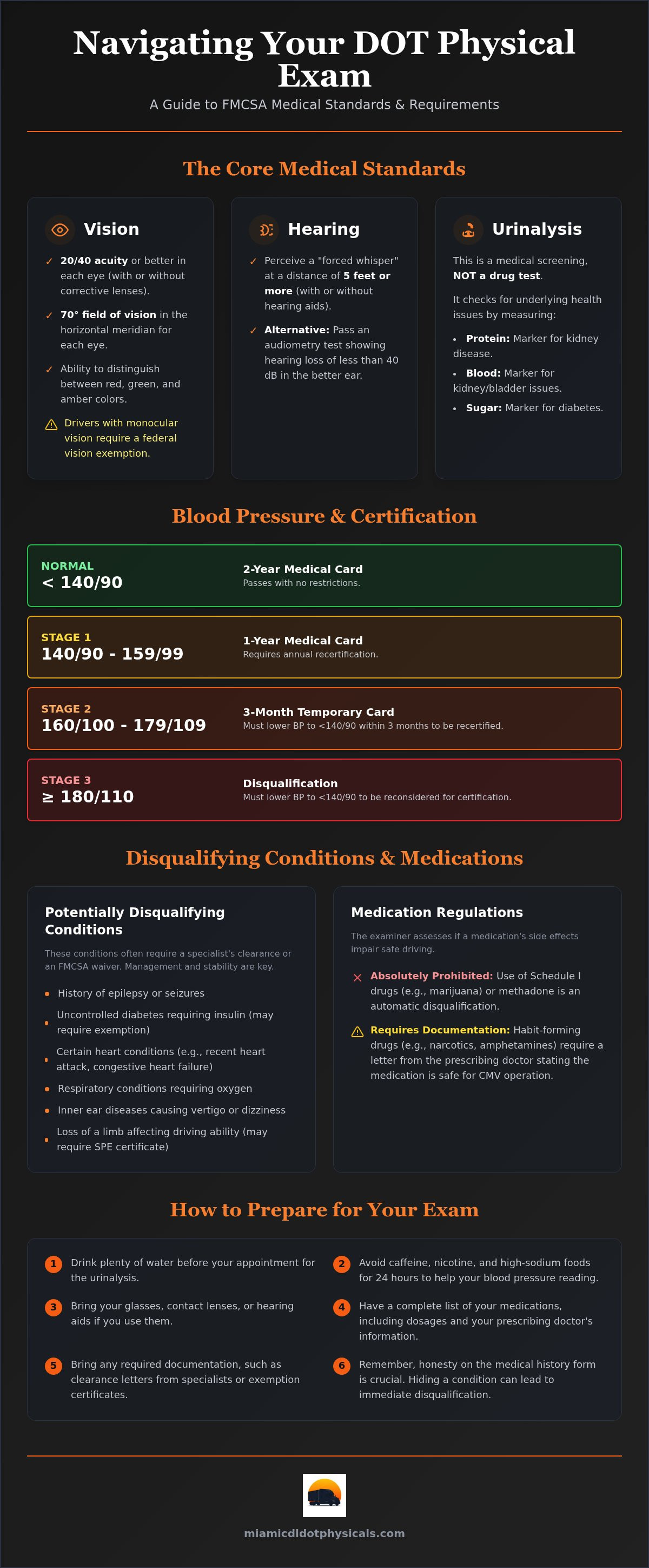
Passing your exam requires meeting three primary physical benchmarks: vision, hearing, and blood pressure. These are the "big three" that examiners check first. While they seem straightforward, understanding the specific numbers helps you prepare. For vision, you must have at least 20/40 acuity in each eye, either naturally or with corrective lenses. You also need a field of vision of at least 70 degrees in the horizontal meridian in each eye. A common concern for drivers is monocular vision. If you only have functional vision in one eye, you aren't necessarily out of a job, but you'll need to seek a federal vision exemption to stay compliant.
Hearing is the next hurdle. You must be able to perceive a "forced whisper" in your better ear at a distance of five feet. If you can't pass the whisper test, the examiner will use an audiometry test to measure your decibel loss. Another area that causes anxiety is the urinalysis. It's vital to clarify that the DOT physical urinalysis is not a drug test. Instead, the examiner checks for protein, blood, and sugar. These are markers for kidney issues or undiagnosed diabetes. If you need a DOT drug test for your employer, that's a separate procedure from the physical itself. Knowing this can lower your stress levels when you head into the clinic.
Managing Blood Pressure During the Exam
Blood pressure is a major factor in what disqualifies you from a DOT physical in Florida. The goal is 140/90 or lower for a standard two-year card. If your reading is between 140/90 and 159/99, you're in Stage 1 hypertension and will likely receive a one-year certificate. Stage 2 (160/100 to 179/109) usually results in a one-time, three-month certificate to give you time to lower it. Stage 3 (180/110 or higher) is an immediate disqualification. High blood pressure is the leading cause of short-term DOT certifications, but it's rarely a permanent disqualifier if managed with medication.
Diabetes and Insulin Regulations
Under current FMCSA medical standards, drivers with insulin-treated diabetes mellitus (ITDM) can stay on the road. You no longer need to apply for a complex waiver. Instead, your treating clinician must complete the ITDM Assessment Form (MCSA-5870). This form proves your condition is stable and that you're monitoring your blood sugar effectively. As long as your diabetes is well-controlled and you have the right paperwork, it's no longer an automatic bar to your certification.
Disqualifying Medications and Substance Use Regulations
Your physical health is only one half of the equation. What you put into your body is just as critical to road safety. Medication use is a primary factor in what disqualifies you from a DOT physical in Florida because many substances impair your reaction time or judgment. Federal law identifies all Schedule I controlled substances as absolute disqualifiers. This includes substances like heroin and LSD, but it also covers medications that might be legal at the state level but remain prohibited by federal standards. Even if a drug is prescribed by a doctor, it can still keep you off the road if it causes side effects like dizziness or extreme drowsiness.
According to the FMCSA, disqualifying medications are those that interfere with the safe operation of a commercial vehicle. This often includes habit-forming drugs like benzodiazepines or certain high-strength opioids. Anti-seizure medications also fall into this category. In most cases, these are automatically disqualifying because the underlying condition they treat, such as epilepsy, poses a significant risk for sudden impairment behind the wheel. The examiner's goal isn't to judge your medical needs, but to ensure that your treatment plan doesn't create a hazard for you or other drivers.
The Medical Marijuana Conflict
Florida has a well-established medical marijuana program, but the FMCSA does not recognize state-level legalization. For CDL holders, there is no "medical exception" for THC. If you test positive for marijuana during a DOT drug test Miami, you will be marked as a fail. This leads to a "prohibited" status in the FMCSA Clearinghouse, which legally bars you from safety-sensitive driving until you complete a Return-to-Duty process. Always remember that federal regulations override state laws when it involves your commercial medical certificate.
Common Prescription Medications That Require Caution
Some common prescriptions fall into a "grey area" where approval depends on your specific case. Medications like Chantix, used for smoking cessation, or certain sleep aids can cause psychiatric side effects or morning-after impairment. If you take strong painkillers or sedatives, you'll likely need a "Letter of Clearance" from your prescribing physician. This letter must state that the doctor is aware of your job duties and believes the medication is safe for you to use while driving. To ensure a smooth process, bring a full list of your medications and dosages to your DOT physical Miami appointment. Being prepared with the right paperwork can often turn a potential disqualification into a successful certification.
Navigating Temporary Disqualifications and FMCSA Waivers
Many drivers assume that a medical issue during an exam results in an immediate, permanent loss of their license. In reality, most issues lead to a temporary disqualification. This is essentially a "pending" status where the examiner puts your certification on hold until you provide more information or treatment results. Knowing what disqualifies you from a DOT physical in Florida often helps you realize that many "fails" are actually just delays. Most certified examiners provide a 45-day window to complete your exam. If you return with the necessary specialist clearances or test results within this timeframe, you usually won't have to pay for a brand-new physical.
For conditions that fall outside standard limits, the FMCSA offers formal waiver and exemption programs. These programs are designed for drivers with stable conditions involving vision, hearing, or even a history of seizures. If you have a missing or impaired limb, you can apply for a Skill Performance Evaluation (SPE) certificate. This process involves a driving test to prove you can safely operate a commercial vehicle despite the physical impairment. These pathways ensure that a physical limitation doesn't automatically end a career for a capable driver. If you're concerned about a specific health factor, you can book your DOT physical to discuss your eligibility for these federal exemptions.
What to Do If You 'Fail' Your Physical
If you don't meet the requirements on the day of your test, follow these steps to get back on the road. First, ask the examiner for the specific medical reason for your disqualification in writing. Next, consult with a specialist, such as a cardiologist or neurologist, to stabilize the condition. You'll need to gather documentation from them proving the issue is under control and doesn't impair your safety. Finally, return to your certified examiner for a follow-up evaluation to finalize your medical card.
The Sleep Apnea Hurdle
Sleep apnea is a common reason for a "pending" status. An examiner might trigger a sleep study if they notice specific risk factors like a high BMI, a large neck circumference, or symptoms of chronic fatigue. If you're diagnosed with Obstructive Sleep Apnea (OSA), you must prove compliance with your CPAP machine. This typically requires a data report showing you use the device at least four hours a night for 70% of the time. Learning how to pass DOT physical requirements often starts with managing these chronic sleep issues long before you sit in the exam room.
How to Prepare for Your DOT Exam to Avoid Disqualification
Preparation is the difference between a same-day pass and a stressful delay. Many drivers walk into their exam without realizing that their morning routine can directly influence their results. For instance, consuming high amounts of caffeine or nicotine within 24 hours of your test can cause temporary spikes in blood pressure. This often leads to a shorter certification period or a "pending" status. Drink plenty of water to stay hydrated and arrive at the clinic early to allow your heart rate to settle before the examiner takes your vitals.
You should also continue taking your regular medications as prescribed on the morning of your exam. Some drivers mistakenly skip their blood pressure or diabetes medication thinking it will "clear" their system, but this usually results in dangerously high readings during the physical. At the Miami CDL/DOT Physical Exam Center, we act as your partner in maintaining compliance. We want to ensure you have every tool necessary to meet federal standards without unnecessary hurdles. Understanding what disqualifies you from a DOT physical in Florida helps you stay proactive rather than reactive with your health.
The 'Driver's Checklist' for Exam Day
Arriving prepared with the correct documentation prevents the examiner from having to place your file in a "pending" status. Use this checklist to ensure you have everything ready for your appointment:
- Identification: Bring your current driver's license and your most recent medical card.
- Aids: Wear your glasses, contact lenses, or hearing aids if you use them for driving.
- Medical Records: Provide your most recent lab results (A1C) if you are diabetic or have thyroid issues.
- Specialist Letters: Bring clearance letters for any recent surgeries, heart conditions, or sleep apnea compliance reports.
- Medication List: Have a complete list of all current prescriptions, including the dosages and the names of the prescribing doctors.
Long-term Health Maintenance for CDL Holders
Proactive health management is the most effective way to ensure you always receive a full two-year medical card. While the exam focuses on your current fitness, your daily habits regarding diet and exercise determine your long-term eligibility. High-sodium diets and sedentary lifestyles contribute to the hypertension and weight issues that often trigger additional testing. Small changes, like meal prepping for the road and finding time for brief walks during breaks, can keep your vitals within the "normal" range year after year.
Staying informed about renewal timelines is also a key part of the job. You can review our CDL medical card Miami guide to better understand when you should schedule your next evaluation. Remember that your health is your most valuable asset as a professional driver. By managing your conditions and keeping your documentation organized, you can navigate the 2026 regulations with ease and keep your career moving forward.
Secure Your Professional Future and Stay on the Road
The 2026 FMCSA standards are designed to ensure safety, but they don't have to be a barrier to your career. Most medical issues found during an exam are temporary hurdles rather than permanent stops. By managing your blood pressure, keeping your specialist documentation organized, and staying clear of prohibited substances, you can navigate the certification process with ease. Understanding what disqualifies you from a DOT physical in Florida empowers you to take control of your health before you even step into the clinic.
Our team is here to simplify the process and get you back behind the wheel quickly. We offer same-day appointments and comprehensive drug and alcohol testing conducted by Certified FMCSA Medical Examiners. We prioritize your time and your livelihood, providing the expert guidance you need to maintain federal compliance. Our goal is to make your medical certification as straightforward and stress-free as possible.
Schedule your FMCSA-compliant DOT physical today and take the uncertainty out of your next exam. You've worked hard to earn your CDL; we're here to help you keep it.
Frequently Asked Questions
Can I pass a DOT physical with a heart condition?
Yes, you can pass with a heart condition if it's stable and well-managed. You'll need a clearance letter from your cardiologist stating you're fit for safety-sensitive duties. Certain conditions, like a recent heart attack or a pacemaker insertion, require a specific waiting period before you can be recertified to ensure your health is consistent.
Does sleep apnea automatically disqualify me from driving a truck?
Sleep apnea does not automatically disqualify you from driving. You can maintain your certification as long as you're compliant with your treatment, which usually involves using a CPAP machine. Examiners typically require a data report showing you use the device at least four hours a night for 70% of the time to prove you're well-rested for the road.
What happens if my blood pressure is too high during the DOT physical?
If your blood pressure is too high during the exam, you may receive a shorter certification or face temporary disqualification. A reading of 140/90 or higher results in a one-year or three-month card. However, a reading of 180/110 or higher is what disqualifies you from a DOT physical in Florida until the pressure is lowered and stabilized through medication or lifestyle changes.
Can I use CBD oil and still pass my DOT physical in 2026?
Using CBD oil is risky because many products contain trace amounts of THC. Even if you have a valid reason for use, a positive THC result on a drug test will lead to a failure and a prohibited status in the FMCSA Clearinghouse. The federal government doesn't currently make exceptions for CBD or medical marijuana, regardless of state laws in Florida.
Is a hernia a disqualifying condition for a CDL?
A hernia is only disqualifying if it's symptomatic or interferes with your ability to safely operate a commercial vehicle. If the hernia causes significant pain or limits your physical movement, the examiner may require you to have it repaired before granting a medical certificate. They want to ensure you won't experience sudden, debilitating pain while driving.
How long does a DOT disqualification last if it's temporary?
A temporary disqualification lasts as long as it takes to resolve the underlying medical issue. Many examiners allow a 45-day "pending" window for you to submit specialist letters or new test results. If you don't resolve the issue within that timeframe, you'll likely need to start the process over and pay for a new exam once you're healthy.
Can I drive a commercial vehicle if I am deaf or hard of hearing?
You can drive a commercial vehicle if you meet the hearing standards or obtain a federal hearing exemption. You must be able to hear a forced whisper at five feet in your better ear or pass an audiometry test. If you can't meet these requirements, you must apply for an FMCSA hearing waiver to maintain your driving privileges legally.
What medications are strictly prohibited by the FMCSA?
The FMCSA strictly prohibits the use of Schedule I controlled substances, including marijuana and heroin. Other prohibited medications include methadone and certain anti-seizure drugs that may cause sudden impairment. When determining what disqualifies you from a DOT physical in Florida, remember that any medication causing drowsiness or impaired reaction time can be a deal-breaker for your certification.


