

A diagnosis of monocular vision is no longer a permanent disqualifier for commercial drivers. For years, the industry operated under the assumption that losing sight in one eye meant turning in your keys for good. If you're worried about your upcoming medical certification, you aren't alone. You likely have one pressing question: can you pass a DOT physical with one eye? The answer is a definitive yes. The FMCSA replaced the old, cumbersome waiver program with a streamlined Alternative Vision Standard that puts the power back into the hands of certified medical examiners and your eye specialist.
We understand the stress that comes with medical uncertainty, especially when your paycheck is on the line. You deserve clear answers instead of confusing government jargon. This guide will show you exactly how to use the new rules to keep your CDL active and legal. We'll walk through the specific visual acuity requirements, provide a checklist of what to bring to your appointment, and explain how Form MCSA-5871 simplifies the entire process. By the time you finish reading, you'll have a clear roadmap to pass your physical and continue your career with confidence.
Key Takeaways
- Learn how the FMCSA Alternative Vision Standard confirms that yes, you can pass a DOT physical with one eye under current 2026 regulations.
- Review the precise benchmarks for distant visual acuity and horizontal field of vision required in your functioning eye.
- Identify the mandatory role of Form MCSA-5871 and why your eye specialist must sign it before your medical exam.
- Understand the requirement for annual medical certification and how it differs from the standard two-year renewal cycle.
Understanding Monocular Vision and DOT Certification
Drivers often panic when they lose vision in one eye, fearing their commercial career is over. The reality is much more optimistic. So, can you pass a DOT physical with one eye? Yes, you absolutely can. The Federal Motor Carrier Safety Administration (FMCSA) recognizes that many drivers successfully adapt to vision changes and maintain excellent safety records. Your ability to stay on the road depends on meeting the specific criteria of the Alternative Vision Standard rather than having perfect sight in both eyes.
Understanding Monocular Vision is the first step in this process. In the context of trucking, monocular vision occurs when a driver has one eye that doesn't meet the standard 20/40 acuity or the required field of vision. The DOT physical vision test exists to ensure you can safely perceive depth, judge distances, and detect hazards in your periphery. While these tasks are naturally easier with two functioning eyes, the body and brain are remarkably good at compensating for a deficit in one eye.
The Difference Between Impairment and Disqualification
It's vital to distinguish between different types of vision issues. Monocular vision typically involves a permanent loss of sight or significant impairment in one eye. This is different from monovision, which is a surgical correction where one eye is set for distance and the other for near vision. The FMCSA doesn't automatically disqualify you for having one weak eye. Instead, they focus on whether your functioning eye is strong enough to handle the demands of the job. As long as your better eye meets the strict benchmarks for acuity and field of vision, you have a clear path to certification. You aren't being judged on what you've lost, but on how well you can see with the vision you have.
The 2022 FMCSA Regulatory Update
Before March 22, 2022, the process was much more difficult. Drivers with monocular vision had to apply for a formal federal vision waiver. This process was slow and often took months of back and forth paperwork with the FMCSA. It felt like an administrative barrier rather than a safety check. It left many qualified drivers sitting on the sidelines while they waited for government approval.
The new Alternative Vision Standard changed everything. It removed the waiver requirement and empowered Certified Medical Examiners (CMEs) to make the qualification decision directly. This shift means less red tape and faster turnaround times for your medical card. You no longer wait on a distant government agency. Instead, you work with your eye doctor and your medical examiner to prove you're safe for the road. This streamlined approach makes it easier to answer yes when you ask, can you pass a DOT physical with one eye?
The Alternative Vision Standard: Requirements for 2026
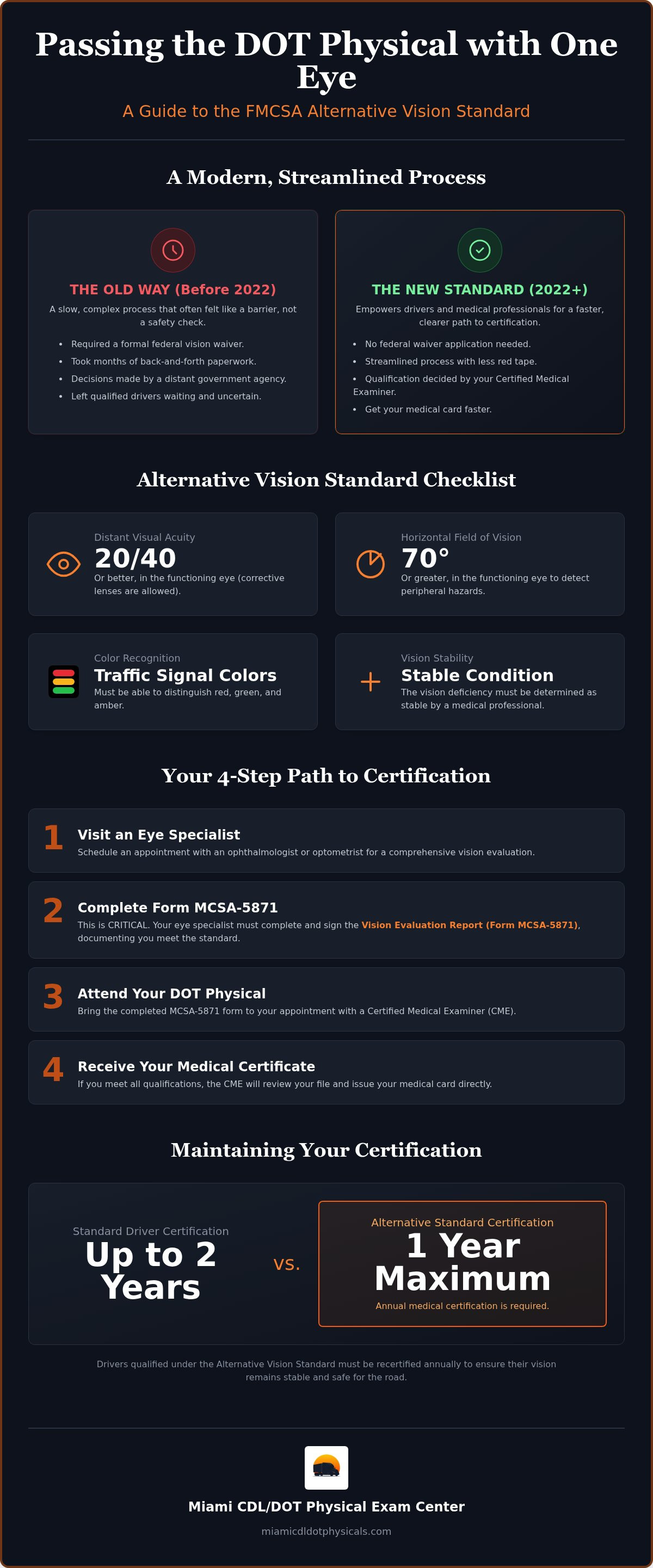
To move forward with your career, you must understand the specific technical benchmarks that define the current Alternative Vision Standard. The FMCSA no longer requires a lengthy federal exemption application. Instead, you must meet four clear criteria during your medical evaluation. These standards ensure that your vision is sufficient to handle a heavy vehicle safely in all traffic conditions. When drivers ask, can you pass a DOT physical with one eye, the answer depends entirely on meeting these specific numbers.
The primary requirements for monocular drivers include:
- Distant visual acuity of at least 20/40 in the better eye.
- A horizontal field of vision of at least 70 degrees in the functioning eye.
- The ability to recognize the colors of standard traffic signals: red, green, and amber.
- A medical determination that your vision condition is stable.
Distant Visual Acuity in the "Better Eye"
The most critical metric is the visual acuity of your functioning eye. You must achieve a rating of 20/40 or better. It's important to remember that you can use corrective lenses, such as glasses or contacts, to reach this goal. During your exam, the medical examiner will test your distance vision using a standard Snellen chart. If your better eye tests at 20/50 or worse, you won't meet the qualification standards, even with the alternative program. Ensure your prescription is current before you arrive at the clinic. If you're unsure about your current acuity, visiting a DOT physical exam specialist can help clarify your status before you start the formal paperwork.
Peripheral Vision and Color Recognition
Safe driving requires more than just seeing what's directly in front of you. You must have a horizontal field of vision of at least 70 degrees in your functioning eye. This allows you to detect vehicles in adjacent lanes and see pedestrians at intersections. Additionally, you must demonstrate the ability to distinguish between traffic light colors. This isn't a complex test for most, but it's a mandatory safety check. Your eye specialist will document these metrics on the Vision Evaluation Report (Form MCSA-5871), which serves as the official proof of your visual capabilities.
Finally, your condition must be stable. This means your vision isn't currently deteriorating due to an active disease or an unmanaged medical issue. The FMCSA relies on your ophthalmologist or optometrist to verify this stability. They must sign your evaluation form no more than 45 days before your physical exam. This ensures the medical examiner has the most recent data possible to confirm that can you pass a DOT physical with one eye applies to your specific situation.
The Role of the Vision Evaluation Report (Form MCSA-5871)
Form MCSA-5871 is now the mandatory link between your eye specialist and your medical examiner. It serves as the backbone of the current certification process, replacing the old, slow federal waiver application that took months to approve. Under The Alternative Vision Standard, the FMCSA shifted the responsibility of certification directly to the medical examiner. However, the examiner cannot make this call in a vacuum. They rely on the Vision Evaluation Report to verify your clinical stats and confirm you meet safety benchmarks.
Timing is everything with this documentation. You must have your eye specialist complete and sign the report no more than 45 days before your actual DOT physical appointment. If the form is 46 days old, it's invalid, and you'll have to start over. This 45-day rule ensures the medical examiner has the most current data on your visual health. If you're a new driver seeking certification with monocular vision, there's an additional requirement often overlooked: the road test. New monocular drivers must typically complete a road test or demonstrate a three-year history of safe commercial driving with the condition before they receive full certification. This ensures you've adapted to the change in depth perception before handling heavy equipment.
Visiting Your Ophthalmologist or Optometrist
Your eye specialist is your first stop. When you visit them, ensure they have the latest version of Form MCSA-5871. They must document the specific date of your vision loss and provide a professional opinion on the stability of your condition. If they fail to sign or date the form correctly, your medical examiner won't be able to process your certification. Ensure the specialist provides clear measurements for both your visual acuity and your 70-degree horizontal field of vision. This report is the evidence that proves can you pass a DOT physical with one eye in your specific case.
What the Medical Examiner Looks for on the Report
The medical examiner uses the report to verify that your "better eye" hits the 20/40 target and that you can recognize traffic colors. They also scan the specialist's notes for progressive diseases like glaucoma or cataracts. Consistency is vital. If the report shows a stable condition, the examiner can issue a medical card for a maximum of 12 months. Monocular drivers don't qualify for the standard two-year card. This annual renewal cycle keeps you compliant and ensures that any changes in your vision are caught early. Preparation and accurate paperwork are the fastest ways to get back behind the wheel.
Step-by-Step Process for Monocular Driver Certification
Navigating the certification process doesn't have to be overwhelming. By following a methodical path, you can ensure you meet all federal requirements without unnecessary delays. The question of can you pass a DOT physical with one eye is often answered by how well you prepare your documentation before stepping into the exam room. Efficiency is key to keeping your career on track and avoiding multiple trips to the clinic.
- Step 1: Schedule an appointment with an ophthalmologist or optometrist for a comprehensive vision evaluation.
- Step 2: Have the specialist complete and sign Form MCSA-5871, ensuring all measurements are accurate and the condition is listed as stable.
- Step 3: Bring the signed form to your Certified Medical Examiner (CME) within 45 days of the eye exam.
- Step 4: Complete the standard DOT physical exam, which includes blood pressure, hearing, and urine testing.
- Step 5: Receive your medical certificate once the examiner validates that you meet the Alternative Vision Standard.
Special Requirements for New Monocular Drivers
If you're transitioning to monocular vision or are a new driver with the condition, you face an additional step. The FMCSA requires a road test for drivers who haven't previously operated a commercial motor vehicle (CMV) with monocular vision. You must coordinate with your employer to conduct this test. Your employer will then provide a certificate of driver road test. There's an exception if you have a valid three-year record of safe driving in intrastate commerce with your vision condition. This record proves you've already mastered the necessary depth perception and safety maneuvers required for the job.
Preparing for Your DOT Physical Appointment
Success at the clinic starts at home. Use this checklist to ensure you have everything ready for your examiner:
- The completed and signed Form MCSA-5871.
- Your current corrective lenses (glasses or contacts).
- A full list of medications and your vision health history.
Being honest about your vision history is critical for federal compliance. Falsifying information can lead to immediate disqualification and legal issues. Beyond vision, you should also review how to pass DOT physical for tips on managing blood pressure and general health before your visit. If you're ready to secure your medical card, schedule your DOT physical exam with a certified specialist today.
Maintaining Your CDL Medical Card with One Eye
Securing your medical card is a major milestone, but the process doesn't end there. Drivers with monocular vision must commit to a more frequent certification schedule than their peers. While a standard driver might receive a two-year certificate, you'll be limited to a maximum of 12 months. This annual requirement ensures your vision remains stable and that you continue to meet the safety benchmarks of the Alternative Vision Standard. This recurring cycle is the standard for anyone asking can you pass a DOT physical with one eye in 2026.
Regular eye care is your best defense against disqualification. If you notice any changes in your functioning eye, such as increased blurriness or a loss of peripheral clarity, see your specialist immediately. You don't have to wait for your annual physical to address vision health. Keeping your good eye in peak condition is the only way to ensure that the answer to can you pass a DOT physical with one eye stays a definitive yes for the duration of your career.
Annual Recertification and Form MCSA-5871
Timing is the most critical factor in maintaining your status. We recommend scheduling your vision evaluation at least 60 days before your current medical card expires. This buffer allows for any delays in getting your specialist's signature on Form MCSA-5871. Stay ahead of the deadline. It prevents a downgrade of your CDL. If your certificate expires, your state's DMV will automatically change your status to non-certified. This can lead to fines or a suspended license. Managing your CDL medical card renewal is simple as long as you treat the 12-month expiration as a hard deadline.
The Importance of a Qualified Medical Examiner
You need a partner who knows the current regulations inside and out. Since the FMCSA streamlined the process in 2022, the medical examiner has more authority and more responsibility. Choosing an examiner experienced in the Alternative Vision Standard reduces the risk of paperwork errors. The Miami CDL/DOT Physical Exam Center provides the expertise needed to navigate these specific requirements. We verify that your eye specialist has filled out every field correctly. We also ensure your certification is properly uploaded to the FMCSA National Registry. Working with a specialist who understands monocular vision keeps you compliant and on the road without unnecessary stress.
Secure Your Career with the Alternative Vision Standard
The assumption that vision loss ends your commercial driving career is outdated. With the current Alternative Vision Standard, you have a direct path to certification that bypasses the old federal waiver system. Success depends on preparation. Ensure your eye specialist completes Form MCSA-5871 within 45 days of your appointment. This documentation proves your functioning eye meets the necessary acuity and field of vision benchmarks.
Many professional drivers still ask, can you pass a DOT physical with one eye? The answer is a clear yes, provided you stay proactive with your annual renewals and maintain your vision health. Our team offers a fast, efficient certification process led by certified FMCSA medical examiners who specialize in Alternative Vision Standards. We understand the high stakes of your profession and work to ensure your paperwork is accurate and compliant.
Don't let regulatory confusion stall your progress. Schedule your DOT physical with an FMCSA-certified examiner today and keep your career moving forward. Your experience on the road is valuable, and we're here to help you protect it.
Frequently Asked Questions
Can I get a DOT medical card if I am blind in one eye?
Yes, you can. Under the Alternative Vision Standard, total blindness in one eye is not an automatic disqualification for commercial drivers. You must have at least 20/40 vision in your functioning eye and a 70-degree horizontal field of vision. You'll need an eye specialist to complete Form MCSA-5871 no more than 45 days before your physical. This allows the medical examiner to certify you for up to one year.
What is the 20/40 vision rule for a CDL?
The 20/40 rule requires drivers to have a distant visual acuity of at least 20/40 in each eye. However, if you're asking can you pass a DOT physical with one eye, the rule changes. Under the alternative standard, you only need to meet the 20/40 requirement in your better eye. You can use corrective lenses like glasses or contacts to reach this benchmark during your examination at the clinic.
Do I still need a federal vision waiver in 2026?
No, the federal vision waiver program was replaced in 2022 by the Alternative Vision Standard. Drivers no longer need to wait for months for a government exemption. Instead, your certified medical examiner can qualify you directly if you provide a completed Vision Evaluation Report from your eye doctor. This streamlined process makes certification faster and more accessible for drivers with monocular vision who meet the safety criteria.
What is Form MCSA-5871 and who fills it out?
Form MCSA-5871 is the Vision Evaluation Report required for the Alternative Vision Standard. Your ophthalmologist or optometrist must fill out this form. They provide clinical data on your visual acuity, field of vision, and the stability of your condition. You must bring this signed form to your DOT physical. The medical examiner uses this data to determine if you meet the federal safety requirements for commercial driving.
Can I drive interstate with monocular vision?
Yes, drivers with monocular vision can drive in interstate commerce if they meet the Alternative Vision Standard. Previously, many monocular drivers were restricted to intrastate driving unless they had a federal waiver. The current regulations allow for national certification. As long as you have your medical certificate and a completed Form MCSA-5871, you can legally operate a commercial vehicle across state lines throughout the entire country.
How long is a DOT medical card valid for a driver with one eye?
A DOT medical card for a driver with monocular vision is valid for a maximum of 12 months. Unlike standard drivers who may receive a two-year card, monocular drivers require annual recertification. This ensures that your vision remains stable. This annual requirement is a key part of how can you pass a DOT physical with one eye while remaining compliant with federal safety standards. You'll need a new Vision Evaluation Report every year.
What happens if I fail the vision portion of the DOT physical?
If you fail the vision portion, the medical examiner cannot issue your certificate. However, this doesn't mean your career is over. You should visit an eye specialist to see if corrective lenses can bring your better eye to the 20/40 standard. If your vision is corrected, have the specialist complete Form MCSA-5871 and return to the examiner. Many drivers successfully pass on their second attempt after updating their prescription lenses.
Does the DOT vision test check for color blindness?
Yes, the DOT vision test includes a color recognition portion. You must be able to distinguish between standard traffic signal colors, specifically red, green, and amber. This requirement applies to all drivers, including those with monocular vision. You don't need perfect color perception, but you must be able to identify these three colors accurately to ensure you can safely navigate intersections and follow traffic laws on the road.


