

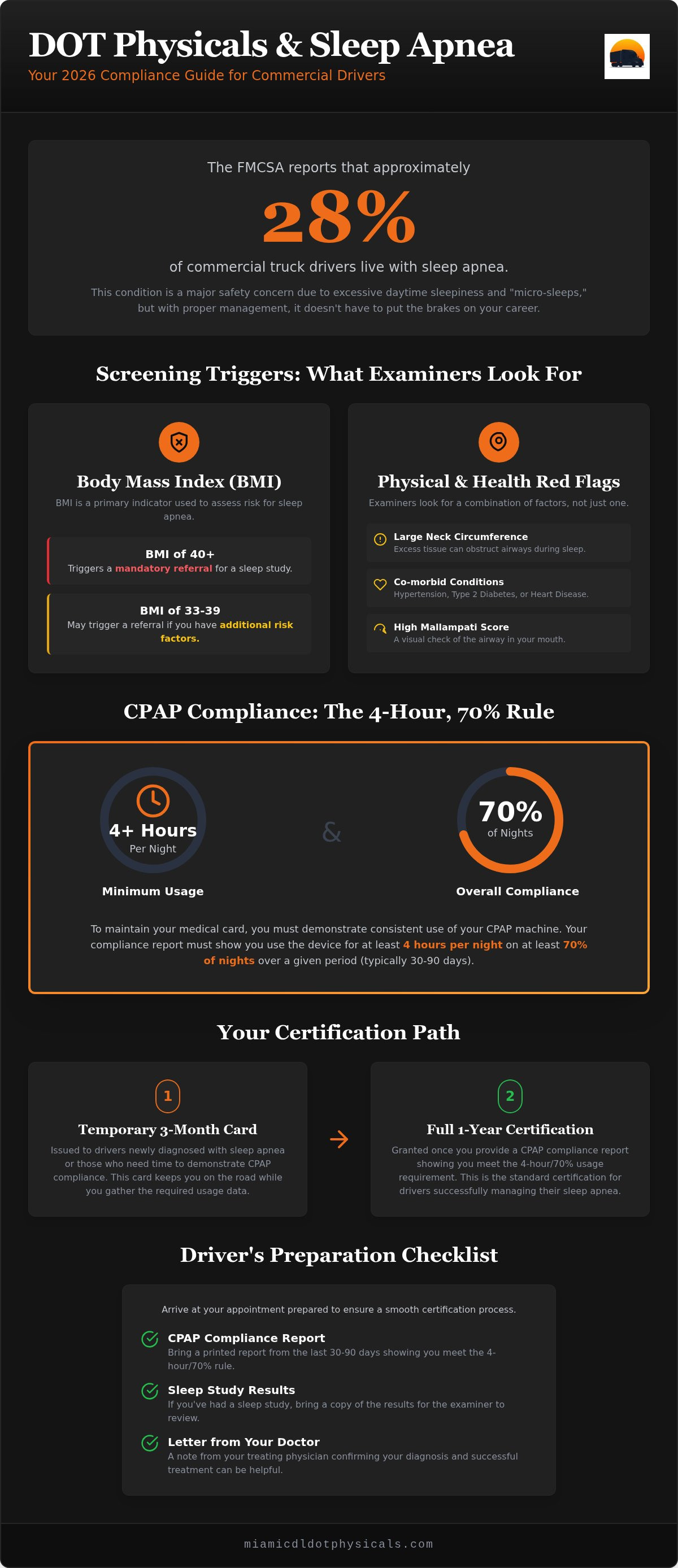
The Federal Motor Carrier Safety Administration reports that approximately 28% of commercial truck drivers live with sleep apnea. If you're one of them, you likely know the gut-wrenching worry that comes with every renewal. It's frustrating to feel like your livelihood depends on a neck measurement or a BMI chart. You've probably heard horror stories about drivers being sidelined over DOT physical sleep apnea requirements, but the reality in 2026 is much more manageable than the rumors suggest.
We understand that your medical card is your ticket to a paycheck, and the pressure to remain compliant can be overwhelming. This guide will show you exactly how the FMCSA evaluates sleep apnea today and how you can ensure your condition keeps you on the road rather than in the unemployment line. We'll walk through the current CPAP usage standards, explain how to prepare your compliance data for the examiner, and provide a clear path to passing your physical with confidence. By the end of this article, you'll have a roadmap to navigate the regulations and avoid the risk of an automatic license downgrade.
Key Takeaways
- Learn why the FMCSA prioritizes screening for daytime sleepiness and how examiners use medical discretion to keep safe drivers behind the wheel.
- Understand the specific BMI and neck circumference "red flags" that may trigger a mandatory sleep study during your exam.
- Master the 2026 DOT physical sleep apnea requirements by following the 4-hour usage rule and maintaining 70% compliance to secure your medical card.
- Discover the difference between a temporary 3-month certificate and a full 1-year card, and how to transition quickly between the two.
- Use our preparation checklist to ensure you have the correct compliance reports and sleep study data ready for your appointment.
Understanding Sleep Apnea and FMCSA Safety Standards
Sleep apnea is a respiratory disorder where your breathing stops and starts repeatedly while you sleep. The most common form, Obstructive Sleep Apnea (OSA), occurs when the throat muscles relax and block your airway during the night. For a deeper look at the medical mechanics of this condition, Understanding Sleep Apnea helps clarify how these pauses impact your oxygen levels and overall health. The FMCSA is deeply concerned about this condition because it leads to excessive daytime sleepiness. This isn't just about feeling tired; it's about "micro-sleeps." These are brief moments where a driver loses consciousness behind the wheel without even realizing it. Because of this risk, every certified medical examiner is required to screen for OSA during your appointment to meet current DOT physical sleep apnea requirements. In 2026, the regulatory focus has shifted. The goal is no longer just to pull drivers off the road. Instead, the focus is on ensuring you're treated, alert, and capable of handling a heavy vehicle safely.
The Risks of Untreated Sleep Apnea
Driving with untreated sleep apnea is dangerous for you and everyone on the road. Research shows that the slower reaction times caused by sleep deprivation are often comparable to driving while intoxicated. You might think you're "pushing through" the fatigue, but your brain isn't processing information at full speed. Beyond the immediate crash risk, untreated OSA puts massive strain on your heart. It's linked to high blood pressure, heart disease, and even sudden incapacitation. If you want a long career in this industry, managing your sleep health is just as important as maintaining your rig. Treating the condition doesn't just protect your CDL; it protects your life and your long-term earning potential.
Screening vs. Disqualification
Many drivers panic when an examiner mentions a sleep study, but it's important to understand that a referral isn't an automatic disqualification under DOT physical sleep apnea requirements. The goal of the 2026 regulations is to keep you working safely. Examiners look for specific markers to identify high-risk drivers who may have moderate-to-severe apnea. They typically categorize findings into three levels:
- Mild Apnea: Often managed with lifestyle changes or periodic monitoring.
- Moderate Apnea: Usually requires treatment like a CPAP to ensure you stay alert during your shift.
- Severe Apnea: Requires immediate intervention and consistent treatment to maintain your medical certification.
The examiner acts as a partner in your health rather than a gatekeeper. They use these screenings to identify potential issues before they become a liability on the highway. If you're referred for a study, it's simply the first step in a process designed to get you the treatment you need to stay compliant and stay on the road.
The Physical Markers: BMI and Neck Width Requirements
During your exam, the medical examiner isn't just looking at your general health; they are specifically hunting for physical indicators that suggest a high risk for obstructive sleep apnea. It's vital to distinguish between a screening marker and a clinical diagnosis. Having a high BMI or a large neck doesn't mean you have sleep apnea, but it does mean the examiner may be legally required to refer you for testing to satisfy 2026 DOT physical sleep apnea requirements. These benchmarks act as a standardized way to identify which drivers might experience airway collapse during sleep. Examiners also use the Mallampati Score, which is a quick visual check of your open mouth to see how much space is available for airflow. If your tongue or soft palate obscures your airway, it's a significant red flag.
The primary trigger for a mandatory sleep study is a Body Mass Index (BMI) of 40 or higher. However, the rules are more nuanced for those with a BMI between 33 and 39. In these cases, examiners look for secondary "comorbidities" like hypertension, Type 2 diabetes, or heart disease. If you fall into this weight range and have one of these conditions, a sleep study is almost certain. Understanding the Physical markers for sleep apnea can help you anticipate what the examiner will focus on during your appointment. If you're concerned about how your specific metrics will impact your certification, you can book a consultation with Miami CDL/DOT Physical Exam Center to discuss your compliance options before your current card expires.
Why Weight and Neck Size Matter
For drivers aiming to reduce their BMI and avoid the need for mandatory sleep studies, drharrisweightloss.com provides medically supervised weight management programs that can help you stay within FMCSA health guidelines.
Physical anatomy plays a direct role in respiratory stability. Excess fatty tissue around the neck and throat can compress the airway when your muscles relax during sleep. This is why neck circumference is a standard screening benchmark. For males, a neck size of 17 inches or larger is considered a risk factor; for females, the threshold is 15.5 inches. This extra tissue creates a physical obstruction that makes it harder for your lungs to pull in oxygen, leading to the "pauses" in breathing that characterize OSA. Examiners use these objective measurements to justify a sleep study referral, ensuring that their decision is based on anatomical data rather than a subjective guess.
Other Risk Factors Evaluated
While BMI and neck size are the most visible markers, examiners also weigh your demographic and lifestyle data. Age is a factor, as drivers over 42 are statistically more likely to develop OSA. Gender also plays a role, with males being at a naturally higher risk. Beyond the physical exam, you'll be asked about your sleep history. Loud, habitual snoring or reports from a partner about witnessed gasping or choking during the night are major indicators of a problem. When these lifestyle factors combine with conditions like heart disease, the examiner must prioritize safety by confirming you're getting restful, restorative sleep before clearing you for the road.
CPAP Compliance Rules for DOT Physicals in 2026
If you've already been diagnosed with Obstructive Sleep Apnea, your medical card depends on proving that your treatment is effective. The 2026 DOT physical sleep apnea requirements are very specific about what constitutes "compliance." To stay on the road, you must follow the 4-hour rule. This means you need to use your CPAP machine for at least 4 hours per night. Additionally, you must meet the 70% requirement, which means you've used the device for at least 70% of the nights during a 30-day period. Drivers who consistently meet these standards are typically issued a 1-year medical card, requiring an annual check-in to verify that the treatment is still working.
Consistency is your best friend when it comes to certification. The examiner isn't trying to find reasons to disqualify you; they're looking for data that proves you're rested and alert. Providing a clear, computer-generated usage report at your appointment is the fastest way to get your card. Without this data, the examiner cannot legally certify you, regardless of how well you feel. Maintaining these DOT physical sleep apnea requirements ensures that you remain a safe professional and that your livelihood isn't interrupted by paperwork delays.
Proving Your Compliance to the Examiner
Modern CPAP machines make data collection simple. Most devices store information on an SD card or sync directly with a cloud-based app. You'll need to download and print a usage report that covers at least the last 30 days, though 90 days of data is often preferred for long-term users. The examiner reviews this report for two critical metrics: average hours of use and mask leakage rates. They also check your Apnea-Hypopnea Index (AHI). This index measures how many times your breathing is still interrupted while using the machine. An AHI that remains too high suggests your pressure settings might need adjustment by your sleep specialist.
What Happens if You Fall Out of Compliance?
Life on the road is unpredictable, and equipment failures or illnesses can happen. If your compliance dips below the 70% mark, don't wait until the day of your physical to address it. An examiner may place your certification in a "Pending" status or issue a 35-day temporary card to give you time to get back on track. This short window allows you to demonstrate a fresh 30 days of consistent use. To avoid these stressful situations, it's helpful to review your data monthly. For more tips on getting your paperwork in order, see our guide on How to Pass Your DOT Physical in 2026: The Ultimate Driver’s Preparation Guide. Staying proactive with your data is the only way to guarantee a smooth certification process.
The 3-Month Temporary Card vs. Full Certification
A diagnosis of sleep apnea changes the rhythm of your medical certification. Under the standard 2026 DOT physical sleep apnea requirements, you can no longer receive a two-year medical card. This is because the FMCSA requires more frequent monitoring to ensure your treatment remains effective and your safety on the road is never compromised. For most drivers with well-managed apnea, a one-year certificate is the maximum duration allowed. However, if you're just starting your treatment journey, you'll likely begin with a three-month temporary card.
This three-month window isn't a penalty; it's a bridge. It gives you enough time to receive your CPAP machine, adjust to wearing the mask, and generate the usage data required for a longer extension. If you have severe OSA, your examiner may also require a short waiting period after you start treatment before you can return to duty. This ensures the therapy has actually reversed the daytime sleepiness that puts you at risk. Once you've proven you can handle the equipment, you can schedule your follow-up exam to secure your one-year card and keep your career moving forward.
The Timeline for New Diagnoses
Navigating a new diagnosis follows a specific three-step process. First, your initial physical identifies risk factors, leading to a sleep study referral. If the study confirms moderate-to-severe apnea, you'll move to step two: receiving a temporary three-month certificate. This allows you to legally drive while you initiate CPAP therapy. Finally, you return to the examiner with 30 to 90 days of compliance data. If your report shows you've met the usage standards discussed in the previous section, the examiner will upgrade you to a full one-year certification. This methodical approach ensures you aren't sidelined while getting your health in order.
Renewing Your CDL Medical Card with OSA
Don't wait until the last minute to renew your card. If your current medical certificate expires while you're waiting for a compliance report or an appointment, your CDL will be automatically downgraded to a non-commercial status. We recommend starting the renewal process at least 30 days before your card expires. Ensure your machine has recorded a fresh 90 days of usage data to show the examiner you're still meeting the DOT physical sleep apnea requirements. For a deeper look at the costs and administrative steps involved in maintaining your status, check out the CDL Medical Card: The 2026 Buying Guide for Commercial Drivers. Keeping your documentation current is the only way to avoid a forced break from the driver's seat.
Preparing for Your Appointment: A Driver’s Checklist
Walking into your exam without the right paperwork is the fastest way to get your certification delayed. While we've discussed the technical side of DOT physical sleep apnea requirements, the actual appointment day requires a practical approach to documentation. Being prepared doesn't just save time; it reduces the anxiety that often leads to elevated heart rates or blood pressure spikes. Your goal is to walk in with everything the examiner needs to say "yes" to your medical card immediately.
- Compliance Report: Bring a computer-generated report covering the last 90 days. New users should provide at least 30 days of data.
- Polysomnogram Results: Have a copy of your original sleep study available. The examiner needs to verify your baseline diagnosis and AHI levels.
- Machine Maintenance: Ensure your CPAP is functioning and your mask fits perfectly. A leaking mask can skew your data and suggest your treatment isn't working.
- Symptom Honesty: Be ready to discuss symptoms like morning headaches or daytime fatigue. Honesty allows the examiner to help you adjust your treatment rather than simply marking a failure.
Tips for a Smooth Exam Process
Contact your sleep specialist at least two weeks before your scheduled DOT physical to ensure they can pull your compliance data and print the necessary reports. Waiting until the day of the exam to find your SD card or login to an app creates unnecessary stress. If you suffer from "white coat syndrome," arrive 15 minutes early to sit quietly and relax. This helps your blood pressure settle into its normal range before the clinical testing begins. Choosing an FMCSA-certified examiner provides a major advantage. These professionals understand the unique challenges of the driver lifestyle and treat you as a partner in safety rather than a gatekeeper.
Your Road to Compliance Starts Here
The 2026 sleep apnea requirements are designed to keep you safe through effective treatment, not to end your career. By maintaining your CPAP usage and keeping your documentation organized, you're taking direct control of your health and protecting your livelihood. Don't let a manageable condition stand between you and your medical card. Our team is here to help you navigate these rules with efficiency and respect for your time. Taking these steps today ensures you're ready for the road tomorrow.
Schedule your professional DOT physical today to ensure your medical card stays current.
Take Control of Your CDL Medical Certification
Meeting the DOT physical sleep apnea requirements doesn't have to be a source of stress. In 2026, the focus is on effective treatment rather than disqualification. By maintaining your 70% CPAP usage and bringing your data reports to your exam, you demonstrate that you're a safe, alert professional. Remember that physical markers like BMI are just screening tools; your actual compliance data is what truly matters for your one-year certification.
Our FMCSA-certified examiners are here to act as your partners in safety. We provide expert sleep apnea guidance and fast, professional certification to help you avoid a CDL downgrade. Don't leave your livelihood to chance by arriving unprepared. Arriving with your 90-day compliance report already printed ensures a smooth, efficient process that respects your busy schedule.
Schedule Your Professional DOT Physical and Stay Compliant
We're committed to helping you navigate these regulations so you can focus on what you do best: keeping the country moving. Stay safe out there and keep those wheels turning.
Frequently Asked Questions
Is a sleep apnea test mandatory for all DOT physicals?
A sleep apnea test is not a universal requirement for every driver. Examiners only order a study if you display specific risk factors during your exam. These indicators include a BMI over 40, a large neck circumference, or a history of loud snoring and daytime fatigue. If you don't meet these criteria and have no history of respiratory dysfunction, you won't be required to undergo a sleep study.
Can I get a DOT medical card if I have sleep apnea but don't use a CPAP?
You can still qualify for a medical card without a CPAP if your condition is mild. Some drivers use dental appliances or undergo specific lifestyle changes to manage their airway. However, if you have moderate-to-severe apnea, a CPAP is usually the only way to meet 2026 DOT physical sleep apnea requirements. You must prove your chosen treatment effectively stops breathing pauses and keeps you alert while driving.
What is the maximum BMI for a DOT physical without a sleep study?
There isn't a single maximum BMI, but 40 is the threshold where testing becomes mandatory. If your BMI is between 33 and 39, the examiner looks for secondary factors like high blood pressure or heart disease. If you have a BMI of 35 and no other health issues, you may not need a study. The decision rests on the examiner's overall assessment of your risk for obstructive sleep apnea.
How many hours of CPAP use do I need to be compliant?
You must use your CPAP machine for at least 4 hours per night to be considered compliant. This usage must occur on at least 70% of nights within a consecutive 30-day period. This standard ensures you're receiving enough restorative sleep to prevent dangerous micro-sleeps behind the wheel. Examiners verify this by reviewing the digital usage report stored on your machine's SD card or cloud-based application during your appointment.
Will I lose my CDL if I am diagnosed with sleep apnea?
A sleep apnea diagnosis is not a career-ender and won't cause you to lose your CDL. It simply means you have a manageable medical condition that requires treatment. As long as you follow your doctor's orders and maintain CPAP compliance, you can stay on the road. The only risk to your license is ignoring the condition or failing to provide usage data, which leads to a medical certification denial.
How often do I need a DOT physical if I have sleep apnea?
Drivers with a sleep apnea diagnosis are typically limited to a one-year medical certificate. While healthy drivers often receive two-year cards, the FMCSA requires annual check-ins for those with respiratory conditions. This frequency allows the examiner to verify that your treatment is still working and that your compliance data remains consistent. You must bring a fresh 90-day usage report to every annual renewal appointment to keep your card current.
Can I do a home sleep apnea test for my DOT physical?
Home sleep apnea tests are a widely accepted and convenient option for most commercial drivers in 2026. These tests are often more affordable than in-lab studies and allow you to sleep in your own bed. As long as a board-certified sleep physician interprets the results and provides a formal diagnosis, the DOT examiner will accept the findings. Drivers with complex heart or lung issues may still require an in-lab study.
What happens if my CPAP compliance report shows I missed a few days?
Missing a few days won't automatically disqualify you from meeting DOT physical sleep apnea requirements. The 70% compliance rule is designed to account for occasional equipment issues or illnesses. If your overall average stays above 4 hours for 21 out of 30 nights, you'll remain compliant. If you fall below that threshold, the examiner might issue a short-term temporary card to give you time to improve your usage and provide better data.


