
Did you know that nearly 25% of CBD products tested in a Johns Hopkins study contained THC, even when the label promised they were "THC-Free"? If you're managing chronic pain or anxiety from long hours on the road, it's natural to look for relief in the local health aisle. You probably feel frustrated that a federally legal hemp product could still put your livelihood at risk. When you ask, "can a CDL driver use CBD oil," you aren't just asking about legality; you're asking about the future of your medical certification.
This guide provides a definitive look at why using CBD as a commercial driver is a high-stakes gamble that could end your career in 2026. You'll discover the specific DOT regulations that make CBD a "buyer beware" product and why a positive test result won't be excused by a medical examiner. We will also cover the 50% random drug testing rate for this year and offer safe, compliant alternatives for pain management that won't trigger a career-ending violation in the FMCSA Clearinghouse.
Key Takeaways
- DOT regulations do not authorize CBD use for safety-sensitive employees, meaning state legality won't protect your medical certification.
- Many drivers asking can a CDL driver use CBD oil find that unregulated manufacturing often leads to unexpected positive THC results.
- Trace amounts of THC in CBD products can accumulate in your body over time, triggering a failed DOT drug test even if you don't feel impaired.
- A positive test result leads to immediate removal from safety-sensitive duties and a long-term mark on your FMCSA Clearinghouse record.
- Protect your career by discussing safe pain management alternatives with a certified medical examiner instead of relying on unregulated supplements.
The Legal Confusion: Is CBD Oil Allowed for CDL Drivers?
If you walk into a truck stop today, you'll likely see shelves stocked with oils, gummies, and creams. Many drivers ask, can a CDL driver use CBD oil without losing their medical card? The answer isn't a simple yes or no, which creates a dangerous trap for professionals. While Cannabidiol (CBD) is a non-psychoactive compound found in the cannabis plant, it's often extracted alongside Tetrahydrocannabinol (THC), the chemical responsible for the "high" associated with marijuana. The core conflict is simple. It's legal for you to buy CBD at a retail store, but it's illegal for a CDL holder to have THC in their system during a DOT drug test. When wondering can a CDL driver use CBD oil, you must realize the DOT prioritizes safety over retail legality.
Hemp-Derived CBD vs. Marijuana
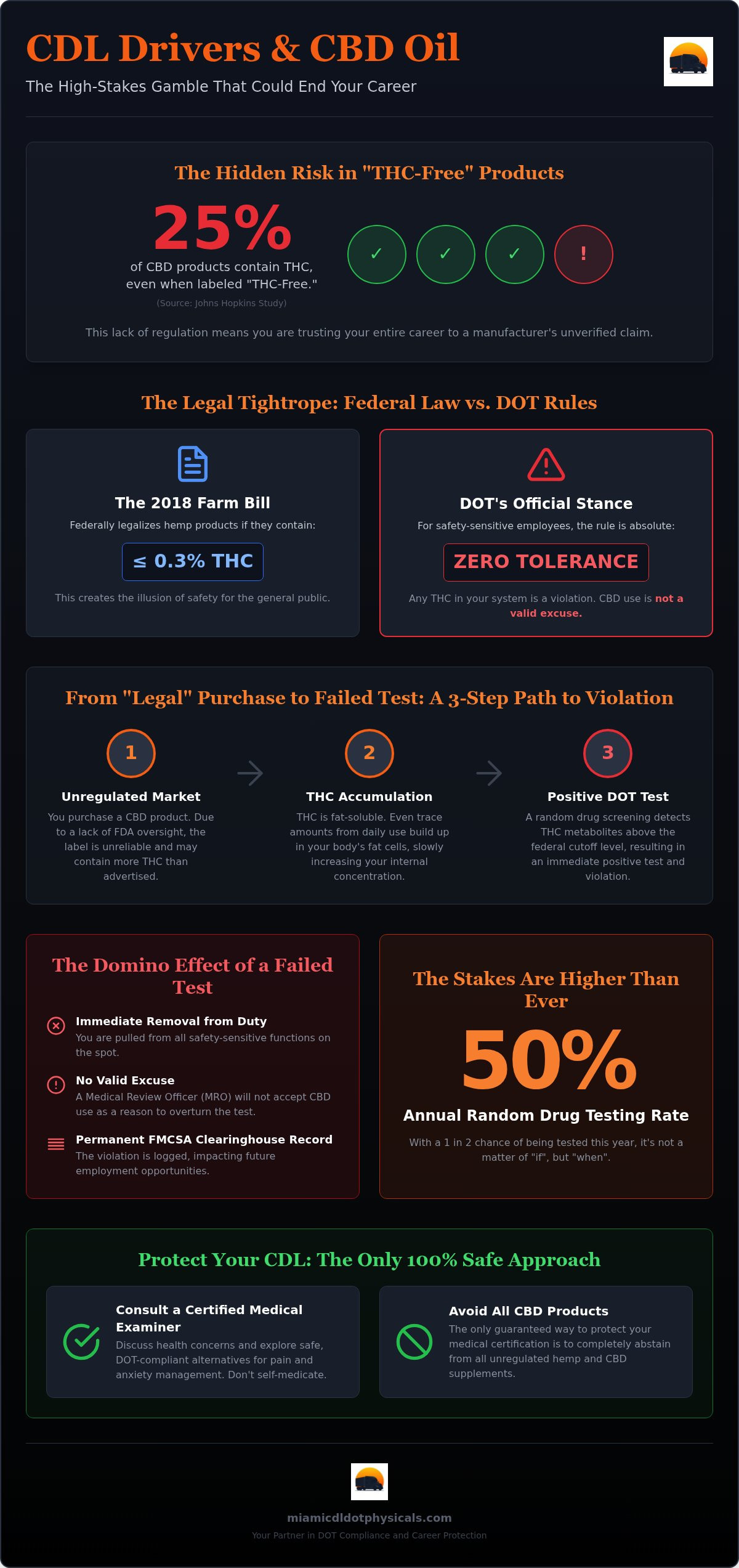
The Agricultural Improvement Act of 2018, often called the Farm Bill, changed everything for the general public. It removed hemp from the list of controlled substances, provided the plant contains no more than 0.3% THC. Any cannabis plant exceeding that 0.3% threshold is legally classified as marijuana, a Schedule I drug according to the DEA. For a commercial driver, this distinction is a thin line. Even if a product meets the legal definition of hemp, that trace amount of THC can still show up on a lab report. Since the FDA doesn't regulate these labels, you're essentially trusting a manufacturer's word with your entire career.
The DOT's Official Stance on CBD
The Department of Transportation (DOT) issued a clear "CBD Notice" to address this confusion. Their stance is firm: they do not authorize the use of CBD products for safety-sensitive employees. While the DOT doesn't technically "ban" CBD as a substance, they do ban marijuana. Because CBD products are unregulated, there's no guarantee they are THC-free. Even products labeled as containing 0% THC can contain enough to trigger a positive result during your random drug screening.
If you test positive for THC, your medical examiner cannot accept CBD use as a valid medical explanation. There are no exceptions for "medical" CBD or "legal" hemp. A positive result immediately invalidates your medical certification. You'll be pulled from the road and required to complete the return-to-duty process before you can drive again. This policy remains unchanged in 2026, despite shifting state laws. Relying on retail products for pain management is a risk that most drivers simply can't afford to take.
Why CBD Often Leads to Failed DOT Drug Tests
The DOT mandates specific urine drug screens that are incredibly sensitive to THC metabolites. While you might wonder can a CDL driver use CBD oil safely, the laboratory process is designed to detect even minuscule amounts of prohibited substances. These tests look for a specific metabolite called THC-COOH. If the concentration exceeds the federal cutoff level, the lab reports a positive result. This happens more often than drivers realize because the CBD market operates without strict federal oversight. The sensitivity of these tests means that "legal" levels of THC in a bottle can still lead to an "illegal" level in your system.
THC Contamination in CBD Products
The FDA does not currently certify the levels of THC in retail CBD products. This lack of regulation means that labels are often inaccurate. Some manufacturers use "hot" hemp, which is hemp that contains more than the legal 0.3% THC limit. Even if the extraction process is clean, trace amounts of THC can remain in the oil. A study from Johns Hopkins found that nearly 25% of tested CBD products contained THC despite being labeled "THC-Free." For a driver subject to the 2026 random drug testing rate of 50%, these odds are not in your favor. These trace amounts aren't just a one-time risk. THC is fat-soluble, meaning it stores in your body's fat cells and accumulates over time with regular use. Daily use of a "legal" product can slowly build up your THC levels until you cross the failure threshold.
The Role of the Medical Review Officer (MRO)
When a laboratory detects THC in your sample, the result goes to a Medical Review Officer (MRO). The MRO is a licensed physician responsible for reviewing lab results and interviewing the driver to see if there's a legitimate medical explanation for the positive test. This is where many drivers face a hard reality. According to the DOT's official notice on CBD, using CBD oil is not a valid medical excuse for a positive marijuana test.
The MRO cannot verify a positive test as "negative" just because you have a bottle of "legal" hemp oil. Once the lab confirms the presence of THC metabolites above the cutoff, the MRO must report the violation to the FMCSA Clearinghouse. There's no middle ground or "warning" phase. This finality makes the question of whether can a CDL driver use CBD oil a matter of career survival. To stay compliant and keep your records clean, it's best to work with a DOT medical exam specialist who understands these high-stakes regulations and can guide you through the requirements of your physical.
Misleading Labels: The Risk of 'THC-Free' Products
The CBD market is often called the "Wild West" because it lacks the oversight found in the pharmaceutical industry. When you ask, can a CDL driver use CBD oil, you are really asking if you can trust the marketing on a retail bottle. For a commercial driver, the stakes are much higher than they are for the manufacturer. If a company mislabels a product, they might face a warning letter or a fine. If you use that product and test positive, you lose your livelihood. The gap between marketing promises and chemical reality is where many careers end.
Most products fall into three categories: full-spectrum, broad-spectrum, and isolate. Full-spectrum oils intentionally include trace amounts of THC to create what marketers call an "entourage effect." Broad-spectrum and isolates are marketed as THC-free. However, without strict FDA regulation of CBD products, these categories are often loosely applied. Cross-contamination in the factory or "hot" hemp crops can easily result in a "THC-free" bottle containing enough THC to trigger a violation. The FDA has already issued numerous warning letters to companies whose products contained significantly more THC than their labels suggested.
Understanding CBD Product Labels
While consumers not bound by federal drug testing often seek out reputable sources like Green Express DC for access to premium, lab-tested cannabis products, CDL holders must remain extremely cautious as even high-quality products can pose a risk to their certification.
Labels often use confusing terms to attract buyers. A bottle might claim "0% THC," but this is often a marketing claim rather than a scientific fact. In the lab world, "non-detectable" THC simply means the amount was below the specific lab's detection limit at that time. It does not mean the product is truly free of THC. A different lab with more sensitive equipment could find the substance easily.
Many drivers look for a Certificate of Analysis (COA) to feel safe. While a COA shows third-party testing, it isn't a guarantee for your specific bottle. A COA only represents the specific batch tested. If the manufacturer's quality control slips between batches, the bottle in your hand could be very different from the one sent to the lab months ago.
Why the DOT Doesn't Care About the Label
The DOT operates on a principle of strict liability. This means if a prohibited substance is in your system, you are responsible regardless of how it got there. 49 CFR Part 40 is the gold standard for federal drug testing procedures and leaves no room for product label excuses. The Medical Review Officer is not interested in the "THC-free" claims on your packaging. They only care about the laboratory-confirmed metabolites in your sample. Trusting a label is essentially betting your commercial driver's license on the honesty of an unregulated industry.
What Happens if You Fail a DOT Drug Test Due to CBD?
A positive drug test result triggers an immediate shutdown of your driving career. As soon as the Medical Review Officer (MRO) verifies the laboratory result, your employer must remove you from all safety-sensitive duties. This isn't a suggestion; it's a federal mandate. If you are an owner-operator or an employee wondering can a CDL driver use CBD oil, you need to understand that ignorance of the law won't stop the clock. You'll be parked until you complete a strict, multi-step process that can take months and thousands of dollars to resolve. The fallout affects your current job, your future employability, and your insurance eligibility.
The FMCSA Clearinghouse Record
Every drug and alcohol violation is recorded in the FMCSA Clearinghouse, a federal database that follows your CDL number across state lines. This record stays visible to potential employers during pre-employment screenings for at least five years, or until you successfully finish the return-to-duty process. Managing these records and staying compliant with reporting is complex, which is why many drivers and small fleets rely on an FMCSA Clearinghouse Consortium to handle the heavy lifting of regulatory paperwork. Trying to hide a violation is impossible; every carrier you apply to will see the "Prohibited" status on your profile until the violation is cleared.
The Return-to-Duty (RTD) Process
Getting back behind the wheel involves much more than just passing a new test. You must first locate a qualified Substance Abuse Professional (SAP) for an initial evaluation. The SAP will prescribe a specific plan of education or treatment that you must complete at your own expense. Once you finish that program, you'll have a follow-up evaluation. If the SAP clears you, you still have to take a return-to-duty drug test under direct observation. Even after returning to work, you'll be subject to a minimum of six unannounced follow-up tests over the next 12 months. This schedule is in addition to the standard 50% random testing rate required in 2026.
The financial and professional burden is why many drivers never make it back to the road. Carriers often view a Clearinghouse violation as too high of an insurance risk, regardless of whether the cause was "legal" CBD or marijuana. If you have already consumed a CBD product and are worried about your upcoming medical certification, the best move is to consult with a certified DOT drug testing specialist to discuss your options and stay compliant with federal law. Proactive management is the only way to protect your CDL in a high-stakes environment.
Protecting Your CDL: Safe Alternatives and Compliance
The safest and most direct advice for any professional asking can a CDL driver use CBD oil is to avoid these products entirely. While the potential benefits for sleep or pain management might seem attractive, they don't outweigh the risk of a permanent career shutdown. Compliance isn't about avoiding the rules; it's about building a sustainable career. By choosing to abstain, you remove the uncertainty from your next random drug screen. Protecting your livelihood requires a proactive approach to health that doesn't involve unregulated supplements. You've worked hard for your license, so don't let a poorly labeled bottle take it away.
Preparing for your DOT physical involves more than just showing up at the clinic. It requires a clear understanding of what enters your body. Medical examiners are trained to identify health risks, and an undisclosed supplement habit is a major red flag during the certification process. If you're struggling with chronic pain or anxiety, look for FDA-approved medications or physical therapies that don't carry the risk of THC contamination. Your medical certification depends on your ability to prove you are safe and drug-free at all times.
Talking to Your Doctor About CDL Compliance
During your medical exam, be completely transparent with the provider. Your examiner needs to know about every vitamin, herbal tea, or topical cream you use. Many drivers believe that topical CBD creams are safer because they aren't ingested, but even these can lead to skin absorption and a positive test result. Ask your doctor for CDL-safe alternatives like physical therapy, safe anti-inflammatories, or sleep hygiene techniques. Disclosing these concerns early helps your examiner guide you toward compliance rather than a violation. For a deeper look at getting ready, check out our guide on how to pass DOT physical exams.
Proactive Testing for Drivers and Fleets
Some drivers and fleet managers utilize a DOT drug test service for proactive, non-DOT testing. This allows a driver to verify their system is clear before an official federal record is ever at stake in the Clearinghouse. Fleet managers play a critical role here by educating their teams about the 'buyer beware' nature of the CBD industry. They should emphasize that the answer to whether can a CDL driver use CBD oil is a practical 'no' because of the lack of industry regulation. Ultimately, the risk of CBD far outweighs the benefits. One bottle of oil isn't worth the five-year struggle of a Clearinghouse violation. Stay focused on safe, proven methods to manage your health and keep your truck on the road.
Stay Compliant and Keep Your Career on Track
The high-stakes environment of commercial driving leaves no room for the uncertainty of the CBD market. While retail products are legal to purchase, the question of can a CDL driver use CBD oil ultimately comes down to risk management. A single mislabeled bottle can lead to a positive THC result, triggering immediate removal from service and a long-term mark on your federal record. The costs of the return-to-duty process and the loss of employability far outweigh any temporary relief CBD might offer. It's simply a gamble that isn't worth your license.
Your medical certification is your most valuable asset. Our team of FMCSA-certified medical examiners and Clearinghouse compliance experts is here to help you stay ahead of federal regulations. We offer on-site DOT drug testing to give you peace of mind before you hit the road. Schedule your DOT physical or drug test with our FMCSA-certified team today. We are dedicated to providing the reliability and ease you need to maintain your livelihood.
Staying informed is the first step toward a long and successful career in the transportation industry. We look forward to being your partner in compliance.
Frequently Asked Questions
Can CBD oil make you fail a DOT drug test?
Yes, CBD oil can absolutely cause a failed DOT drug test. Many CBD products contain trace amounts of THC that are not listed on the label. Laboratory tests for commercial drivers look for THC-COOH metabolites. If these levels exceed the federal threshold, the result is a confirmed positive. Since the FDA does not regulate CBD manufacturing, you're taking a significant risk with your career every time you use these products.
Is there any DOT-approved CBD oil for truck drivers?
No, there is currently no such thing as a DOT-approved CBD product. The Department of Transportation has issued clear notices stating they do not authorize the use of CBD for safety-sensitive employees. Regardless of the brand or marketing claims, the DOT treats any detected THC as a violation. Avoid any product that claims to be "certified" for CDL holders, as these claims are misleading and have no legal standing with federal regulators.
What should I do if I already used CBD oil and have a drug test coming up?
Stop using the product immediately to prevent further THC accumulation in your fat cells. You should consider scheduling a private, non-DOT drug test to see if THC is detectable in your system before your official exam. If you are currently asking can a CDL driver use CBD oil because you already took some, transparency with a compliance expert is your best path. Stay hydrated and focus on healthy habits to support your body.
Does 'Broad Spectrum' CBD show up on a drug test?
Broad-spectrum CBD can still lead to a positive drug test result. While this version is marketed as having the THC removed, the lack of federal oversight means cross-contamination often occurs during the extraction process. Some products labeled as broad-spectrum have been found to contain significant levels of THC in independent lab studies. For a commercial driver, the distinction between full-spectrum and broad-spectrum is often not enough to guarantee a clean urine sample for the DOT.
Can a doctor prescribe CBD oil for a CDL driver?
A doctor cannot provide a valid medical explanation for CBD use that the DOT will accept. Even in states where medical marijuana or CBD is legal, federal regulations still classify marijuana as a Schedule I controlled substance. Medical Review Officers are prohibited from overturning a positive THC test based on a doctor's recommendation for CBD. Your medical card depends on federal compliance, which currently excludes all cannabis-derived products for safety-sensitive positions regardless of a prescription.
How long does CBD-related THC stay in a driver's system?
THC from CBD products can stay in your system for several days to over a month. Because THC is fat-soluble, it stores in your body's adipose tissue and is released slowly over time. Heavy or frequent users will likely test positive for a longer duration than occasional users. Factors like your body fat percentage, metabolism, and the specific concentration of the CBD oil you used all play a role in how long it remains detectable in urine.
Will the DOT eventually allow CBD use for commercial drivers?
There is no indication that the DOT will change its stance on CBD in the near future. Federal agencies typically wait for the FDA to establish clear safety standards and for federal law to reclassify cannabis before updating safety-sensitive regulations. As of 2026, the DOT remains focused on the risk of impairment and the lack of product consistency. Drivers should not expect a policy shift that would allow for cannabis-derived supplements anytime soon.
What are the best alternatives to CBD for truck driver back pain?
Safe alternatives for managing back pain include physical therapy, ergonomic seat cushions, and regular stretching during breaks. Many drivers find relief through FDA-approved over-the-counter anti-inflammatories like ibuprofen or naproxen, provided they are cleared by their medical examiner. Heat therapy and professional massage are also excellent, compliant options. Consulting with a specialist can provide clarity on the question can a CDL driver use CBD oil while helping you find much safer ways to manage pain.


