

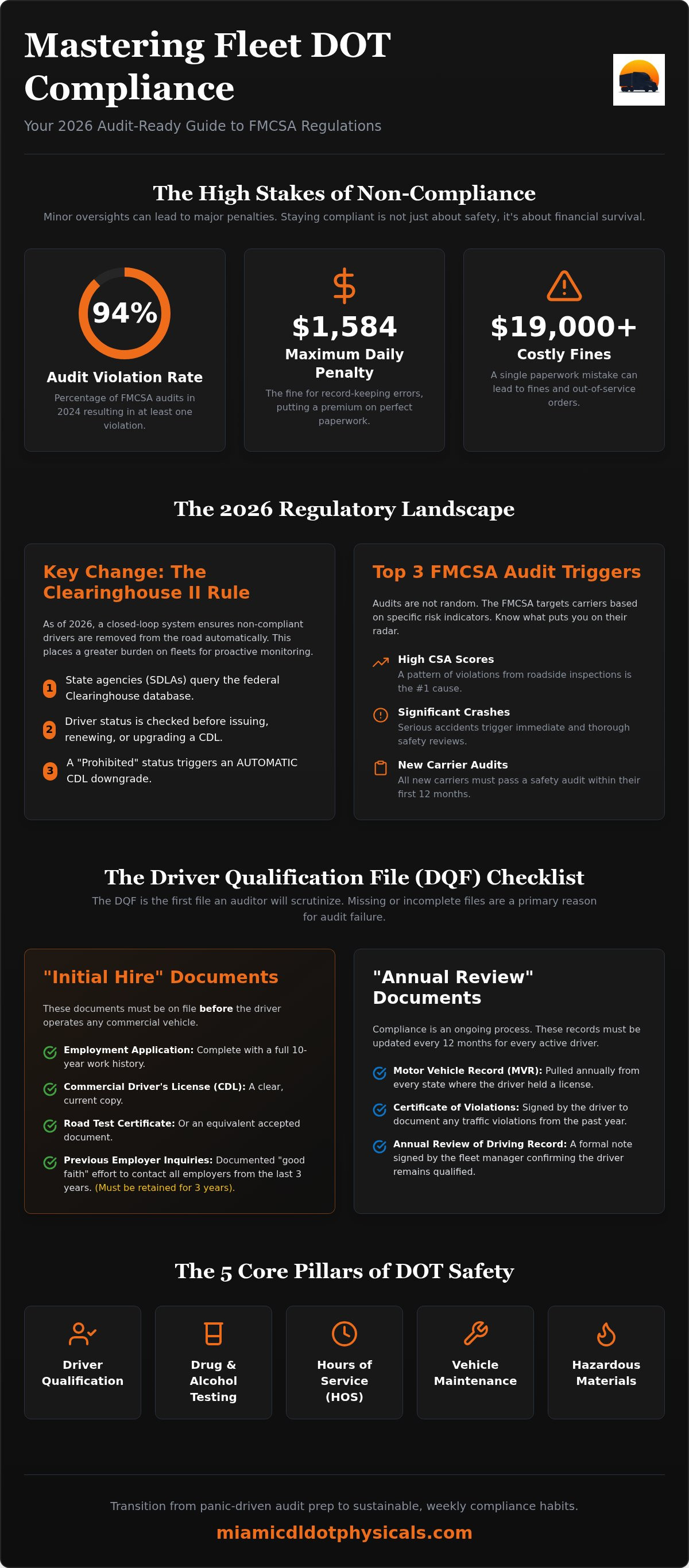
Did you know that 94% of FMCSA audits in 2024 resulted in at least one violation, often triggered by minor record-keeping oversights? In 2026, the stakes are even higher as the maximum daily penalty for record-keeping errors has climbed to $1,584. Keeping your trucks on the road requires more than just good drivers. It demands a flawless fleet DOT compliance checklist that accounts for every digital trail and medical certification.
It's understandable if the sheer volume of paperwork feels overwhelming. Between the complexity of the FMCSA Clearinghouse and the strict new ELD requirements effective January 2026, staying compliant can feel like a full-time job. You shouldn't have to worry about a roadside inspection turning into a costly "out-of-service" order or a $19,000 fine for a paperwork mistake. This article provides a clear, step-by-step framework to master every federal requirement. We'll walk you through driver qualification files, the latest drug testing protocols, and the transition to electronic DVIRs. By the end of this guide, you will have the tools to build a filing system that keeps your fleet audit-ready and your business moving forward with total confidence.
Key Takeaways
- Understand how 2026 regulatory updates and increased civil penalties for record-keeping errors impact your fleet's daily operations.
- Learn how to organize Driver Qualification Files to meet the rigorous "Initial Hire" requirements that DOT auditors scrutinize most.
- Master the 49 CFR Part 382 requirements and FMCSA Clearinghouse protocols using a comprehensive fleet DOT compliance checklist.
- Identify critical steps in systematic vehicle maintenance to prevent roadside out-of-service orders, the leading cause of inspection failures.
- Discover how to transition from panic-driven audit preparation to a sustainable weekly habit that keeps you ready for both on-site and off-site reviews.
The 2026 Landscape of Fleet DOT Compliance
DOT compliance isn't a suggestion; it is the legal foundation for operating commercial motor vehicles in the United States. Specifically, it refers to your adherence to 49 CFR, the section of federal law governing transportation safety. Staying compliant protects your business from the rising costs of non-compliance. For instance, the maximum daily penalty for record-keeping violations increased to $1,584 as of late 2024. A robust fleet DOT compliance checklist is your best defense against these mounting costs and the legal risks that follow.
Audits don't happen at random. The FMCSA typically targets carriers based on three primary triggers. High CSA (Compliance, Safety, Accountability) scores are the most common reason for a knock on the door. If your roadside inspection data shows a pattern of violations, you'll move up the priority list. Significant crashes also trigger immediate reviews. Finally, every new carrier must pass a safety audit within their first 12 months of operation to prove they have the proper systems in place. Maintaining a fleet DOT compliance checklist ensures you cover the five core pillars of safety: Driver Qualification, Drug and Alcohol Testing, Hours of Service, Vehicle Maintenance, and Hazardous Materials handling.
Understanding DOT vs. FMCSA Authority
It helps to know who you're dealing with. The Department of Transportation (DOT) is the federal cabinet department that sets broad goals for the nation's infrastructure. The Federal Motor Carrier Safety Administration (FMCSA) is the specific agency under that umbrella tasked with enforcing safety rules for the trucking industry. If you operate a vehicle over 10,001 pounds or transport hazardous materials in interstate commerce, you fall under their jurisdiction. Your USDOT number acts as the central digital record of your safety history. Think of it as a public credit score for your fleet. Every inspection, crash, and audit result is tied to this number, influencing your insurance rates and your ability to secure high-paying freight contracts.
Key Regulatory Changes for 2026
The 2026 regulatory environment is defined by increased digital transparency. The FMCSA is moving away from manual checks toward automated data sharing. This shift is most visible in the Clearinghouse II rule. State Driver Licensing Agencies (SDLAs) are now required to query the federal database before issuing, renewing, or upgrading a CDL. This creates a closed-loop system where there's nowhere for non-compliant drivers to hide. It's a significant change that requires carriers to be more proactive than ever before. A driver with a "Prohibited" status in the FMCSA Clearinghouse will face an automatic CDL downgrade by their state licensing agency as of the 2026 enforcement standards. This automation ensures that unfit drivers are removed from the road in real-time, placing the burden of monitoring squarely on the fleet manager's shoulders.
The Driver Qualification File (DQF) Checklist
The Driver Qualification File (DQF) is often the first thing a DOT auditor asks to see. It is the most scrutinized folder in your office because it proves your drivers are legally qualified to operate. In 2026, the FMCSA expects these records to be digitally accessible. This means you should be able to produce these files instantly during a remote or "desk" audit. Using a digital fleet DOT compliance checklist helps you avoid the common trap of missing a single signature that could lead to a fine. Missing or incomplete DQFs are a primary reason for audit failure, so maintaining these files is non-negotiable for fleet safety.
Mandatory Documents for Every Driver
Your files must contain specific "Initial Hire" documents before a driver ever gets behind the wheel. This includes a completed employment application with a full 10-year work history and a copy of the driver’s current CDL. You also need a road test certificate or its equivalent. One area where fleets often fail is the three-year retention rule for previous employer inquiries. You must document your "good faith" effort to contact every employer the driver worked for in the last three years to verify their safety and drug testing history. Records of these inquiries must stay in the DQF for three years after the inquiry date.
For existing drivers, the work doesn't stop after the hire. You're required to pull a Motor Vehicle Record (MVR) annually from every state where the driver held a license. Combine this with a signed Certificate of Violations from the driver to complete your annual review. Driving with a suspended or revoked CDL remains the top acute violation cited by the FMCSA. Pulling that annual MVR is your only way to catch these issues before an auditor does. If you need help managing these recurring requirements, our consortium management services can streamline the process.
Managing Medical Certificates and DOT Physicals
Medical compliance is a high-priority item for auditors. A DOT physical must be performed by a certified provider listed on the FMCSA National Registry. Once the exam is complete, you must verify the driver’s medical status on their official CDL record through the state’s self-certification portal. This step is critical; simply having a paper card in the file is no longer enough. You must ensure the driver has successfully updated their record with the State Driver Licensing Agency (SDLA).
Keep a sub-checklist for medical card management to stay ahead of expirations. It's best to follow these steps:
- Track expiration dates at least 30 days in advance.
- Verify the examiner's registry number on every new certificate.
- Ensure the driver has self-certified with their SDLA within 15 days of the exam.
- Maintain the medical examiner's certificate in the DQF for three years.
To reduce the risk of a driver failing their exam and being pulled off the road, share this ultimate driver's preparation guide with your team before their next appointment. Staying proactive ensures your fleet DOT compliance checklist remains green and your trucks stay moving.
Drug and Alcohol Testing & Clearinghouse Protocols
Drug and alcohol compliance is often where fleets face their most severe legal exposure. Under 49 CFR Part 382, every motor carrier must implement a testing program that identifies and removes impaired drivers from the road. This isn't just about safety; it's about protecting your company from massive liability. If an accident occurs and your records are incomplete, the legal consequences are devastating. A robust fleet DOT compliance checklist must prioritize these testing protocols to ensure every driver is fit for duty.
The regulations focus on three primary testing events. Pre-employment testing requires a verified negative result before a driver performs any safety-sensitive function. Random testing uses a neutral selection process to ensure every driver has an equal chance of being tested at any time. For 2026, the random testing rates remain at 50% for drugs and 10% for alcohol. Post-accident testing is triggered by specific criteria, such as a fatality or a citation issued after a vehicle is towed. In every case, the Medical Review Officer (MRO) acts as the essential gatekeeper. The MRO reviews all lab results and speaks with drivers to determine if a positive result was caused by a legitimate prescription. Without an MRO's verification, a test result isn't legally valid for DOT purposes.
Drivers must understand that a "Refusal to Test" is legally equivalent to a positive result. This includes failing to show up at the collection site on time or providing an unadulterated sample. Once a refusal is recorded, the driver must immediately stop operating and enter the return-to-duty process.
FMCSA Clearinghouse Annual Requirements
When dealing with sensitive internal investigations or verifying driver statements in high-liability situations, you can check out Morgan Polygraph for professional investigative services that help ensure transparency and accountability.
The FMCSA Clearinghouse is a centralized database that tracks drug and alcohol violations in real-time. It's designed to stop drivers from hiding violations by moving between states or employers. To stay compliant, follow these three essential steps:
- Step 1: Register your company and ensure all drivers have created their own Clearinghouse accounts.
- Step 2: Conduct a "Full Query" for every new hire. This requires the driver's electronic consent and must be completed before they drive.
- Step 3: Conduct a "Limited Query" at least once every 12 months for every driver on your roster to check for new violations.
The 2026 enforcement standards have added a layer of urgency to this process. Under the Clearinghouse II mandate, any driver who reaches a "Prohibited" status will have their CDL or CLP downgraded by their state licensing agency within days. This automated data sharing means you can no longer wait for an annual audit to catch problems. Real-time monitoring is the only way to keep your fleet operational.
Implementing a Random Drug Testing Consortium
Owner-operators and small fleets face a unique challenge: they cannot legally manage their own random testing pool. Federal rules require "scientific neutrality," which means you need an outside party to handle the selections. Joining a drug consortium solves this problem by placing your drivers into a larger, professionally managed pool. This ensures you meet the mandated testing percentages without the administrative headache of manual tracking. Professional management of your DOT drug tests provides a secure audit trail and ensures your fleet DOT compliance checklist stays current with the latest federal standards.
Operational Safety: HOS and Vehicle Maintenance
Vehicle maintenance is the single most common reason trucks are pulled off the road during roadside inspections. According to FMCSA data, mechanical failures account for the majority of out-of-service orders. To stay compliant, you must follow the "Systematic Inspection, Repair, and Maintenance" rule found in 49 CFR 396.3. This regulation requires you to have a proactive plan for every vehicle under your control. Your fleet DOT compliance checklist should include a schedule for regular service and a system for documenting every repair. You must keep these maintenance records for 12 months while the vehicle is in service and for six months after it leaves your fleet.
ELD Records and Hours of Service (HOS)
Modern HOS compliance relies heavily on Electronic Logging Devices (ELDs). As of January 20, 2026, all drivers must use ELDs that appear on the FMCSA’s current registered device list. Using a non-compliant or "self-certified" device that has been removed from the registry can result in an immediate out-of-service order. Your drivers must know how to initiate an ELD data transfer during a roadside inspection to provide the officer with their last eight days of logs instantly.
Fleet managers have a specific duty to monitor these logs for accuracy. You must review and reconcile "Unassigned Driving Time" to ensure drivers aren't moving vehicles off the clock. The core HOS limits remain strict: the 11-hour driving limit, the 14-hour on-duty window, and the 60/70-hour weekly limits. If your drivers struggle with the medical side of staying fit for these long hours, our team can help with professional DOT compliance services to keep your roster healthy and legal.
DVIR and Periodic Inspection Records
The Driver Vehicle Inspection Report (DVIR) is your daily proof of roadworthiness. A final rule effective March 23, 2026, encourages the use of electronic DVIRs to streamline record-keeping and reduce errors. Drivers must complete these reports at the end of every day. If a driver identifies a safety-critical defect, a technician must sign the report to certify the repair was completed before the truck returns to service.
- Brake systems and adjustment levels
- Tire tread depth and sidewall integrity
- Lighting devices, reflectors, and electrical wiring
- Steering mechanisms and suspension components
- Coupling devices and fifth-wheel assemblies
Preparing for a DOT Audit: Best Practices for Success
Audit preparation should be a weekly habit, not a panic-driven event triggered by an FMCSA notification. Since 94% of audits in 2024 resulted in at least one violation, assuming your files are "good enough" is a high-risk strategy. By the time an investigator contacts you, it's often too late to fix missing records or date gaps. A proactive fleet DOT compliance checklist allows you to identify and correct errors before they become costly penalties. Staying audit-ready ensures that when the FMCSA calls, you can respond with speed and precision.
Modern audits come in two forms. An Off-site (Desk) Audit is conducted remotely, where you must upload digital files to the FMCSA’s portal within a strict timeframe. An On-site Comprehensive Audit involves an investigator visiting your facility to review every aspect of your operation. Both result in a safety rating. A "Satisfactory" rating is the goal. A "Conditional" rating indicates safety deficiencies and can lead to doubled insurance premiums or the loss of preferred contracts. An "Unsatisfactory" rating is the most severe, often leading to a federal order to cease all operations.
The 'Audit-Ready' Filing System
Organization is your best defense. Whether you use a traditional three-ring binder or a secure digital folder, your records should be divided into three clear pillars: Driver Qualification (DQF), Maintenance, and Drug/Alcohol compliance. Auditors look for "Red Flag" items first. These include missing signatures on applications, date gaps in maintenance logs, and expired CDL medical cards.
Perform a "Mock Audit" every quarter to stress-test your system. Pick three random drivers and three random vehicles. Verify that every MVR is current and that every maintenance repair has a matching DVIR signature. If you find a gap, document the correction immediately. This shows auditors that you have a functioning self-monitoring system, which can often mitigate the severity of minor findings.
Leveraging Professional Compliance Services
You don't have to manage the administrative burden alone. Partnering with third-party experts for commercial driver medical exams ensures that your drivers are seen by FMCSA-certified examiners who understand the latest 2026 standards. These professionals handle the registry verification and medical data entry, reducing the risk of "prohibited" status errors in the Clearinghouse.
A professional consortium management service provides an additional layer of security by neutralizing the random selection process and maintaining a secure audit trail for every drug test. As a final tip, always maintain a "Compliance Calendar." This master schedule should track every recurring expiration date, from annual MVR pulls to biennial medical exams. When you automate the tracking, you eliminate the guesswork. This disciplined approach is the only way to ensure your fleet DOT compliance checklist stays 100% current and your business stays on the road.
Securing Your Fleet's Long-Term Road Success
Staying ahead of federal regulations requires a shift from reactive fixes to proactive management. By mastering the 2026 fleet DOT compliance checklist, you protect your business from the rising costs of civil penalties and the risk of a "Conditional" safety rating. Remember that maintaining organized Driver Qualification Files and implementing a systematic vehicle maintenance plan are your best defenses during an audit. With the FMCSA moving toward real-time data sharing through the Clearinghouse, there is no longer any room for manual record-keeping errors or expired medical cards.
You don't have to navigate these complex requirements alone. We're here to serve as your dependable ally in high-stakes compliance. Ensure your fleet stays compliant with certified DOT physicals and drug testing through our team of FMCSA-certified medical examiners. We provide the professional occupational health expertise and automated Clearinghouse Consortium management you need to keep your drivers on the road and your office audit-ready. Taking these steps today ensures your business remains a reliable and respected leader in the professional community. Let's keep your trucks moving with total peace of mind.
Frequently Asked Questions
What are the most common DOT compliance violations in 2026?
Driving with a suspended or revoked CDL remains the top acute violation cited by the FMCSA. Other frequent issues include failing to conduct required Clearinghouse queries and missing medical certificates in the DQF. Roadside inspections often cite lighting, tires, and brake adjustments as primary mechanical failures. Maintaining a fleet DOT compliance checklist helps you catch these recurring issues before they trigger a full audit or lead to costly out-of-service orders.
How long must I keep Driver Qualification Files (DQF) after a driver leaves?
You must keep the complete Driver Qualification File for three years after a driver's employment ends. This includes their application, MVRs, and annual reviews. Some specific documents, like the medical examiner’s certificate, also follow this three-year retention rule. Keeping these records organized ensures you can prove past compliance if an investigator reviews your historical data during a comprehensive on-site audit. Don't discard these files early, as they are essential for your defense.
Does an owner-operator need to be in a drug and alcohol consortium?
Yes, owner-operators are legally required to join a drug and alcohol consortium. Federal rules prohibit individuals from managing their own random testing pools to ensure scientific neutrality. By joining a consortium, you satisfy the 2026 mandate for random testing at a 50% rate for drugs and 10% for alcohol. It also simplifies your fleet DOT compliance checklist by automating the selection process and providing the necessary documentation for a federal audit.
What happens if a driver’s medical certificate expires while they are on the road?
If a certificate expires, the driver is immediately unqualified to operate a commercial vehicle. Under the 2026 Clearinghouse II standards, the State Driver Licensing Agency will downgrade the driver’s CDL to a non-commercial status shortly after the expiration date. This makes any further driving a top acute violation. You should track expiration dates at least 30 days in advance to avoid these automatic downgrades and the high fines associated with roadside inspections.
How often does the FMCSA perform random DOT audits on small fleets?
The FMCSA doesn't follow a fixed random schedule for most established fleets. Instead, they use a data-driven approach based on your CSA scores and crash history. However, every new carrier must undergo a safety audit within their first 12 months of operation. If your safety data remains within acceptable limits, you may go years without a review. High-risk carriers are always prioritized for on-site comprehensive audits to ensure public safety.
What is the difference between a DOT drug test and a non-DOT drug test?
A DOT drug test follows strict federal procedures outlined in 49 CFR Part 40 and uses a standard five-panel screen. It requires a certified Medical Review Officer and specific collection protocols. A non-DOT test is a private employer requirement and can test for a wider variety of substances using different methods. You cannot use a non-DOT result to satisfy federal pre-employment or random testing requirements for your commercial drivers.
Can I use digital signatures for my DOT compliance record-keeping?
Yes, the FMCSA fully supports and encourages the use of digital signatures for all compliance record-keeping. A final rule effective March 23, 2026, specifically clarifies and promotes the use of electronic Driver Vehicle Inspection Reports (DVIRs). Digital records must be legible, protected against unauthorized alterations, and made available to an investigator within 48 hours of a request. Transitioning to digital files often reduces the risk of missing signatures or date gaps.
What are the current DOT physical blood pressure requirements for 2026?
To qualify for a standard two-year medical card, a driver's blood pressure must be 140/90 or lower. If the reading is between 140/90 and 159/99, the examiner may issue a one-year certificate as Stage 1 hypertension. Higher readings may result in shorter certifications or temporary disqualification until the pressure is controlled. Certified medical examiners follow these national standards to ensure every driver is physically fit for their safety-sensitive duties on the road.


