

A slight dip in your hearing doesn't have to be the reason you hang up your keys for good. Many drivers worry that failing a single part of their medical exam will end their careers instantly. You depend on your CDL for your livelihood, and the thought of a subjective whisper test or a technical decibel reading can be incredibly stressful. It's common to feel confused about whether your hearing aids are a help or a hindrance during the exam. We understand that regulatory compliance feels high-stakes because your paycheck is on the line.
This 2026 guide clarifies the current DOT physical hearing requirements so you can walk into your appointment with total confidence. You'll learn the exact FMCSA standards for both the 5 foot whisper test and the audiometric exam, including the 40 decibel threshold you need to meet in your better ear. We'll also show you how to use hearing aids to pass the test and the specific steps required to secure a hearing exemption if necessary. This article provides a clear roadmap to pass your exam and keep your career moving forward without any unnecessary guesswork.
Key Takeaways
- Identify the exact FMCSA standards, including the 40-decibel average loss threshold required in your better ear.
- Learn the difference between the initial forced whisper screening and the scientific audiometry test used for backup.
- Understand how to meet DOT physical hearing requirements while using hearing aids and what those certifications mean for your daily driving.
- Prepare for your exam by managing earwax buildup and following the "quiet time" rule to ensure accurate test results.
- Explore the referral and exemption pathways available to keep you on the road even if you don't pass the initial screening.
Understanding FMCSA Hearing Standards for Commercial Drivers
Federal regulations are clear about the physical standards required to operate a commercial motor vehicle safely. Under 49 CFR 391.41, the Federal Motor Carrier Safety Administration (FMCSA) mandates that every driver must pass a hearing assessment to hold a Commercial Driver's License. This isn't just a box to check; it's a vital safety measure. Meeting the DOT physical hearing requirements ensures you can react to the dynamic environment of the open road. The rules focus on your "better ear," meaning you only need to meet the standard in one ear to pass. This provides a fair pathway for drivers who may have partial hearing loss but still maintain excellent situational awareness.
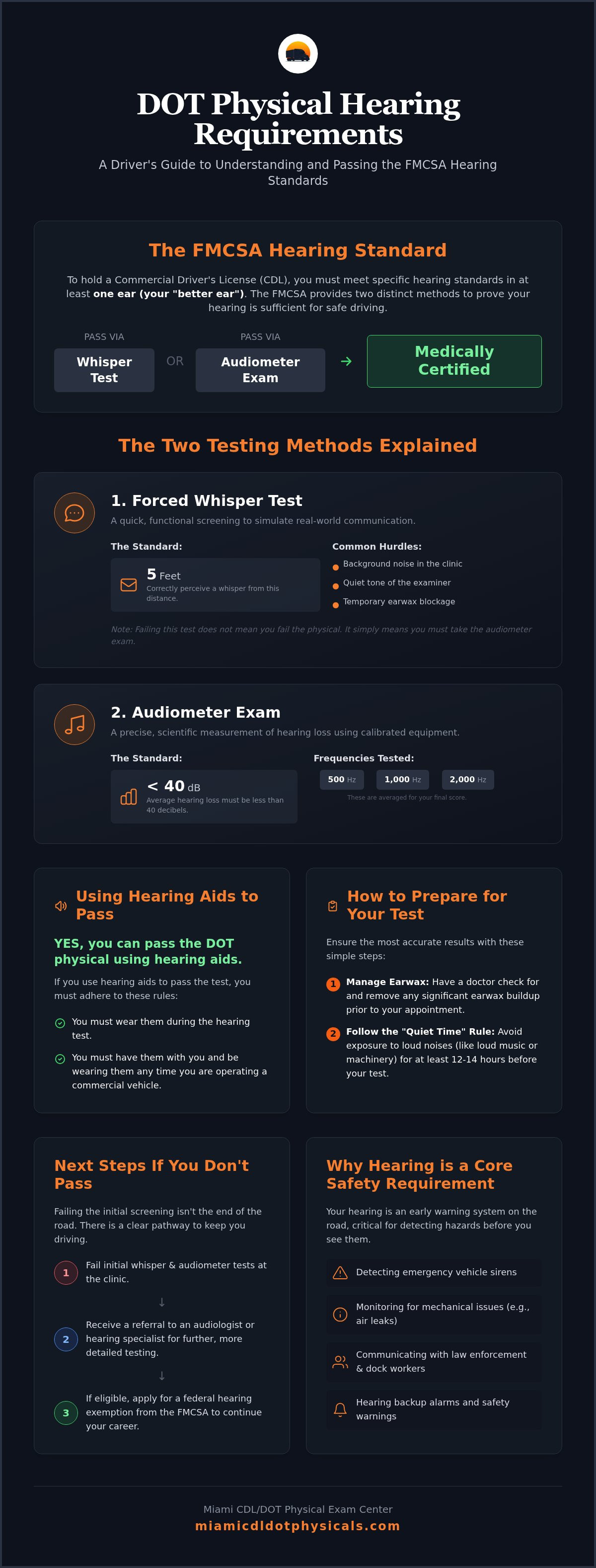
The 2026 hearing standard is defined as perceiving a forced whisper at five feet or having an average hearing loss of less than 40 decibels. If you can hear the examiner's whisper from five feet away in at least one ear, you've met the requirement. If not, the examiner moves to a more technical audiometric test to measure your hearing at specific frequencies. This two tiered approach ensures that safe, capable drivers aren't disqualified by a single subjective test.
Why Hearing is a Core Safety Requirement
Hearing serves as your early warning system. While your mirrors show you what's behind you, your ears often detect hazards before they enter your field of vision. High quality hearing is essential for several critical tasks:
- Emergency Detection: You must be able to hear sirens from police cars, fire trucks, and ambulances to clear the way quickly and safely.
- Mechanical Monitoring: Experienced drivers listen for the distinct hiss of an air brake leak or the unusual grinding of a failing wheel bearing.
- Roadside Communication: You need to hear and follow instructions from law enforcement or emergency responders during inspections or at accident scenes.
- Dock Safety: Busy loading docks are high traffic zones where backup alarms and shouted warnings from ground guides prevent serious accidents.
The Examiner’s Role in Hearing Assessment
Your medical examiner acts as a compliance partner. Their goal is to verify that you're physically fit to drive while keeping you on the road legally. During the exam, they perform an initial screening, usually the forced whisper test. If you don't pass this initial check, the examiner doesn't just fail you. Instead, they'll use secondary diagnostic testing or refer you to an audiologist for a formal audiogram. This ensures the final decision is based on accurate, scientific data. Understanding the DOT physical hearing requirements helps you see the examiner as a guide through the certification process rather than a barrier to your career.
Forced Whisper vs. Audiometry: The Two Testing Methods
The FMCSA provides two distinct paths to satisfy DOT physical hearing requirements. You don't need to pass both tests; success in either one is enough to secure your medical certificate. Most examiners begin with the Forced Whisper test because it's quick and non-invasive. However, if environmental noise or a quiet examiner makes this difficult, the audiometry test serves as a precise, scientific backup. This dual system ensures that drivers aren't unfairly disqualified due to a single subjective screening.
How the Forced Whisper Test Works
The setup for this test is straightforward. You'll stand five feet away from the examiner with your better ear facing them while you cover the other ear. The examiner then breathes out fully and whispers a series of numbers, letters, or words. To pass, you must correctly repeat the sequence. It's a functional test designed to mimic real-world communication scenarios you might encounter at a weigh station or loading dock.
Many drivers fail this portion not because of significant hearing loss, but due to external factors. Clinic background noise, humming air conditioning units, or even the examiner's specific vocal tone can interfere with the results. If you don't pass the whisper test, don't worry. It's simply a signal to move to the more objective audiometric screening where variables are more tightly controlled.
Audiometry: The Decibel Standards
Audiometry is the scientific standard for measuring hearing capacity. It uses calibrated equipment and headphones to test how you respond to specific sound frequencies in a controlled environment. The FMCSA focuses on three key levels: 500 Hz, 1,000 Hz, and 2,000 Hz. These specific frequencies are critical for understanding human speech and detecting road hazards like sirens or air leaks.
The examiner records your hearing loss in decibels (dB) for each of these three frequencies. They then average these numbers to find your score. To meet the standard, your average hearing loss must be 40 dB or less in your better ear. For example, if your readings are 35 dB, 40 dB, and 45 dB, your average is 40 dB, which is a passing score. This objective measurement removes the guesswork from the process.
If you cannot meet the 40 dB threshold even with the help of hearing aids, you still have options. You can apply for a federal hearing test exemption to prove you can drive safely despite the loss. Working with an experienced DOT medical examiner ensures you understand every testing alternative available to protect your CDL and your livelihood.
Can You Pass a DOT Physical with Hearing Aids?
Modern technology ensures that hearing loss doesn't have to end your driving career. You can absolutely use hearing aids to meet the DOT physical hearing requirements. Whether you're taking the whisper test or the audiometric exam, using your prescribed devices is fully permitted under the FMCSA physical qualification standards. If you pass using a hearing aid, you must wear it at all times while operating a commercial vehicle. This will be noted on your medical certificate as a "Hearing Aid Required" restriction. It's a standard practice that keeps you compliant while ensuring you can safely monitor your surroundings.
Before your appointment, take a few minutes to review our DOT physical requirements guide to ensure your equipment is ready. Always bring a fresh set of batteries and check your settings to ensure the devices are functioning at peak performance. It's also wise to carry a spare set of batteries in your cab. If your examiner sees that you're prepared and your hearing is well-managed, the certification process moves much faster.
The Hearing Aid Exemption (Waiver) Process
Sometimes, even the best hearing aids aren't enough to meet the 40 decibel threshold. If you fail both the whisper and audiometric tests, you still have a path forward through the FMCSA Hearing Exemption program. This waiver is designed for experienced drivers who can demonstrate they operate safely despite profound hearing loss. To qualify, you'll need to provide comprehensive documentation from both your primary care doctor and a licensed audiologist. They must verify that your hearing loss is stable and doesn't interfere with your ability to perform the essential duties of a commercial driver.
Applying for the FMCSA Federal Hearing Waiver
The application for a federal hearing waiver is a detailed process, but it's a reliable way to protect your livelihood. You'll submit your medical records, a copy of your driving history, and the specific FMCSA application forms for review. Approval typically takes several weeks, so it's best to start this process well before your current certificate expires. Once granted, these waivers usually operate on a two year renewal cycle. This waiver becomes a critical part of your CDL medical card status, allowing you to remain legally on the road. Keep a copy of your approved waiver in your vehicle at all times to show during inspections or roadside checks.
How to Prepare for Your Hearing Test
Preparing for the hearing portion of your exam is just as critical as managing your blood pressure or vision. Many drivers don't realize that their daily environment can temporarily dull their hearing, leading to a "fail" on a test they should have passed. To meet the DOT physical hearing requirements with ease, you must control the variables within your reach. Simple steps like resting your ears and ensuring physical health can make a significant difference in your results.
If you use hearing aids, bring them along with a fresh set of batteries. It's also helpful to have any recent reports from your audiologist, especially if you've had a formal audiogram in the last six months. Showing up prepared demonstrates to your examiner that you're proactive about your health and your professional compliance.
Ear Health and Maintenance
Physical blockages are one of the most common reasons for a poor test result. Earwax buildup can significantly muffle sound, so if you feel any "fullness" or muted hearing, visit a professional for a cleaning a week before your appointment. Never use Q-tips to clean your ears yourself. These often push wax deeper against the eardrum, making the problem worse and potentially causing temporary irritation that affects the test.
Your overall health also plays a role. Temporary congestion from a cold or seasonal allergies can cause fluid buildup behind the eardrum, which dampens sound. If you're currently battling a heavy head cold, it's often better to wait until your sinuses clear before scheduling your exam. This ensures your DOT physical hearing requirements are assessed when your hearing is at its natural baseline.
Exam Day Tips for Success
The "Quiet Time" rule is your best defense against a temporary threshold shift. Avoid loud music, power tools, or heavy machinery for at least 14 hours before your exam. If you've been driving a loud rig all morning, your ears need time to recover. Arrive at the clinic 15 to 20 minutes early to let your hearing adjust to the quiet office environment. This simple rest period can sharpen your perception for the whisper test.
Communication with your FMCSA medical examiner is equally important. Be honest about your hearing history. If a loud air conditioner or hallway noise interferes with the whisper test, don't be afraid to ask for a re-test in a quieter setting. Most examiners want to see you succeed and will accommodate a fair request. To ensure a smooth experience, schedule your appointment at a specialized center that understands the specific needs of commercial drivers.
Next Steps if You Fail the Hearing Portion
Failing the initial hearing screening at your appointment can feel like a major setback. It isn't. Many drivers experience a moment of panic when they can't quite catch the examiner's whisper, but a failed test is rarely a permanent disqualification. The FMCSA provides a clear path for drivers to validate their hearing through more precise, scientific methods. We view a failed whisper test as the start of a validation process, not the end of your career. Your livelihood is too important to leave to a single subjective screening, which is why the system includes built in safeguards for your protection.
The Referral and Recertification Path
When an examiner determines you haven't met the DOT physical hearing requirements during the whisper test, they don't have to fail you immediately. Instead, they'll often use a "determination pending" status. This status holds your certification for up to 45 days while you see a specialist for a formal audiogram. This specialized test provides the exact decibel readings needed to satisfy federal standards in a soundproof environment. It removes variables like office noise or the examiner's vocal pitch from the equation.
The audiologist will test your hearing at the 500 Hz, 1,000 Hz, and 2,000 Hz frequencies. They'll provide a signed report confirming whether your average hearing loss is 40 decibels or less in your better ear. Once you have these results, you'll return to the exam center to finalize your CDL medical exam. If the audiogram shows you meet the standard, the examiner will issue your medical card immediately. If you still fall short of the threshold, this is the point where you would begin the hearing aid or federal waiver process discussed in previous sections.
Long-term Compliance and Hearing Protection
Career longevity depends on proactive health management. Trucking is a loud profession. Constant engine noise, wind shear, and high decibel loading docks can cause gradual hearing loss over several years. Protecting your baseline hearing now makes it much easier to pass your physical in 2026 and beyond. Consider these steps for long term compliance:
- Cab Maintenance: Ensure your door seals and cab insulation are in good repair to minimize constant engine drone.
- Strategic Protection: Wear earplugs during pre-trip inspections or while standing near loud idling engines and reefers.
- Annual Baselines: Schedule a hearing check with your primary doctor every year, even when your physical isn't due.
Catching changes early allows you to adjust your hearing aids or prepare for waiver renewals before they become an emergency. Staying ahead of the regulations ensures that your medical card remains valid and your career stays on track. Schedule your professional DOT physical today and keep your career on track.
Securing Your Future on the Road
Meeting the DOT physical hearing requirements doesn't have to be a source of stress for your livelihood. The FMCSA provides multiple pathways to certification, whether you pass the initial whisper test or require a precise audiogram. Hearing aids are fully permitted tools that help you meet safety standards, and even profound hearing loss can often be managed through the federal exemption process. By preparing your ears for the exam and understanding the decibel thresholds, you take control of your professional standing and keep your career moving forward.
Our FMCSA-certified medical examiners have deep expertise in CDL compliance standards and are here to act as your partner in safety. We focus on fast, efficient driver certifications to respect your busy schedule and provide peace of mind. Miami CDL/DOT Physical Exam Center today to ensure your medical card is processed without delay. Your dedication to the industry is vital, and we're committed to helping you stay legally and safely behind the wheel.
Frequently Asked Questions
Can I pass the DOT physical if I am deaf in one ear?
Yes, you can pass the exam if you have functional hearing in at least one ear. The FMCSA standards only require you to meet the hearing threshold in your better ear. If your left ear has total hearing loss but your right ear perceives a forced whisper at five feet, you'll meet the requirement. This rule ensures that drivers with unilateral hearing loss stay on the road safely without needing a federal waiver.
Do I have to take the audiometry test if I pass the whisper test?
No, you don't need to take the audiometry test if you successfully pass the forced whisper screening. The FMCSA provides two separate pathways to satisfy the DOT physical hearing requirements. Most examiners start with the whisper test because it's faster. If you correctly repeat the whispered sequence from five feet away, the hearing portion of your physical is complete and no further technical testing is required.
What happens if I forget my hearing aids on the day of the physical?
If you rely on hearing aids to meet the standard and forget them, the examiner cannot certify you that day. You'll likely be placed in a "determination pending" status. This gives you time to retrieve your devices and return for a re-test. It's a good idea to keep a spare set of batteries and your devices in your vehicle to avoid any unnecessary delays in receiving your medical card.
How much hearing loss is allowed for a CDL?
The FMCSA allows an average hearing loss of up to 40 decibels in your better ear. This average is calculated using your results at three specific frequencies: 500 Hz, 1,000 Hz, and 2,000 Hz. If your average loss across these frequencies is 40 dB or less, you're physically qualified. If your hearing loss exceeds this limit, you'll need to explore the federal hearing exemption process to maintain your DOT physical hearing requirements.
Is the hearing waiver permanent once I receive it?
No, a federal hearing waiver isn't permanent. These exemptions are typically issued for a two year period. You must apply for a renewal before your current waiver expires to ensure there's no gap in your legal driving status. During your regular DOT physical, you'll need to present your valid waiver to the medical examiner so they can note it correctly on your medical certificate and in the federal system.
Can an examiner fail me if I have too much earwax?
An examiner won't permanently disqualify you for earwax, but they can't pass you if the buildup prevents an accurate test. If wax is blocking your ear canal, the examiner will likely pause the exam. They'll advise you to have your ears professionally cleaned by a specialist. Once the blockage is removed, you can return to complete the hearing portion of your exam and receive your certification without issue.
Does the DOT hearing test check both ears simultaneously?
No, the hearing test evaluates each ear individually. During the whisper test, you'll cover one ear while the examiner whispers toward the other from five feet away. For the audiometry test, the headphones deliver sounds to one ear at a time. This individual testing identifies which ear is your "better ear," which is the only one that needs to meet the federal standard for you to pass the exam.
Will my hearing aid brand affect my DOT certification?
Your hearing aid brand has no impact on your certification. The medical examiner is only concerned with the functional result of the device. As long as the hearing aids allow you to perceive a forced whisper at five feet or meet the 40 decibel average threshold, you'll pass. Ensure your devices are well-maintained and have fresh batteries on the day of your exam to guarantee the best possible performance for your physical.


