

A positive drug test violation isn't a permanent dead end for your trucking career. While the initial prohibited status in the FMCSA Clearinghouse feels like a career-ending blow, it's actually the beginning of a regulated recovery path. Successfully completing a DOT return-to-duty drug test is the final, critical hurdle in a structured process designed to get safe, professional drivers back behind the wheel. We understand that the financial stress of being off the road is heavy, especially with so many CDL holders nationwide competing for high-value routes. You don't have to navigate this alone or stay sidelined by confusion.
You deserve a clear, no-nonsense roadmap to compliance that respects your time and your livelihood. This 2026 guide removes the guesswork from the SAP process and explains exactly how the June 10th rules for directly observed collections affect your upcoming test. We'll walk you through a simple five-step plan to resolve your violation, clarify who reports what to the Clearinghouse, and help you find a certified testing center for your final RTD screen. You'll gain the knowledge needed to handle these requirements efficiently so you can get back to work legally and safely.
Key Takeaways
- Learn the exact 6-step sequence required by the FMCSA to transition from a "Prohibited" status back to active driving duty.
- Understand why a standard pre-employment screening cannot substitute for a formal DOT return-to-duty drug test Florida and how the direct observation mandate applies.
- Discover how to select a qualified Substance Abuse Professional (SAP) and why their evaluation is the essential foundation of your return-to-work plan.
- Master the reporting requirements for the FMCSA Clearinghouse to ensure your status is updated correctly and your CDL privileges are protected.
- Find out how professional consortium services simplify mandatory follow-up testing and help Florida drivers maintain long-term regulatory compliance.
What is a DOT Return-to-Duty Drug Test in Florida?
The DOT return-to-duty drug test Florida is a specific, mandatory evaluation for any commercial driver who has violated federal drug or alcohol regulations. This isn't a standard screening. It represents the final step in the FMCSA’s Return-to-Duty (RTD) pathway. Once a violation is reported to the FMCSA Clearinghouse, your status changes to "prohibited." This means you cannot perform safety-sensitive functions, like driving a commercial motor vehicle, until you complete the entire process. While Florida has its own state-level workplace programs, federal DOT jurisdiction always takes precedence for CDL holders. Even with local laws regarding medical marijuana, the DOT maintains a strict zero-tolerance policy for THC. If you drive in Florida, you must follow the federal rules to keep your license active.
A common mistake is thinking a standard pre-employment test can clear your record. It can't. The RTD test requires specific drug testing procedures, including direct observation by a collector of the same gender. This higher level of scrutiny ensures the integrity of the sample and confirms you're ready to safely re-enter the workforce. You cannot bypass the Substance Abuse Professional (SAP) process and simply take a new test at a different company. The Clearinghouse tracks your status across all employers, making the formal RTD test the only way to clear your name.
When is an RTD Test Required?
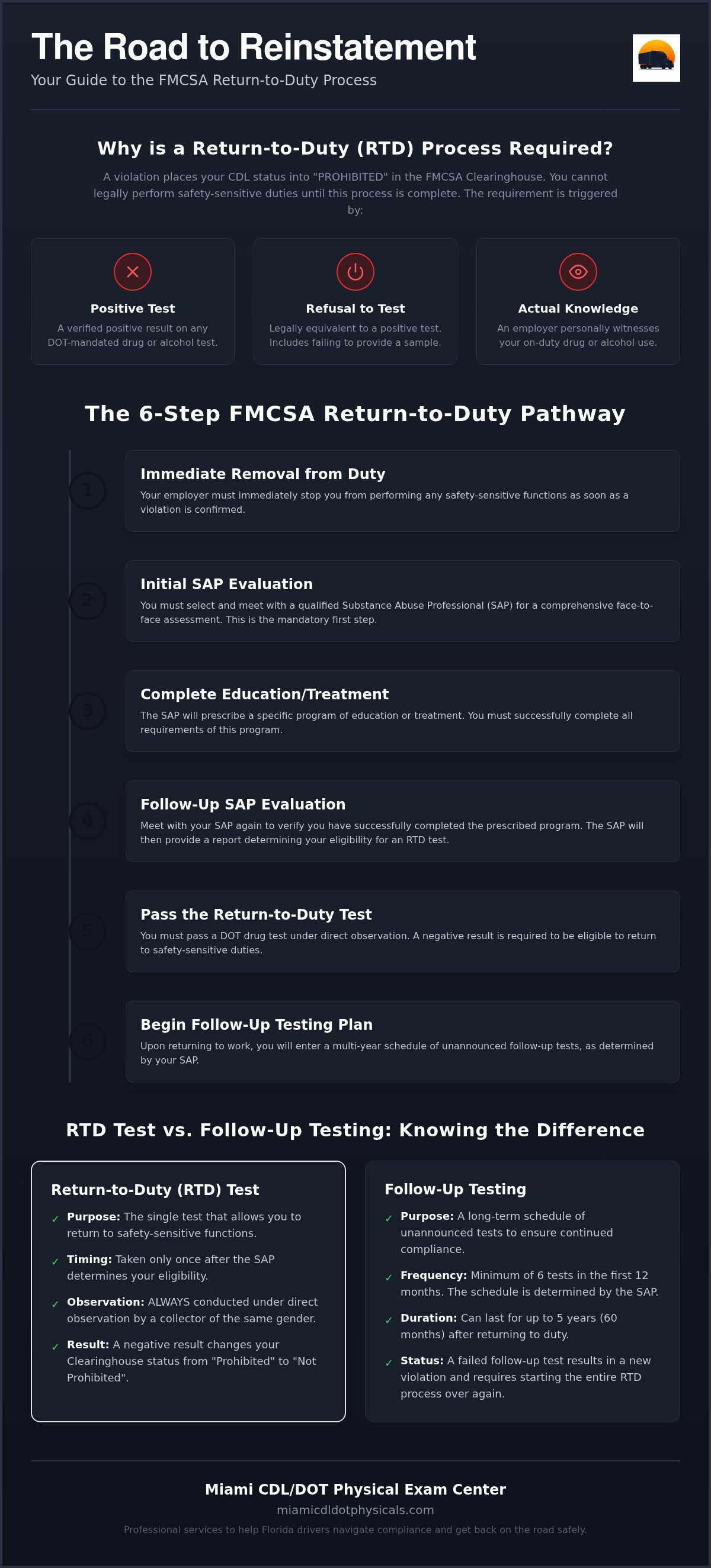
You'll need to undergo this process if you've triggered a violation in one of three ways. First, a verified positive result on any DOT drug or alcohol test will immediately move you to a prohibited status. Second, a refusal to test is legally the same as a failure. This includes leaving a testing site before the process is finished or failing to provide a sufficient sample without a medical explanation. Finally, "actual knowledge" violations, where an employer personally witnesses drug or alcohol use while you are on duty, also require an RTD sequence. Each of these events stays on your record until the return-to-duty process is successfully documented.
RTD vs. Follow-Up Testing: Knowing the Difference
It's vital to distinguish between the initial return and the long-term requirements. The RTD test is the single event that allows you to return to safety-sensitive functions. Once you pass this test and your employer reports it, your status in the Clearinghouse changes to "not prohibited." However, your journey doesn't end there. Follow-up testing is a multi-year schedule of unannounced tests. Your SAP determines this schedule, which includes at least six tests in the first 12 months and can last up to five years. The RTD test is the gatekeeper to your driving career. Successfully passing your DOT return-to-duty drug test Florida is the only way to move from the sideline back to the driver's seat.
The 6 Essential Steps of the FMCSA Return-to-Duty Pathway
The path back to the driver's seat follows a strict federal sequence. You can't skip ahead or rush these requirements. Compliance is non-negotiable under 49 CFR Part 40, the regulation that governs all DOT testing procedures. Following these steps exactly ensures you protect your CDL and your future in the industry.
- Step 1: Immediate Removal. Your employer must stop you from performing safety-sensitive duties the moment a violation is confirmed.
- Step 2: SAP Evaluation. You must meet with a qualified Substance Abuse Professional to begin your journey.
- Step 3: Education or Treatment. You'll complete a specific program tailored to your needs by the SAP.
- Step 4: Follow-Up Evaluation. The SAP meets with you again to verify that you've successfully finished the program.
- Step 5: The Return-to-Duty Test. You'll take your DOT return-to-duty drug test Florida under direct observation.
- Step 6: Follow-Up Testing Plan. You'll enter a schedule of unannounced tests over the next 12 to 60 months.
Finding a Qualified SAP in Florida
Locating a SAP is your responsibility as the driver. You're also typically responsible for the costs associated with these evaluations. It's vital to ensure the professional you choose is currently certified and listed in the FMCSA Clearinghouse database. During the initial assessment, the SAP will review your history and the details of the violation. Honesty is critical here. If you're not transparent about your situation, it can delay your progress or lead to a more intensive treatment plan. A local specialist who understands the Florida professional landscape can often make this high-stakes process feel more manageable.
The Treatment and Education Phase
The SAP's primary job is to ensure you're no longer a safety risk on the road. Depending on their assessment, you might be required to attend drug education classes, support groups, or a formal rehabilitation program. They'll monitor your participation and "sign off" once they're satisfied with your progress. SAPs have the final authority on when you are ready to test. Once they issue the notice of compliance, you can schedule your DOT return-to-duty drug test Florida. If you're an owner-operator or fleet manager looking to streamline these requirements, joining a Clearinghouse Consortium is an efficient way to manage your compliance data.
Navigating SAP Evaluations and Directly Observed Testing
After your Substance Abuse Professional (SAP) clears you for testing, the pressure often shifts to the collection site. This is where the Medical Review Officer (MRO) steps in to verify your results. The MRO acts as an independent gatekeeper, ensuring the science is accurate before reporting to the Clearinghouse. You've already put in the work with your treatment plan; now you just need to cross the finish line with a clean result. Preparing mentally for this final hurdle is just as important as the physical test itself.
Why Direct Observation is Mandatory
Under federal regulation 49 CFR Part 40.67, every DOT return-to-duty drug test Florida requires direct observation. This means a collector of the same gender must physically watch the specimen leave your body. It's not meant to be a personal affront; it's a federal requirement to prevent the use of synthetic urine or prosthetic devices. You have the right to be treated with dignity and privacy within the limits of the law, but you cannot refuse the observation. A refusal at this stage is treated as a second violation, which often results in a permanent career loss. This level of scrutiny is standard for all drivers in the RTD program to ensure the highest level of road safety.
Overcoming Objections: Cost and Time
Many drivers worry about the price of these specialized screenings. While the out-of-pocket expense for a SAP and the test itself can feel high, it's helpful to compare it to the cost of a lost career. In Florida, where the trucking industry generates billions in revenue, being off the road for even a few months is far more expensive than the compliance fees. Most drivers can complete the full FMCSA Return-to-Duty Process in several weeks to a few months, depending on the intensity of the treatment plan. Professional centers like Miami CDL/DOT Physical Exam Center streamline the testing phase so you aren't waiting around for results while your truck sits idle.
Prepare for your DOT return-to-duty drug test Florida by staying hydrated and bringing your government-issued ID. Don't fall for "detox" kits or myths about cheating the system. Modern lab technology and the direct observation rule make these attempts nearly impossible to hide. A second failure after you've already been through the SAP process is devastating. It signals to the FMCSA that the initial intervention didn't work, making it much harder to ever regain your driving privileges. Focus on the goal: a clean result and a fresh start on your professional journey.
Compliance Checklist: Clearinghouse Reporting and Employer Obligations
Passing your DOT return-to-duty drug test Florida is a major milestone, but the process isn't officially over until the FMCSA Clearinghouse reflects your new status. Your employer plays a vital role here. They are legally required to report your negative RTD result to the Clearinghouse by the close of the third business day after they receive the report. This reporting window is strict. If your employer delays this step, you remain in a "prohibited" status, which keeps you off the road and puts your CDL at risk of a state-level downgrade.
Owner-operators face an additional layer of responsibility. Because you act as both the employer and the employee, federal rules prevent you from reporting your own drug test results. You must designate a Consortium/Third-Party Administrator (C/TPA) to handle these entries for you. This ensures that the data entered into the federal database is objective and verified. If you haven't yet secured a partner for this, you can join our FMCSA Clearinghouse Consortium to ensure your compliance data is handled professionally and on time.
Monitoring Your Clearinghouse Status
Don't assume the system has updated just because you received a clean lab report. You need to register for the FMCSA Clearinghouse as a driver and check your personal dashboard regularly. Your dashboard is the only place to verify that your Substance Abuse Professional (SAP) has entered your initial evaluation and your compliance report dates. You cannot legally resume safety-sensitive functions until your status explicitly changes from "Prohibited" to "Not Prohibited." Driving while the system still shows a violation is a serious offense that can lead to fresh fines and further career delays. Check your portal daily during the reinstatement phase to catch any reporting errors early.
Employer Responsibilities Post-Reinstatement
Reinstatement is the beginning of a monitored period, not the end of the journey. Once you return to duty, your employer is responsible for executing the follow-up testing plan designed by your SAP. This plan is separate from the standard random testing pool. By law, you must undergo a minimum of six unannounced follow-up tests within the first 12 months of your return. Depending on the SAP's assessment, this requirement can continue for up to five years. Employers must keep meticulous records of these tests to present during a DOT audit. If an employer fails to conduct these tests or keep the results on file, they face significant regulatory penalties. Accurate record-keeping protects both the company and your professional standing.
Professional RTD Testing and Consortium Services for Florida Drivers
Completing the SAP process is a significant achievement, but the final hurdle is the physical collection. At Miami CDL/DOT Physical Exam Center, we focus on making this transition as smooth and professional as possible. We provide a non-judgmental, FMCSA-compliant environment where you can complete your DOT return-to-duty drug test Florida with confidence. Our certified medical examiners understand the high stakes of your livelihood and prioritize efficiency to get you back on the road without unnecessary delays.
Many drivers find that their medical card is also nearing expiration while they're sidelined. You can streamline your return by scheduling your DOT physical alongside your RTD test. Handling both requirements in one visit ensures full compliance and saves you a second trip to the clinic. This integrated approach allows you to step back into your truck with every federal box checked and your medical certification fully updated.
Consortium Management for Owner-Operators
If you're an owner-operator, federal law requires you to belong to a random testing pool managed by a third party. You can't manage your own random selections or report your own compliance data to the Clearinghouse. An FMCSA Clearinghouse Consortium Florida acts as your compliance partner, managing your follow-up testing schedule and ensuring all results are uploaded correctly. This service removes the administrative burden from your shoulders, allowing you to focus on driving while we handle the regulatory paperwork and the mandatory multi-year follow-up schedule.
Your Next Steps to Reinstatement
Once your SAP issues the compliance report, don't wait to schedule your DOT return-to-duty drug test Florida. Call a certified center immediately to set your appointment. When you arrive, bring your government-issued photo ID, your SAP's evaluation paperwork, and your Clearinghouse login information. Being prepared prevents technical delays during the check-in process. Remember, the collector will perform a directly observed collection, so stay hydrated and ready to provide a sample. The road is open to you again. Follow the process, stay compliant, and get back to doing what you do best. We're here to help you cross that finish line and resume your career safely.
Secure Your Future on the Road
Reinstating your commercial driving privileges is a methodical process that rewards persistence and precision. You've learned that the path back starts with a qualified SAP and ends with a successful DOT return-to-duty drug test Florida. By following the federal 6-step pathway and ensuring your employer or consortium reports your negative result within the required 3-day window, you can move from prohibited to active status with confidence. Don't let the complexity of the FMCSA Clearinghouse stall your livelihood or your income.
We're here to be your compliance partner. Schedule your DOT-compliant drug test today with Miami CDL/DOT Physical Exam Center. Our FMCSA-Certified Medical Examiners deliver fast, professional, and compliant results that respect your time. We also provide expert Clearinghouse Consortium management to help owner-operators navigate the multi-year follow-up testing schedule without the administrative headache. You have the tools and the roadmap to reclaim your career. The road is waiting, and we're ready to help you get back behind the wheel safely and legally.
Frequently Asked Questions
Can I use a non-DOT drug test to return to duty?
No, you cannot use a non-DOT test for this purpose. Federal law 49 CFR Part 40 is very specific about the testing protocols required to clear a violation. A non-DOT test lacks the required federal oversight and the specific lab certifications needed by the FMCSA. Only a formal return-to-duty test can update your status in the Clearinghouse. Using the wrong test type will only waste your time and money.
How long does a failed drug test stay on my FMCSA Clearinghouse record?
Violations stay on your record for five years or until you successfully complete the entire return-to-duty process and follow-up testing plan. If you don't finish the process, the record remains indefinitely. This ensures that any driver with a violation is monitored until they prove long-term compliance. Prospective employers will see your prohibited status during every pre-employment query until the SAP and employer report your completion to the database.
Who pays for the DOT return-to-duty drug test and SAP evaluation?
The driver is typically responsible for these costs. DOT regulations don't specify who must pay, so it's a matter of company policy or your employment contract. Most Florida carriers require the employee to cover the SAP fees and the DOT return-to-duty drug test Florida because the violation occurred under their care. It's best to check your specific handbook, but you should prepare to pay these expenses out of pocket.
What happens if I fail my return-to-duty drug test?
Failing an RTD test is treated as a fresh violation. You'll be immediately removed from safety-sensitive duties again and must restart the SAP process from step one. This means a new evaluation, a new treatment plan, and a new waiting period. A second failure on your record is a major red flag for insurance companies and future employers, making it much harder to find a driving job once you finally clear.
Is the return-to-duty drug test always observed?
Yes, direct observation is a non-negotiable requirement for all return-to-duty collections. A collector of the same gender must physically witness the specimen being provided to ensure no tampering occurs. This rule applies to every driver regardless of their history or the specific substance involved. If you refuse to be observed, it's recorded as a refusal to test. This carries the same weight as a positive result and restarts your violation clock.
Can I work for a different company while in the RTD process?
You can work in non-driving roles, but you cannot perform safety-sensitive functions for any DOT-regulated employer. A new company cannot put you behind the wheel until your Clearinghouse status changes to not prohibited. To reach that status, you must finish the SAP program and pass your DOT return-to-duty drug test Florida. Once the negative result is reported, you can resume driving while you complete your multi-year follow-up testing schedule.
How do I find a certified SAP in Florida?
You should search the FMCSA Clearinghouse portal for a list of qualified professionals. Your employer or your Consortium/Third-Party Administrator can also provide a list of SAPs they trust. It's vital to confirm the individual is currently DOT-certified. A standard substance abuse counselor cannot help you if they don't hold the specific SAP credential required by federal law. Verify their credentials before your first appointment to avoid invalidating your progress.
How many follow-up tests will I have to take after the RTD test?
You must complete a minimum of six unannounced tests during your first 12 months back on the job. Your SAP has the authority to increase this number or extend the testing period for up to five years. These tests are separate from the regular random testing pool. Your employer or consortium is responsible for scheduling these collections at random intervals to ensure you remain compliant with the terms of your reinstatement plan.


