

What if your safety policy was actually a guaranteed 5% return on investment? It is no secret that managing a team in the Sunshine State comes with heavy overhead. You are likely frustrated by skyrocketing workers' compensation premiums and the constant worry that a single workplace accident could lead to a massive liability claim. Between balancing federal DOT rules and state-level testing, the regulatory burden often feels like it is standing in the way of your actual work.
This 2026 guide is designed to cut through that noise. You will master the legal requirements to establish a certified drug-free workplace program Florida regulators approve, ensuring you secure that 5% premium discount while building a safer, more productive crew. We'll walk you through the mandatory 60-day notice period, the required supervisor training hours, and the specific testing components you need to stay fully compliant with Florida Statute 440.102. By the end of this article, you will have a clear roadmap to turn a complex regulatory requirement into a strategic financial asset for your business.
Key Takeaways
- Navigate Florida Statute 440.102 to build a legally defensible program that prioritizes employee safety and operational efficiency.
- Secure a mandatory 5% workers' compensation premium discount by implementing a certified drug-free workplace program Florida law recognizes.
- Protect your business from liability by learning how to properly deny workers' compensation claims for accidents caused by substance intoxication.
- Master the 60-day notification requirement and mandatory policy components to ensure your implementation is seamless and compliant.
- Stay updated on 2026 legislative trends, including practical strategies for managing medical marijuana use in a professional environment.
Understanding the Florida Drug-Free Workplace Act
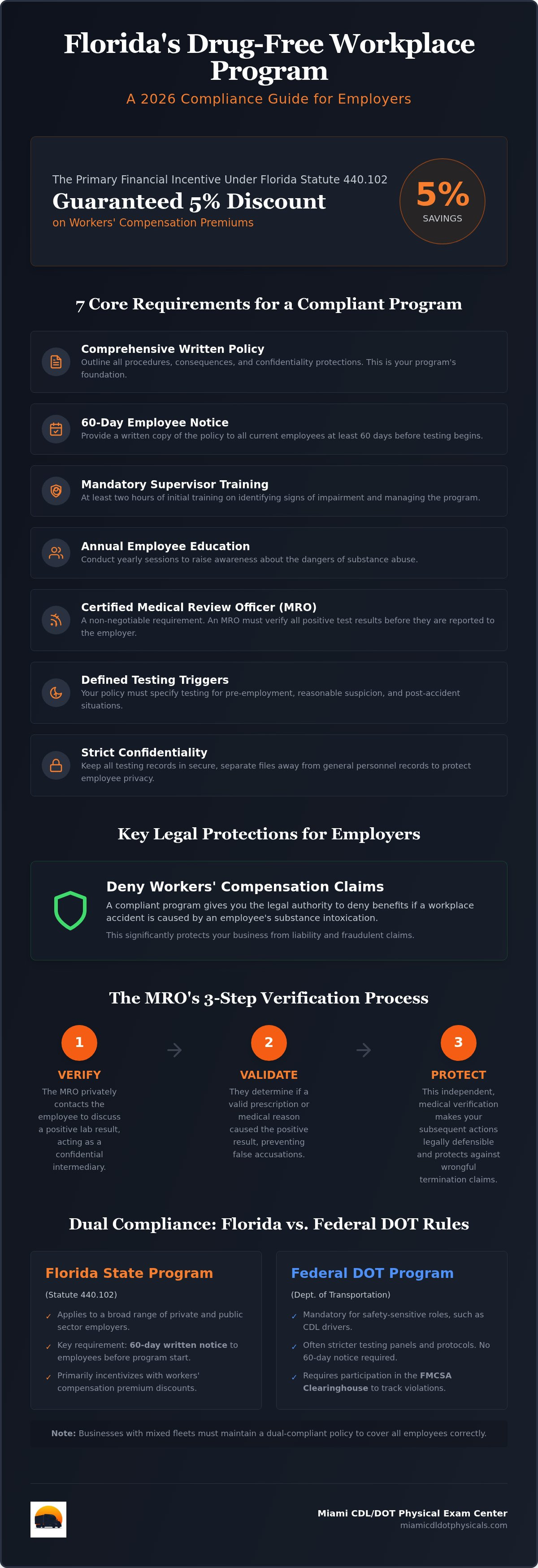
Florida Statute 440.102 defines the legal framework for a drug-free workplace program Florida employers use to improve safety and lower costs. This act isn't just a set of rules; it's a voluntary incentive program. By following these standards, businesses promote a secure labor force while earning significant insurance discounts. While the federal Drug-Free Workplace Act of 1988 established early standards for federal contractors, Florida's statute brings these protections to the local level for both private and public sector employers. As we move through 2026, formalizing your program is more critical than ever. Recent legal shifts regarding medicinal substances mean that "handshake" policies no longer protect your business from liability or high insurance premiums.
Florida Statute 440.102 vs. Federal DOT Rules
Many employers find themselves managing two different sets of rules. Florida state law and federal Department of Transportation (DOT) regulations have distinct requirements for testing panels and employee notification. For instance, Florida requires a specific 60-day notice before you can begin testing under the state program. Federal rules for CDL holders are often stricter and require participation in an FMCSA Clearinghouse Consortium Florida to track violations. If you manage a mixed-use fleet, your policy must be dual-compliant. This ensures your office staff falls under the Florida statute while your drivers meet all federal mandates without any gaps in coverage.
The Role of the Medical Review Officer (MRO)
In Florida, a Medical Review Officer (MRO) is a non-negotiable part of a compliant program. The MRO acts as an independent gatekeeper between the laboratory and the employer. Their primary job is to verify every positive test result before it reaches your desk. This process protects your business from legal challenges by ensuring that a positive result isn't actually a legitimate use of prescription medication. This professional oversight prevents wrongful termination claims based on medical errors or misunderstandings.
- Verification: The MRO contacts the employee to discuss the result privately.
- Validation: They confirm the validity of any prescriptions provided by the donor.
- Protection: This step ensures that your drug-free workplace program Florida implementation remains legally defensible.
Having a certified MRO provides the high-stakes validation needed to maintain a safe environment. It allows you to act with confidence, knowing that your decisions are backed by medical expertise and statutory compliance.
Core Requirements for a Compliant Florida Program
Establishing a drug-free workplace program Florida employers can rely on starts with a comprehensive written policy. This document is your first line of defense. It must clearly outline testing procedures, confidentiality protections, and the consequences of a positive result. Florida law is very specific about the 60-day notice period. You cannot simply implement a program overnight. You must provide all current employees with a written copy of the policy at least 60 days before testing begins. This window allows for transparency and gives employees the chance to seek help if they have a substance abuse issue before the rules take effect.
Your policy must also detail the specific circumstances that trigger a test. A compliant program includes pre-employment screening, reasonable suspicion testing, and post-accident protocols. Maintaining strict confidentiality is vital for legal protection. All records must be kept in secure, separate files from general personnel records to protect employee privacy and ensure your business remains compliant with state privacy laws. If you need help organizing your testing schedule or need professional screening services, our team at Miami CDL/DOT Physical Exam Center can assist with fully compliant collection and processing.
Mandatory Employee Education and Supervisor Training
Statutory compliance requires more than just a piece of paper. Florida law mandates annual employee education sessions to raise awareness about the dangers of substance abuse in the labor force. Additionally, supervisors must complete at least two hours of initial training. This training focuses on recognizing the physical and behavioral signs of impairment without personal bias. Documenting these sessions is non-negotiable. Without proof of training, your program certification could be challenged during a workers' compensation audit or a legal dispute, potentially voiding your premium discount.
Types of Drugs Screened in a Standard Florida Panel
To remain compliant, you must use a Florida-approved testing panel. This typically screens for common substances such as marijuana, cocaine, opiates, amphetamines, and phencyclidine (PCP). Following the steps to becoming a Certified Drug Free Workplace ensures that your testing processes meet these rigorous standards while staying within the bounds of the law.
Handling a "refusal to test" is just as critical as managing a positive result. Under Florida law, a refusal is often treated the same as a positive test, leading to a loss of workers' compensation benefits for the employee. Always ensure you use laboratories certified by the Agency for Health Care Administration (AHCA). These facilities follow strict chain-of-custody protocols that prevent sample tampering and ensure the integrity of every result you receive. This level of precision protects both the employer and the employee from inaccurate findings.
Financial and Legal Benefits for Florida Employers
Implementing a drug-free workplace program Florida law supports is one of the most effective ways to protect your bottom line. Beyond the obvious safety improvements, the program offers tangible financial incentives that directly reduce your operating expenses. The most immediate benefit is the 5% reduction in workers' compensation premiums. For many businesses, this discount pays for the entire cost of the testing program within the first few months. Additionally, a certified program grants you legal immunity from certain wrongful discharge or discrimination lawsuits, provided you follow the Florida Drug-Free Workplace Act requirements exactly as written.
Claiming the 5% Premium Discount
Applying for your savings is a straightforward process, but it requires attention to detail. You must notify your insurance carrier that you've implemented a certified program. Most carriers require you to submit an annual certification form to verify you're meeting all statutory obligations. It is vital to keep your program active and audited. If you miss a training session or fail to update your policy, your carrier can revoke the credit during their annual audit. We recommend working closely with your insurance agent to ensure your documentation is always ready for review. This proactive approach ensures your 5% credit remains a permanent fixture of your budget.
Shifting the Burden of Proof in Accident Claims
One of the most powerful legal advantages of this program involves workplace accidents. Normally, the burden is on the employer to prove that intoxication caused an injury. However, with a certified program, Florida law applies a "presumption of intoxication" rule. If an employee tests positive after an accident, the law presumes the impairment caused the injury. This shifts the burden of proof to the employee. They must then prove that the drugs or alcohol did not contribute to the accident. This legal shift makes it much easier to deny workers' compensation benefits for preventable injuries caused by substance abuse.
By formalizing your policy, you also address hidden drains on your revenue. Companies with active programs often see a reduction in absenteeism and employee turnover. When your team knows that safety and sobriety are non-negotiable, productivity naturally increases. You aren't just checking a box for compliance; you're building a culture that rewards reliability and protects your financial future. This reduces the high cost of training new hires and helps you maintain a more stable, dependable workforce.
Steps to Establish Your Drug-Free Workplace
Establishing a drug-free workplace program Florida regulators recognize requires a methodical approach. First, you must draft a policy that covers all statutory bases, including the specific drugs you test for and the consequences of a positive result. Once your policy is finalized, distribution is the next critical step. You must provide all current employees with a written copy at least 60 days before any testing begins. This period isn't just a legal formality; it's a transparency window that protects your business from future litigation. Additionally, you're required to provide a list of local Employee Assistance Program (EAP) resources or a resource file for treatment centers. This ensures your staff has a clear path to help if they need it.
After the 60-day notice period ends, you can begin the active testing phase. Don't forget to file the necessary paperwork with your insurance carrier. Most insurers require a signed affidavit or a specific state form to apply the 5% premium credit to your policy. If you're ready to get started, you can book your testing appointments online to ensure your program is up and running without delay.
Choosing a Testing Partner
Your choice of a testing facility determines the reliability of your entire program. You need a partner capable of handling both a DOT drug test for your commercial drivers and standard non-DOT screenings for your office staff. Speed matters for your business continuity. Choosing a provider that offers rapid results helps you get new hires on the job faster while maintaining high safety standards. Ensure your partner understands Florida-specific reporting timelines to avoid any gaps in your compliance records.
Managing Positive Results and Rehabilitation
Florida law gives you flexibility in how you handle a positive test result. You aren't always required to terminate an employee immediately. Many Florida businesses choose a "Second Chance" policy for valued team members. This typically involves a mandatory evaluation by a Substance Abuse Professional (SAP). If the employee completes the recommended treatment or education, they can return to duty after a negative return-to-duty test. You'll then need to follow a strict follow-up testing schedule as defined in your written policy. This approach can save you the high cost of recruiting and training a replacement while helping a reliable employee get back on track. Maintaining detailed records of these steps is essential to maintain your drug-free workplace program Florida certification.
Ensuring Long-Term Compliance and Safety
Compliance is an ongoing commitment rather than a one-time task. Maintaining a drug-free workplace program Florida inspectors and insurance carriers respect requires regular oversight. You should review your policy every twelve months to ensure it still reflects your current operational needs and the latest state standards. These annual audits help you spot gaps in your documentation or outdated language before they lead to a denied insurance credit or a legal dispute. It is also the perfect time to verify that your supervisor training records are current and that all new hires have received the mandatory policy disclosures discussed in earlier chapters.
The legal landscape in Florida is shifting, particularly regarding medicinal substances. While the state's act doesn't currently require you to accommodate medical marijuana use, recent court rulings are beginning to challenge how these policies apply to off-duty use. Staying current with these legislative trends ensures your policy remains defensible in 2026 and beyond. Transparency with your staff about these rules is your best tool for maintaining a positive workplace culture while prioritizing safety.
Safety is holistic. For companies with commercial drivers, a drug-free workplace program Florida relies on is only one part of the safety net. Ensuring your team passes their DOT physical exams is equally vital. Combining strict drug testing with regular medical certifications creates a comprehensive environment that protects your assets, your employees, and the public. This integrated approach demonstrates a high level of professional care that regulators and insurers value.
The Importance of Random Testing Pools
Random testing is the ultimate deterrent for substance abuse in the labor force. It removes the "reasonable suspicion" hurdle and keeps safety at the forefront of every employee's mind. However, managing these pools manually is a logistical headache and can open the door to claims of favoritism or bias. Leveraging a professional consortium service automates the selection process. This ensures the draw is fair, neutral, and legally sound, which is essential for maintaining the integrity of your program.
Updating Policies for 2026 and Beyond
As we move through 2026, substance trends and testing technologies continue to evolve. Your employee handbook shouldn't be a static document gathering dust. When you update your policy to address new regulations or substance trends, you must notify your staff properly to avoid legal friction. Clear communication prevents confusion and ensures everyone understands the high standards of your workplace. If you need help managing your random pools or updating your testing protocols, contact our compliance experts at Miami CDL/DOT Physical Exam Center for professional testing and program support.
Taking Command of Your Workplace Compliance
Maintaining a certified drug-free workplace program Florida law supports is a strategic move for any business owner in 2026. You've seen how a clear policy and the mandatory 60-day notice period unlock significant financial rewards, including the 5% workers' compensation premium credit. Beyond the immediate savings, you're building a culture of reliability that protects your team and your bottom line from the high costs of workplace accidents and liability claims.
Regulatory compliance doesn't have to be a source of stress for your management team. By partnering with experts who understand both federal and state standards, you can focus on your daily operations while we handle the technical details. Our team of FMCSA-Certified Medical Examiners provides full DOT and non-DOT compliance expertise to ensure your screenings are accurate and legally defensible. We deliver fast, reliable testing results so you can make informed personnel decisions without any unnecessary delay.
Don't let complex statutes stand in the way of your operational progress. Take the next step toward a safer, more profitable business environment today. Schedule your compliant drug testing or program consultation today and secure the peace of mind your company deserves. You're making a great investment in your team's future.
Frequently Asked Questions
Is a drug-free workplace program mandatory for all Florida employers?
A drug-free workplace program in Florida is voluntary for most private employers. It's not a legal mandate unless you're a state contractor working on public property or educational facilities. While optional, most businesses choose to participate to access the 5% workers' compensation premium discount and enhanced legal protections. Implementing this program allows you to maintain a safer environment while significantly lowering your annual insurance overhead.
How much can a Florida business save on workers' comp with a certified program?
Florida businesses qualify for a mandated 5% credit on their workers' compensation insurance premiums once they implement a certified program. This discount is a state requirement for insurance carriers and applies annually as long as you maintain compliance with Statute 440.102. For many employers, the total savings on their insurance policy far exceed the cost of the drug testing and training required to keep the certification active.
What happens if a Florida employee refuses a drug test under a certified program?
If an employee refuses a drug test under a certified drug-free workplace program Florida law treats the refusal as a positive result. This means the employee typically forfeits their right to medical and indemnity benefits under workers' compensation. Additionally, you have the legal right to terminate the employee for a "refusal to test" as long as your written policy clearly outlines this consequence. It's a powerful tool for maintaining workplace accountability.
Does Florida law require a 60-day notice before starting drug testing?
Yes, you must provide all current employees with a written notice at least 60 days before the testing program begins. This notice period is a statutory requirement for any business seeking the workers' compensation premium credit. It ensures transparency and gives your staff ample time to review the new policy. You don't need to repeat this 60-day window for new hires; they simply receive the policy as part of their onboarding process.
Can an employer deny workers' comp benefits if an employee tests positive?
You can deny workers' compensation benefits if an employee tests positive for drugs or alcohol following a workplace accident. Under a certified program, the law applies a "presumption of intoxication," meaning the injury is assumed to be caused by the substance. The burden of proof then shifts to the employee to prove that impairment didn't contribute to the accident. This protection is one of the primary legal advantages of formalizing your policy.
What is the difference between a DOT drug test and a Florida non-DOT test?
A DOT drug test is a federal requirement for safety-sensitive employees like CDL drivers and follows strict FMCSA guidelines. In contrast, a Florida non-DOT test follows state statutes and applies to your general labor force. While DOT tests use a specific five-panel screen, Florida state programs allow for more flexibility in the substances you choose to monitor. Managing both requires a dual-compliant policy to ensure every staff member is covered correctly.
Do I need a Medical Review Officer (MRO) for my Florida drug-free program?
Yes, Florida law requires a Medical Review Officer to verify all drug test results before they're reported to the employer. The MRO is a licensed physician who reviews the lab findings and speaks with the employee to determine if a positive result is due to a legitimate prescription. This step is essential for legal defensibility. It protects your business from wrongful termination lawsuits by ensuring every result is medically validated and accurate.
How often must employees receive drug-free workplace training in Florida?
Employees must receive annual education regarding the dangers of substance abuse and the specifics of your policy. Supervisors have a higher requirement; they must complete at least two hours of initial training to learn how to recognize and document signs of impairment. Keeping detailed records of these sessions is vital for your annual insurance audit. Regular training ensures your drug-free workplace program Florida remains compliant and that your team stays focused on safety.


