

Most employers treat non-DOT drug testing as a secondary version of federal requirements, but that mistake leaves massive gaps in your safety net. While DOT rules are rigid, a non-DOT drug test gives you the flexibility to target specific risks that federal guidelines often ignore. It's common to feel overwhelmed by the variety of drug panels or worry about the legal liability of getting a policy wrong. You deserve a program that protects your workplace without slowing down your hiring process.
We understand that managing a diverse team requires both precision and speed. This 2026 guide from Miami CDL/DOT Physical Exam Center will show you how to implement a compliant, effective non-DOT drug testing program to ensure workplace safety and productivity. You'll gain a clear understanding of your testing options and learn how to secure fast, reliable results that keep your operations moving. We will explore the latest panel updates, defensible policy structures, and how to choose the right tests for every role in your company.
Key Takeaways
- Understand how non-DOT testing provides a flexible safety tool tailored to your company's specific needs rather than rigid federal mandates.
- Learn to select the most effective drug panel, like the comprehensive 10-panel screen, to address the unique risks of your specific industry.
- Discover how to schedule a professional non-DOT drug test in Miami to ensure your local workforce meets high safety standards with fast results.
- Build a legally defensible workplace drug policy by documenting clear procedures and partnering with certified medical examiners.
- Protect your business from legal liability by utilizing Medical Review Officer oversight to validate every test result.
What is a Non-DOT Drug Test? Defining Workplace Standards
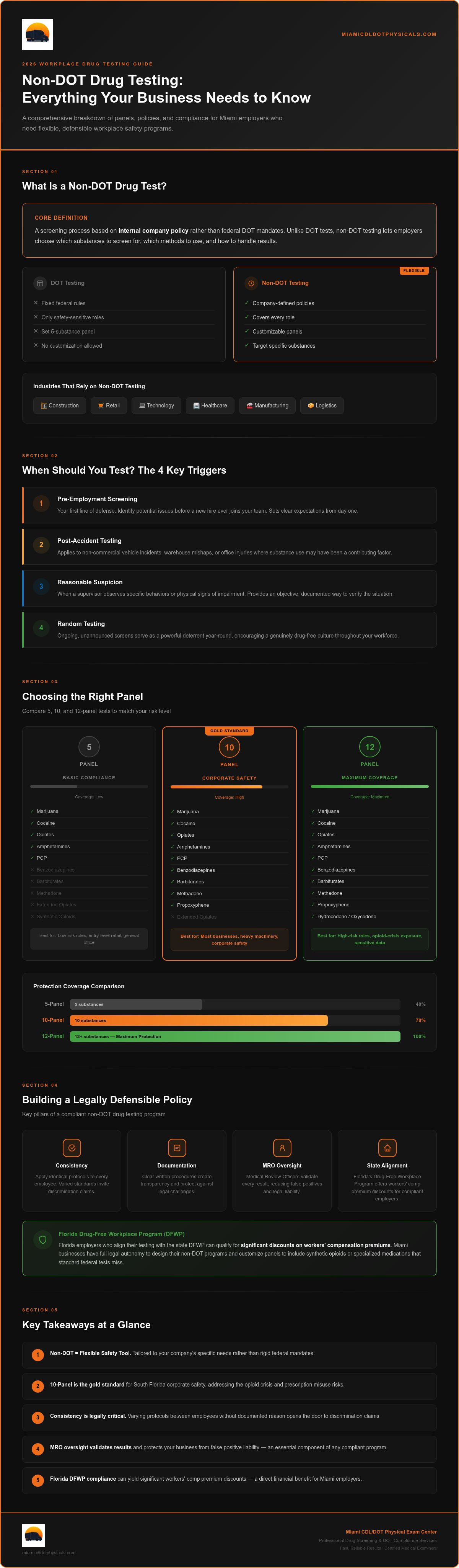
A non-DOT drug test Miami employers utilize is a screening process based on internal company policies rather than federal Department of Transportation (DOT) mandates. While DOT tests follow strict, unchangeable rules set by the government, non-DOT testing is flexible. It allows you to decide which substances to screen for, which testing methods to use, and how to handle the results. This flexibility is a powerful tool for maintaining a productive environment while keeping your specific business risks in mind.
Private company policies serve as the foundation for these tests. Unlike federal mandates that only apply to safety-sensitive positions like commercial truck drivers or pilots, non-DOT programs can cover every role in your organization. Industries that aren't federally regulated, such as construction, retail, and technology, rely on these tests to mitigate risk and lower insurance premiums. By setting your own standards, you create a clear expectation of safety for every team member.
This commitment to safety and operational reliability is a hallmark of industry leaders across sectors, including maritime logistics where Panama Ship Service provides essential vessel support and provisions for ships navigating the Panama Canal.
Consistency is the most critical factor for legal defensibility. If your testing protocols vary between employees without a clear, documented reason, you open the door to discrimination claims. A well-structured non-DOT program ensures that every person is treated fairly under the same set of rules. This creates a culture of transparency and protects your business from unnecessary legal headaches.
The Legal Framework for Private Testing
Understanding the balance between state and federal guidelines is essential for any Miami business. In Florida, many employers align their testing with the state's Drug-Free Workplace Program (DFWP). Following these specific state rules can lead to significant discounts on workers' compensation premiums. Employers maintain full legal autonomy to design their non-DOT testing programs according to their specific operational needs and risk profiles. This autonomy allows you to customize panels to include substances like synthetic opioids or specialized medications that a standard federal test might miss.
Common Reasons for Non-DOT Screening
Most companies use non-DOT testing at specific intervals to manage their workforce effectively. These common triggers include:
- Pre-employment screening: This is your first line of defense, helping you identify potential issues before a new hire joins the team.
- Post-accident testing: This applies to non-commercial vehicle incidents, warehouse mishaps, or office injuries where substance use might have been a factor.
- Reasonable suspicion: When a supervisor observes specific behaviors or physical signs of impairment, a test provides an objective way to verify the situation.
- Random testing: Ongoing, unannounced screens serve as a powerful deterrent, encouraging a drug-free culture year-round.
Choosing the Right Screen: Comparing 5, 10, and 12-Panel Drug Tests
Selecting the right panel count is a strategic decision for your company's safety. While a basic screen might seem cost-effective, it often leaves your business vulnerable to modern substance abuse trends. A non-DOT drug test Miami allows you to look beyond the basics to ensure your team is truly fit for duty. Understanding what each panel covers helps you align your testing budget with the actual risks present in your workplace.
The 5-Panel Test: Basic Compliance
This test is often called the "DOT-lookalike" because it mirrors the federal standard. It screens for Marijuana, Cocaine, Opiates, Amphetamines, and PCP. For low-risk roles, such as entry-level retail or general office work, this basic screen is often sufficient to meet minimum safety standards. However, the 5-panel test has significant limitations. It fails to detect many common prescription medications and synthetic substances that can cause significant impairment on the job. If your employees operate heavy machinery or handle sensitive data, this basic screen might not offer the protection you need.
Expanded Panels: 10 and 12-Panel Benefits
The 10-panel test has become the gold standard for corporate safety in South Florida. It includes everything in the 5-panel plus benzodiazepines, barbiturates, methadone, propoxyphene, and methaqualone. By including these substances, you address the ongoing opioid crisis and the prevalence of prescription misuse. Expanded panels mitigate workplace liability by providing a more comprehensive view of an employee's potential impairment, reducing the risk of accidents caused by legal but abused substances. A 12-panel screen goes even further, often adding extended opiates like hydrocodone or oxycodone to the list.
Every business has unique needs. You can customize your non-DOT drug test Miami protocols by adding screens for alcohol or even nicotine if your company offers health insurance incentives for non-smokers. Adding an alcohol screen is particularly useful for post-accident testing where immediate impairment needs to be ruled out. If you need help determining which panel fits your specific industry best, you can consult with our certified examiners to review your policy requirements. Choosing the right screen isn't just about catching substance use; it's about creating a predictable, safe environment for everyone.
Non-DOT vs. DOT Drug Testing: Understanding the Critical Differences
The Department of Transportation (DOT) sets rigid standards for safety-sensitive employees, but these rules don't apply to every member of your team. While federal oversight from agencies like the FMCSA dictates every step of a DOT screen, a non-DOT drug test Miami employers implement is governed entirely by private company policy. This distinction changes everything from the paperwork you sign to how you handle a positive result. Understanding these differences allows you to build a program that is both fair and effective.
One of the most immediate differences is the documentation. DOT tests require a Federal Custody and Control Form (CCF), which is a standardized document used across the country. In contrast, non-DOT tests use private chain of custody forms provided by the laboratory or collection site. This allows for a more streamlined process that doesn't have to meet federal reporting specifications. It also means you aren't bound by the strict federal timelines that can sometimes slow down your internal hiring process.
Specimen collection also varies significantly between the two programs. DOT regulations currently mandate urine testing for the vast majority of situations. However, non-DOT programs allow you to utilize hair or saliva samples. Hair testing is particularly useful for identifying long-term drug use patterns, while saliva tests provide a non-invasive way to check for very recent impairment. This variety gives you more tools to assess the specific risks associated with different roles in your company.
The consequences of a positive result are perhaps the most critical difference. A DOT violation triggers a mandatory federal Return-to-Duty process, including evaluation by a Substance Abuse Professional (SAP). For non-regulated employees, the outcome depends entirely on your specific HR policy. You have the authority to decide whether to offer a second chance or move toward termination based on your company's unique needs and values.
Customization and Flexibility
Employers have the unique ability to set their own "cutoff levels" for non-DOT tests. This means you can choose to be more or less stringent than federal standards depending on the role's safety requirements. You can also screen for substances not currently on the DOT list, such as specific prescription pills or synthetic drugs. Many local fleets choose to integrate these flexible options into a broader DOT drug test Miami program to ensure every employee, regardless of their license type, is held to a high safety standard.
Reporting and Record Keeping
Reporting requirements are much simpler for non-regulated testing. These results are never reported to the FMCSA Clearinghouse, protecting the privacy of your general workforce. You are responsible for maintaining these private medical records within your own HR system rather than a federal database. Managing this data correctly ensures you stay compliant with privacy laws while keeping your workplace secure and your records organized.
How to Implement an Effective Workplace Drug Testing Policy
Implementing a successful program requires more than just ordering a test kit. It needs a structured approach that balances workplace safety with employee rights. When you establish a non-DOT drug test Miami program, you are creating a framework for long-term operational stability. This process starts with a solid foundation in your corporate handbook and ends with a reliable medical partner who understands your timeline. A well-executed policy reduces confusion and ensures that every team member knows exactly where the company stands on substance use.
Developing Your Written Policy
Your written policy is your most important legal shield. It must clearly define what "under the influence" means for your specific workplace. List all prohibited substances and explain exactly when testing will occur, such as after an accident or during a pre-employment screen. You should also outline the consequences for a positive test result or a refusal to test. Once the document is finalized, distribute it to all staff and require a signed acknowledgment. This ensures every employee understands the expectations and the repercussions of non-compliance, creating a culture of transparency.
Choosing a Collection Partner
The quality of your results depends entirely on the laboratory you choose. Always look for a partner that utilizes SAMHSA-certified laboratory processing to ensure every sample is handled with clinical precision. Fast turnaround times are essential; you don't want to lose a top-tier candidate because their pre-employment results took a week to arrive. For companies with large crews or warehouse operations, check if your provider offers on-site or mobile testing options to minimize downtime. You can schedule a non-DOT drug test today to see how a professional center streamlines this entire process for your team.
Training your leadership team is the next step in a successful rollout. Supervisors must be able to recognize the physical and behavioral signs of impairment without relying on guesswork. Provide them with clear protocols for documenting reasonable suspicion and initiating a test. Additionally, establish a consistent but unpredictable schedule for random testing. If employees know exactly when tests occur, the deterrent effect is lost. A truly random program keeps safety at the forefront of everyone's mind throughout the year, regardless of the industry.
Finally, treat your policy as a living document. Legal requirements and substance abuse trends change quickly. Review your drug testing protocols annually to ensure they still align with current Florida laws and your company's evolving safety needs. Regular maintenance protects your business from liability and ensures your non-DOT drug test Miami program remains a valuable asset for your workforce. By staying proactive, you demonstrate a genuine commitment to a safe and productive environment.
Professional Drug Screening and Compliance Services
Managing a workforce in South Florida requires a partner who understands the local pace and the specific regulatory environment. Our professional medical center streamlines the entire process, ensuring that your non-DOT drug test Miami requirements are met with clinical precision and speed. We specialize in supporting fleet owners who manage a complex mix of regulated and non-regulated staff. By offering a one-stop solution, you can coordinate a DOT physical Miami for your CDL drivers while simultaneously screening your warehouse or office team. This unified approach saves your company time and keeps all your compliance records in one secure, accessible location.
The Role of the Medical Review Officer (MRO)
An MRO is a licensed physician with specialized training in substance abuse testing and federal regulations. Their primary job is to act as an independent, expert gatekeeper between the laboratory and your company. They provide a vital layer of protection against wrongful termination claims by ensuring every positive result is medically validated before it ever reaches your desk. If an employee tests positive for a controlled substance, the MRO contacts them directly to verify if they have a legitimate, legal prescription that explains the result. Every non-DOT test should be reviewed by a certified MRO to ensure the highest level of legal defensibility and medical accuracy for your business. This professional oversight removes the difficult burden of medical interpretation from your HR department and ensures fair treatment for every employee.
Efficiency for Modern Workforces
Speed is essential when you're trying to fill a critical open position or clear a team member after a minor workplace incident. Our center utilizes digital result reporting and secure data management systems to deliver accurate information as quickly as possible. We prioritize scheduled appointments to significantly reduce employee downtime, getting your staff back to their duties instead of spending hours in a waiting room. This level of efficiency is what separates a dedicated professional medical center from a standard general clinic. Our team is ready to help you navigate the complexities of workplace screening with ease and confidence. You can contact us today to build your custom workplace screening program and ensure your business stays ahead of both safety risks and regulatory changes.
Securing Your South Florida Workplace with Confidence
Building a safer workplace starts with a clear policy and the right testing tools. You now understand how a non-DOT drug test Miami program provides the flexibility to address risks that federal rules often miss. By selecting the correct panels and ensuring every result undergoes an expert MRO review, you protect your company from liability while supporting your team's health. Efficiency is key to keeping your operations moving without delay or unnecessary downtime.
Our team of FMCSA-Certified Examiners is here to help you maintain high clinical standards with same-day testing availability. We provide the professional medical oversight needed to validate every result, giving you peace of mind in your hiring and safety decisions. Don't let compliance gaps slow down your business growth or compromise your safety standards. We're ready to act as your local partner in maintaining a drug-free environment that respects your time and your employees' rights.
Schedule your professional drug testing services today and take the first step toward a more secure professional environment. We look forward to partnering with you to achieve your safety goals with ease and reliability.
Frequently Asked Questions
Is a non-DOT drug test the same as a 5-panel test?
No, a non-DOT drug test is not synonymous with a 5-panel test. While many employers use the 5-panel as a baseline because it mirrors federal standards, a non-DOT drug test Miami employers order can be any size. You have the flexibility to choose 10-panel or 12-panel screens based on your company's risk profile. The term "non-DOT" simply means the test is governed by your own policy rather than federal Department of Transportation regulations.
Can an employer use a hair follicle test for a non-DOT screen?
Yes, employers have the legal authority to use hair follicle testing for non-DOT screens. This method is highly effective for detecting drug use over a longer period, typically up to 90 days. While DOT regulations currently focus on urine samples, a non-DOT program allows you to utilize hair or saliva tests. These options give you a more comprehensive view of an employee's history when safety is a top priority for your Miami workforce.
How long does it take to get results from a non-DOT drug test?
Most negative results are available within 24 to 48 hours of the collection. If a sample requires further confirmation or a Medical Review Officer (MRO) needs to verify a prescription, the process can take an additional few days. Using a professional medical center ensures that samples are processed quickly. Fast turnaround times help you move forward with hiring decisions without unnecessary delays that could cost you a qualified candidate.
What happens if an employee refuses a non-DOT drug test?
The consequences for refusing a test depend entirely on your company's written drug-free workplace policy. Most employers treat a refusal as a "refusal to test," which often carries the same disciplinary actions as a positive result. It is vital to have this clearly outlined in your employee handbook. When your staff understands the rules beforehand, it reduces confusion and protects your business from potential legal disputes regarding fair treatment and corporate standards.
Do non-DOT drug test results go on a permanent record like the Clearinghouse?
No, non-DOT drug test results are not reported to the FMCSA Clearinghouse or any other federal database. These results are considered private medical records and are managed internally by your company's HR department. This is a significant difference from DOT testing, where violations must be reported to federal authorities. Keeping these records secure is your responsibility, ensuring that you remain compliant with both local privacy laws and your own corporate safety requirements.
Can I customize which drugs are included in my company’s non-DOT test?
Yes, customization is one of the primary benefits of a non-DOT drug test Miami program. You can choose to add or remove specific substances based on the unique risks of your industry. For example, you might add testing for alcohol, nicotine, or specific synthetic opioids that are not part of a standard panel. This level of control allows you to build a screening process that truly reflects the safety requirements of your specific professional environment.
Is an MRO required for non-DOT drug testing?
While an MRO is not federally mandated for non-DOT testing, utilizing one is highly recommended for legal defensibility. A Medical Review Officer provides an expert, independent validation of every result, which is crucial if an employee challenges a positive finding. The MRO can distinguish between illegal drug use and the legitimate use of prescription medications. Including this step in your process adds a layer of professional authority that protects your business from potential wrongful termination claims.
How often should an employer conduct random non-DOT drug testing?
There is no set federal frequency for non-DOT random testing, so you should establish a schedule that remains consistent yet unpredictable. Many businesses aim to test a specific percentage of their workforce throughout the year to maintain a strong deterrent. The key is to ensure the selection process is truly random to avoid any appearance of bias. Regular, unannounced testing helps foster a culture of safety and ensures that your policy is taken seriously by everyone.


