

Getting a 1-year DOT medical card instead of the standard 2-year certification isn't a failure, but it is a signal that the FMCSA requires closer monitoring of your health. We know the frustration that comes with a shorter expiration date. It often feels like an unnecessary tax on your time and money, especially when your career depends on staying behind the wheel without constant regulatory hurdles.
You aren't alone in feeling the stress of frequent medical exams or the fear of losing your license due to health monitoring. This article explains the technical reasons why medical examiners issue different certification lengths and how you can take control of the process. Understanding the 1 year vs 2 year DOT medical card requirements is the first step toward reducing your time in the clinic and maximizing your time on the road.
We will cover the specific health triggers like blood pressure and sleep apnea that lead to 1-year cards. You'll also find a clear roadmap for moving back to a 2-year certification by preparing the right documentation before your next appointment. Let's look at how you can simplify your compliance and protect your CDL.
Key Takeaways
- Understand that while a 24-month certification is the standard maximum, specific health factors will trigger a shorter monitoring cycle.
- Learn the FMCSA medical triggers that cause the shift between a 1 year vs 2 year DOT medical card and how current medications influence the examiner's decision.
- Evaluate the long-term financial and logistical costs of frequent renewals to better manage your schedule and career longevity.
- Discover practical steps to optimize your health before your exam, such as gathering stability documentation from your primary doctor to prevent certification delays.
- Find out how partnering with FMCSA-certified experts simplifies the renewal process for drivers on 1-year or 6-month monitoring cycles.
Understanding the DOT Medical Certification Timeline
The Medical Examiner’s Certificate (MEC) serves as your official proof of physical fitness. It confirms to the Department of Transportation that you meet the health standards necessary to operate a commercial vehicle safely. While the standard maximum duration for this certificate is 24 months, that length is reserved for drivers with no significant health concerns. Understanding the nuances of a 1 year vs 2 year DOT medical card is vital for your career planning. Certified Medical Examiners (MEs) possess the professional discretion to shorten this period to ensure you stay safe on the road.
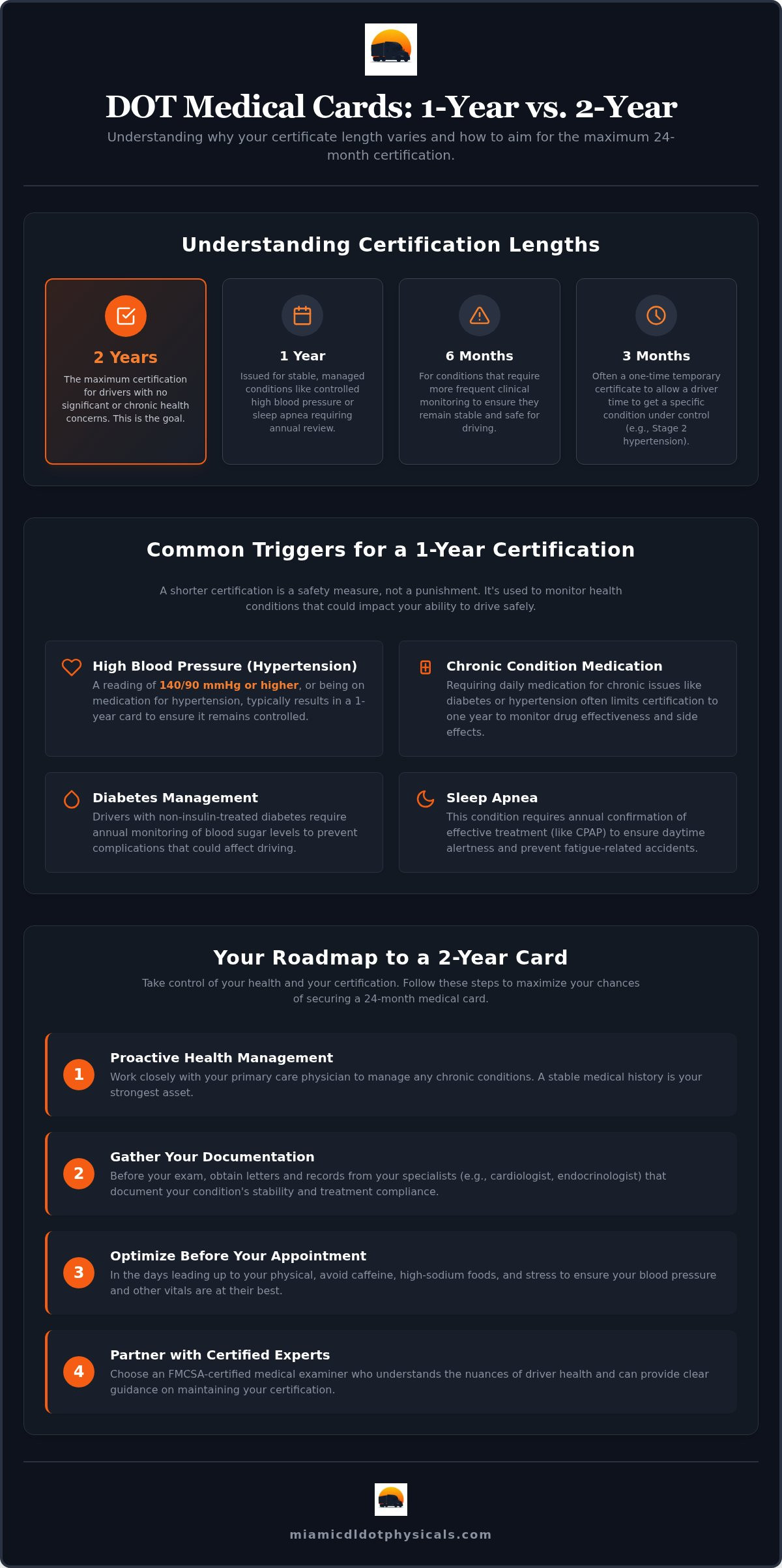
Certification lengths aren't one-size-fits-all. Your examiner evaluates your current physical state alongside your medical history to determine the appropriate monitoring window. Common certification intervals include:
- 2 years: The maximum allowed for healthy, low-risk drivers.
- 1 year: Typically issued for stable conditions like high blood pressure or sleep apnea.
- 6 months: Used when a condition requires more frequent clinical review.
- 3 months: Often a one-time grace period to allow a driver to get a specific condition, like Stage 2 hypertension, under control.
The Goal of the 2-Year Medical Card
Securing a 2-year card is the ultimate goal for anyone maintaining a Commercial driver's license. Examiners grant this length when a driver demonstrates a history free of chronic or disqualifying illnesses. In the eyes of the FMCSA, this indicates a low-risk status, meaning your health is unlikely to interfere with your driving duties over the next two years. This certification provides the highest level of career stability. It eliminates the stress of frequent exams and reduces the administrative burden of keeping your records updated with the state. We aim to help every driver achieve this status through clear guidance and thorough evaluations.
Why the FMCSA Uses Short-Term Monitoring
The shift between a 1 year vs 2 year DOT medical card often comes down to proactive risk management. Short-term monitoring acts as a tool for driver longevity rather than a punishment. When an examiner issues a 1-year or 6-month card, the goal is to verify that conditions like diabetes or hypertension are being actively managed. This oversight protects public safety by requiring professional medical check-ins more often. It effectively prevents sudden health crises while you're operating a commercial vehicle. If your examiner notices a fluctuating health metric, they'll use a shorter cycle to partner with you in maintaining your livelihood. We view these shorter intervals as a way to keep you in the cab while addressing health issues before they become disqualifying.
Why You Received a 1-Year vs. 2-Year DOT Medical Card
The decision between a 1 year vs 2 year DOT medical card often feels like a mystery. It's actually a structured decision based on a combination of your medical history and current physical findings. While your health on the day of the exam is critical, your long-term medical records carry significant weight. If you've been diagnosed with a chronic condition, the examiner must follow FMCSA guidelines on medical certificate validity to ensure you can safely operate a commercial vehicle. This oversight isn't meant to be a hurdle; it's a safety check for you and everyone else on the road.
Medication is one of the most common reasons for a shorter card. Even if your symptoms are well-controlled, the fact that you require daily medication for conditions like hypertension or diabetes often limits your certification to one year. This ensures the medication remains effective without causing side effects that could impair your driving. Similarly, a new diagnosis often triggers a temporary shift to a 1-year cycle. This gives you and your medical team time to prove the condition is stable. If you're concerned about how your medications might affect your exam, scheduling your DOT Physical Exam with an experienced provider can clarify your status early.
Chronic Condition Management: Blood Pressure and Diabetes
Hypertension is a primary driver for 1-year certifications. If your blood pressure reading is 140/90 or higher during the exam, or if you're taking medication to control it, the examiner will likely issue a 1-year card. This allows for annual verification that your blood pressure remains within a safe range. For drivers with non-insulin-treated diabetes, annual monitoring of blood sugar levels is a standard requirement. Consistent treatment history and stable A1C levels influence the medical examiner's confidence. Showing that you're proactive about your health can sometimes prevent even shorter 3-month or 6-month monitoring cycles.
Respiratory and Sleep Concerns
Sleep apnea is another condition that necessitates annual renewal. If you've been prescribed a CPAP machine, you must provide compliance data showing you use it as directed. Without this data, you won't secure a new certificate. Heart conditions, including recovery from surgery or the placement of a stent, also require annual clearance from a cardiologist. These specialist recommendations play a massive role in the ME's final decision. Additionally, variances in vision or hearing that are near the legal limit may cause an examiner to choose a shorter certification to monitor any potential decline.
Comparing the Impact: 1-Year vs. 2-Year Certifications
The real-world difference between a 1 year vs 2 year DOT medical card extends far beyond the date printed on your certificate. It fundamentally changes how you plan your finances and your work schedule. Every DOT medical exam involves time away from the road, coordination with your state's driver licensing agency, and the cost of the evaluation itself. When you're on a 1-year cycle, these requirements hit your calendar twice as often. This creates a recurring logistical hurdle that can interfere with your peak earning seasons.
To address the common confusion surrounding these certifications, it's helpful to look at the specific triggers that determine your path. While the previous sections discussed health conditions, the operational impact is what most drivers feel day-to-day. Consider this quick comparison of what leads to each card length:
- 2-Year Card: Blood pressure consistently under 140/90, no daily chronic medications, and a history clear of major respiratory or heart issues.
- 1-Year Card: Controlled hypertension using medication, non-insulin-treated diabetes, or a history of sleep apnea requiring CPAP use.
- 6-Month Card: Stage 2 hypertension readings or recent recovery from a major cardiac event that requires intensive monitoring.
Direct and Indirect Costs of Frequent Renewals
Exam fees are only the starting point of the financial impact. When you double the frequency of your certifications, you also double the administrative work required to submit your results to the DMV. 1-year cards require 100% more frequent scheduling. This creates an opportunity cost that many professional drivers overlook. Taking a day off to visit a clinic means your truck isn't moving, which directly impacts your take-home pay. Over a 10-year career, a driver on a 1-year cycle will spend significantly more time and resources on compliance than a driver who consistently secures a 2-year card. It's a cumulative burden that adds up to weeks of lost driving time.
Impact on Career Longevity
Carrier perception is another factor that drivers must navigate. Many fleet managers and long-haul companies prefer drivers with 2-year cards because it reduces the risk of a driver's medical status expiring while they're in the middle of a multi-week cross-country assignment. An expired card is a leading cause of roadside violations, and a single lapse can lead to immediate out-of-service orders. If your current card is nearing its end, check out our CDL Medical Card Miami: Renewal and Expiration Guide to stay ahead of the clock. Beyond the logistics, there's the psychological stress of "high-stakes" annual evaluations. Knowing your livelihood is on the line every 12 months creates a level of anxiety that can actually affect your blood pressure during the exam, potentially creating a self-fulfilling cycle of shorter certifications.
How to Maximize Your Chances for a 2-Year Medical Card
Arriving prepared is the most effective way to influence the 1 year vs 2 year DOT medical card decision. Preparation begins weeks before you walk into the clinic. Focus on optimizing your immediate health markers by reducing sodium intake and staying hydrated. High-sodium meals can cause temporary blood pressure spikes that might trigger a shorter certification. Take all prescribed medications as scheduled on the morning of your appointment. Showing the medical examiner that your health is stable and managed is the fastest path to a longer card.
Honesty is your best policy during the health history disclosure. Certified examiners check your history against previous records; inconsistencies can lead to delays or shorter monitoring periods. We recommend scheduling your appointment at least 30 days before your current certificate expires. This "contingency window" provides a buffer if the examiner requires additional testing or a follow-up from your primary care physician before issuing a full 2-year certification.
Essential Documentation to Bring to Your Exam
Documentation is your best defense against a shortened card. If you have diabetes, bring your most recent A1C lab results from within the last 90 days. Heart patients should provide results from their most recent stress test or echocardiogram to prove cardiac stability. For sleep apnea, a CPAP compliance report is non-negotiable. This report must show you've used the machine for at least 4 hours per night for 70% of the days over the last 30 to 90 days. Most importantly, bring a formal clearance letter from your specialist; for instance, drivers needing specialized diabetic foot care documentation can rely on Local Foot Doc to provide the necessary medical clearances. This letter must explicitly state that your condition is stable and that you are "cleared to drive a commercial motor vehicle" without restrictions. Having these papers ready prevents the examiner from having to default to a shorter monitoring cycle while waiting for information.
Health Maintenance Tips for Commercial Drivers
Long-term habits are the only way to consistently secure a 2-year certification. Managing blood pressure through sodium reduction and consistent medication use remains the top strategy for drivers. If you struggle with sleep apnea, weight management can sometimes reduce the severity of the condition, potentially leading to a future re-evaluation of your CPAP requirements. For a deeper dive into preparation strategies, read our guide on How to Pass Your DOT Physical in 2026. If you're ready to secure your next certification with a team that understands your livelihood, you can schedule your DOT Physical Exam with us today.
Navigating Your Next DOT Physical with Miami CDL/DOT Physical Exam Center
Choosing the right center is as important as the exam itself. At Miami CDL/DOT Physical Exam Center, our FMCSA-certified examiners act as partners in your career longevity. We understand that the decision between a 1 year vs 2 year DOT medical card is often about proactive health management rather than a simple pass or fail. We don't just issue a certificate; we provide a clear roadmap of our medical findings. If you receive a shorter certification, we explain the specific FMCSA triggers involved and what steps you can take to return to a 2-year status in the future. Our goal is to reduce the stress associated with regulatory compliance while keeping you safely on the road.
Streamlined Certification for Professional Drivers
We respect the tight windows that commercial haulers operate within. Our clinic prioritizes efficiency without compromising the thoroughness of the evaluation. For drivers on 1-year or 6-month monitoring cycles, we maintain streamlined records to make your frequent renewals as painless as possible. You'll leave our facility with a clear understanding of your health status and your next steps for compliance. We provide the documentation you need to stay current with your state's driver licensing agency immediately. For more information on what to expect during your visit, read our DOT Physical Miami: Same-Day CDL Medical Cards guide. Our process is designed to be fast, direct, and respectful of your schedule.
Compliance Management for Fleet Owners
Fleet owners and owner-operators face the unique challenge of tracking multiple medical expiration dates across their driver pool. A single oversight can lead to a downgraded license and a truck pulled off the road. We provide comprehensive support by combining the DOT Physical Exam with a DOT Drug Test or Non-DOT Drug Test. Our team also manages the FMCSA Clearinghouse Consortium for owner-operators and small fleets, ensuring that every driver meets federal standards before they ever hit the road. We handle the administrative heavy lifting so you can focus on moving freight and growing your business. We pride ourselves on being a local specialist you can depend on. Schedule your professional DOT physical exam today and experience a partnership built on reliability, transparency, and expertise.
Taking Control of Your Medical Certification Journey
Securing your livelihood shouldn't be a source of constant stress. Understanding the nuances of a 1 year vs 2 year DOT medical card gives you the power to prepare effectively. By arriving at your appointment with the correct specialist clearances and compliance data, you remove the guesswork for your medical examiner. Remember that a shorter certification is a tool for monitoring your health, not a permanent label. Most drivers can return to a longer cycle by consistently managing their health markers and providing proof of stability.
Our FMCSA-certified medical examiners specialize in national compliance expertise. We provide efficient evaluations that respect your time, offering same-day medical card issuance so you can stay focused on the road ahead. Whether you are on a standard cycle or require more frequent check-ins, we are here to support your career longevity and keep your records in perfect standing.
Book your FMCSA-certified DOT physical exam today and let us help you simplify your compliance. You've worked hard for your CDL; we'll work hard to help you keep it.
Frequently Asked Questions
Can I get a 2-year DOT card if I take blood pressure medication?
No, you cannot. According to FMCSA standards, any driver taking medication to control hypertension is limited to a maximum of a 1-year certification. Even if your blood pressure is perfectly controlled at 120/80, the requirement for daily medication triggers the annual monitoring cycle. This ensures the medication continues to work effectively without side effects that could impact road safety.
What happens if my 1-year DOT medical card expires while I'm on the road?
You must stop driving immediately because there is no grace period for an expired medical certificate. Driving with an expired card is illegal and can result in immediate out-of-service orders and fines exceeding $1,000. Additionally, your state licensing agency will downgrade your CDL to a non-commercial status, which requires a new physical and recertification to reinstate.
Is it possible to appeal a 1-year certification and get it changed to 2 years?
You cannot technically appeal the examiner's decision, but you can seek a second opinion from a different certified medical examiner. However, you must be honest about your medical history during the second exam. Most examiners follow the same strict FMCSA guidelines, so if you have a condition like treated hypertension, the result between a 1 year vs 2 year DOT medical card will almost always be the 1-year option.
Does a 1-year medical card mean I am failing my physical?
No, a 1-year card is a valid medical clearance that confirms you are fit to drive. It simply means you have a managed condition that requires more frequent professional oversight. Many successful long-haul drivers spend their entire careers on 1-year cycles. It's a tool used by the FMCSA to support driver longevity while maintaining high safety standards on public highways.
Will a diagnosis of sleep apnea always result in a 1-year medical card?
Yes, a diagnosis of obstructive sleep apnea typically limits you to a 1-year certification. The medical examiner must verify your CPAP compliance annually to ensure you are getting restorative sleep and aren't at risk of falling asleep at the wheel. You must provide a compliance report showing at least 4 hours of use per night for 70% of the time to maintain your certification.
What is the shortest medical card a DOT examiner can issue?
The shortest temporary certification an examiner can issue is typically 3 months. This is usually a one-time grace period granted to drivers with Stage 2 hypertension, where readings fall between 160/100 and 179/109. It provides a short window for the driver to start medication or lifestyle changes to bring their blood pressure down to a safer level for a longer certification.
How much does it cost to renew a 1-year DOT medical card?
The cost varies by clinic and location, but most drivers find the price for a 1-year renewal is the same as a 2-year exam. Since the medical examiner performs the same comprehensive physical evaluation regardless of the certificate's length, the professional fee remains consistent. We recommend checking with your local provider for their specific rates to help you budget for more frequent renewals.
Can my employer require more frequent physicals than the DOT card specifies?
Yes, employers have the legal right to set higher safety standards than the federal minimums. While the 1 year vs 2 year DOT medical card represents the federal requirement, a company policy might demand annual physicals for all drivers. Always review your employment contract or company handbook to understand your specific carrier's compliance expectations and how they might affect your schedule.


