

A $2,500 fine per driver is a heavy price to pay for a simple administrative oversight. Many fleet managers find themselves staring at the calendar, unsure if their annual window is a fixed date or a moving target. Understanding the annual FMCSA Clearinghouse query requirements is no longer just about checking a box; it's about protecting your bottom line and your drivers' livelihoods. Since State Driver Licensing Agencies now have real-time access to this data, a single compliance gap can lead to immediate CDL suspensions.
We know that keeping track of rolling 12-month cycles and driver consent forms feels like chasing a moving vehicle. It's stressful to manage these technicalities while trying to keep your trucks on the road. This 2026 guide promises to simplify the process by providing a clear, repeatable checklist for your fleet. You'll learn exactly how to verify 100% compliance, establish a steady consent process, and master the timing of every query. We've broken down the complex regulations into actionable steps so you can focus on your business with total peace of mind.
Key Takeaways
- Master the rolling 12-month cycle to ensure you never miss a deadline for your annual FMCSA Clearinghouse query requirements.
- Distinguish between limited queries for routine checks and full queries for pre-employment or follow-up actions.
- Learn the specific requirements for general written consent versus electronic portal consent to keep your driver files audit-ready.
- Use our five-step checklist to audit your driver list and verify that every active CDL holder is 100% compliant.
- Understand why owner-operators must use a consortium and how it serves as a "set it and forget it" solution for larger fleets.
Understanding the Annual FMCSA Clearinghouse Query Mandate
The Clearinghouse is a secure, online database that gives employers, the Federal Motor Carrier Safety Administration (FMCSA), and state law enforcement real-time information about CDL and CLP holders' drug and alcohol program violations. Every employer who uses commercial drivers must check this system at least once a year. This check ensures that drivers aren't operating in a "prohibited" status due to unresolved violations. Meeting your annual FMCSA Clearinghouse query requirements is a fundamental part of fleet safety, applying to every company regardless of size. This includes independent owner-operators, who are legally required to designate a consortium or third-party administrator (C/TPA) to manage these checks on their behalf.
The Rolling 12-Month Calendar Explained
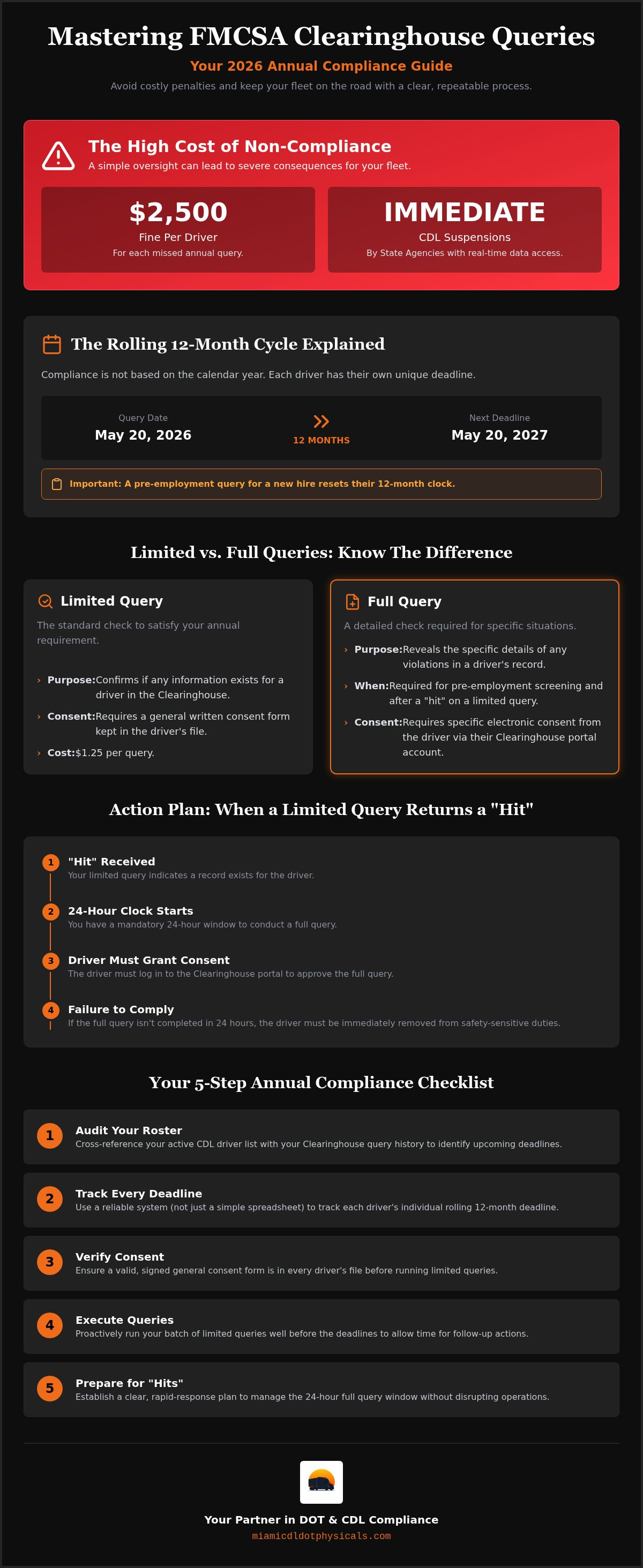
Compliance isn't tied to the traditional calendar year; instead, it operates on a rolling 12-month cycle based on each driver's unique timeline. For example, if you conduct a query for a driver on May 20, 2026, their next annual check must be completed by May 20, 2027. It's a common mistake to assume a single company-wide sweep in December covers everyone for the following year. A pre-employment query effectively "resets" the clock for new hires, making their hire date the new anniversary for future annual checks. Tracking these staggered dates is where many fleets struggle. Manual spreadsheets often fail because they don't account for new hires or the 24-hour window required to upgrade to a full query if the system flags a record.
Legal Authority and Fines
The legal weight behind these checks comes from 49 CFR § 382.701. This regulation mandates that employers must not allow a driver to perform safety-sensitive functions if they haven't been cleared through the database within the last 12 months. The FMCSA identifies missing queries easily during routine safety audits by cross-referencing your payroll and driver logs with Clearinghouse activity logs. As of 2026, the penalties for failing to query a driver annually can reach $2,500 per driver. If a missed query results in a prohibited driver staying on the road, you risk even higher fines and a "prohibited" status for your entire operation. Since State Driver Licensing Agencies now have real-time access to this data, they will automatically suspend CDL credentials for any driver with an unresolved violation, making your compliance even more visible to regulators.
Limited vs. Full Queries: Choosing the Right Compliance Check
Choosing the correct query type is essential for maintaining a compliant fleet. A limited query is the standard tool used to satisfy your annual FMCSA Clearinghouse query requirements. This check simply confirms whether the database contains any information about a specific driver. It's a fast, non-intrusive process that doesn't require the driver to log into the portal, provided you have their written consent on file. In contrast, a full query reveals the specific details of a violation. You must perform a full query during the pre-employment phase for every new hire before they perform safety-sensitive work. Both query types currently cost a flat fee of $1.25 per driver. Whenever you conduct a query, the FMCSA notifies the driver via their preferred contact method, ensuring transparency throughout the process. This notification happens regardless of the query result, so it's helpful to let your team know when you're running your annual checks to avoid unnecessary alarm.
When a Limited Query Returns a 'Hit'
If a limited query indicates that information exists in the system, you must act quickly. This result, often called a "hit," triggers a mandatory 24-hour window to conduct a full query. You cannot let this deadline pass. If the full query isn't completed within 24 hours, you must immediately remove the driver from safety-sensitive functions. Transitioning from a limited to a full query requires the driver to grant electronic consent through their personal Clearinghouse account. This is a critical moment where delays can stall your operations. If the full query reveals a violation, you must ensure the driver has completed the return-to-duty process before they get back behind the wheel. Working with a specialized FMCSA Clearinghouse Consortium helps you manage these high-pressure transitions without missing a beat.
Query Plan Management
To run any check, you must first purchase a query plan through the official portal. These plans function like a prepaid balance; the FMCSA deducts the fee every time a query is performed. It's important to remember that while a Consortium can execute these checks for you, they are legally barred from purchasing the plans for you. You must buy them yourself. When planning your budget, count your total number of drivers and add a buffer for expected turnover. Since query credits never expire, it's safer to over-estimate than to run out during a busy hiring season. Running out of credits at the wrong time can leave a new hire sitting at the terminal instead of hitting the road. Following the official annual query requirement guidelines ensures you always have the necessary credits to stay legal.
Managing Driver Consent: The Foundation of Legal Queries
Consent is the legal gatekeeper for every check you perform. To meet your annual FMCSA Clearinghouse query requirements, you must have the correct type of authorization on file before you access the database. For standard yearly checks, known as limited queries, you need a signed general consent form. This is a physical or digital document kept in your internal driver qualification files. It doesn't involve the FMCSA portal directly, but you must produce it if an auditor asks to see your records. Industry experts confirm that Clearinghouse Queries Are Required for all CDL holders, and having a streamlined consent process is the best way to avoid operational delays. You must keep these consent forms for at least three years after the date of the last query performed. If a driver refuses to sign the form, the law is clear: they cannot perform safety-sensitive functions. You must remove them from the road immediately until consent is granted and the query is successfully cleared.
Drafting a General Consent Form
A solid general consent form should be simple but specific. It must include the driver's full name, CDL number, and a clear statement authorizing you to conduct limited queries for the duration of their employment. You can choose to have drivers sign a one-time consent for a specific date or a multi-year consent. Most fleets prefer the multi-year option to reduce annual paperwork. For more localized advice, check out our FMCSA Clearinghouse Consortium Florida guide, which details how to manage these forms within a regional compliance framework. Ensure your form explicitly states that a "hit" on a limited query will require the driver to provide additional electronic consent for a full query.
The Driver's Role in Full Query Consent
Full queries work differently because they involve sensitive violation data. For these, drivers must grant electronic consent through their personal Clearinghouse account. This means every driver on your roster needs to be registered and have a verified login. When you request a full query, the system notifies the driver, and they must log in to approve the request. If they can't remember their password or haven't set up their account, your compliance process will stall. Encourage your drivers to verify their login information during their annual review. This proactive step ensures they are ready to act if a full query becomes necessary after a limited query "hit" or during the pre-employment process.
The 5-Step Annual Query Compliance Checklist for 2026
Managing your annual FMCSA Clearinghouse query requirements doesn't have to be a source of stress. By following a structured Standard Operating Procedure (SOP), you can turn a complex regulatory hurdle into a routine administrative task. This checklist provides a clear path to 100% compliance for the 2026 cycle. It's designed to help you catch errors before they become fines and keep your drivers focused on the road rather than paperwork. Use these five steps to verify your fleet is fully protected.
- Step 1: Audit your driver list. Compare your current payroll against the drivers registered in your Clearinghouse portal to establish your 2026 timeline.
- Step 2: Verify consent forms. Ensure you have a valid, signed general consent form on file for every active CDL holder in your fleet.
- Step 3: Check your query balance. Log into the portal and confirm you have enough credits to cover your entire roster. Each check costs $1.25.
- Step 4: Execute limited queries. Run the checks and immediately document the "Clear" results in each driver's qualification file.
- Step 5: Schedule the next rolling date. Set a calendar reminder for 364 days from today to prevent any future lapses in compliance.
Auditing Your Driver Roster
A clean roster is the secret to an easy audit. Start by identifying "ghost" drivers; these are former employees who are still linked to your company in the Clearinghouse portal. Removing them reduces your liability and ensures you aren't paying for unnecessary queries. Accuracy is vital here. You must match CDL numbers and issuing states exactly as they appear on the physical license. Even a small typo can result in a failed query or an administrative flag. While you're reviewing these files, it's a great time to ensure all medical certifications are current. Our guide to DOT Physical Miami compliance can help you sync these two essential parts of driver management.
Documenting the Results
When a limited query returns a "Clear" result, your work isn't quite finished. You must save a PDF copy of the result and place it in the driver's qualification file. This digital or physical paper trail is exactly what a DOT officer will look for during a safety audit. If you manage a large fleet, consider integrating these Clearinghouse records with your other compliance documents. For example, keeping these results alongside CDL Medical Card Miami records creates a centralized hub for every driver's legal status. This level of organization shows auditors that you take safety seriously. If you're tired of tracking these dates manually, you can join our FMCSA Clearinghouse Consortium to automate your query scheduling and consent management today.
Simplifying Compliance with an FMCSA Clearinghouse Consortium
Managing your annual FMCSA Clearinghouse query requirements is often the most time-consuming part of fleet administration. A Consortium or Third-Party Administrator (C/TPA) acts as a dedicated compliance partner to handle these burdens for you. For larger fleets, this means automated query scheduling and streamlined consent tracking. For owner-operators, it's a legal necessity. Using a consortium ensures that every check is performed correctly and documented according to federal standards. This partnership is especially valuable during a DOT safety audit. Your consortium provides the verified records and activity logs that prove your fleet has remained 100% compliant throughout the year.
Owner-Operator Specific Requirements
If you're an owner-operator, you face the "two-hat" problem. You're both the employer and the driver. Federal law requires you to designate a C/TPA in the Clearinghouse portal to manage your employer-side requirements. You cannot simply run a "self-query" as a driver and expect it to satisfy the annual mandate. This is a common point of confusion that leads to significant fines. Once you designate a partner, they handle the reporting of violations and the execution of annual queries. This keeps you focused on the road while they manage the regulatory paperwork. You must complete this designation within your employer account before any queries can be performed on your behalf.
True compliance involves more than just database checks. It requires a cohesive strategy that includes professional DOT Drug Test Miami services. When your testing provider and your consortium are the same entity, data sharing becomes seamless. Positive test results or refusals are reported within the mandatory 24-hour window without manual data entry. This integration reduces the risk of reporting errors and ensures your driver records are always up to date. It creates a "set it and forget it" environment where the technical details are handled by experts.
Choosing the Right Compliance Partner
Look for a consortium that offers more than just a software platform. You need a team with deep expertise in DOT regulations and a localized presence. A partner who understands the specific needs of the South Florida professional community provides a level of service that national call centers can't match. They should offer clear communication and immediate support when a query returns a hit. Efficiency and reliability are the most important traits in a compliance partner. To simplify your operations and protect your livelihood, Join our FMCSA Clearinghouse Consortium to automate your 2026 compliance today.
Protect Your Fleet with Proactive Compliance
Compliance is a continuous cycle rather than a single annual task. By mastering the rolling 12-month window and securing proper driver consent, you protect your business from costly safety audit failures and immediate driver disqualifications. You now have the tools to manage your annual FMCSA Clearinghouse query requirements with total confidence. Whether you're an owner-operator navigating the "two-hat" requirement or a fleet manager overseeing dozens of drivers, a structured approach keeps your trucks moving and your records audit-ready.
We are here to act as your dependable compliance partner in South Florida. Our facility offers specialized expertise, including FMCSA-certified medical examiners, same-day DOT drug testing, and complete Clearinghouse management. We take the technical guesswork out of federal regulations so you can focus on your professional growth. Secure Your Fleet's Compliance with Our FMCSA Consortium and experience the reliability that comes with expert oversight. You have the checklist; now it's time to put it into action and drive forward with peace of mind.
Frequently Asked Questions
What happens if I miss the annual Clearinghouse query deadline?
Missing the annual deadline can result in civil penalties of up to $2,500 per driver and immediate "prohibited" status during a safety audit. Since state licensing agencies now have real-time access to the database, your drivers could face automatic CDL suspensions or renewals being denied. You must execute a query immediately to restore compliance and document the result in your driver qualification files.
Do I need to run a query on a driver I just hired last month?
You don't need to run an annual check if you conducted a full pre-employment query within the last 12 months. That initial check effectively resets the rolling clock for that specific driver. Their first annual FMCSA Clearinghouse query requirements will come due exactly one year from their original hire date. This staggered timeline is why tracking individual hire dates is much more effective than a single company-wide sweep.
Can I use the same consent form for multiple years of queries?
Yes, you can use a single consent form for multiple years if the document explicitly states it covers the duration of the driver's employment. This "general consent" is sufficient for all limited queries. You must keep this physical or digital form in the driver's qualification file for three years after the date of the last query you performed to stay audit-ready.
How much does each Clearinghouse query cost in 2026?
Each query currently costs a flat fee of $1.25 as of 2026. This price applies equally to both limited and full queries. You must maintain a positive balance in your official portal by purchasing query bundles in advance. The system does not allow for "pay-as-you-go" transactions at the moment you run the check, so always keep a small buffer of credits in your account.
Is a limited query enough to satisfy the annual requirement?
A limited query is sufficient to satisfy the annual mandate as long as it returns a "Clear" result. If the system indicates that information exists, you have exactly 24 hours to conduct a full query. Failure to upgrade to a full query within that specific window will result in the driver being prohibited from safety-sensitive work until the detailed report is reviewed and cleared.
What is the difference between a C/TPA and a Consortium?
A C/TPA and a Consortium are essentially the same entity in the eyes of the FMCSA. They act as a third-party service provider that manages drug and alcohol testing programs and database tasks. While owner-operators are legally required to use one, larger fleets often join a consortium to automate their query schedules and ensure consistent record-keeping across their entire driver roster.
How do I know if my driver has a violation in the Clearinghouse?
You will know if a violation exists when the limited query result shows "information found." Additionally, the Clearinghouse will send an automated notification if a driver's status changes within 30 days of any query you have performed. To see the specific details of a drug or alcohol violation, you must obtain electronic consent from the driver and execute a full query through the portal.
Do I need to run queries on part-time or seasonal CDL drivers?
You must conduct annual queries for every driver on your roster, including part-time and seasonal employees. If they hold a CDL and perform safety-sensitive functions, they are subject to the same annual FMCSA Clearinghouse query requirements as full-time staff. Always verify that you have a valid consent form on file before they start their seasonal shift to avoid simple administrative fines during an audit.


