
Over 200,000 commercial drivers are currently in a "prohibited" status in the FMCSA Clearinghouse as of early 2026. This staggering number highlights how easy it is to fall out of compliance when you're confused about DOT vs non-DOT drug testing requirements. Whether you're an owner-operator or a fleet manager, the distinction between a federal safety mandate and a private company policy isn't just a matter of paperwork. It's the difference between staying on the road or losing your livelihood.
You likely already know that keeping up with 49 CFR Part 40 rules feels like a full-time job. It's stressful to worry about whether a standard workplace test meets federal standards or if a Clearinghouse entry was handled correctly. We're here to clear up that confusion. This guide helps you master the critical differences between federal mandates and employer-led testing so your fleet or career stays fully compliant. You'll gain a clear understanding of current testing panels, learn how results affect driving records, and get the facts on specimen collection rules for the year ahead.
Key Takeaways
- Identify the fundamental legal differences between federal safety mandates and private employer policies to ensure you always schedule the correct test for your role.
- Master the specific DOT vs non-DOT drug testing requirements regarding drug panels, ranging from the mandatory DOT 5-panel screen to flexible non-DOT hair and saliva options.
- Learn how to navigate strict regulatory oversight from agencies like the FMCSA and FAA to protect your fleet from costly violations during safety audits.
- Understand the critical "Return-to-Duty" process and how Substance Abuse Professional (SAP) evaluations differ from standard workplace disciplinary actions.
- Discover how partnering with a certified consortium can simplify your compliance paperwork and keep your Clearinghouse record in good standing.
What is the Difference Between DOT and Non-DOT Drug Testing?
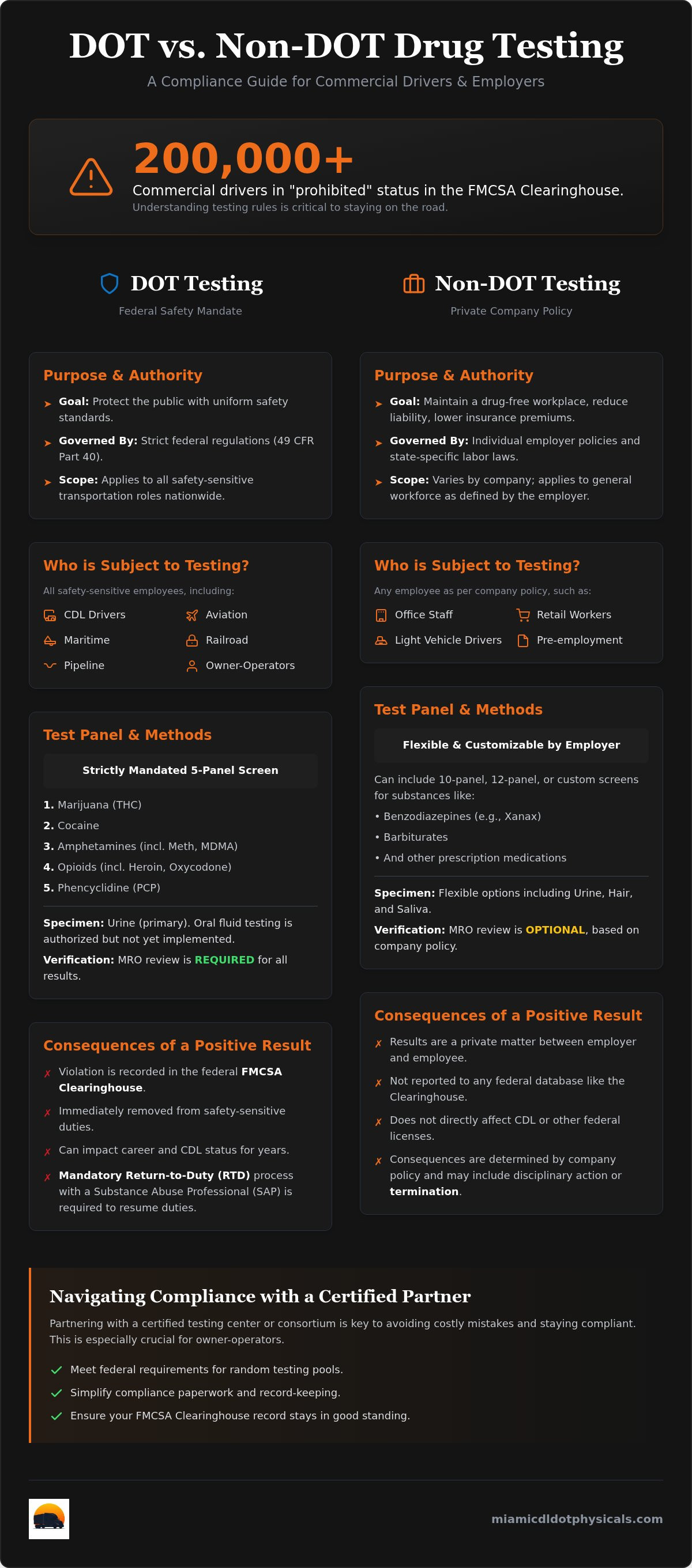
Understanding the core distinction between these two systems is the first step toward total compliance. DOT drug testing is a strict federal mandate regulated by the Department of Transportation. It applies specifically to employees in safety-sensitive positions where impairment could lead to catastrophic public accidents. These rules are codified in 49 CFR Part 40, ensuring that every test follows a rigid, national protocol. The primary goal here is simple: protect the public by maintaining uniform safety standards across the entire transportation industry.
Non-DOT drug testing operates on a different level. These are private programs designed by individual employers to maintain a drug-free workplace. While DOT tests focus on public protection, non-DOT programs prioritize corporate liability reduction, lower insurance premiums, and general workplace safety. Because these aren't federal mandates, companies have significant freedom to choose their own drug testing methodologies, including which substances to screen for and which specimen types to collect. This flexibility allows a business to tailor its policy to its specific industry risks or regional legal requirements.
The legal weight behind these tests is the most significant difference. A DOT violation stays with a driver through the federal Clearinghouse, potentially impacting their career for years. A non-DOT violation is typically a private matter between the employer and the employee, governed by company policy and state labor laws. Mastering the nuances of DOT vs non-DOT drug testing requirements ensures you never accidentally apply the wrong standard to your workforce.
Who is Subject to DOT Testing?
The most common group under this umbrella includes drivers of Commercial Motor Vehicles (CMVs) who must hold a CDL. However, the reach is much wider. You're subject to federal rules if you work in safety-sensitive roles in aviation, maritime operations, railroads, or pipeline transport. This also includes owner-operators. Since an owner-operator cannot randomly test themselves, federal law requires them to join a random testing consortium to stay legal. If your job involves the safety of the traveling public, you're likely in the DOT pool.
Who is Subject to Non-DOT Testing?
If your role doesn't involve operating heavy machinery on public roads or managing national infrastructure, you likely fall into the non-DOT category. This covers general office staff, retail workers, and even company drivers who operate light vehicles that don't require a CDL. Many businesses use these tests as a standard part of their pre-employment screening or as a requirement for certain insurance discounts. Because these programs are employer-led, the specific DOT vs non-DOT drug testing requirements you face will depend entirely on your company's written drug-free workplace policy.
Comparing Test Panels, Procedures, and Collection Methods
The technical execution of a drug screen is where most compliance errors occur. Under the DOT vs non-DOT drug testing requirements, the actual substances tested vary significantly. A DOT test strictly follows a 5-panel screen. This includes Marijuana, Cocaine, Amphetamines (including Meth and MDMA), Opioids (such as Heroin, Hydrocodone, and Oxycodone), and PCP. These specific DOT drug and alcohol rules ensure that every safety-sensitive employee is held to the same standard across the country, regardless of which state they're in.
Non-DOT testing offers much more room for customization. Employers can opt for 10-panel or 12-panel screens to look for additional substances like benzodiazepines or barbiturates. They can also use different collection methods, such as hair testing, which is currently a non-DOT exclusive. Regardless of the panel size, every DOT result must be verified by a Medical Review Officer (MRO). This licensed physician reviews positive results to determine if there's a legitimate medical explanation, such as a valid prescription, before the result is reported to the employer or the Clearinghouse. This layer of protection isn't always present in non-DOT programs, where an employer might handle results directly.
Specimen Types: Urine vs. Oral Fluid in 2026
As of August 2026, urine remains the primary specimen for federal testing. While the DOT has authorized oral fluid testing as an alternative, the industry is still waiting for the Department of Health and Human Services to certify at least two laboratories to process these samples. Until that happens, you must continue using urine collections for federal compliance. A final rule effective June 10, 2026, has clarified the procedures for directly observed urine collections. These observed tests are mandatory for all return-to-duty and follow-up testing to prevent specimen tampering. If you need to schedule a compliant DOT drug test, ensure your provider understands these latest procedural updates.
The Paperwork: CCF vs. Private Forms
The paperwork you use is just as important as the specimen you collect. All federal tests require the Federal Drug Testing Custody and Control Form (CCF). Using a private, non-DOT form for a required FMCSA test is a major violation that can result in a cancelled test and an audit red flag. By 2026, the adoption of the Electronic CCF (eCCF) has become the industry standard. It reduces manual entry errors and speeds up the reporting process. Always verify that your collection site is using the correct, up-to-date federal form to protect your driving record and stay within the lines of federal law.
Regulatory Oversight: Federal Mandates vs. Workplace Policies
One of the most misunderstood aspects of DOT vs non-DOT drug testing requirements is the legal firewall created by Rule 40.13. This federal regulation mandates a strict separation between federal and private testing. You can't combine them. If you're conducting a federal test, you must follow 49 CFR Part 40 procedures exactly. Employers often try to add extra substances to a DOT test, but that's a direct violation. The federal government wants the safety standard to remain uniform and untainted by individual company preferences. This ensures that a driver in California is held to the exact same standard as a driver in Florida.
Agencies like the FMCSA, FAA, and FRA enforce these rules through rigorous audits. They don't just look at whether a driver passed; they examine the entire chain of custody and the timing of the tests. If your paperwork shows you used a non-DOT form for a federal requirement, you're looking at significant fines. While federal law always takes precedence for safety-sensitive roles, non-DOT programs must often navigate a complex web of state and local labor laws. This is where the employer has the power to define their own substance abuse policy, provided it doesn't conflict with regional worker protections. This flexibility is great for office environments but requires careful legal drafting.
Random Testing Rates and Requirements
For 2026, the FMCSA has maintained a random drug testing rate of 50% and a random alcohol testing rate of 10%. This means half of your covered drivers must be tested for drugs every year. Small businesses and owner-operators often find this impossible to manage alone. That's where a consortium comes in. It pools drivers from multiple companies into one large group, ensuring the math works out for everyone and keeping you compliant with federal selection rules. In contrast, non-DOT random testing is completely at the employer's discretion. You can test 5% of your office staff or 100%, as long as your written policy is applied consistently and follows state guidelines.
Post-Accident Testing Thresholds
The triggers for a post-accident test under DOT rules are very specific and non-negotiable. You must test if there's a fatality, or if the driver receives a citation and a vehicle is towed or someone receives immediate medical treatment away from the scene. You don't have the luxury of choice here. Non-DOT policies are much broader. An employer might require a test for any "fender bender" that results in property damage, even without a citation. If you're operating in South Florida and need to ensure your triggers meet both federal and local standards, reviewing a DOT drug test Miami resource can help keep your fleet on the right side of the law.
Consequences of a Positive Result: SAP vs. Termination
A positive result under DOT vs non-DOT drug testing requirements leads down two very different paths. If you fail a DOT test, you're immediately prohibited from operating a commercial motor vehicle. Federal law requires you to complete the Return-to-Duty process with a qualified Substance Abuse Professional (SAP). This typically involves an evaluation, which costs between $450 and $650 in 2026, followed by a prescribed education or treatment plan and a negative return-to-duty test. These steps are non-negotiable. Considering that marijuana accounts for approximately 60% of all positive drug tests in the industry, many drivers find themselves navigating this process unexpectedly. In contrast, a non-DOT failure is usually handled by company policy. While many employers choose to terminate the employee, others might offer a private "second chance" program that doesn't involve federal oversight.
One common point of confusion is how a non-DOT failure affects a CDL holder. If you fail a drug screen for a non-safety-sensitive role, that result is not reported to the FMCSA Clearinghouse. It stays in your private HR file. However, it can still lead to professional disqualification. If your employer loses trust in your ability to remain sober, they may disqualify you from driving company vehicles regardless of the federal status of the test. Understanding these DOT vs non-DOT drug testing requirements is essential for anyone holding a CDL, as a mistake in one area can still haunt you in another.
The FMCSA Clearinghouse and Driver Records
The FMCSA Clearinghouse has revolutionized how violations are tracked. As of early 2026, over 200,000 drivers remain in a prohibited status because of reported violations. A DOT failure stays visible to potential employers for five years or until you successfully complete the return-to-duty process. Employers must conduct annual queries on all drivers to ensure no new violations have appeared. Managing this data is a major hurdle for many owner-operators and small fleets. Joining an FMCSA Clearinghouse Consortium Florida can take this weight off your shoulders by handling the reporting and queries for you.
Refusal to Test: The "Hidden" Positive
Walking away from a collection site is just as damaging as a positive result. Under DOT rules, a "refusal to test" is legally equivalent to a failure. Common behaviors like failing to show up within a reasonable time, leaving the site before the process is complete, or providing an insufficient volume of urine without a valid medical excuse all count as refusals. For non-DOT tests, the consequences are entirely up to the employer. Most companies treat a refusal as an automatic admission of guilt leading to immediate termination. If you need help staying compliant or scheduling a DOT drug test, partnering with a certified center is the best way to protect your career.
Navigating Compliance with a Certified Testing Partner
Managing a fleet or a professional driving career is demanding enough without the added stress of tracking every federal rule change. Partnering with the right testing center is the most effective way to handle the "paperwork headache" that comes with DOT vs non-DOT drug testing requirements. You need an FMCSA-certified medical examiner who understands the nuances of the 2026 regulatory landscape. This includes staying updated on the certification status of oral fluid labs and ensuring that all urine collections follow the direct observation rules finalized in June 2026. A certified partner doesn't just collect a sample; they act as a compliance shield for your business.
For owner-operators, a random testing consortium is a legal necessity. Since you cannot randomly select yourself for testing, the consortium pools you with other drivers to meet the FMCSA's 50% annual testing rate. This service simplifies your life by managing the selection process and documenting your compliance for future audits. You can further reduce the stress of these appointments by preparing for your physical and drug screen ahead of time. Arriving with the correct documentation and understanding the process ensures your visit is fast and successful.
Why One-Stop Testing Centers Save Time
Efficiency is critical for busy professionals. Choosing a center that combines the DOT physical exam and drug testing in a single visit eliminates the need for multiple appointments. While DOT tests require lab verification and MRO review, many non-DOT screenings can offer instant results. This allows you to make faster hiring decisions for office staff or non-CDL drivers. Professional medical oversight during this process ensures that every test, whether federal or private, is conducted with the highest level of accuracy and legal integrity.
Getting Started with a Compliance Program
If you're an owner-operator or a small fleet manager, your first step is enrolling in a random testing consortium. This immediately places you in a compliant pool and satisfies federal auditors. For your non-DOT employees, you should develop a clear, written workplace drug policy. This document should outline when tests occur, which substances are screened, and the consequences of a positive result. Having these systems in place before an accident or audit occurs protects your liability and your livelihood. Don't leave your compliance to chance. Schedule your DOT or non-DOT drug test today to ensure your records are fully up to date and audit-ready.
Take Control of Your Compliance Today
Mastering the nuances of DOT vs non-DOT drug testing requirements is the best way to protect your career from avoidable violations. Federal mandates focus on public safety and follow rigid national standards, while workplace policies allow for more flexibility to suit your specific business needs. Using the correct federal forms and staying active in the FMCSA Clearinghouse ensures you stay on the road without the threat of a "prohibited" status. These details might seem small, but they carry the weight of your entire livelihood and your ability to earn.
You don't have to manage these complex regulations alone. Our FMCSA-certified medical examiners provide the professional medical oversight you need to handle both federal and private testing with absolute ease. We offer a dedicated Clearinghouse Consortium for owner-operators and same-day appointments to respect your tight schedule. Stay compliant and keep your CDL active; book your DOT drug test today. We're proud to serve as your dependable ally in this high-stakes environment. We're here to help you succeed and keep your professional record clean.
Frequently Asked Questions
Can a non-DOT drug test be used to satisfy DOT requirements?
No. A non-DOT test can never satisfy federal requirements because it doesn't use the mandatory Federal Drug Testing Custody and Control Form. Federal law requires specific lab protocols and Medical Review Officer oversight that standard workplace tests don't always follow. If you're in a safety-sensitive role, you must complete a test specifically labeled as DOT to remain compliant with federal regulations.
What drugs are included in the 2026 DOT drug testing panel?
The standard DOT 5-panel test screens for Marijuana, Cocaine, Amphetamines (including methamphetamine and MDMA), Opioids (including heroin and synthetic opioids like oxycodone), and Phencyclidine (PCP). While there's a strong regulatory push to add fentanyl to the panel, this change hasn't been finalized as of August 2026. Employers should continue to monitor federal updates for any future expansions to the standard panel.
Does a failed non-DOT drug test go into the FMCSA Clearinghouse?
No. Only violations of federal drug and alcohol regulations are reported to the FMCSA Clearinghouse. Because non-DOT tests are governed by private company policies rather than federal mandates, a failure stays within your employer's internal HR files. This is a major distinction in DOT vs non-DOT drug testing requirements, as only DOT violations can lead to a "prohibited" status in the national database.
Is oral fluid testing now allowed for all DOT agencies in 2026?
The DOT has authorized oral fluid testing, but it's not yet a practical option as of August 2026. Implementation is currently stalled because the Department of Health and Human Services hasn't certified the required minimum of two laboratories to process these samples. Until these certifications are complete, all DOT-regulated agencies and employers must continue using urine collection methods for their drug testing programs.
What happens if a driver fails a DOT drug test but has a prescription?
The Medical Review Officer will contact you to verify your medical records before the result is finalized. If you have a valid, legal prescription that explains the positive result, the MRO will report the test as "negative" to your employer. This verification process is a critical safeguard in DOT vs non-DOT drug testing requirements, ensuring that drivers aren't unfairly penalized for legitimate medical treatments.
Who is responsible for paying for a DOT drug test: the driver or the employer?
Federal regulations don't specify who must pay for the test, so this is usually determined by company policy or labor contracts. Most employers cover the cost of pre-employment and random testing to maintain their fleet's compliance. However, drivers are frequently responsible for the costs associated with the return-to-duty process, including Substance Abuse Professional evaluations which typically range from $450 to $650 in 2026.
How long does a DOT drug test violation stay on a driver’s record?
A violation remains visible in the FMCSA Clearinghouse for five years or until you successfully complete the return-to-duty process and all follow-up testing. Once you've met both requirements, the violation is removed from the record that employers see during a query. It's vital to start the SAP process immediately after a violation to minimize the time you're prohibited from driving.
Can an employer perform a non-DOT test at the same time as a DOT test?
Yes, but the two tests must be kept completely separate. Rule 40.13 prohibits using a DOT specimen for any non-DOT testing purposes. The collector must perform two distinct collections using two separate sets of paperwork. This maintains the legal firewall between the federal safety mandate and the employer's private workplace policy, ensuring that neither process compromises the integrity of the other.


