

A single FMCSA Clearinghouse violation in 2026 can cost you up to $6,386 per occurrence. That's a staggering price to pay for a simple administrative oversight, especially when joining an owner operator drug consortium Miami should be a straightforward process. You started driving for the freedom of the open road, not to spend your limited downtime deciphering complex federal codes or tracking random testing windows. It's frustrating to feel like your livelihood is one paperwork error away from being put out of service.
We understand that your time is your money. This guide helps you master compliance by turning a complex legal requirement into an automated background process. You'll learn exactly how to handle the 2026 random testing rates, which remain at 50% for drugs and 10% for alcohol. We also cover the addition of fentanyl to standard testing panels and how to maintain audit-ready records with minimal effort. By the end of this article, you'll have a clear path to staying legal, staying on the road, and keeping your focus where it belongs.
Key Takeaways
- Solo owner-operators are legally required to enroll in a third-party random testing pool because they cannot manage their own selection process.
- Joining an owner operator drug consortium Miami automates your compliance and ensures your records are always ready for a surprise DOT audit.
- Stay current with 2026 FMCSA requirements, including the 50% random drug testing rate and the addition of fentanyl to the screening panel.
- Master your dual role in the FMCSA Clearinghouse to correctly perform and document mandatory annual queries for yourself as a driver.
- Reduce your administrative stress by letting a professional consortium handle the complex paperwork while you focus on staying on the road.
Understanding the Owner Operator Drug Consortium Miami Requirements
A DOT drug and alcohol consortium is a collective pool of commercial drivers from various small companies and independent operations. When you join an owner operator drug consortium Miami, you're essentially outsourcing the administrative burden of federal compliance to a professional manager. For a solo driver, this isn't just a convenience; it's a federal mandate. The FMCSA requires this because a single person cannot legally maintain a random selection process for themselves. Without a third-party pool, there's no way to prove that testing selections are truly random and unbiased.
The legal distinction between a standalone program and a consortium membership is simple. Large carriers with hundreds of drivers can manage their own internal pools because they have enough "slots" to satisfy random testing percentages. Solo operators don't have this luxury. You must be part of a larger group to meet the annual testing quotas. This system falls under the broader DOT Part 40 rules, which govern several agencies including the FAA, FRA, and PHMSA. While the procedures remain consistent across these agencies, the specific rules for truckers are found in FMCSA Part 382.
The Legal Necessity for Solo Drivers
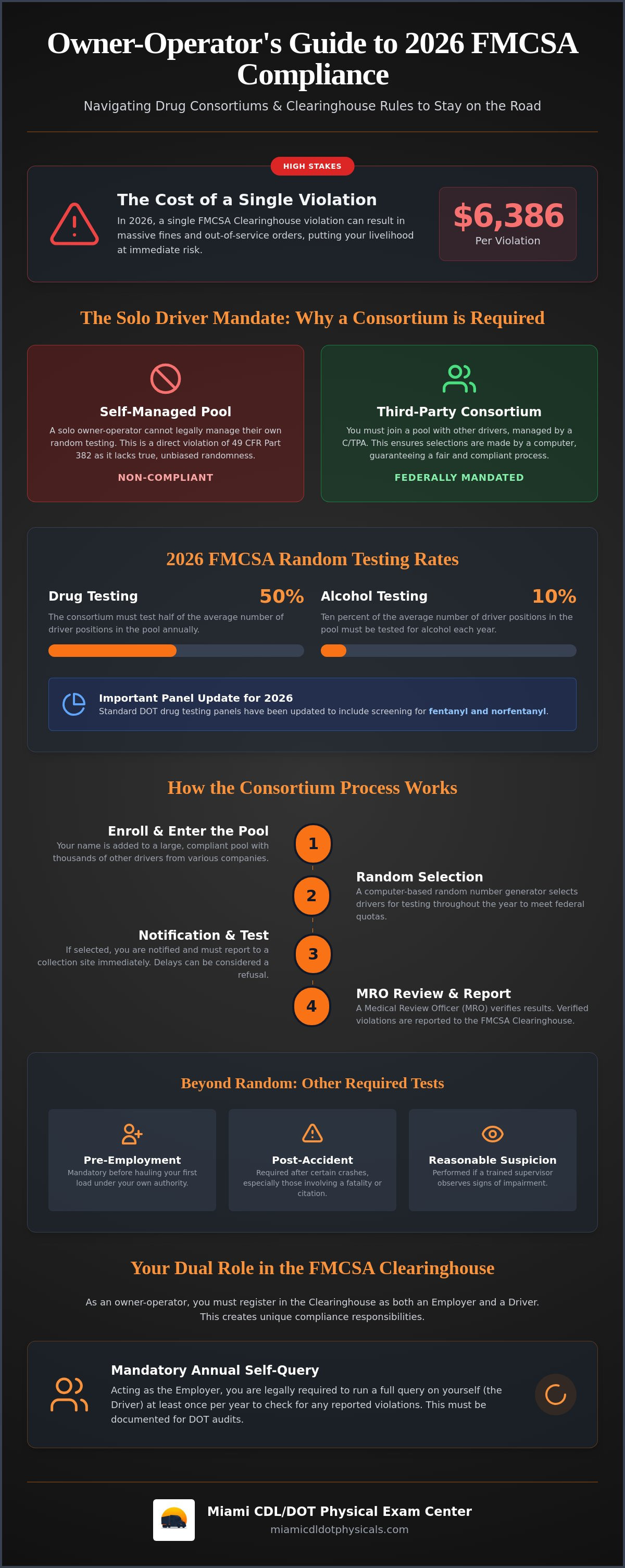
You cannot self-manage a random testing pool. If you try to handle your own selections, you're in direct violation of 49 CFR Part 382. A Consortium/Third-Party Administrator (C/TPA) acts as your compliance partner, using a computer-based random number generator to select drivers for testing. This ensures federal oversight is maintained without you having to lift a finger. The consequences of skipping this step are severe. In 2026, failure to conduct required queries or maintain consortium records can lead to fines of up to $6,386 per violation. DOT inspectors can also issue out-of-service orders, which effectively grounds your truck and halts your income until the issue is resolved.
FMCSA Part 382 vs. DOT Part 40
It's vital to understand which rules apply to your daily operations. DOT Part 40 is the procedural "bible" for drug testing across all transportation sectors; it dictates how a specimen is collected and analyzed. FMCSA Part 382 is the specific set of regulations for commercial motor vehicle drivers. It defines who must be tested and when those tests occur. As of early 2026, these protocols have been updated to include fentanyl and norfentanyl in the standard testing panel. Every CDL holder operating on public roads must adhere to these standards to maintain their driving privileges. Working with an owner operator drug consortium Miami ensures that these technical updates are integrated into your program automatically.
How the Owner-Operator Random Testing Pool Operates
The random testing pool isn't a simple list where names are crossed off. It's a mathematically neutral system designed to ensure every driver has an equal chance of selection during every draw. When you join an owner operator drug consortium Miami, your name enters a combined pool with thousands of other drivers. For the calendar year 2026, the FMCSA has set the random drug testing rate at 50% and the alcohol testing rate at 10%. These percentages are based on the average number of driver positions in the pool. This means that in a pool of 1,000 drivers, the consortium must conduct 500 drug tests and 100 alcohol tests over the year.
If your name is drawn, the clock starts ticking immediately. You'll receive a notification and must proceed to a collection site without delay. This "immediate" requirement is a critical part of the DOT Drug & Alcohol Testing Program. Any delay that isn't justified by a legitimate safety concern can be recorded as a refusal to test. Once the lab processes your specimen, a Medical Review Officer (MRO) examines the findings. The MRO is a licensed physician who acts as an independent gatekeeper. They verify if a positive result might be caused by legally prescribed medication before reporting a violation to the Clearinghouse.
Types of Required Testing
Compliance begins before you ever haul your first load. A pre-employment drug test is mandatory for any new owner-operator entity. Once you're active, random testing becomes your primary ongoing obligation within the consortium. However, other triggers exist. Post-accident testing is required if a fatality occurs or if you receive a citation following a crash where a vehicle is towed. Reasonable suspicion testing occurs if a trained supervisor observes specific physical signs of impairment. You can simplify these requirements by joining our FMCSA Clearinghouse Consortium for expert management.
The Random Selection Process
Consortiums group solo drivers and small fleets into a single, massive pool to satisfy federal quotas efficiently. Selections typically happen on a quarterly or monthly cycle. A computer program uses a random number generator to pick names, ensuring that every member has an "equal chance" in every draw. This means you could potentially be selected two quarters in a row. It isn't a mistake; it's the mathematical reality of a truly random system. Maintaining this level of fairness is why an owner operator drug consortium Miami is the only legal way for solo drivers to stay compliant with federal law.
Benefits of Joining a Managed Drug Consortium
Joining an owner operator drug consortium Miami transforms compliance from a source of stress into a background utility. Instead of tracking quarterly draw dates or searching for a certified lab while you're on a long haul, you let the Consortium/Third-Party Administrator (C/TPA) manage the logistics. This partnership ensures that every piece of paperwork, from the initial enrollment certificate to the final lab result, is filed correctly. When a DOT inspector requests your records, you don't have to scramble through a glove box. You provide a single, verified report that proves your active status in the pool.
Cost is always a factor for independent drivers. Managing a private drug testing program is prohibitively expensive because you'd bear the full cost of Medical Review Officer (MRO) fees, lab contracts, and random selection software alone. A consortium spreads these operational costs across a large national pool. This makes federal compliance affordable while granting you access to over 15,000 collection sites nationwide. No matter where the road takes you, a certified facility is likely within a short drive. You benefit from the scale of a large fleet while maintaining your independence as a solo operator.
Automated Compliance Management
Manual tracking is a recipe for missed deadlines. A managed consortium automates your reporting requirements, including the mandatory submissions to the Drug and Alcohol Clearinghouse. You'll receive automated alerts for upcoming requirements, ensuring your driver qualification file stays current. This "set-it-and-forget-it" approach is best handled through a random drug testing pool for owner-operators, which eliminates the risk of human error in your record-keeping. We handle the digital filing so you can focus on the road.
Professional Expertise and Support
Regulations are rarely static. When the DOT adds substances like fentanyl to the testing panel or changes reporting thresholds, your consortium handles the transition. If you ever face a complex situation, such as a positive test result, you have immediate access to professional guidance regarding Substance Abuse Professional (SAP) referrals. This level of support is a core part of a DOT drug test Miami compliance reference, ensuring that every collection site used meets strict federal forensic standards. Being part of an owner operator drug consortium Miami means you never have to interpret vague legal language on your own.
FMCSA Clearinghouse Management for Owner-Operators
The FMCSA Clearinghouse is a digital gatekeeper that tracks drug and alcohol violations for all CDL holders. For most company drivers, this is a database their boss manages. However, when you run your own business, you occupy a dual role that many find confusing. You're the employer responsible for oversight and the driver subject to that oversight. Joining an owner operator drug consortium Miami simplifies this by bridging the gap between these two roles. You must register as an employer first, then link your personal CDL to your DOT number to complete the profile.
One of the most critical steps in the portal is designating your Consortium/Third-Party Administrator (C/TPA). Federal law requires owner-operators to have a consortium manage their Clearinghouse reporting. This isn't optional. Your consortium will report your test results and any refusals to test directly to the database. This ensures that the person being tested isn't the same person reporting the results, which maintains the integrity of the federal system. Without this designation, your business is technically non-compliant, even if you're part of a testing pool.
Registering Your Business in the Clearinghouse
Registration involves a multi-step verification process through the official FMCSA portal. You'll need your USDOT number and a Login.gov account to begin. Once your business profile is active, you must select your consortium to act on your behalf. This authorization allows your C/TPA to conduct queries and report violations as required by law. For a detailed walkthrough of this process, see our FMCSA Clearinghouse Consortium Florida guide. Completing this registration is the only way to prove to DOT inspectors that you've established a legal oversight program.
Annual Queries and Reporting
You're required to conduct at least one query on yourself every 12 months. A 'limited' query is the standard annual check. It costs $1.25 and simply confirms whether the database contains any information about you. If the limited query shows a "hit," you must then conduct a 'full' query to see the specific details. Failure to complete these annual queries is a major red flag during audits. As of early 2026, the penalty for failing to conduct required queries can reach $6,386 per violation. This is a steep price for a task that takes only a few minutes to automate.
Reporting violations is another area where the dual role is vital. You're legally obligated to report any drug or alcohol infractions, including "actual knowledge" violations. Since marijuana accounts for nearly 60% of all positive tests in the Clearinghouse, staying informed about your status is essential for keeping your CDL active. You can enroll in our FMCSA Clearinghouse Consortium today to ensure your queries are handled correctly and your records remain "in the green" for roadside inspections.
Joining the Miami CDL/DOT Physical Exam Center Consortium
Choosing an owner operator drug consortium Miami is a decision that affects your daily operations and your long-term career security. At Miami CDL/DOT Physical Exam Center, we've built our reputation on professional authority and approachable service. Drivers trust our FMCSA-certified medical examiners because we understand that compliance isn't just about rules; it's about your livelihood. We provide a "set-it-and-forget-it" solution that manages the complexities of federal law while you focus on hauling your next load.
Our facility offers a streamlined approach by housing all essential services in one location. You don't need to visit three different offices to stay legal. We provide the DOT Physical Exam, pre-employment drug testing, and full consortium management under one roof. This integration ensures that your medical and testing records are perfectly synchronized, reducing the chance of data errors in the FMCSA Clearinghouse. We value your time and prioritize same-day service to get you back on the road as quickly as possible.
A Seamless Compliance Experience
We handle the technical details of your program so you don't have to. Our automated system manages the 2026 random selection rates and ensures all documentation meets strict federal forensic standards. You can use our DOT drug consortium program Florida checklist to verify your current status and identify any gaps in your records. Having professional medical oversight in your testing program means you have an expert ally if a complex situation arises. We act as your compliance partner, not just a service provider.
Ready to Enroll?
The enrollment process is designed for speed and clarity. After you submit your application, we immediately add you to our national testing pool. You'll receive a certificate of enrollment right away, which serves as your official proof of compliance during roadside inspections. We provide continuous support for random selections and federal reporting throughout the year, keeping your business audit-ready at all times. Don't leave your career to chance. Join our Owner-Operator Consortium today and take the first step toward stress-free compliance.
Drive with Confidence and Total Compliance
Maintaining your status as a solo driver requires more than just a clean driving record. It demands strict adherence to the 2026 FMCSA testing rates and precise management of your dual role in the federal Clearinghouse. By choosing a professional owner operator drug consortium Miami, you turn these complex legal obligations into a seamless background process. You've learned how automated pools ensure fairness and how professional oversight protects your CDL from the $6,386 penalties associated with administrative errors. Staying current with the new fentanyl testing panels is essential for your livelihood.
Our team of FMCSA-Certified Medical Examiners is here to simplify your professional life. We provide Same-Day Compliance Certificates and Automated Clearinghouse Reporting to ensure you never miss a deadline or fail an audit. Stop worrying about paperwork and start focusing on your next haul. Enroll in the Owner-Operator Drug Consortium Today and secure your future on the road. We're dedicated to keeping you legal, safe, and moving forward.
Frequently Asked Questions
Do owner-operators really need to join a drug consortium?
Yes, federal law 49 CFR Part 382 requires every solo owner-operator to be enrolled in a random testing pool managed by a third party. You cannot legally manage your own random selection process. Joining an owner operator drug consortium Miami ensures that your testing is truly random and unbiased; this protects your CDL from immediate out-of-service orders during a DOT audit or roadside inspection.
How much does it cost for an owner-operator to join a consortium in 2026?
Annual membership fees for a consortium typically cover the administrative costs of pool management and federal reporting. While prices vary across the industry based on the level of support provided, most drivers find these programs to be a cost-effective way to avoid thousands of dollars in FMCSA fines. These fees generally don't include the cost of non-random tests, such as pre-employment or post-accident screenings.
What happens if I am selected for a random test while I am on a long-haul trip?
You must proceed to the nearest certified collection site immediately once you're notified of a selection. If you're on a long-haul trip, your consortium will help you locate one of the 15,000 nationwide testing facilities. Delaying the test to finish a delivery can be classified as a refusal to test; this carries the same severe penalties as a positive result.
Can I use any clinic for my consortium drug test?
No, you must use a collection site that is authorized by your consortium and follows strict DOT forensic protocols. Using an unauthorized clinic may result in a test that the FMCSA does not recognize as valid. Our owner operator drug consortium Miami provides access to a vast network of certified labs to ensure your results are legally defensible and properly reported to the Clearinghouse.
How do I report my consortium membership to the FMCSA Clearinghouse?
You report your membership by logging into the FMCSA Clearinghouse portal and designating your Consortium/Third-Party Administrator (C/TPA). This digital authorization allows the consortium to conduct required queries and report test results on your behalf. This step is a mandatory part of your dual role as both an employer and a driver under federal regulations.
What is the difference between a DOT drug test and a non-DOT drug test?
A DOT drug test follows the rigorous procedural standards of 49 CFR Part 40 and uses a specific 5-panel screen that now includes fentanyl. These tests are mandatory for safety-sensitive positions. Non-DOT tests are governed by private company policies rather than federal law; they often use different testing panels and have no impact on your federal Clearinghouse record.
How long does a drug consortium membership last?
Most consortium memberships are valid for one calendar year and require annual renewal to maintain active status. Your compliance certificate will typically display an expiration date to help you track your standing. Staying ahead of your renewal ensures there is never a gap in your random pool enrollment, which is a common trigger for DOT enforcement actions.
What happens if I fail a random drug test as an owner-operator?
You must immediately stop all safety-sensitive functions, including driving, if you fail a random test. You'll be required to complete the Return-to-Duty process with a qualified Substance Abuse Professional (SAP). This process includes an evaluation, a prescribed treatment plan, and a successful return-to-duty test before you can legally operate a commercial motor vehicle again.


