
A single 24-hour reporting delay or a misunderstanding of state marijuana laws can end a commercial driving career in an instant. You've worked hard for your CDL, and it's frustrating when confusing federal mandates or slow testing centers threaten your livelihood. Finding a reliable DOT drug test Miami provider shouldn't feel like another hurdle in your busy schedule. We understand that your time is valuable and your compliance is non-negotiable.
It's true that keeping up with the 2026 FMCSA regulations often feels like a full-time job. This guide simplifies the process by helping you master federal drug testing requirements and stay compliant with the latest standards. You'll learn how to navigate the 50% random testing rate, understand the impact of the new identity verification rules, and discover how to automate your Clearinghouse requirements. We're here to help you pass your tests and keep your career moving forward without the stress of accidental non-compliance.
Key Takeaways
- Learn the critical differences between federal standards and employer policies to ensure your screening meets all 49 CFR Part 40 requirements.
- Identify the specific substances included in the 2026 5-panel test and understand the vital role a Medical Review Officer plays in verifying your status.
- Simplify your compliance schedule by booking a DOT drug test Miami at the same time as your medical exam for a more efficient, one-stop experience.
- Protect your CDL by mastering FMCSA Clearinghouse reporting rules and leveraging a consortium to automate your random testing pool obligations.
What is a DOT Drug Test? Federal Requirements for Commercial Drivers
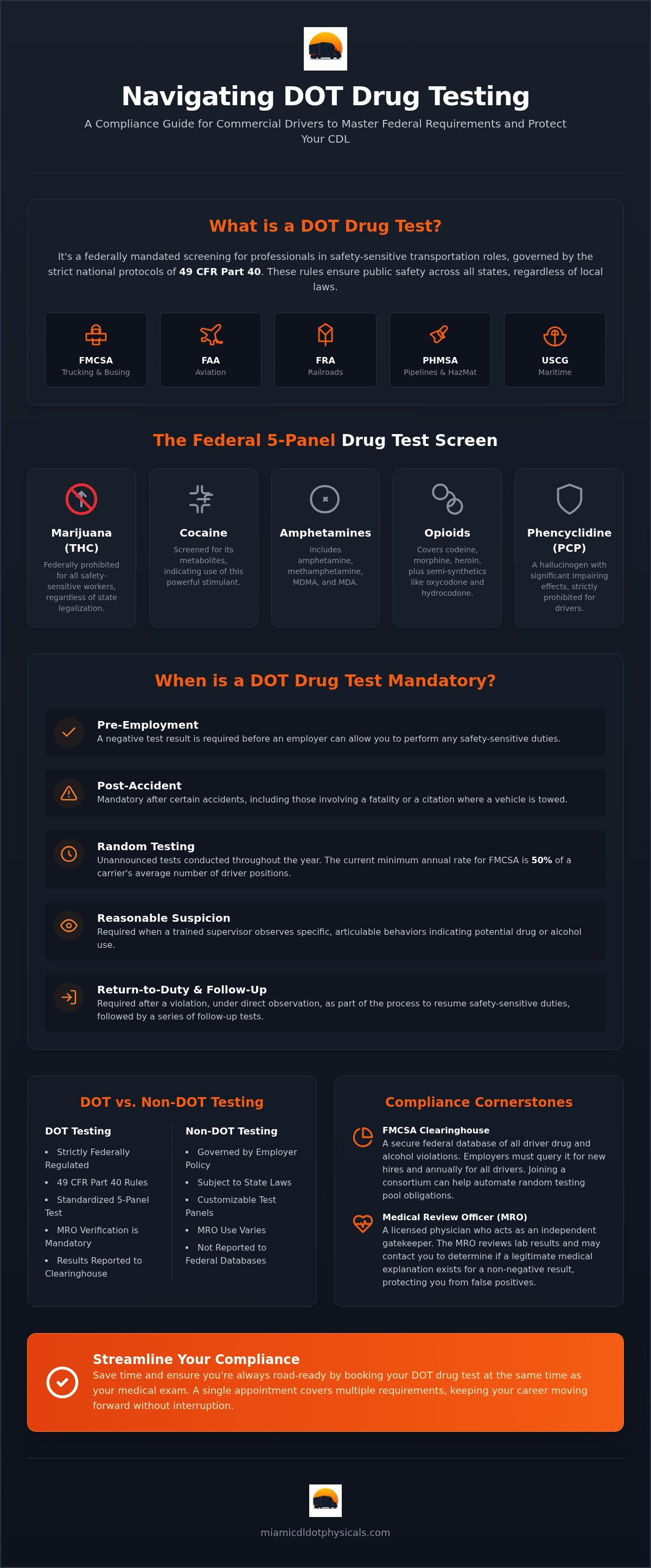
A DOT drug test is a specialized medical screening required for professionals in safety-sensitive transportation roles. While you might be looking for a DOT drug test Miami center to stay local, the rules governing your test are strictly national. These protocols ensure that anyone operating heavy machinery or transporting the public is fit for duty and free from substances that could impair judgment or reaction time. This system isn't just a hurdle for your CDL; it's a vital safety measure for everyone sharing the road.
Every federal drug test follows the procedures outlined in 49 CFR Part 40. This regulation is a comprehensive set of rules that dictates how tests are collected, analyzed, and reported by certified laboratories. It isn't just about the FMCSA; these standards apply across several federal agencies to maintain a high level of safety across our nation's infrastructure.
The Department of Transportation oversees several agencies that mandate these screenings:
- FMCSA: Federal Motor Carrier Safety Administration (Trucking and busing)
- FAA: Federal Aviation Administration (Aviation)
- FRA: Federal Railroad Administration (Railroads)
- PHMSA: Pipeline and Hazardous Materials Safety Administration (Pipelines)
- USCG: United States Coast Guard (Maritime)
Who Must Undergo Federal Drug Screening?
Federal law identifies specific roles that carry a higher level of responsibility for public safety. If your job falls into one of these categories, you're required to participate in a DOT testing program. This includes any CDL holder operating a commercial motor vehicle with a gross weight rating over 26,001 pounds. It also covers drivers transporting hazardous materials that require placards and anyone operating a vehicle designed to carry 16 or more passengers, including the driver.
When is a DOT Drug Test Mandatory?
Compliance isn't a one-time event; it's a career-long commitment. You'll first encounter this requirement during pre-employment screening. An employer cannot allow you to perform safety-sensitive duties until they receive a verified negative result. Beyond the initial hire, you'll face testing after certain accidents based on federal criteria, such as a fatality or a citation issued after a vehicle is towed. These rules are non-negotiable and strictly enforced to protect your career.
Supervisors can also mandate a test if they have a reasonable suspicion of drug use based on specific, articulable observations. Finally, if a violation occurs, you must complete the return-to-duty process, which includes observed testing. When you schedule a DOT drug test Miami drivers trust, you're ensuring these specific federal triggers are handled professionally and accurately to protect your license and your livelihood.
The 5-Panel DOT Drug Test: What Substances Are Screened in 2026?
When you visit a facility for a DOT drug test Miami, it's vital to recognize that the process is strictly standardized. Every collection follows a rigid chain of custody to ensure the sample isn't tampered with, contaminated, or swapped. This federal oversight, managed by the Federal Motor Carrier Safety Administration (FMCSA), means your results are legally defensible and recognized in every state. Whether you're driving through the Everglades or across the country, the expectations for a clean test remain identical. The process is designed to be efficient, but it leaves no room for error or local variation.
Substances Included in the Federal 5-Panel
The DOT 5-panel test isn't just about five drugs; it covers five specific categories of substances. In 2026, these panels are comprehensive to reflect current public health challenges. The screen includes Marijuana (THC) and Cocaine metabolites. You should remember that despite local changes in marijuana laws, it remains a prohibited substance under federal DOT rules. The panel also looks for Amphetamines, including methamphetamine and MDMA. The Opioid panel is particularly thorough, covering codeine, morphine, and heroin, along with semi-synthetic opioids like hydrocodone, hydromorphone, oxycodone, and oxymorphone. Finally, the test screens for Phencyclidine (PCP). This specific list ensures that drivers are evaluated against a uniform safety standard nationwide.
The Role of the Medical Review Officer (MRO)
The MRO is a licensed physician who acts as an independent gatekeeper for your lab results. They don't simply accept a positive or negative flag from the laboratory. Instead, they review the entire testing process for administrative accuracy and medical validity. If a lab result returns positive, the MRO will reach out to you directly to discuss the findings before any final report is made.
This conversation is your opportunity to provide legitimate medical explanations, such as a valid prescription for a specific medication. If the MRO verifies that your medication use is legal and follows a doctor's orders, they have the authority to report the final result as negative. This protects your CDL from unfair marks and keeps your driving record clean. However, the MRO is also the final authority before reporting violations to the FMCSA Clearinghouse. With the stricter 24-hour reporting windows introduced in 2026, having an MRO who works efficiently is more important than ever for your career. If you're ready to ensure your compliance is handled correctly, book your appointment with our team to keep your driving status secure.
DOT vs. Non-DOT Testing: Key Differences for Safety-Sensitive Roles
Every driver should know that not all drug screenings are created equal. While you might be sent for a test by your employer, it's your responsibility to ensure it meets federal standards if you're operating a commercial vehicle. If you're scheduling a DOT drug test Miami, you're entering a highly regulated environment where every step is dictated by federal law. A standard workplace test might satisfy a company's internal policy, but it won't keep your CDL valid if the FMCSA requires a federal screen. The legal distinction matters because the federal government oversees DOT tests to protect public safety on national highways, while non-DOT tests are simply private contracts between an employer and an employee.
Because of this, you can't substitute one for the other. Even if a lab uses the same collection method, the lack of federal documentation makes the result void for DOT compliance. The most visible difference is the paperwork. Federal tests require a specific Federal Custody and Control Form (CCF). Non-DOT tests use private lab forms. If your collection isn't documented on a Federal CCF, it won't satisfy FMCSA requirements and could lead to a compliance violation during an audit.
Regulatory Authority and Forms
DOT tests are strictly monitored by federal agencies and must be processed at a laboratory certified by the Department of Health and Human Services (HHS). This ensures that every sample is handled with the highest level of scrutiny and that the results are legally defensible. These tests are restricted to the 5-panel substances mandated by the government. Non-DOT tests use private forms and allow for much broader panels. While a DOT test is limited, a non-DOT test could include 10 or 12 different panels, including screenings for nicotine or synthetic drugs, depending on what a company wants to monitor.
Consequences of Failure
The fallout from a failed test is where the two types truly diverge. If you fail a DOT test, you're immediately removed from safety-sensitive duties. You must complete a formal evaluation and treatment program with a Substance Abuse Professional (SAP) before you can drive again. These violations are tracked in the FMCSA Clearinghouse, making them visible to every future employer. Non-DOT failures are handled by your company's HR department. While you might lose your job, the failure isn't reported to a federal database, and the return-to-work requirements are much less rigid.
Testing methods also differ in 2026. While some Miami fleets use hair testing for their own internal non-DOT policies, the DOT still relies on urine as the primary method. Oral fluid testing is now a secondary federal option, providing more flexibility for collections, but it still follows the same strict federal guidelines. When you need a DOT drug test Miami, make sure you're visiting a facility that understands these specific legal requirements so your hard work doesn't go to waste.
Navigating the FMCSA Clearinghouse and Random Testing Pools
The FMCSA Drug and Alcohol Clearinghouse acts as a national safety net. It's a central database where all drug and alcohol violations are recorded in real time. This system prevents drivers from hiding a failed DOT drug test Miami result by moving to a different state or carrier. Since late 2024, state licensing agencies have been required to check this database before issuing or renewing a CDL. A single violation can now trigger an automatic suspension of your driving privileges across the country. Maintaining a clean status in the database is much easier when you use a professional center for your DOT drug test Miami.
Random testing is the primary tool used to maintain highway safety. For 2026, the FMCSA requires carriers to test 50% of their driver positions for drugs and 10% for alcohol every year. These selections must be spread throughout the calendar year and happen without any advance notice. If you're selected, you must proceed to the testing site immediately. Any delay can be considered a refusal to test, which carries the same weight and consequences as a positive result.
Consortium Requirements for Owner-Operators
If you're an owner-operator, you're legally prohibited from managing your own random pool. You can't simply pick your own name out of a hat. You must join an FMCSA Clearinghouse Consortium Florida to stay legal. The consortium manages the pool for you, using a computer-generated process to ensure fairness and compliance. This removes the administrative burden from your shoulders and protects you from the massive fines associated with non-compliance. It's a simple way to automate a complex federal requirement while you focus on the road.
The Clearinghouse Query Process
Employers have a strict duty to check the database regularly. A 'Full Query' happens before you're hired and gives the employer access to your complete violation history. You must provide electronic consent through your own Clearinghouse account for this to happen. For current employees, a 'Limited Query' is required at least once a year. This check only alerts the employer if information exists. If a hit appears, they must upgrade to a full query within 24 hours. Because of new identity verification rules announced on April 27, 2026, we recommend all drivers keep their profiles updated to avoid administrative delays. All query records must be archived for three years to satisfy DOT auditors.
Sign up for our compliance management services to ensure your Clearinghouse queries and random testing are always handled accurately and on time.
Comprehensive Compliance: Integrating Testing with DOT Physicals
Maintaining a valid CDL requires a coordinated approach to your health and your regulatory obligations. For most drivers, a DOT drug test Miami is just one half of the compliance equation. New hires and those renewing their certifications often find that a DOT physical Miami is required at the same time as their drug screening. By treating these requirements as a single, integrated process, you protect your career from administrative gaps. This ensures that your medical card remains in good standing without you having to visit multiple clinics across the city.
Professional medical certifications are the foundation of your commercial driving status. When these services are fragmented, it's easy for paperwork to get lost or for reporting deadlines to be missed. Choosing a provider that handles both the medical exam and the federal drug screen ensures that your records are consistent and accurate. This unified approach is especially helpful when you have complex medical history or take specific prescriptions that require a more detailed review from a Medical Review Officer.
One-Stop Shop for CDL Drivers
Scheduling your physical and drug test with a single provider is a smart move for any professional. It significantly reduces your downtime and keeps all your sensitive medical documentation in one secure location. Our FMCSA-certified medical examiners understand how your health history and current medications might interact with both your physical exam and your drug screen. This expertise helps prevent unnecessary delays during the MRO review process. We also help ensure that your certification details are correctly handled so they can be recognized by the State Driver Licensing Agency (SDLA) without any technical issues.
Preparing for Your Appointment
A successful appointment starts before you walk through our doors. Being prepared helps us get you back on the road faster. Preparation reduces the stress of the exam and ensures that we have everything required by federal law to validate your status. Use this checklist to ensure you have everything you need for your DOT drug test Miami and physical exam:
- Valid Government ID: You must bring a current photo ID, such as your CDL or a passport, to verify your identity for federal records.
- Medication List: Bring a complete list of your current medications, including dosages and the names of your prescribing doctors.
- Hydration: Be prepared to provide a sufficient urine sample of at least 45mL for the drug screen.
- Medical Aids: If you use glasses, contact lenses, or hearing aids, make sure you have them with you for the physical portion of the exam.
When you're ready to handle your compliance in one efficient visit, it's best to work with experts who know the 2026 regulations inside and out. We're here to make the process as simple and fast as possible so you can focus on your work.
Secure Your Career with Reliable Compliance
Staying compliant with the 2026 FMCSA regulations doesn't have to be a source of stress. By mastering the 5-panel requirements and staying active in the Clearinghouse, you protect your livelihood from accidental violations. Integrating your medical exam with your drug screen saves valuable time and keeps your federal records consistent. Our FMCSA-certified medical examiners provide fast turnarounds for federal compliance, ensuring you spend less time in the clinic and more time on the road.
Managing your DOT drug test Miami and physical exam under one roof is the most efficient way to maintain your CDL status. We offer complete Clearinghouse Consortium management to take the guesswork out of random testing pools for owner-operators and fleets. Don't wait for a deadline to approach. Schedule Your DOT Drug Test and Physical Today and experience a partnership built on reliability and professional expertise. Your career is your greatest asset, and we're here to help you keep it moving forward with confidence.
Frequently Asked Questions
How long does a DOT drug test take to get results?
Most negative results are available within 24 to 72 hours after the laboratory receives the sample. If the initial screen shows a potential hit, the sample undergoes confirmatory testing, which can extend the timeline to five business days. We recommend scheduling your testing early in the week to account for lab processing and any necessary Medical Review Officer verifications. This ensures your compliance documentation is ready when you need it.
Can I refuse a DOT drug test if I am an owner-operator?
No, you cannot refuse a mandated test without facing the same penalties as a positive result. Federal law treats a refusal to test as a violation that requires immediate removal from safety-sensitive duties. Refusals include failing to appear at the collection site immediately or leaving the facility before the process is finished. These incidents are reported to the Clearinghouse and stay on your record for five years or until the return-to-duty process is complete.
What happens if I fail a DOT drug test in 2026?
You must immediately stop performing all safety-sensitive functions, including driving a commercial motor vehicle. Under the 2026 FMCSA rules, violations are reported to the Clearinghouse within a strict 24-hour window. To return to work, you'll need to complete a formal evaluation and treatment program with a Substance Abuse Professional (SAP). You cannot return to the road until you successfully pass a return-to-duty test and a SAP clears you for service.
Does a DOT drug test look for prescription medications?
The standard screen identifies specific substances that are often found in legal prescriptions, such as opioids or amphetamines. If your test returns a positive result for a prescribed substance, the Medical Review Officer will contact you to verify your medical history. You must provide a valid prescription from your healthcare provider. If the MRO determines the medication is used legally and as directed, they will report the final result as negative to protect your record.
How often are drivers selected for random DOT drug testing?
Selections occur throughout the year in unpredictable cycles to ensure a fair deterrent. For 2026, the FMCSA requires a random drug testing rate of 50% and a random alcohol testing rate of 10% for the average number of driver positions. Because a computer generates these selections, you might be picked several times in one year or not at all. You must proceed to the testing site immediately once you are notified of a selection.
What is the difference between a 5-panel and a 10-panel drug test?
A 5-panel test is the only version allowed for a federal DOT drug test Miami. It screens for marijuana, cocaine, amphetamines, opioids, and PCP. A 10-panel test is a non-DOT screen that adds substances like benzodiazepines and barbiturates for private employer policies. While a 10-panel provides more data for a company, it does not satisfy federal FMCSA requirements. You must ensure your collection uses the specific federal 5-panel protocol to stay compliant.
Is marijuana legal for CDL drivers if it is legal in their state?
No, marijuana use is strictly prohibited for all commercial drivers under federal law. Even if your state has legalized recreational or medical marijuana, the DOT still classifies it as a Schedule I controlled substance. A positive test for THC metabolites will result in a violation on your federal record. It's vital to understand that state-level legality does not provide a medical exception for a DOT drug test Miami or any other federal screening.
How do I register for the FMCSA Clearinghouse?
You can register by visiting the official FMCSA Clearinghouse website and creating an account through Login.gov. Drivers must register to view their own records and provide electronic consent for employers to conduct full queries. If you're an owner-operator, you have the additional requirement of registering as an employer and designating a consortium. This process is essential for maintaining your eligibility to drive and ensuring your violation status is accurately tracked by federal agencies.


