

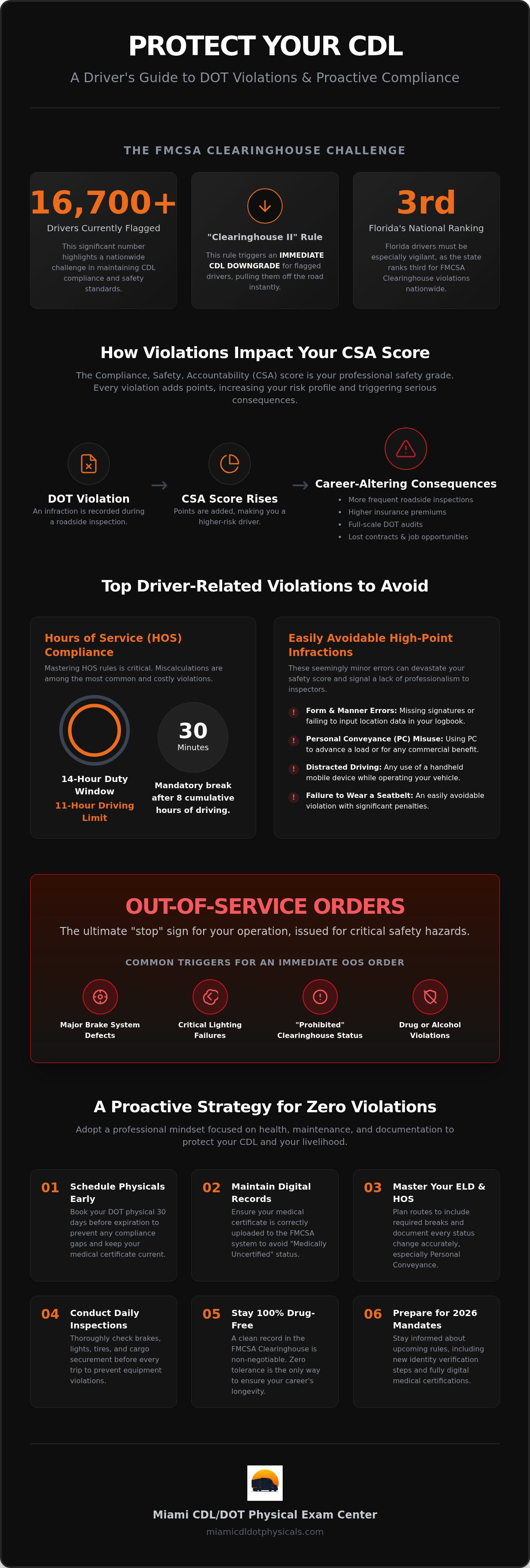
Nationwide, authorities report thousands of FMCSA Clearinghouse violations annually, with over 16,700 drivers currently flagged in the system. This significant number highlights a national challenge in maintaining CDL compliance. Under the "Clearinghouse II" rule, these drivers face immediate CDL downgrades, making it impossible to stay on the road without perfect documentation. One missed annual query or an expired medical card can now trigger an automatic loss of driving privileges before you even realize there's a problem.
We understand the stress of trying to balance a demanding haul with the constant fear of being put out-of-service. It often feels like the rules for HOS, ELDs, and drug testing are designed to be confusing. This guide will help you identify the most frequent DOT violations and teach you exactly how to protect your CDL and safety scores through proactive health and maintenance compliance. We'll walk through the latest 2026 mandates, including new identity verification steps and digital medical certification, to ensure you maintain a clean driving record and keep your business viable.
Key Takeaways
- Learn how DOT violations impact your CSA scores and discover why safety habit synergy is essential for your livelihood.
- Identify the most frequent HOS and ELD infractions that trigger roadside inspections and out-of-service orders.
- Understand the 2026 "Clearinghouse II" rule and how to avoid the FMCSA Clearinghouse violations Florida drivers encounter most often.
- Learn the importance of maintaining a digital medical certificate and a drug-free status to pass every inspection with zero violations.
- Develop a proactive maintenance and health strategy, including scheduling DOT physicals 30 days early to prevent compliance gaps.
Understanding DOT Violations and the CSA Scoring System
A DOT violation is any failure to comply with safety regulations set by the Federal Motor Carrier Safety Administration (FMCSA). These infractions aren't just minor paperwork errors. They're formal records that track your commitment to safety on the road. The FMCSA uses the Compliance, Safety, Accountability (CSA) program to monitor these failures. Every time you receive a citation during a roadside inspection, it's assigned a point value that feeds into the Safety Measurement System (SMS).
Think of your SMS score as a professional safety grade. When your score rises, you become a magnet for law enforcement. High scores increase the frequency of roadside inspections and significantly raise the probability of a full-scale DOT audit. The consequences are both immediate and long-term. You might face heavy fines and Out-of-Service (OOS) orders on the spot. Over time, these marks lead to massive insurance premium hikes and lost business opportunities. With Florida ranking third in the nation for FMCSA Clearinghouse violations Florida drivers must be especially vigilant about their documentation and health status to keep their scores low.
The Impact of CSA Scores on Your Career
Your safety record follows you everywhere. Most reputable carriers review a driver's Pre-Employment Screening Program (PSP) record before making a hire. This report displays your five-year crash history and three-year inspection history. Violations typically stay on your record for 24 to 36 months, depending on the severity. If your record is littered with FMCSA Clearinghouse violations Florida authorities have reported, you'll find it difficult to secure high-paying contracts. Carriers view high CSA scores as a liability. They don't want the increased scrutiny from the DOT that comes with high-risk drivers.
Out-of-Service (OOS) Criteria Explained
An Out-of-Service order is the ultimate "stop" sign for your operation. Inspectors issue these when they find a critical safety hazard that makes the vehicle or driver a danger to the public. Common triggers include major braking system defects, lighting failures, or a driver operating in "prohibited" status in the Clearinghouse. Being sidelined during a haul is a financial disaster. You lose the revenue from the load and often have to pay for expensive, on-site emergency repairs. To resume operations, you must fix the violation and provide proof of compliance. If the OOS order was for a drug or alcohol violation, you must complete the full return-to-duty process before getting back behind the wheel.
Top Driver-Related Violations: HOS and Logbook Compliance
While vehicle maintenance is vital, driver-related violations often carry the heaviest weight in the CSA system. Florida state troopers look closely at your Hours of Service (HOS) and logbook accuracy during every stop. Small errors in "form and manner," such as missing a signature or failing to input location data, can quickly add up. These mistakes signal a lack of attention to detail that might lead an inspector to dig deeper into your records, potentially uncovering FMCSA Clearinghouse violations Florida drivers are required to report.
Beyond paperwork, high-point violations like distracted driving or failing to wear a seatbelt can devastate your safety score. These are easily avoidable but carry significant penalties. Keeping your focus on the road and your documentation up to date is the simplest way to protect your livelihood. It’s about more than just staying legal; it’s about proving you're a professional who respects the rules of the road.
Common HOS Mistakes and How to Avoid Them
Understanding the difference between the 14-hour duty window and the 11-hour driving limit is crucial for staying compliant. Once you start your day, that 14-hour clock doesn't stop for anything. You have 11 hours of actual driving time within that window. Additionally, you must take a 30-minute break after 8 cumulative hours of driving. Failing to plan your route around these breaks is a top cause of HOS infractions.
Personal Conveyance (PC) is another area where many drivers get flagged for fraud. PC is only for off-duty, personal trips where the vehicle isn't being used for commercial benefit. If you use PC to advance toward your next load, it's a violation. Be precise with your documentation. If you're unsure about how your status affects your safety record, you can consult the official FMCSA Clearinghouse website to see how safety data is tracked across all categories.
ELD Documentation and Technical Failures
Your Electronic Logging Device (ELD) must be fully functional and FMCSA-approved. However, technology fails. If your ELD malfunctions, you must notify your carrier within 24 hours and reconstruct your logs for the current day and the previous 7 days on paper. You're required to keep an ELD user manual and a supply of blank paper logs in your cab at all times. Failing to maintain these records can lead to the same level of scrutiny as FMCSA Clearinghouse violations Florida regulators monitor.
During an inspection, you must be able to transfer your data immediately. Practice using the "Export" or "Transfer" function on your device before you get pulled over. If an inspector has to wait for you to figure out the software, the interaction will likely go poorly. Maintaining a clean log is just as important as keeping your DOT physical exam status current. Both are essential pillars of driver fitness that keep you on the road and out of trouble.
Driver Fitness: Medical Certification and FMCSA Clearinghouse Violations
In 2026, the FMCSA's Medical Examiner's Certification Integration rule has made driver fitness a digital priority. Medical certification is no longer just a piece of paper in your wallet; it's a real-time credential synced with your CDL. Operating with an expired or invalid DOT medical card is one of the most frequent triggers for FMCSA Clearinghouse violations Florida inspectors identify. If you fail to maintain a current certificate on file with the State Driver Licensing Agency (SDLA), your license will be downgraded automatically. This digital synchronization means the old "grace periods" for paperwork lapses have effectively vanished.
Beyond the medical card, drug and alcohol compliance is the other half of driver fitness. This includes passing pre-employment, random, and post-accident tests. Any positive result or refusal to test is reported to the federal database within 24 hours. A "Prohibited" status in the Clearinghouse immediately disqualifies you from safety-sensitive functions. Staying compliant requires a proactive approach to both your physical health and your administrative records.
Maintaining a Valid CDL Medical Card
You must carry a physical copy of your medical examiner's certificate for at least 15 days after every new exam. This period allows the SDLA to process the digital transmission from the National Registry. Many drivers receive citations because they assume the electronic update is instantaneous. If you're pulled over on day three and don't have that paper certificate, you're technically in violation.
Common health issues like high blood pressure or managed diabetes often lead to short-term certifications of three to twelve months. These shorter windows increase the risk of an accidental lapse. To stay ahead of the clock, you should learn how to pass DOT physical exams by managing your health conditions well before your appointment. Scheduling your exam 30 days early ensures you have time to resolve any unexpected medical findings without losing your driving status.
Drug Testing and the FMCSA Clearinghouse
The federal database is designed to prevent drivers with unresolved violations from moving between jobs. According to the FMCSA Clearinghouse Violation Rules, even a single "refusal to test" carries the same weight as a positive drug screen. For owner-operators, compliance is more complex because you cannot legally manage your own random testing pool.
You are required to join an FMCSA clearinghouse consortium Florida drivers use to stay in a random testing pool. Failure to enroll in a consortium or missing a random test window are major sources of FMCSA Clearinghouse violations Florida authorities flag during audits. Being in "Prohibited" status doesn't just stop you from driving; it can lead to the permanent loss of your CDL if the return-to-duty process isn't started promptly. Consistency in your testing program is the only way to protect your business viability.
Vehicle Maintenance and Cargo Securement Failures
Your truck is your office, and its condition tells an inspector everything they need to know about your professionalism. Vehicle maintenance failures are often the "hook" that leads to a deeper investigation into your records. Once an officer stops you for a flickering tail light, they'll check your ELD and your status in the federal database. This is how many FMCSA Clearinghouse violations Florida drivers face are discovered. A simple mechanical oversight can quickly escalate into a full driver-fitness audit.
Common safety hazards like braking system defects or cargo securement issues are immediate Out-of-Service (OOS) triggers. If your straps are loose or your weight distribution is improper, you aren't just risking a fine; you're risking a total stop of your operation. Keeping your vehicle in top shape is the best way to avoid the unwanted attention that leads to more complex compliance checks.
The Most Frequent Mechanical Citations
Lighting violations remain the number one reason for roadside stops. An inoperable headlamp or turn signal is visible from a distance, giving inspectors a legal reason to pull you over. Beyond lights, brake stroke measurements are a major focus. Don't rely solely on automatic slack adjusters to keep you safe. They can fail or mask underlying issues like worn bushings or air leaks.
Tire condition is another high-priority area. You must have a minimum tread depth of 4/32 inch on your steer tires and 2/32 inch on all other positions. Look for flat spots caused by skidding or visible sidewall damage during your daily checks. If you need to ensure your physical health is as ready for the road as your equipment, book your DOT physical exam today to stay fully compliant.
Mastering the Pre-Trip Inspection
A systematic walkthrough is your best defense against FMCSA Clearinghouse violations Florida authorities might find during an inspection. Start at the front of the vehicle and work your way around in a consistent pattern. This routine ensures you never miss a critical component. Your Driver Vehicle Inspection Report (DVIR) should be more than a checked box; it's a legal record of your commitment to safety.
Pay close attention to items that are frequently overlooked but carry heavy penalties. These include:
- Working fire extinguishers with a valid charge.
- Three reflective warning triangles in good condition.
- A supply of spare fuses for all major circuits.
- Properly secured air lines and electrical pigtails.
Catching these small issues before you hit the scale prevents a minor repair from becoming a major violation on your CSA score. A professional driver knows that safety begins before the engine even starts.
A Proactive Strategy for Avoiding DOT Violations and OOS Orders
Maintaining a clean record requires more than just luck. It's about building a systematic approach to your compliance. Start by conducting regular self-audits of your Driver Qualification (DQ) file. Don't wait for a DOT auditor to find a missing employment history entry or a gap in your driving record. By reviewing your own files quarterly, you can catch administrative errors before they turn into costly citations. This proactive habit ensures that your paperwork is just as ready for the road as your engine.
Schedule your DOT physical exams at least 30 days before your current card expires. This buffer gives you time to handle any short-term certifications or medical follow-ups without risking a CDL downgrade. In the age of digital integration, a single day of expiration can trigger the FMCSA Clearinghouse violations Florida drivers want to avoid. Combine this with a no-compromise pre-trip and post-trip routine. Catching a small air leak or a frayed strap at the yard is always better than having an inspector find it at the scale. Staying educated on FMCSA rule changes through certified medical and compliance partners keeps you ahead of new 2026 mandates.
Documentation Checklist for Roadside Inspections
Keep a dedicated compliance folder in your cab. When an officer approaches, having your documents organized reduces tension and shows you're a professional. Your folder must include your current CDL, your CDL medical card Miami drivers are required to keep, and the ELD instruction sheet. Don't forget your proof of annual vehicle inspection and current registration. Having these ready helps you pass inspections quickly and keeps your CSA scores low. If you're an owner-operator, ensure your consortium membership letter is also easily accessible.
The Role of Professional Health and Testing Services
Working with a certified partner simplifies the complex world of drug and alcohol regulations. Reliable DOT drug test Miami services ensure your results are reported accurately and within the required 24-hour window. For owner-operators, using a single provider for physicals and drug consortium needs is the most efficient way to prevent FMCSA Clearinghouse violations Florida reporting errors. This partnership keeps you educated on 2026 rule changes and ensures you never miss a random testing window. Consistency in your testing program is the only way to protect your business viability and professional reputation.
Schedule your DOT physical or drug test today to secure your career and stay on the road with confidence.
Protect Your Professional Future on the Road
Success in the commercial driving industry requires a commitment to both vehicle safety and personal health. By mastering your pre-trip inspections and staying ahead of your HOS logs, you remove the most common reasons for roadside stops. Your digital medical card and drug-free status are now the first things inspectors verify. Florida drivers face some of the strictest enforcement levels in the country, so avoiding the FMCSA Clearinghouse violations Florida authorities track is essential for keeping your CDL active and your business profitable.
Our team simplifies your regulatory requirements so you can focus on the drive. We provide FMCSA-certified medical examiners who deliver fast, same-day medical certificates to keep your DQ file current. For owner-operators, we offer comprehensive Clearinghouse consortium management to ensure you never miss a random testing window. Don't let a simple paperwork lapse or an expired card sideline your career. Keep your CDL compliant-Schedule your DOT Physical or Drug Test now. We're proud to be your partner in safety and look forward to seeing you succeed on every haul.
Frequently Asked Questions
What are the top 5 most common DOT violations for drivers?
The most frequent DOT violations include Hours of Service (HOS) infractions, Electronic Logging Device (ELD) malfunctions, speeding, failing to use a seatbelt, and operating with an expired medical card. These areas are high-priority targets for inspectors because they directly impact road safety. Staying on top of your logs and health certification is the best way to avoid these common citations.
Do DOT violations affect my personal car insurance rates?
Standard DOT-specific violations, such as logbook errors or equipment failures, typically don't affect your personal car insurance rates. However, moving violations like speeding or reckless driving while operating a commercial vehicle will appear on your driving record. If your personal insurer sees these major infractions during a policy review, they may increase your premiums or change your risk profile.
How many points is a logbook violation on my CSA score?
A standard logbook or HOS violation typically adds 5 to 7 points to your CSA score. These points are then multiplied based on how recently the violation occurred. For example, a violation in the last six months carries three times the weight of an older one. Keeping a clean log is vital because these points stay active in the Safety Measurement System for 24 months.
Can I drive if my DOT medical card is expired but my CDL is still valid?
No, you cannot legally operate a commercial vehicle if your DOT medical card is expired. Even if your CDL hasn't reached its expiration date, an invalid medical certificate triggers an automatic downgrade of your license status. This is a common source of FMCSA Clearinghouse violations Florida drivers face during roadside inspections, as the system now tracks these credentials digitally in real time.
What happens if I refuse a random DOT drug test?
Refusing a random DOT drug test is treated exactly like a positive test result. You'll be placed in "Prohibited" status in the Clearinghouse immediately and removed from all safety-sensitive functions. To regain your driving privileges, you must complete the full return-to-duty process, which includes an evaluation by a Substance Abuse Professional and follow-up testing.
How long do DOT violations stay on a driver's PSP report?
DOT violations from roadside inspections stay on your Pre-Employment Screening Program (PSP) report for three years. If the violation was related to a crash, that information remains on the report for five years. Carriers use this data to evaluate your safety history before hiring, so maintaining a clean record is essential for your long-term career stability.
Is a cracked windshield a DOT violation?
Yes, a cracked windshield is a DOT violation if the damage is located within the area swept by the windshield wipers or directly in the driver's line of sight. Specifically, cracks cannot be larger than 3/4 of an inch in diameter or intersect with another crack. These mechanical defects are easy for inspectors to spot and often lead to further scrutiny of your FMCSA Clearinghouse violations Florida status.
What is the fine for an overweight DOT violation in 2026?
Overweight fines vary significantly depending on the state and the specific amount of excess weight. In 2026, federal civil penalties for safety violations are adjusted for inflation, and some fines can reach several thousand dollars. Beyond the financial penalty, you'll likely be required to offload the excess cargo before you're allowed to resume your haul, which causes expensive delays.


