

For an independent driver, your medical exam is actually a high-stakes business audit that determines if you stay on the road. You know that keeping your CDL active is the heartbeat of your business, yet the shifting landscape of federal regulations often feels like it's designed to trip you up. It’s stressful to balance the "employer" responsibilities of the FMCSA Clearinghouse while simply trying to book an owner operator DOT physical Miami. We understand that your time is your money, and a day wasted at an inefficient clinic is a day of lost revenue.
This 2026 guide simplifies the entire process, showing you exactly how to secure your certification while checking every regulatory box for your business. We’ll walk you through the transition to the National Registry II electronic system and offer practical tips to manage health issues like blood pressure for a same-day medical card. You’ll also get a clear breakdown of consortium requirements and Clearinghouse query rules, ensuring you leave the clinic with both a valid certificate and total peace of mind.
Key Takeaways
- Understand your dual role as both driver and safety officer to stay ahead of FMCSA audits and regulatory changes.
- Review updated 2026 vision and blood pressure benchmarks to prepare for a successful owner operator DOT physical Miami.
- Learn why independent drivers must join a third-party consortium for drug testing compliance. It's a legal requirement that protects your livelihood.
- Use specific preparation strategies, such as managing sodium and caffeine intake, to secure a same-day medical card.
- Follow essential post-exam self-certification steps to ensure the DMV processes your medical status within the required window.
Understanding the DOT Physical Requirements for Owner-Operators
Being an independent trucker means wearing multiple hats at once. When you schedule an owner operator DOT physical Miami, you're acting as both the employee and the safety officer. This dual role is significant because you're legally responsible for maintaining your own driver qualification file. If a medical examiner identifies a health issue, it isn't just a personal concern; it's a direct threat to your business operations. Choosing a certified examiner who understands the trucking industry is vital. These professionals take a driver-friendly approach, focusing on how to keep you safe and compliant rather than looking for reasons to pull you off the road.
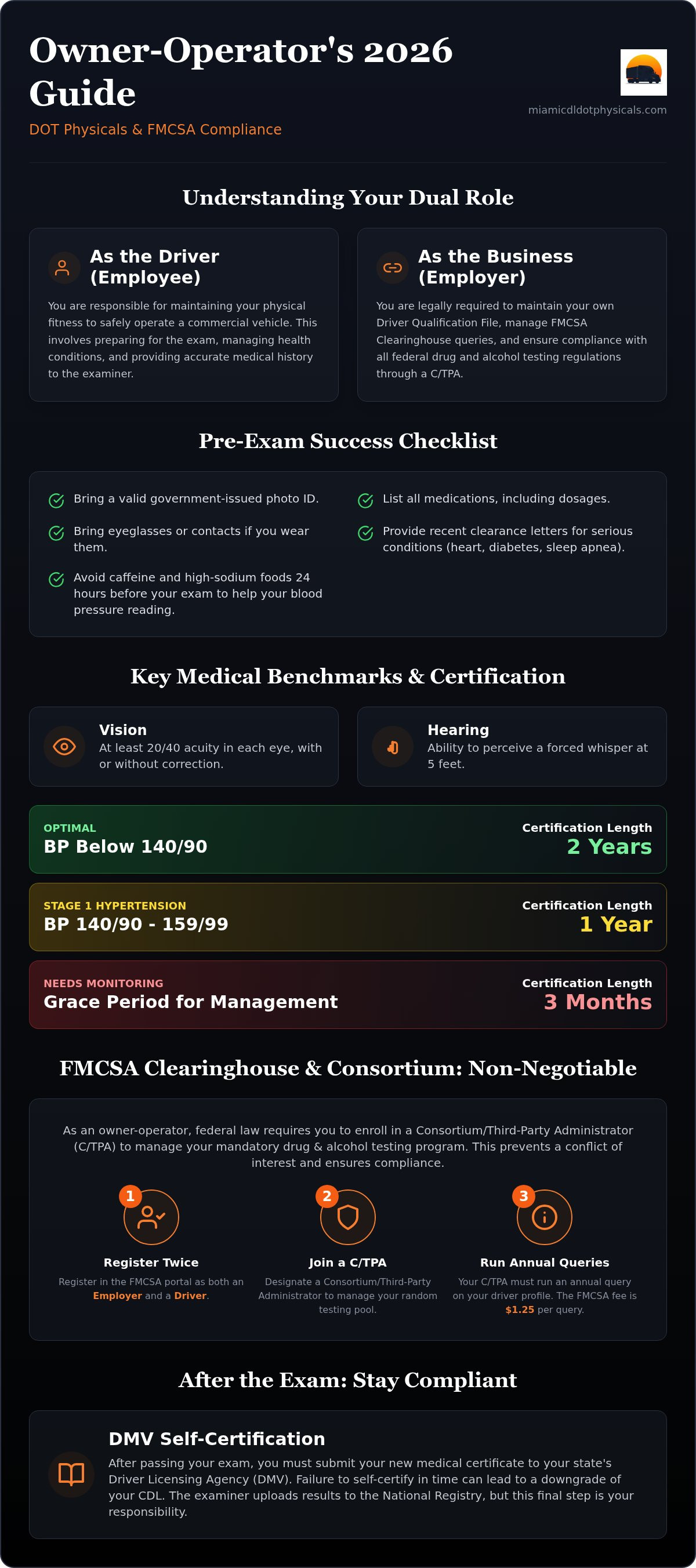
Preparation is the key to a stress-free appointment. You must bring a valid government-issued photo ID and a complete list of any medications you're currently taking, including dosages. If you have a history of heart issues, diabetes, or sleep apnea, bring recent clearance letters from your specialists. Understanding the DOT Physical benchmarks for 2026 is also helpful. You need at least 20/40 vision in each eye and the ability to perceive a forced whisper at five feet. Your blood pressure should ideally be below 140/90 to secure the maximum certification length.
The Anatomy of the FMCSA Medical Examination
The exam involves a thorough review of your medical history and a physical check of your body systems. The examiner will evaluate everything from your neurological reflexes to your musculoskeletal strength. A common point of confusion is the urinalysis. This is a dipstick test used to check for protein, blood, and sugar, which helps screen for kidney issues or undiagnosed diabetes. It is not a drug test. However, because you're an owner-operator, you might choose to perform your required DOT drug test during the same visit to save time. All findings are recorded on the Medical Examination Report Form (MCSA-5875), which stays on file with the examiner.
Certification Lengths and What They Mean
The goal for every driver is the standard 2-year medical card. This is granted when you meet all physical standards without needing frequent monitoring. If you have "borderline" health results, like Stage 1 hypertension (blood pressure between 140-159/90-99), you'll likely receive a 1-year certification. This ensures you're managing the condition effectively. In some cases, a one-time 3-month certificate is issued to give you a grace period to stabilize a condition. You can often upgrade a short-term card to a full certification once you provide documentation that your health is under control. Securing your owner operator DOT physical Miami from a specialist ensures these nuances are handled with your livelihood in mind.
The Critical Role of the FMCSA Clearinghouse Consortium
Many independent drivers assume that because they own the business, they can manage their own drug testing program. Federal law says otherwise. To prevent a conflict of interest, the FMCSA requires every owner-operator to join a Consortium/Third-Party Administrator (C/TPA). This outside agency manages your random testing pool and reports results directly to the federal database. It's a layer of separation that proves your business is operating fairly. When you visit for your owner operator DOT physical Miami, it's the perfect time to ensure your consortium enrollment is active and your records are up to date.
The Clearinghouse doesn't just track drug violations; it's becoming a central hub for your overall eligibility. By following the official medical regulations, the FMCSA ensures that your medical status and drug test results are visible to state licensing agencies in real-time. If you haven't yet designated a C/TPA, you can manage your compliance requirements through a specialized center that understands these dual roles. Integrating these services prevents administrative gaps that could sideline your truck.
Mandatory Consortium Requirements for Independent Drivers
Registering in the FMCSA portal is free, but you must register twice: once as the employer and once as the driver. Your FMCSA Clearinghouse Consortium will then handle the heavy lifting. This includes performing the mandatory annual queries on your own CDL. As of July 2026, the fee for these queries is a flat $1.25. Missing this annual deadline can lead to fines or a "prohibited" status in the database, which stops your truck immediately. A professional consortium ensures you never miss a query or a reporting deadline.
Random Drug and Alcohol Testing Pools
You're placed into a pool with other drivers, and a computer program selects names at random intervals throughout the year. If your name comes up while you're on a long-haul route, you can't ignore it. You must report to a collection site immediately upon notification. In the eyes of the FMCSA, a "refusal to test" is treated exactly like a positive result. This leads to an immediate loss of driving privileges and a mandatory return-to-duty process that can take months to resolve. Staying active in your pool is the only way to remain legal.
Preparation Checklist: How to Secure a Same-Day Medical Card
Securing your medical certificate on the same day you walk into the clinic isn't a matter of luck; it's the result of specific preparation. For an owner operator DOT physical Miami, your goal is to leave with your certificate in hand. To achieve this, you must manage your health habits in the days leading up to the exam. High sodium intake can cause temporary spikes in blood pressure, while excessive caffeine can lead to an elevated heart rate. Aim to reduce salt and stimulants for at least 48 hours before your visit to ensure your readings reflect your true health status.
Walking into your appointment without the right documents is the fastest way to end up in "pending" status. Drivers with chronic conditions must be especially diligent. If you manage sleep apnea, you need a compliance report from your CPAP machine showing usage for at least 70% of the time over the past 90 days. For those with heart conditions, a recent stress test result or a clearance letter from your cardiologist is mandatory. According to 2026 standards, these specialist letters must explicitly state that your condition is stable and that you're cleared to operate a commercial motor vehicle. Having these papers ready prevents the examiner from having to pause your certification while they wait for faxed records.
Step-by-Step Preparation for the Exam Morning
Start your morning by hydrating well with water. Proper hydration ensures your urinalysis doesn't show high levels of protein or specific gravity, which can trigger further testing. Take all your regular medications at their scheduled times. Arrive at the clinic with your current driver's license and your expiring CDL medical card. Prepare a written list of every medication you take, including the name of the prescribing physician and the exact dosage. This level of detail shows the examiner that you're a responsible safety officer for your own business.
Managing Appointment Stress and "White Coat" Hypertension
It's common for blood pressure to rise simply because you're in a medical setting. This "white coat" effect can jeopardize your 2-year card. To combat this, arrive ten minutes early so you aren't rushing. Practice deep, rhythmic breathing while in the waiting room to lower your heart rate. If you feel anxious, tell your examiner. A supportive professional understands the pressure of an owner operator DOT physical Miami and will often allow you to sit quietly for a few minutes before taking your reading. This small window of calm can be the difference between a 1-year and a 2-year certification.
Managing Medical Disqualifications and Exemptions
Discovering a disqualifying condition during an owner operator DOT physical Miami is a major stressor for any independent driver. However, a "fail" today doesn't necessarily mean your career is over. Most medical disqualifications in 2026 stem from manageable issues like uncontrolled hypertension, vision that falls below the 20/40 requirement, or untreated sleep apnea. If an examiner identifies a problem, they'll often provide a path to resolution. This might involve a temporary certificate while you seek treatment or guidance on applying for a federal exemption. If you're facing a complex health challenge, you can consult with a certified examiner to understand your options for staying on the road.
Federal exemption programs exist for specific conditions, including vision, hearing, and even seizure disorders. For instance, drivers who have been seizure-free for at least 8 years can apply for a federal seizure exemption with neurologist clearance. It's vital to understand that these applications are not processed at the clinic level. They require a lengthy submission process to the FMCSA that can take several months. Similarly, drivers with limb impairments may qualify for a Skill Performance Evaluation (SPE) certificate, which proves they can operate a commercial vehicle safely despite a physical limitation.
Navigating the Blood Pressure Standards
The 140/90 threshold is the most common hurdle for drivers. If your blood pressure is between 140-159/90-99 (Stage 1 Hypertension), you'll likely receive a 1-year medical card instead of the standard 2-year card. If it hits 160-179/100-109 (Stage 2), you might be issued a one-time, 3-month certificate. This gives you a short window to lower your readings through medication or lifestyle changes. Once you stabilize your numbers, you can return for a follow-up. Learning how to pass your DOT physical with managed hypertension is a key skill for long-term compliance.
Diabetes and Insulin Use on the Road
The rules for insulin-dependent drivers have simplified significantly in recent years. You no longer need a federal waiver to drive if you have insulin-treated diabetes mellitus (ITDM). Instead, you'll need your treating clinician to complete the ITDM Assessment Form (MCSA-5870). This form documents that your condition is well-managed and that you haven't had a severe hypoglycemic episode. Your medical examiner can then certify you for up to 12 months. It's a streamlined process, but it requires close coordination with your doctor to ensure all FMCSA data is accurate and current before your owner operator DOT physical Miami.
Long-Term Compliance: Keeping Your CDL Medical Status Active
Your exam is finished and you have your medical card in hand. For an independent driver, the work isn't quite over yet. You must complete the self-certification process with the Florida Department of Highway Safety and Motor Vehicles (FLHSMV). This step tells the state you're medically qualified to operate. While certified examiners now upload results to the National Registry, you shouldn't rely solely on the electronic system. The 15-day rule is a critical benchmark. This is the window the DMV typically needs to process your status and update the Commercial Driver’s License Information System (CDLIS). If your status isn't updated before your old card expires, your CDL could be downgraded to a non-commercial license, which stops your business in its tracks.
A valid DOT physical is the foundation of your safety record. It proves to auditors and insurance companies that you take your "employer" responsibilities seriously. To stay ahead, set up a 2026 compliance calendar. Mark your medical expiration date, your annual Clearinghouse query deadline, and your consortium renewal date. This proactive approach prevents the panic of a last-minute owner operator DOT physical Miami. Keeping these dates organized ensures you remain a "prohibited" status-free driver in the eyes of the FMCSA.
Digital Record Keeping for Owner-Operators
The FMCSA is currently transitioning to the National Registry II (NRII) system. This means electronic verification is becoming the primary source for law enforcement. However, you must still keep a physical or digital copy of your Medical Examiner’s Certificate (MEC) in your vehicle for at least 60 days after issuance. Store a scanned copy in a secure cloud folder. This allows you to check your status in the FMCSA portal whenever you're off the road. Having instant access to your records during a roadside inspection reduces stress and demonstrates professional organization.
Planning for Your Next Renewal
Don't wait until the day your card expires to book your next owner operator DOT physical Miami. Schedule your appointment at least 30 days in advance. This buffer allows time for any unexpected specialist clearances or follow-up tests. Returning to the same CDL medical exam center provides continuity of care. The staff will already have your history on file, making the process faster and more efficient. As federal regulations evolve, a consistent partnership with a compliance expert ensures you're always ready for the road ahead.
Secure Your Future on the Road
Mastering the dual role of driver and safety officer is the key to maintaining your independence in 2026. By staying ahead of your FMCSA Clearinghouse queries and proactively managing your health benchmarks, you protect your livelihood from unnecessary delays. Regulatory compliance doesn't have to be a burden when you have the right partner. Getting your owner operator DOT physical Miami should be a streamlined step in your business routine, not a source of stress that keeps you off the road. Our team understands the unique pressures you face as an independent operator.
We provide a comprehensive solution that covers every angle of your certification. With FMCSA Certified Medical Examiners, same-day medical cards issued on-site, and full-service drug consortium management, we ensure you meet every federal requirement in one visit. Don't leave your compliance to chance or wait until your expiration date. Schedule Your Same-Day Owner-Operator DOT Physical Today and experience a process designed for your busy schedule. You've worked hard to build your trucking business; we're here to help you keep it moving forward with total peace of mind.
Frequently Asked Questions
How often do owner-operators need to get a DOT physical?
A standard medical certification lasts for two years. However, if you have certain health conditions like high blood pressure or diabetes, the examiner might issue a certificate for one year or even three months. It's your responsibility to track this date and schedule your next appointment before the current card expires to avoid a CDL downgrade.
Can an owner-operator perform their own drug testing and Clearinghouse queries?
No, you cannot manage your own random drug testing pool. Federal regulations require every owner-operator to join a Consortium/Third-Party Administrator (C/TPA) to handle the random selection process. While you can perform your own Clearinghouse queries, most independent drivers choose to have their consortium manage these administrative tasks to ensure total compliance with 2026 standards.
What happens if my CDL medical card expires before I get a new physical?
Your commercial driving privileges are suspended the moment your medical card expires. The state DMV will automatically downgrade your CDL to a non-commercial license status. You cannot legally operate a commercial motor vehicle until you pass a new owner operator DOT physical Miami and successfully self-certify with the state, which can lead to significant business downtime.
Does an owner-operator need to be in a drug consortium if they don’t have employees?
Yes, being part of a drug consortium is a mandatory requirement for all independent drivers. The FMCSA dictates that you must be in a random testing pool managed by an outside party to ensure the integrity of the results. This is a common point of confusion, but failing to join a consortium can result in heavy fines during a DOT audit.
What medications will disqualify me from getting a CDL medical card in 2026?
Any Schedule I controlled substance, including medical marijuana, is an automatic disqualifier under federal law. Other medications that can lead to failure include methadone, certain anti-seizure medications, and habit-forming drugs that cause drowsiness. Always bring your current prescription list to the clinic so the medical examiner can verify if your medications meet FMCSA safety standards.
How do I register as an owner-operator in the FMCSA Clearinghouse?
You must visit the official FMCSA Clearinghouse website and create an account. As an independent driver, you're required to register twice: once as the employer and once as the driver. During registration, you'll need to designate your Consortium/Third-Party Administrator. Remember that while registration is free, you'll need to purchase query credits, which cost a flat rate of $1.25 each in 2026.
What is the difference between a DOT physical and a regular physical?
A DOT physical is a specialized safety audit required by federal law, while a regular physical focuses on your general long-term wellness. The DOT exam specifically checks if you meet the physical benchmarks for vision, hearing, and blood pressure required to safely operate a heavy vehicle. It isn't a replacement for a comprehensive check-up with your primary care physician.
Can I go to my primary care doctor for a DOT physical exam?
You can only use your primary care doctor if they are specifically certified and listed on the FMCSA National Registry. Most general practitioners don't maintain this certification. It is usually more efficient to visit a specialized center for an owner operator DOT physical Miami where the examiners are experts in trucking regulations and can provide same-day medical cards.


